Now that we’ve examined the caloric impacts of forage and processed feeds on the horse’s diet in Part 1 and Part 2, respectively, let’s take a look at what happens when grass pasture is added to the mix.

According to Dairy One‘s data, “pure” grass pasture has a Digestible Energy of 911 calories per pound with a Standard Deviation of 171 calories, based on 8,436 samples, while mixed, mostly grass pasture (MMG) has a DE of 962 calories with a S.D. of 127 calories, based on 18,544 samples. That translates to 95% of grass pasture having a DE value between 569 and 1,253 calories, while 95% of mixed grass pasture has a DE content between 708 and 1,216 calories. Why so much variation? Because so many factors affect the amount of sugar in, and therefore the calorie content of, grass. Time of day, time of year, amount of moisture, amount of sunlight, temperature – all these and more influence sugar content.

Attempts to actually measure pasture calories are far more common in the cattle industry than in the horse world, but the process is the same regardless of what species is grazing on it. Most often, a device called a plate meter – either the rising or falling type – is used to collect a series of measurements in a random manner throughout the pasture. These devices work by using a (usually) round, weighted plate of a known size to rest on top of the forage, and the distance from the plate to the ground is then recorded. The plate meter must first be calibrated, however, by taking a distance measurement on forage of the same type, clipping the forage under the plate to post-grazing level (with horses, generally 2.5 cm), and then drying and analyzing the forage sample for calorie content. Although simple in concept, many such samples are required for the calibration process to ensure reasonably-accurate meter measurements – a time-consuming endeavor. But by first collecting and analyzing these samples, a correlation between forage height (the distance measurement) and calories per square unit can be derived. After calibration, the amount of calories in a pasture can be fairly quickly and easily estimated by collecting and averaging a set of measurements. Plate meters are available with a wide range of features from several companies, but you can also construct your own for very little cost.

Using a homemade falling plate meter. Image from www.fieldcropnews.com.

But…before you spend either a fair amount of money on a manufactured plate meter, or a fair amount of time constructing and calibrating your own plate meter,  you may want to consider the following: Research has shown that horses’ rate of consumption of grass pasture varies greatly – and not in an entirely predictable way – depending not only on how much time per day they spend on grass pasture, but also on type of horse, temperature, time of day, season, grass height, grass composition, grass density and other factors, making any attempt at calorie calculations for grazing extremely difficult. For example, grazing researchers at North Carolina State University (Dowler, L.E. et al. 2012. “Determination of Pasture Dry Matter Intake Rates in Different Seasons and Their Application in Grazing Management.” Journal of Equine Veterinary Science 32: 85 – 92) note the following –

…this finding still suggests that horses have the potential to consume relatively large amounts of forage even when grazing for a relatively small portion of the day. These results suggest that DMI [dry matter intake] rate decreases with increased grazing duration and that the extrapolation of 24-hour DMI rates (eg, 2.5% of BW [body weight] in DM/d [dry matter per day]) to grazing periods of <4 hours may result in the underestimation of actual DMI. This may have implications for horse owners trying to manage BW/caloric intake of horses by reducing grazing time, in an effort to manage or prevent various diseases (e.g. laminitis, equine Cushing disease, metabolic disease, insulin resistance).

In other words, the relationship between pasture time and the amount of grass consumed is definitely not a linear one; rather, horses with limited pasture time tend to up their rates of pasture consumption, particularly in the first 4 hours. Simply put, this means: 1) even if the calorie content of a pasture is known, you cannot predict how many calories a horse will consume in a given amount of time with any reasonable degree of accuracy, and 2) you cannot use limited pasture time as a means of reducing calories without almost certainly limiting feed and/or hay availability as well. Interestingly, horses on continuous 24-hour grazing were found to voluntarily consume very close to their total calculated daily energy requirement, with no additional feed and/or hay required.

To further complicate this already-complex situation, some horses simply cannot eat green grass without developing metabolic problems, while others can happily eat green grass all day long and never have an immediate issue. Usually, the older the horse, the more often grass consumption becomes a complication. Because the reasons for these differences in tolerance are not well understood, it falls to the owner to determine whether or not grass causes difficulties for their particular horse. In keeping with my sentiments about mimicking nature in feeding, my personal preference is to allow horses only a very limited amount of green grass, based on the idea that the feral horse in his aboriginal environment is never in a position to eat mouthful after mouthful of green grass. Feral horses have evolved to eat sparsely-spaced dry, bunch grasses, and have to travel up to 12 miles every day to find sufficient calories; contrary to the increasingly common notion that domestic horses should have as much hay as they’ll eat, feral horses do not have unlimited access to forage, and certainly not to green grass. Expecting a horse to not overeat when plopped in the middle of the horse equivalent of a candy store all day strikes me as completely unreasonable.

Furthermore, I am becoming increasingly convinced that, like Type 2 diabetes in humans, we can help prevent the development of metabolic problems by feeding our horses as if they already had metabolic problems i.e. severely limiting the amount of green grass they eat. So, some sort of properly-designed (which, by the way, most of them are not) so-called “track system,” in which whatever forage present (mostly grass hay, perhaps with very small and widely-spaced-apart patches of green grass) is spread out over as large an area as possible to force the horse to move to be able to eat, seems to be the best situation for our domestic horses at present.

So there you have it: Although we can use average values to give us a rough idea of the calorie impact of grazing, just as we did with hay and with feed, the (even greater) number of variables affecting not only the forage itself, but also the horse’s rate of consumption, mean that such “guesstimates” should be used only as a very rough starting point for diet planning.

Based on what little published research has been done on the pasture dry matter consumption rates of horses, the average of the rates of consumption reported in these studies is 0.127 pounds of dry matter per 100 pounds of body weight per hour, plus or minus 0.032 pounds per 100 pounds body weight per hour. But keep in mind that that value is only reasonably accurate for longer grazing times – say, those over 3 or 4 hours. So instead of using that value, I’ve taken the 3-, 6-, 9-, and 24-hour measured grazing rate values from some North Carolina State University research, and extrapolated the intermediate values to create the following chart –

Make no mistake: This is a very rough estimate of calories consumed through grazing, as you’ll note by the wide range of values between the Low and High numbers. The next step towards improving the accuracy would be to use actual measured calorie values from your pasture, but, again, it’s still going to be an approximation.

In an attempt to make things a bit simpler, I’ve created an Equine Diet Planner in MS Excel, which you can either download for use on your own computer or use online within your browser.

As you can see in the screenshot of the Planner below, it incorporates the University of Minnesota weight calculator, which calculates Current and Ideal Weights, and then continues in the following section to calculate Required Calories by entering daily riding times.

The next section allows you to choose the amount and type of hay you’re feeding, or enter your own hay sample results, to calculate Total Hay Calories. Similarly, the feed section computes Total Feed Calories from the amount and type of feed, including allowing you to use values for a brand not on the drop-down list, which you can either obtain directly from the manufacturer or have tested by an independent testing laboratory.

The pasture grazing section has several choices for types of pasture, and then estimates Total Pasture Calories based on grazing time and whether or not your horse is muzzled. As I’ve noted above, pasture consumption is undoubtedly the most difficult to predict, but this will help give you at least a point of departure for diet planning.

Finally, the Summary section at the end adds together the previously-calculated calorie values to give an overall picture of your horse’s diet. It also cautions you when the calorie intake exceeds or falls short of the calories required to maintain proper (ideal) body weight by more than 5%.

I would strongly encourage you to use this Planner to develop a better understanding of what and how much your horse is currently eating versus what he actually needs to maintain a healthy body weight, and I would encourage you to share it – and the information/videos from the first two parts of this series – with your friends and your barn owner as well. Because of the very large number of variables involved, though, please remember that ultimately the only certain guide to whether or not you’re under- or over-feeding your horse is an honest eye!

To wrap up both this Post and this series, here are a few things to keep in mind:

  • Be honest about your horse’s weight. If you can’t be objective, ask someone else to take a look. Better still, use accurate measurements in the weight calculator and trust the results.
  • Be honest about how much you actually work your horse. Time spent tacking up, walking to and from the arena, etc. doesn’t count as work time, nor does simply sitting on your horse while he walks around. Think of it this way: If you wouldn’t be sweating and/or breathing hard doing what he’s doing, it’s not work and shouldn’t be counted as such.
  • Be honest about what and how much your horse is eating. Weigh everything. Do the math, and figure out the best way to feed only what he requires to attain/maintain a healthy weight, spread over a 24-hour period.
  • Have your hay tested. It’s relatively easy and inexpensive, and since hay should far and away constitute the bulk of every horse’s diet, knowing how many calories are in it is important.
  • Remember that you can’t feed muscle onto a horse. If your horse has a bad top line or otherwise lacks muscle mass, increase his work load and feed the consequent higher calorie demand; don’t expect to put healthy weight on a horse with just food. And don’t try to rush either the weight loss or the weight gain process; feed for his calorie requirements, and things will take care of themselves.
  • Consider your particular situation when planning your horse’s diet. If you board, you may have very little to no control over certain aspects of your horse’s diet, such as pasture time or brand of feed, so control what you can: Use a grazing muzzle, reduce the amount of feed, increase the amount of hay, etc.
  • Remember that things can, and do, change. Your horse’s current dietary requirements may be very different from his requirements several years ago. Be aware of the impact of pasture time on his diet, and adjust his diet accordingly.
  • Finally, be logical in your approach to feeding. Consider how nature feeds the feral horse, and remember that mimicking nature will generally yield good results. Keep in mind there is plenty of  bad advice out there, including from those with PhD and DVM after their names. If what is offered is inconsistent with what I’ve presented in this series of articles, be suspicious!

Much more to come…

UPDATE: I happened across some new information on approximating current and ideal (target) body weight based on research done at the University of Minnesota. Because they use different formulae for different body types, their method appears to yield more precise approximations than previous methods, so my advice would now be to use their method to determine the target weight for your horse. You can find a description of their research and method here; note they also have an app available for Apple and Android devices at a minimal cost. I decided to create my own MS Excel-based calculator using their formulae that can be used or downloaded from here at no cost. Here’s a preview –


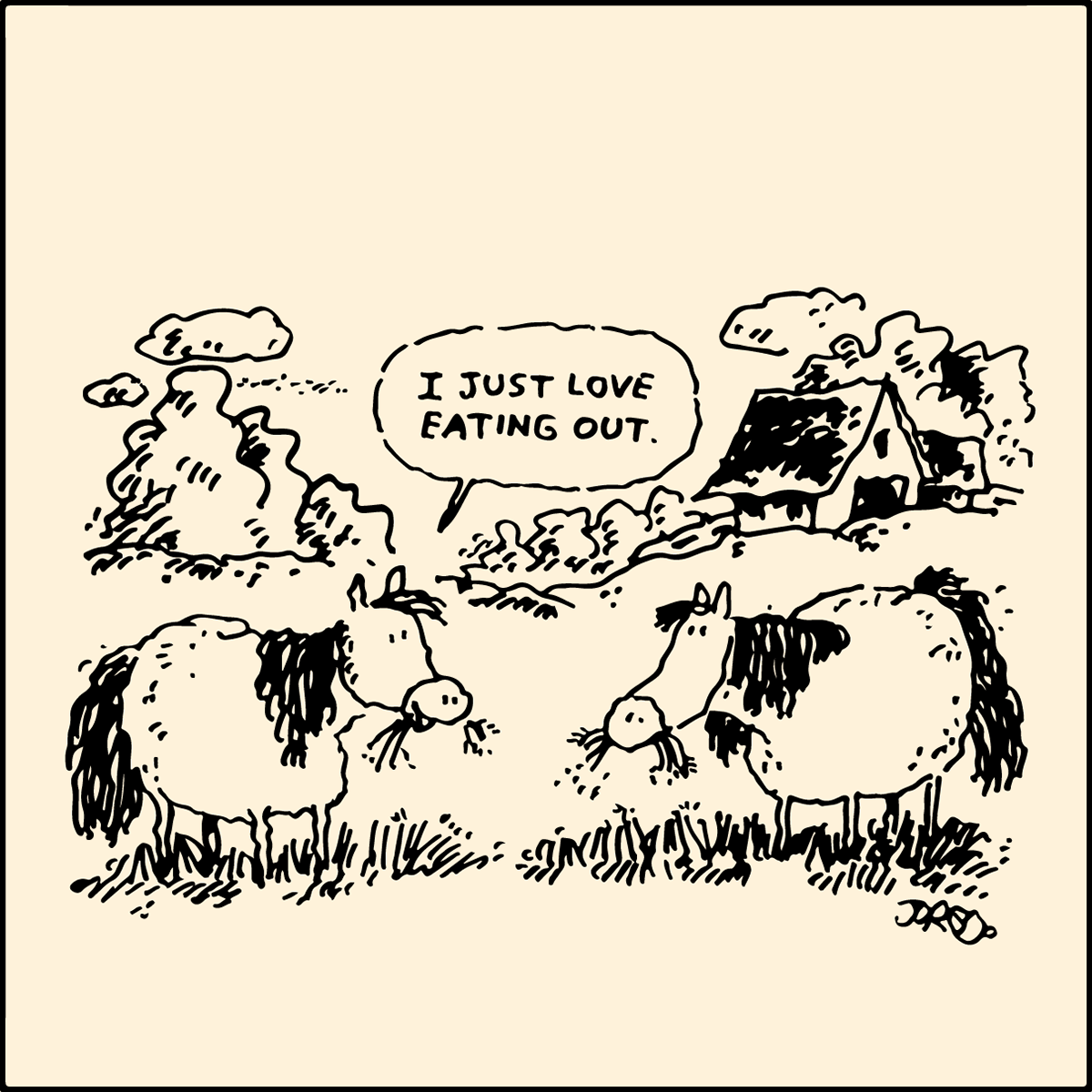
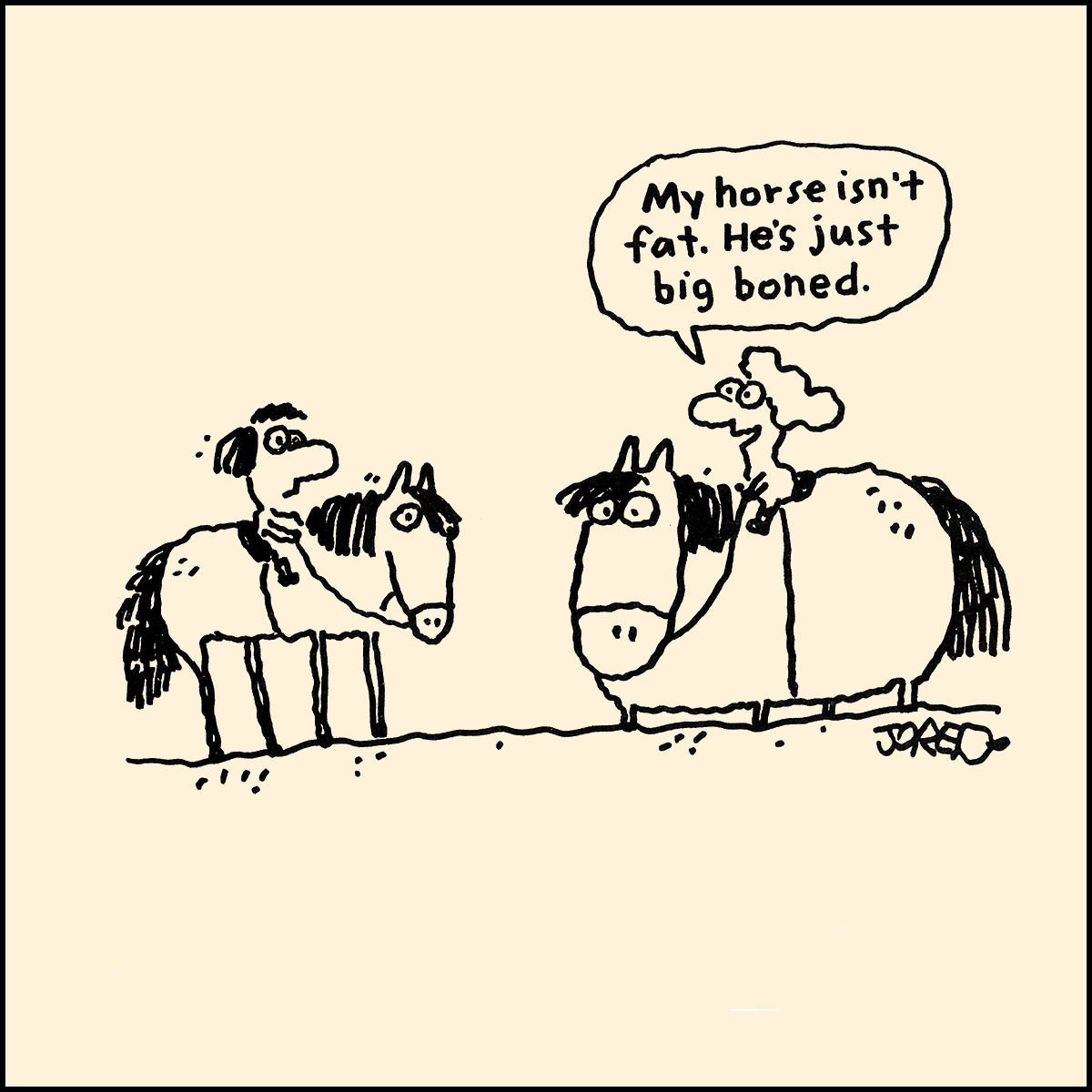
Humorous as Jared Lee’s cartoon may be, the overweight horse is genuinely at risk for increased health and performance problems. Overheating, poor performance, and metabolic disorders are all common consequences of excess body fat, causing discomfort, pain, and even loss of use for your horse, plus costly vet bills, headache, and heartache for you as the owner.

In Calories 101 – Part 1, we looked at several methods for estimating a horse’s current and target weights, and calculated the total number of calories necessary for maintaining a horse’s ideal body weight. And now, equipped with that necessary information, we can next take on the task of planning a proper diet for your horse. But first, I want to reiterate that I’m not an equine nutritionist; I’m merely a guy with an extensive math background who understands and can explain how to do the well-established calculations necessary for the task at hand! For advice about specific nutrients and nutrient ratios, please consult an equine nutritionist – ideally (in my opinion), one at a university, who’s not likely to be employed by the feed or supplement industries, to minimize the possibility of any specific product biases. So let’s get started!

First of all, absolutely everything in diet calculations is measured by weight. Not flakes, scoops, coffee cans, bales, pudding containers, or anything else volume-related. Weight. Period. So you’ll need some reasonably-accurate method of weighing out forage and feed. Yes, we could do some get-it-in-the-ballpark volume-based “guesstimating,” and possibly get within a factor of 2 by the time we figure out the actual amounts to feed, but why knowingly add to the already-present inaccuracies in horse weight and exercise estimations? You’ll need probably two different scales – a small platform-style scale (like a kitchen or postage scale) to weigh feed, and a hanging scale (like a fish scale) with a bag or hay net to measure forage.

When we talk about things that go in your horse’s mouth, it’s important to understand the difference in calories between what we’re actually feeding the horse, known as as-fed basis, and the values listed on any sort of analysis, called dry matter basis. The idea is a simple one: Everything your horse eats contains some amount of moisture. Whether it’s cured hay, with a relatively small water content of around 8 – 13%, or grass pasture, with much higher moisture values of 60% or more, that water needs to be accounted for in any calculations. So for an apples-to-apples comparison, dry matter basis is the way to go!

Our calorie estimations depend on two numbers listed in an analysis: the digestible energy (DE), which is a measure of the number of megacalories per pound in the sample, and the percentage of dry matter (% Dry Matter) present in the sample. For example, suppose my hay sample analysis results state that all figures are on a dry matter basis, and list a DE (Digestible Energy) of 1.000 Mcal/Lb. and a % Dry Matter of 90.000. Since the DE on my report is listed as a dry matter basis figure (in other words, with no water), but what I actually feed contains water, I need to do a bit of math to figure out how many calories are in a pound of what I’m actually feeding. First of all, 1.000 Mcal is equal to 1,000 calories; we have to multiply by 1,000 (i.e. move the decimal point 3 places to the right) to convert megacalories to kilocalories, which are what we usually refer to as just “calories.” Next, we have to multiply the calories by the % Dry Matter to figure out how many calories are in an as-fed pound of hay, so 1,000 × 0.90 = 900 calories per pound. The easy way to help remember that you need to multiply rather than divide is that the as-fed calories will always be lower than the dry matter calories. And now I know how many calories are in a pound of my hay!

So we’ll begin by talking about how to plan a diet using already-provided average values for forage and feed, and then we’ll describe how to properly collect and prepare a forage sample for actual laboratory analysis. And this seems like an appropriate time to mention my general approach to feeding horses.

As with hoof care, I believe our feeding perspective should emulate nature’s process of feeding feral horses in their aboriginal environment to the extent possible. Even though our horses’ energy (calorie) needs may at times exceed those of the feral horse, what they eat and the method of delivering it can still be consistent with nature’s methods. By doing so, we can minimize or even eliminate most of the feeding-related problems; laminitis, choke, insulin-related metabolic issues, and colic are all examples of conditions most properly-fed horses rarely suffer from. So keep this in mind as I describe the diet planning.

The table below lists the average DE and % Dry Matter values for some of the most common forages and grains, including fresh forages like grass pasture. These values come from a fabulous and absolutely free resource: Dairy One’s Interactive Feed Composition Libraries. While not every possible thing you might want to feed your horse can be found in their libraries, most typical items – and even some seemingly-odd ones (for horse people) like fresh pineapple forage – are definitely provided! And, being the nice guy that I am, I’ve calculated the As-Fed Basis DE calories as well –

Let’s begin with dry forage (hay), since that’s crucial to every horse’s digestive health, and should by far constitute the largest percentage of any horse’s diet. The absolute minimum amount of forage required to keep a horse’s digestive system working properly is considered to be 1% of his Target Weight per day, on a dry-matter basis. That means my 15-hand horse with an ideal weight of 1,014 pounds needs at least 1,014 × 0.01 = 10.14 pounds of dry-matter-equivalent forage each and every day just to keep things operating properly. According to the above table, grass hay has a % Dry Matter of 92.255, so the easiest conversion to as-fed would be 10.14 ÷ 0.92255 = 11 pounds. Remember, the as-fed amount will always be higher than the dry-matter basis amount, so dividing by the percentage of dry matter gives us the increase in weight due to water. The table also lists an average digestible energy (DE) content of 864 calories per pound, so feeding the absolute minimum forage requirement for my 15-hand horse would provide only 11 × 864 = 9,504 calories. But if you remember from Part 1, my 15-hand horse requires 15,210 calories per day to maintain his target weight, so we have a calorie deficit of 15,210 – 9,504 = 5,706 calories. So let’s see how much additional grass hay I would need to take care of this deficit.

If we divide the deficit by the average as-fed DE for our grass hay, we have 5,706 ÷ 864 = 6.6 pounds. So, by feeding my horse 11 + 6.6 = 17.6 pounds of grass hay per day, we’ve provided all of the calories necessary for him to maintain his Target Weight – no other feed required! Admittedly, that was more complicated than it needed to be, because directly computing the forage amount from the required calories will always more than satisfy the 1% requirement. So, making certain to use appropriate values to end up with as-fed weight:

Required Calories per Day ÷ Digestible Energy per Pound of Forage = Required Pounds of Forage per Day, or

15,210 ÷ 864 = 17.6 pounds

Simple enough, right?

…but now I need to mention there are several caveats to keep in mind when using the information. Keep in mind that the Digestible Energy number, like all of the numbers, is an average value based (in this case) on 66,310 samples, and, in reality, the values can and will vary over a fairly wide range. For grass hay’s DE, for example, those samples had a Standard Deviation of 111 calories. Without getting into the statistics behind these numbers, let me just say this indicates that 95% of the samples tested actually had a DE somewhere between 715 and 1,159 calories per pound (dry matter basis), or 660 and 1,069 calories per pound as-fed. Let’s try to understand the implications of that on our simple feeding program.

If you feed the originally-calculated 18 pounds of grass hay (yes, I rounded it up to the nearest pound) per day which used the average DE for the calculation:

18 × 660 = 11,880 calories per day with a DE at the lower end of the samples, leaving a deficit of 3,330 calories and thus underfeeding the horse by 22%

18 x 1,069 = 19,242 calories per day with a DE at the higher end of the samples, creating a surplus of 4,032 calories and thus overfeeding the horse by 27%

Conversely, if you adjust the forage amount for the lower and higher ends of the samples:

15,210 ÷ 660 = 23 pounds per day will be required if the hay is actually at the lower end of the samples measured

15,210 ÷ 1,069 = 14.23 pounds per day will be required if the hay is actually at the higher end of the samples measured

This same variability, of course, is present in the % Dry Matter numbers as well; more or less water present than the average value will have a potentially serious effect on the calculated as-fed amounts, thus throwing your feeding program off even farther! Hopefully, you’re starting to understand from this example why it’s so important to have your hay tested; you could very easily be underfeeding or overfeeding by a significant amount if your hay’s DE and % Dry Matter aren’t very close to the averages! Fortunately, hay testing is very easy and inexpensive, and will provide an in-depth look at the composition of your hay. A basic analysis from Dairy One, for example, will cost you only $23, and they’ll provide you with a postage-paid mailer for the sample, and email you the test results in very short order. The international handling fee is only an additional $7. Well worth the money! On to feed…

As we just saw in the above calculation, we were able to meet the calorie requirements of my 15-hand horse with 18 pounds of grass hay per day, and no other feed or grain. Horses are able to eat upwards of 2% of their body weight in dry matter per day, which translates to:

1,014 pounds body weight × 0.02 = 20.28 pounds Dry Matter

20.28 pounds Dry Matter × 0.937 Mcal/lb. DE = 19,002.36 calories

This means my horse is able to eat enough of this grass hay per day to meet all of his calorie needs even if he were being ridden or driven an hour every single day – no concentrates required! And in keeping with my philosophy about emulating nature’s process of feeding feral horses, let me also state now that I’m not of the opinion that horses should have unlimited access to hay – for a very simple and logical reason: Although feral horses have a theoretical 24-hour access to forage, in reality they must work hard to get that forage. Unlike our domestic horses, who can simply stand in front of a mountain of hay and gorge themselves, feral horses are eating sparsely-spaced dry, bunch grasses, and typically travel just under 12 miles every day to eat enough to satisfy their calorie requirements. While some domestic horses may eventually “self-regulate,” and eat only an amount necessary to meet their daily caloric needs, many others will simply continue to eat in excess – as evidenced by the tremendous number of overweight horses! So, your horse’s hay – whatever the required amount – needs to be parceled out via some slow-feeding method over a 24-hour period, thus emulating nature’s feeding method to the degree possible.

Feeding grain to horses came about at a time in history when horses were being used many hours per day, whether for farming, warfare, or transportation, and simply hadn’t enough time available to consume sufficient forage to maintain their body weight. So the use of “concentrated calories” came about to allow horses to meet their calorie needs and still be able to do heavy work. Unfortunately, that tradition has continued, and many horse owners believe or are told that their horses must eat feed or grain to remain healthy. That’s simply not the case; as you can see, most of our horses’ much lower calorie requirements can easily be met just by feeding hay. And because horses must consume at least 1% of their body weight (dry matter basis) in forage to maintain proper gut function, concentrate manufacturers generally list their feeding recommendations with that 1% forage + maximum concentrate as the starting point, followed by progressively higher amounts of forage + lower amounts of concentrate. Enough of that for now!

The following data was provided to me by Dr. Don Walsh, founder of the now-closed Animal Health Foundation, which supported laminitis research all over the world (thank you, Don!). Don collected this information directly from feed manufacturers because they do not list calories on their products; sadly, you have to contact them for calorie information. This list is by no means comprehensive, but it can give us a pretty good sense of the calories in most concentrates. I’ve listed them in order of ascending calories, as that’s more useful and interesting to me than the specific feed type –

As you can see, there’s quite a range of calorie values here – from a low of 900 to a high of 3,900! Incidentally, the feeds at the lower end are typically forage or ration balancers, which are products designed to make up for forage deficiencies in a particular geographic area. They aren’t intended to be major calorie sources, and are fed at lower amounts than complete feeds. If your forage analysis reveals deficiencies,  a ration balancer is the ideal way to make certain your horse’s vitamin and mineral needs are being met without adding a bunch of unnecessary calories to his diet.

Once equipped with the necessary feed calorie information (remember: you may need to call the manufacturer to get it), any feed component in your horse’s diet can be calculated in the same manner. Let’s use the numbers from our previous example: a 15-hand horse with a target weight of 1,014 pound requiring 15,210 calories per day, with 9,504 calories already provided by 11 pounds of grass hay. So if we use the most common calorie value for feed of 1,550 calories per pound (as-fed), our 5,706-calorie deficit can be met by:

5,706 ÷ 1,550 = 3.68 pounds of concentrate

So our entire diet calculates out to be 11 pounds of grass hay plus just under 4 pounds of feed per day. Remember that your horse must have the 11 pounds of hay; that’s a well-established absolute minimum! And with only 4 pounds more of feed – or just under 7 pounds more of grass hay – we’ll satisfy all of his calorie requirements. Anything beyond that is excess calories, which will be converted to fat! Based on what I see and hear on a daily basis, I’m certain these quantities seem quite small to you – especially the amount of feed. But keep in mind that that feeling exactly demonstrates my point: We’re grossly overfeeding our horses!

To wrap up Part 2, let’s discuss how to collect and prepare a forage sample for testing. The first step is to gather an appropriate sample, which needs to be collected in a random manner to be truly representative of our lot of hay. The table below will help you know how many samples to gather to create your final sample for submission –

This particular approach to sampling, including the numbers in this table, is called the Acceptable Quality Limit standard, and dates back to World War II and the manufacture of bullets for the armed forces. It provides a method of determining the characteristics of a group of items by testing a randomly-chosen number of items from that group; how many items need to be tested is a function of the total number of items in the group. For diet planning, the numbers can represent some unit of hay – either bales or pounds probably being the most logical. For example, suppose we buy 100 bales of hay from a dealer. Looking at the table, we see that randomly testing 20 bales will give us a very good idea of the characteristics of the entire 100-bale lot. For our purposes here, we’re interested in the two numbers we’ve been using to plan our horse’s diet: the Digestible Energy (DE) and the % Dry Matter.

I can’t stress the importance of a random sample enough. If we merely test the last 20 bales unloaded, for example, it might turn out they were leftover bales from an earlier crop, and therefore wouldn’t be representative of the entire lot. So we need to be a bit creative in our approach to picking the 20 bales. It’s really not difficult; for instance, as the hay is being unloaded, you could set aside every 3rd, then every 5th, then every 7th bale, repeating that pattern until you had the 20 bales. At any rate, once you have the 20 bales set aside, you need to reach into the center of each of the bales and pull out 2 or 3 handfuls of hay (you could also use a hay probe for sampling, which is like a long, small-diameter hole saw, but it’s not necessary). Take a pair of scissors, cut each of your handfuls into 2- to 3-inch pieces, and combine all of the cut samples in a clean, dry plastic bucket. Thoroughly mix the samples. Weigh out one (1) pound, place it in the sample bag, squeeze out the air, and seal the bag. That’s it!

And rather than have a downloadable file of the tables in this Post, I’ve decided I’ll create an MS Excel spreadsheet that’ll incorporate the content of all 3 parts of this series in one “spot,” and will automatically do all of the calculations for you!

In Calories 101 – Part 3, we’ll tackle what I consider the most challenging part of basic diet planning: the pasture. Stay tuned…

Thanks to COVID-19, most of us probably aren’t spending much time in restaurants these days. But many of our horses, on the other hand, may nevertheless be spending more time eating higher-calorie food than they should be! Yes, I realize I’m not an equine nutritionist, and I don’t pretend to be one. But I have spent a fair amount of time studying enough of the basics of equine nutrition with Dr. Jessica Bedore, my former equine nutritionist colleague at The Ohio State University, to feel competent talking about how to determine proper caloric intake.

My decision to discuss it now is being driven by three things: 1) the ever-increasing number of overweight horses we encounter on a daily basis, 2) the apparent lack of knowledge by horse owners and barn managers about how to determine how much a horse should be eating, and 3) the usual annual increase in the incidence of laminitis in the area because of the rapidly-growing (and sugar-laden) grass. And because truly comprehensive hoof care involves a great deal more than just proper hoof trimming (which, by the way, is why we spend a tremendous amount of time discussing other contributing factors to hoof quality and form in the Liberated Horsemanship Gateway Clinics), I feel compelled to share this knowledge in a sincere effort to help horses avoid the health issues that result from obesity.

Yes, I’m well aware many people find the idea of having to do any sort of calculations intimidating and even frightening. But the good news is the math we need for diet planning is extremely simple and straightforward, and can be done by anyone using even the lowliest of calculators, including the one on your phone. So let’s get started!

Part 1 of this series is aimed at teaching you to recognize whether your horse is too fat, too thin, or just right, and how to calculate how many calories per day he needs to maintain a proper weight. Probably the most standardized way of starting this process is to figure out your horse’s Body Condition Score, or BCS. This method of assessing the amount of fat on a horse’s body was developed in 1983 by Dr. Don Henneke at Texas A&M University, and the Henneke System has become the de facto standard for describing a horse’s condition.

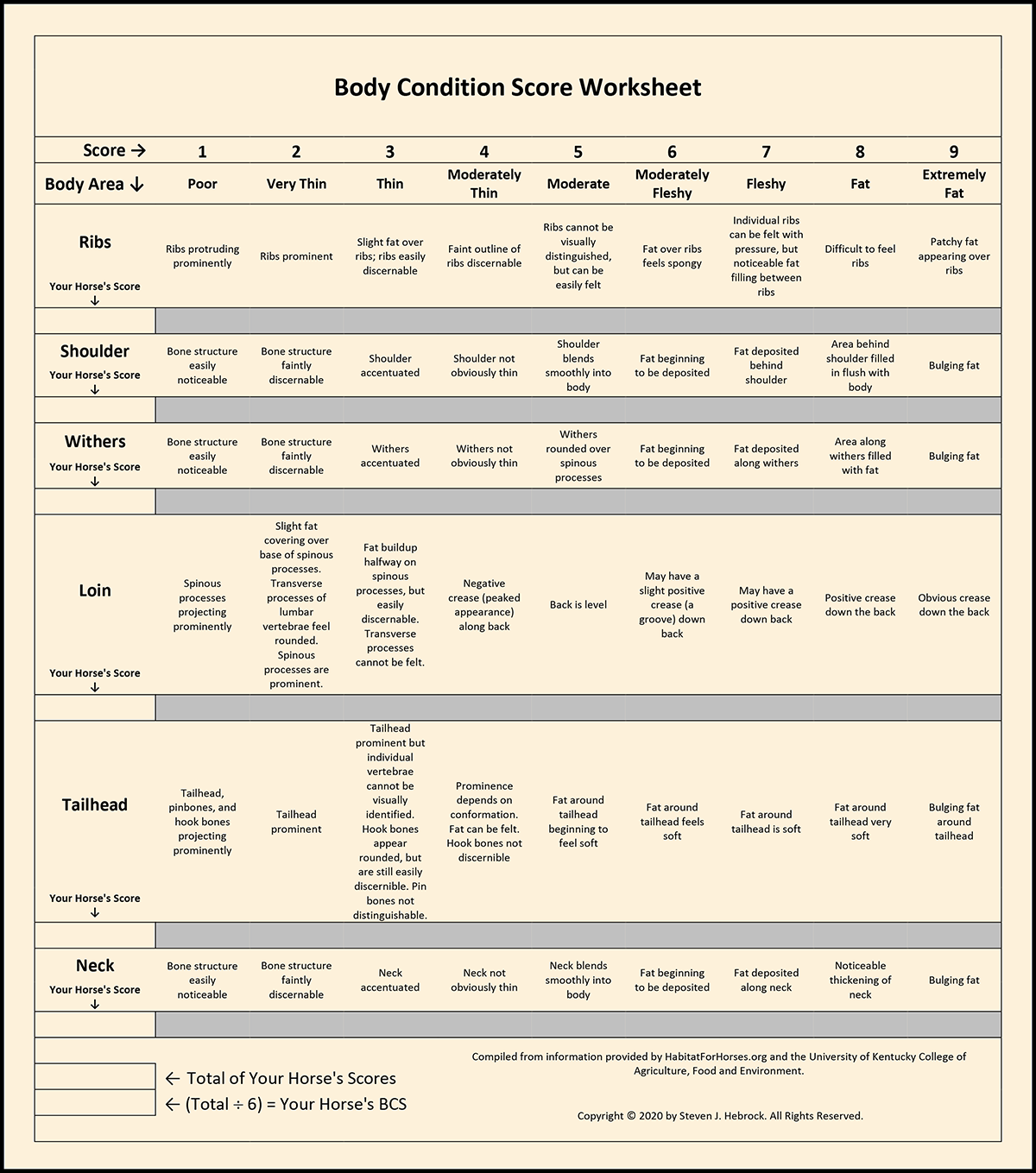
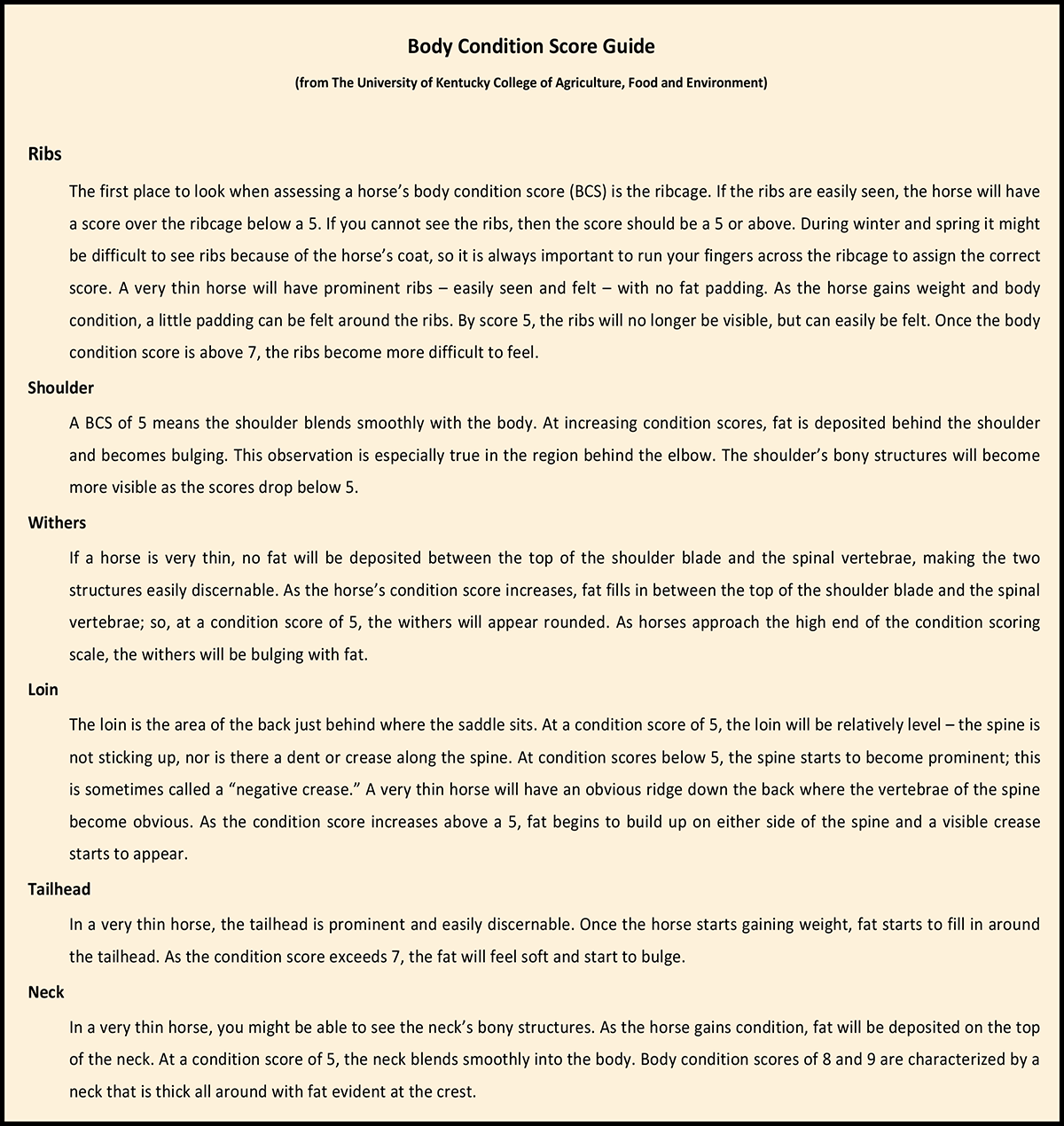
For many, this will undoubtedly be the most difficult part of our task, simply because we horse owners can’t seem to look at our horses with an unbiased eye. But there’s no upside to convincing ourselves that our horse isn’t overweight if, in fact, he is – only a potentially horrible downside. Just make certain whoever does the evaluation is as objective as possible: someone with a discerning eye who’s willing to put aside all feelings and opinions and honestly assess your horse. And if you or your chosen evaluator isn’t reasonably familiar with the process of calculating BCS, I strongly suggest you both familiarize yourselves with this very useful process; you can find a good step-by-step article on Body Condition Scoring here, although there are a number of articles and video guides available. To help you with the actual process of Body Condition Scoring your horse, I’ve created the following worksheet and guide –

Incidentally, to make all this information a bit easier to read, use, and share with others, I’ve created a PDF file containing all of the tables, charts, and worksheets in this article for downloading and printing here!

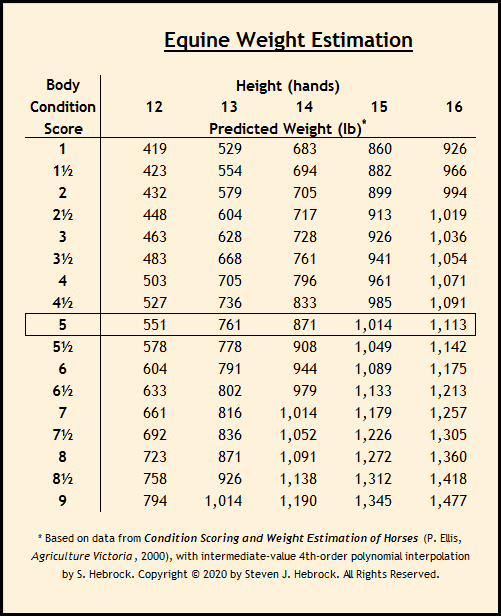
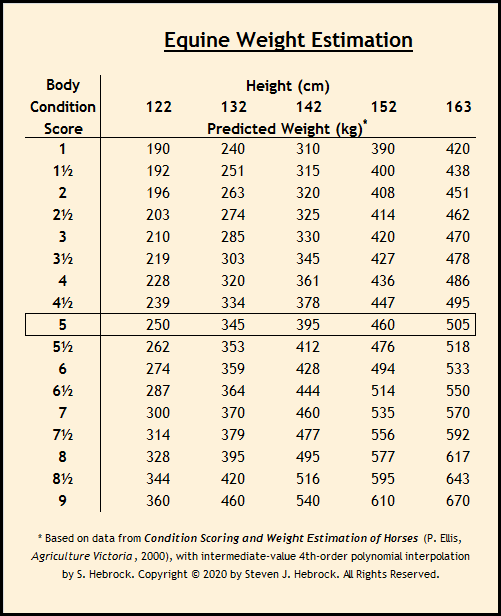
Once you’ve determined the BCS, the next step is to find out how much weight your horse needs to lose or gain. The following chart should help; just look up your horse’s BCS in the column under his height, and compare it to the weight given for the same height with a BCS 5. For example, a 15-hand horse with a BCS 6.5 (extremely common, in my experience) has an approximate weight of 1,133 pounds and a target weight of 1,014 pounds; therefore, he needs to lose about 119 pounds. Of course, these are approximations, and are presumably based on average-build i.e. riding horses. But the numbers should be accurate enough to give you a solid feel for how much weight change your horse requires. This table is in hands and pounds –

This is the metric version, with the hands heights converted to centimeters and the weights in kilograms –

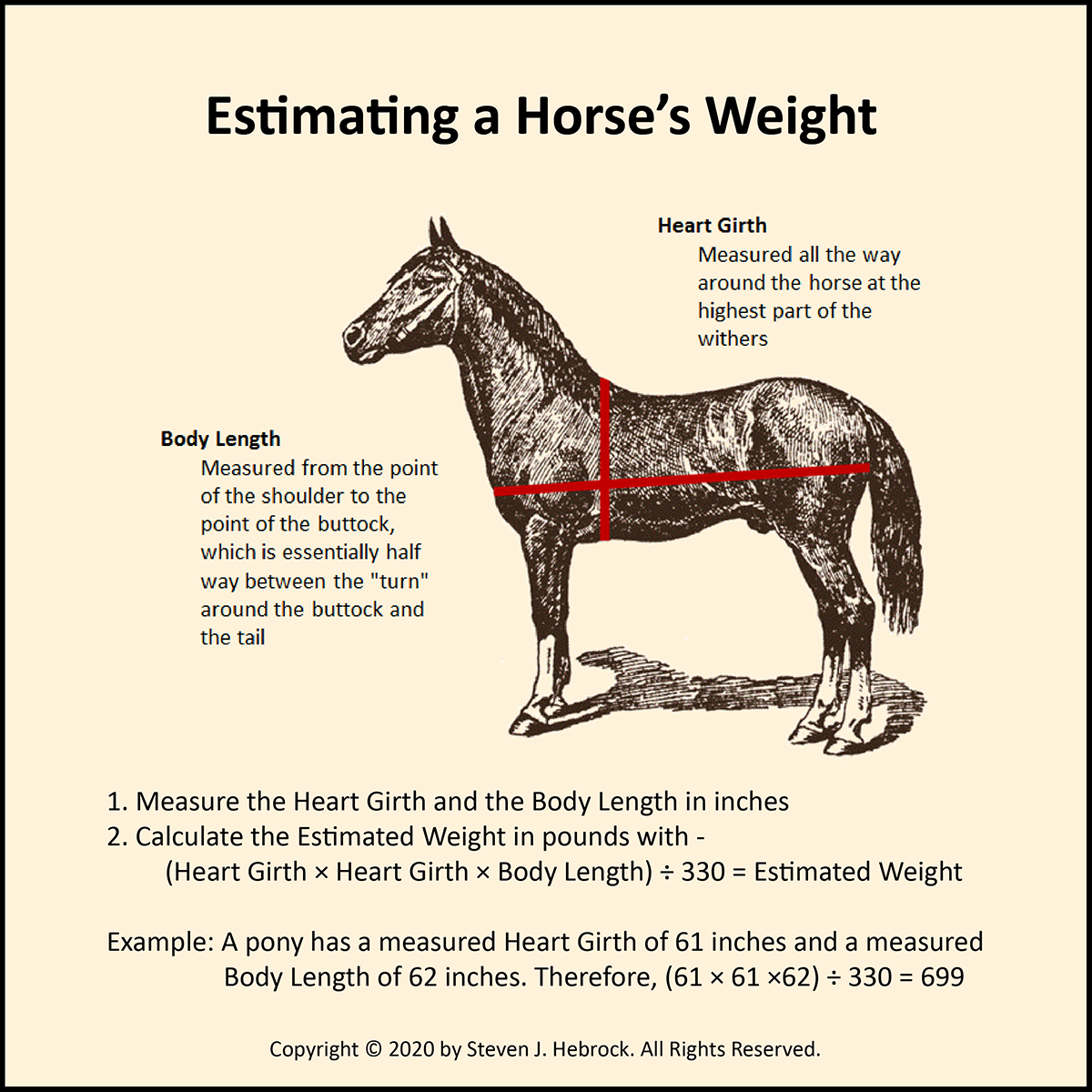
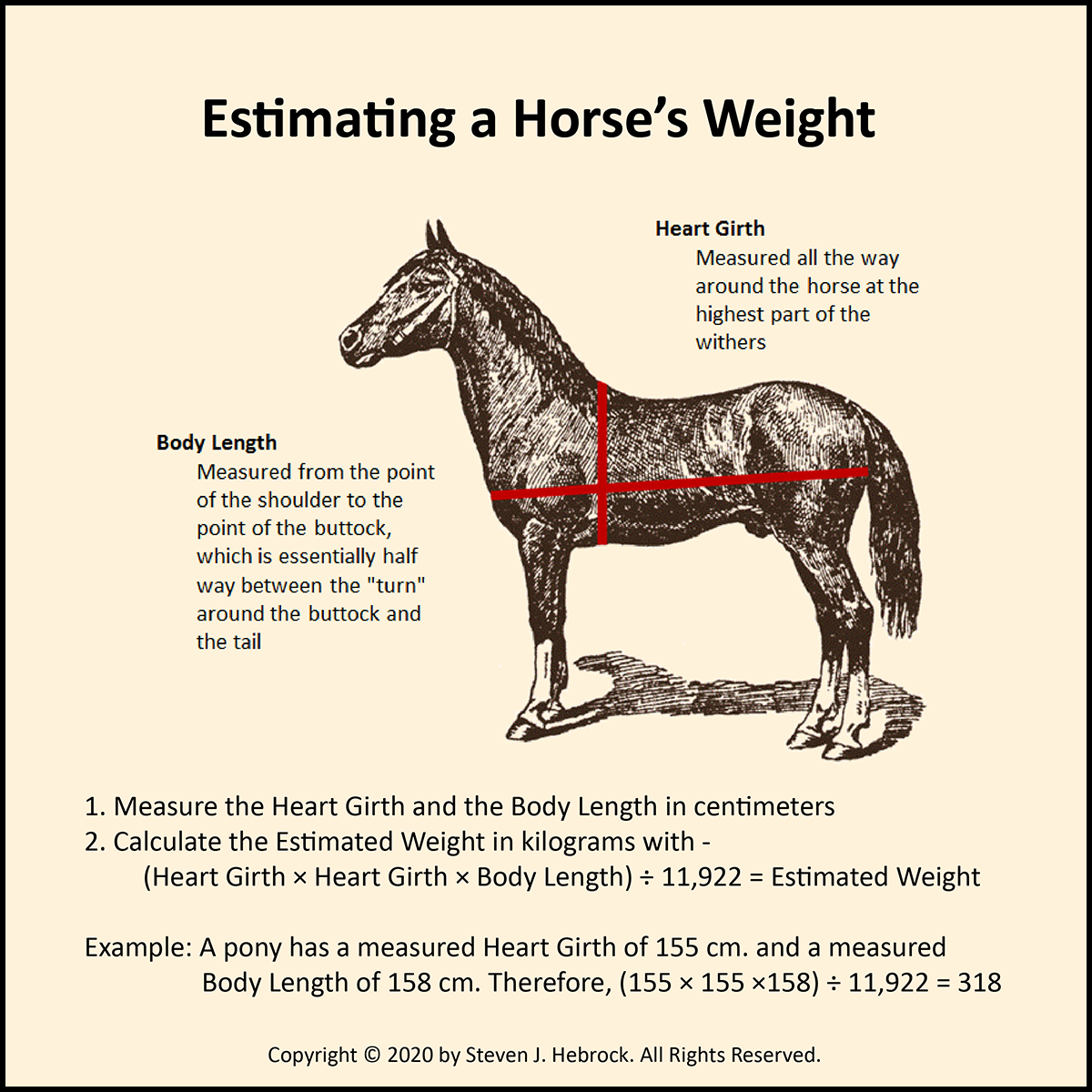
At this point you may be wondering why we don’t simply use the ubiquitous weight tape instead of bothering with figuring out the horse’s BCS. A couple of reasons: 1) we know weight tapes aren’t particularly accurate, and 2) we want to actually look at the horse’s body fat to assess his condition, and not base our diet decisions solely on a string of numeric approximations. Still, the weight tape is a useful tool when it comes to tracking changes in our horse’s weight, so knowing what your horse weighs in addition to calculating his BCS is useful. However, Texas A&M University has developed a far more accurate method of estimating a horse’s weight than with a weight tape, using an ordinary cloth tape measure and some simple math as described below. I’ve discovered, by the way, that most of us will need some assistance to measure the Body Length on the average-sized riding horse; my arms just aren’t that long!

Again – here’s the metric version, with lengths in centimeters and weight in kilograms –

So you now know approximately how much your horse weighs, and how much he should weigh. Now it’s time to figure out how many calories per day are necessary for your horse to maintain his target weight, which is probably not his current weight. And just as with the BCS, determining caloric requirements requires you to be absolutely honest about how much you actually ride (or drive) your horse, because the amount of work he does is key to calculating caloric needs.

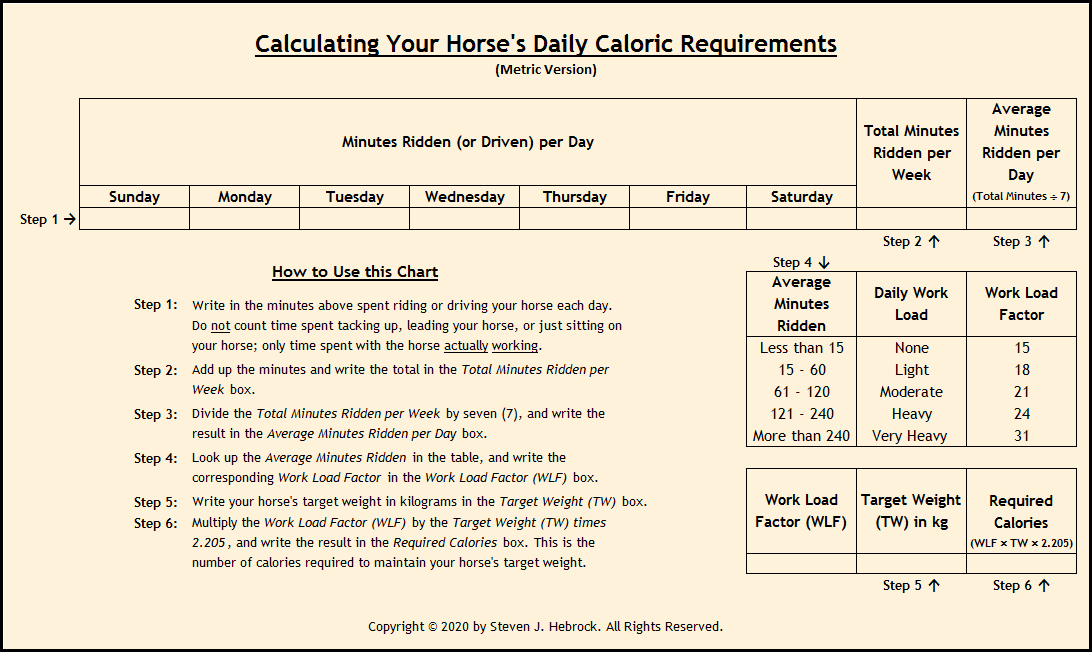
This is really the easiest and most straightforward part of the process;  all we need is some accurate information about your riding or driving habits. You’ll need to collect some information about how much you ride, and then do some simple calculations using the worksheet below to figure out how many calories per day your horse needs to maintain his target weight –

Here’s the metric version, with the target weight in kilograms –

As an example, suppose I ride my 15-hand horse with a target weight of 1,014 pounds for 20 minutes every Tuesday, Thursday, Saturday, and Sunday. Just for the record, I’ve not counted the 10 minutes it takes to collect my horse from the pasture, the 10 minutes it takes to clean and tack him up, the 5 minutes each of a leisurely warm-up and cool-down walk, or the 10 minutes to get to and from the arena and untack and put him away when I’m done.  So, following through the worksheet:

Steps 1 & 2 –

20 + 20 + 20 + 20 = 80 Total Minutes Ridden per Week

Step 3 –

80 ÷ 7 = 11 Average Minutes Ridden per Day

Step 4 –

11 = Less Than 15 = 15 Work Load Factor

Steps 5 & 6 –

15 x 1,014 = 15,210 Required Calories per Day

And now we know how many calories our horse needs to maintain a healthy weight! So take an objective look at your horse’s body and your riding or driving patterns, and figure out how many calories your horse should be consuming in preparation for the second part of this series.

In the next installment, we’ll discuss the potential challenges of selecting appropriate types and amounts of forages and feeds to meet, but not exceed, this requirement. Why will it be challenging? Primarily for two reasons: 1) in the case of forage, the calorie content of all of them, including green grass, varies by a number of factors, including forage type, maturity when cut or consumed (in the case of green grass), time of day when cut or consumed, moisture content, and storage conditions, and 2) in the case of feeds, manufacturers don’t generally publish the calorie content of their products so you have to directly contact the company to get the information you need to plan the diet. But in spite of all these apparent obstacles, it’s fairly easy to ensure your horse is getting adequate, but not excessive, calories.

All for now…

Jared Lee Cartoon "Big-Boned"

“You’re killing your horse!” I exclaimed. The woman had just related how her geriatric Morgan was on constant grass pasture, with continuous access to hay, and now also being fed what she described as “just over twelve pounds of feed a day.” “But the vet told me I need to put weight on him!” she protested. Dora and I weren’t concerned about his weight at that particular moment; we were worried about what we were seeing in his feet: flat soles, very stretched white lines, sore to the point of being unwilling to lift his feet, and – most disturbing of all – soft, squishy sole tissue directly beneath the coffin bones. And if he continued on that course, we knew it would only be a short time before his coffin bones penetrated his soles…

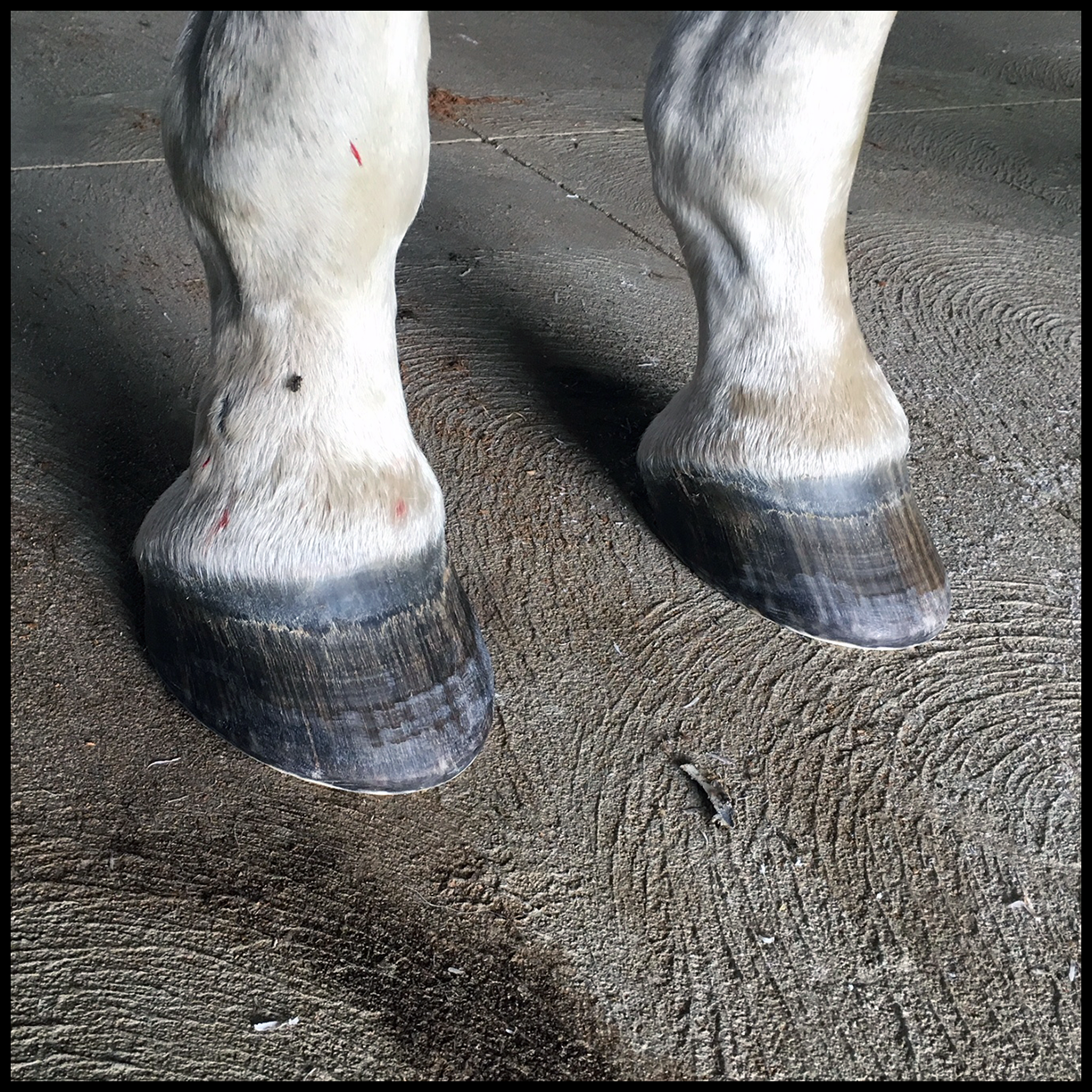
EL - Front Feet
The feet of this big warmblood may appear fairly normal, but…

Four years ago, I wrote an article entitled How Much is Too Much? that described research done by one of my university colleagues on the question of how much weight a horse can carry without evidence of muscle damage. And while riders too heavy for their horses continue to be a serious problem (for their horses, certainly!), overweight horses such as Jared Lee’s “big-boned” cartoon horse and the very real horse described above are all-too-typical examples of what we now see on a near-daily basis.

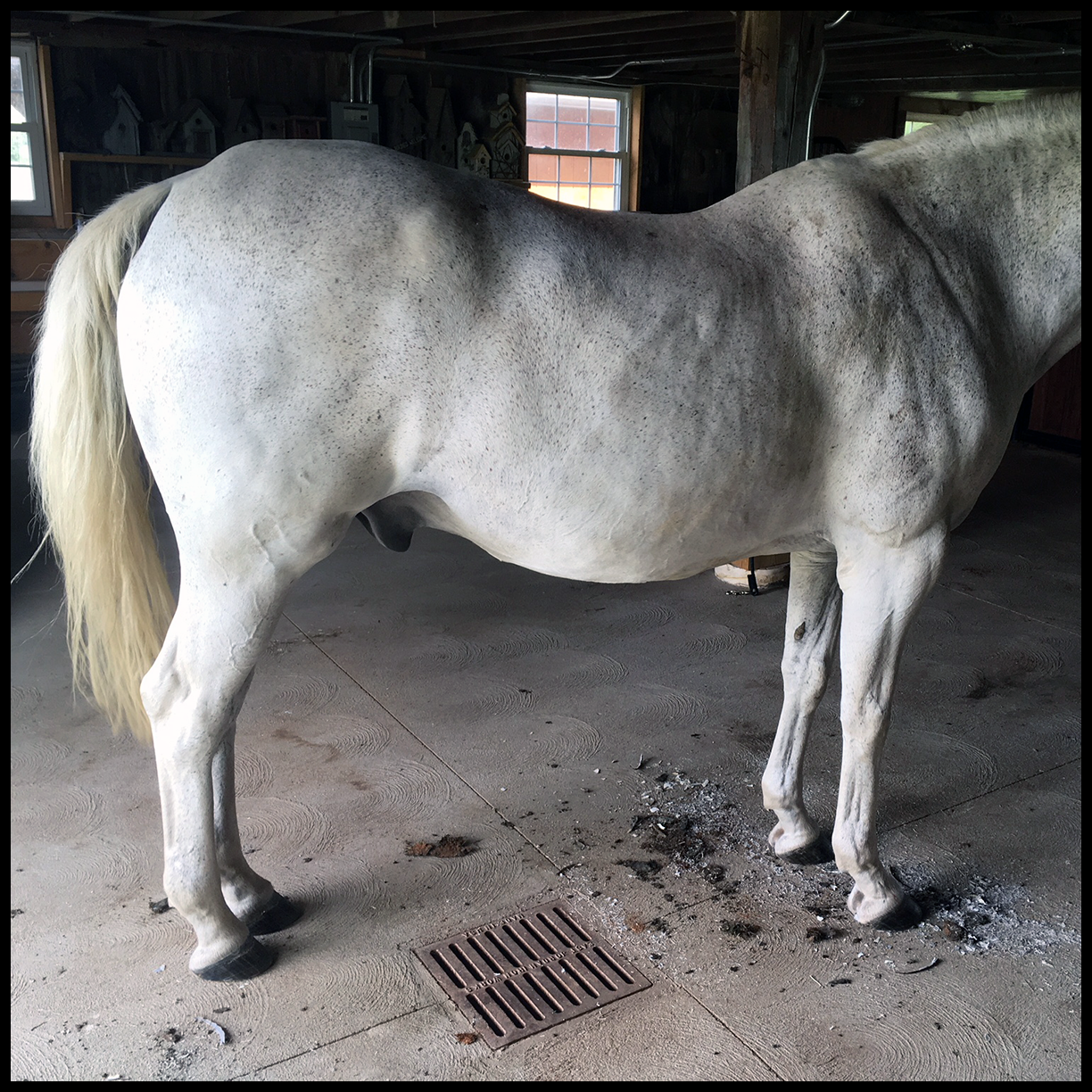
EL - Body
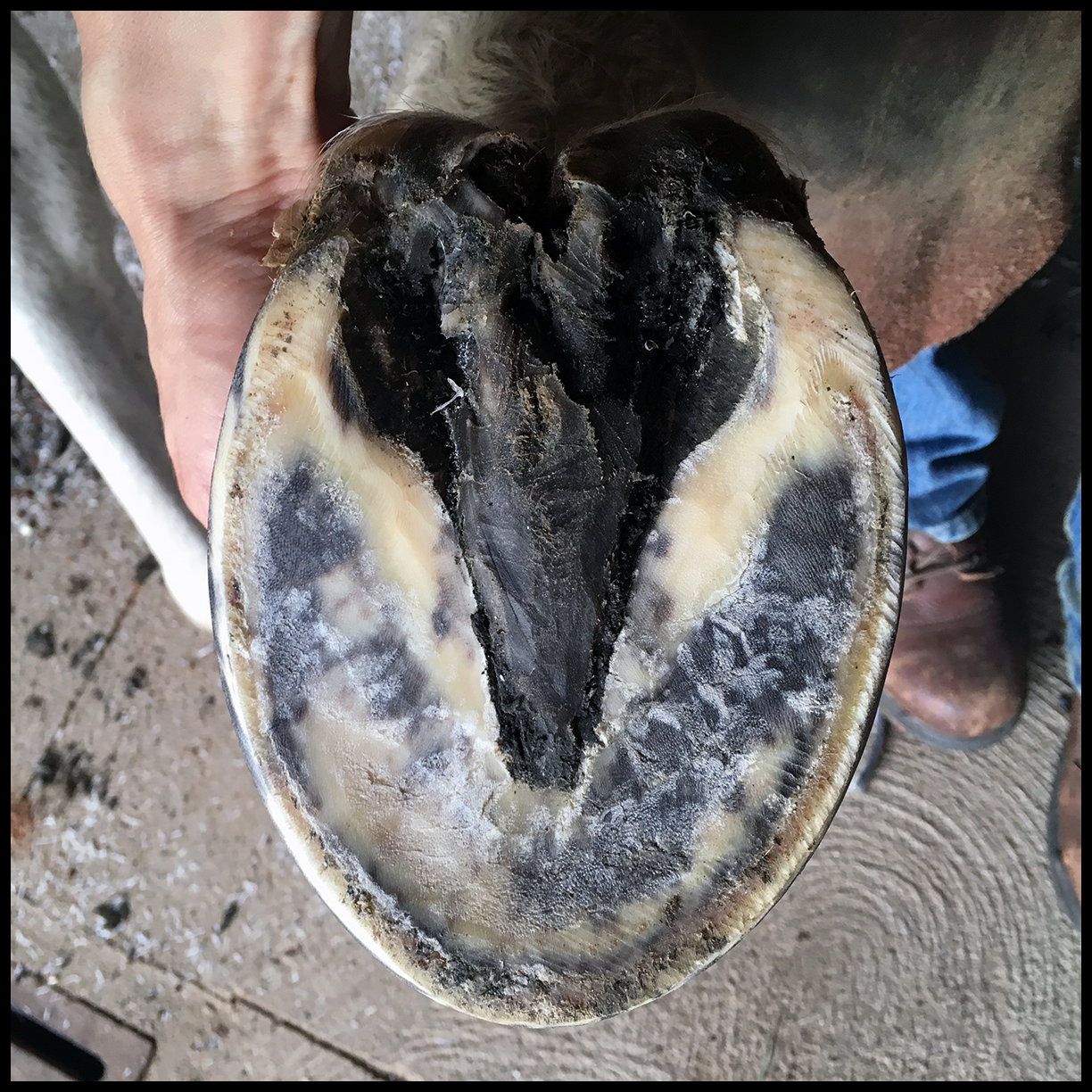
…the body suggests all is not right! A quick glance at the bottoms of the feet…

“So what’s the big deal about a few extra pounds on my horse?” you may ask. Well, it’s because these “big-boned” horses have taken the first (or second or third) step on the path toward a condition known as endocrinopathic laminitis – an extremely common form of laminitis now recognized as distinctly different from the laminitis caused by the sudden excessive intake of carbohydrates that occurs, for example, when a horse gets into the feed room. So when we encounter an overweight horse accompanied by word that he was “a bit sensitive” after his last trim, we can pretty well predict what his feet are going to look like before we’re even close enough to see them properly. Along with increased post-trim sensitivity, they’ll often exhibit:

  • A loss of solar concavity i.e. flattening of the soles as the coffin bone descends
  • Sole bruising, particularly below the coffin bone
  • Separation of the white line at the toe, eventually extending all the way around the hoof
  • Flaring of the hoof wall at the toe, eventually extending all the way around the hoof
  • Horizontal rings and waves in the hoof wall rather than normal straight growth
  • Frequent hoof abscessing

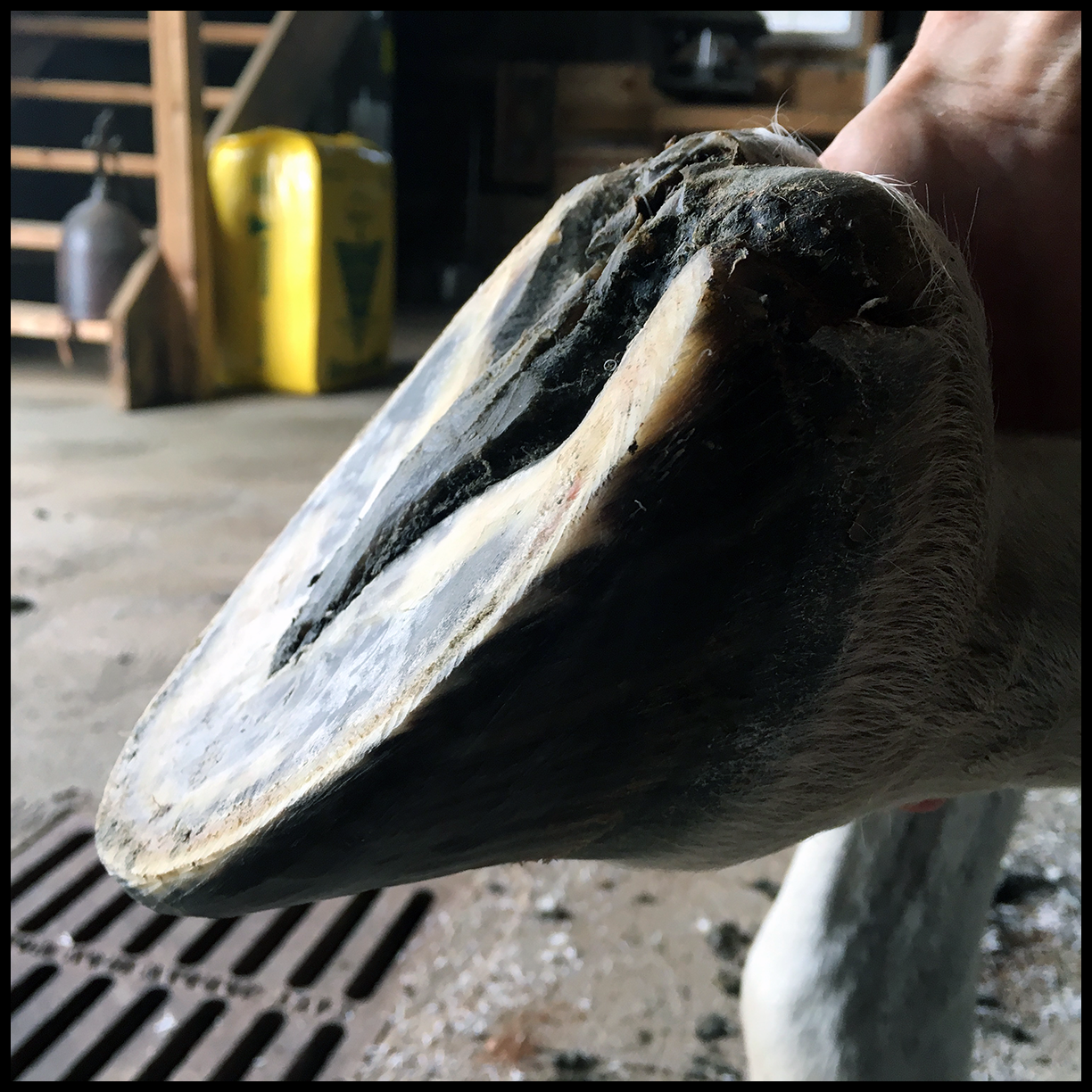
EL - Hoof Oblique
…reveals a near-complete loss of solar concavity…

Unfortunately, and to the disservice of horses and horse owners (and hoof care providers), many veterinarians have been slow to keep up with research on this condition, instead clinging to the outdated belief that horses presenting with clinical symptoms consistent with laminitis (some of which are listed above) but without an “obvious” cause for laminitis must actually have some other condition. Yet, as a recent article in The Veterinary Journal points out –

Endocrinopathic laminitis is now recognized as the most common form of naturally occurring laminitis in horses and ponies presenting primarily with lameness in developed countries….An earlier misconception that laminitis was predominantly associated with sepsis or SIRS arose from its prevalence in equids treated at veterinary referral hospitals, where laminitis research is concentrated….This misperception was highlighted by a large epidemiological study in the USA, which showed that grain overload, retained placenta, colic or diarrhoea accounted for only 12% of owner-reported cases of laminitis; the remainder were associated with dietary problems or obesity, or were of unknown cause. Subsequent, more convincing studies from the USA and Europe identified endocrinopathies (i.e. “hormone problems”) in 90% of cases of laminitis in horses/ponies presenting for lameness. (Patterson-Kane, J.C., et al. “Paradigm Shifts in Understanding Equine Laminitis.” The Veterinary Journal, vol. 231, 2018, pp. 33–40)

EL - Hoof Bottom
…and the beginnings of a stretched white line at the toe!

Please be aware that improper trimming can also cause some of these same symptoms, and it can occasionally be challenging to sort out the real culprit! But if you haven’t changed hoof care providers and your horse is now showing signs of having sensitive feet, you should first consider whether or not any or all of the following are true.

If your horse is:

  • Objectively overweight i.e. a Body Condition Score (BCS) of 6 or higher,
  • Regularly consuming more calories than are required to maintain his body weight,
  • No longer doing as much work as he was previously doing, but his caloric intake hasn’t been reduced,
  • Being fed differently than when he was sound, including treats and supplements, and/or
  • Consuming any grass,

there’s an extremely good chance the sensitivity he’s experiencing is a symptom of the early stages of endocrinopathic laminitis. Again – your vet probably won’t recognize it as such, because most veterinarians simply don’t have the experience or expertise to recognize the subtle (at least to them!) changes in the feet that signal potential disaster looming over the horizon. But the foot is a marvelous “early warning system” for dietary and other health/management issues, so if your hoof care provider is properly trained – admittedly a big “if” as well – he/she should see what the vet and others may not. So ask questions, and listen carefully to the answers. I can’t emphasize this enough: endocrinopathic laminitis, like any other form of laminitis, is an extremely painful condition, yet the condition can usually be avoided if the diet is properly managed. And while it’s definitely treatable, with full recovery possible, it’s certainly much easier to spare you and your horse by attempting to prevent it in the first place by ensuring your horse stays at a healthy weight (4.5 – 5.5 BCS).

Contrary to what most horse owners I talk to seem to think, it’s really neither difficult nor time-consuming to do the math to figure out approximately how many calories your horse requires to maintain a proper body weight for the amount of work he’s doing. But keep in mind that all calorie information and feed calculations are based on weight, not volume, which means that whoever feeds your horse should be weighing his hay and feed. And although you should only need to correlate weight with volume once for a given brand and type of feed e.g. “this orange scoop full of HappyHorse Brand SuprGood Feed has a net (feed) weight of 3 pounds,” hay varies tremendously and each feeding should be weighed!

Remember: In order to help prevent possible endocrinopathic laminitis problems, it’s extremely important that you be objective about your horse and his situation:

  • Be honest about your horse’s current weight and BCS
  • Be honest about how much work your horse is actually doing
  • Be honest about what your horse should weigh
  • Be honest about what and how much your horse is consuming

I realize many horse owners think horses are “supposed” to be round-looking, or that horses look “healthier” or “cuter” with “a few extra pounds.” But believe me: they’re not, it’s not, and they don’t! So please do the right thing and do right by your horse.

I intend to cover treatment options for the horse who does develop laminitis in a future article. But for now, let me just mention that putting shoes on a laminitic horse – even a mildly laminitic one whose only obvious symptom is foot sensitivity – is absolutely the wrong thing to do, and will actually increase pain and delay healing in spite of what others may try to convince you of! So if you find yourself in that situation, do your horse a huge favor and resist the urge to shoe him; I promise you I’ll provide a well-thought-out and logical explanation in an upcoming article.

And what of the Morgan described at the beginning of this article? Well, after a great deal of discussion with the owner, including assurances that her horse wasn’t going to starve to death any time soon, we managed to convince her to eliminate the “just over twelve pounds of feed a day” from her horse’s diet. And just as has been the case with other clients’ horses, his feet recovered fairly quickly. In fact, by the time his next trim came around a few weeks later, the sensitivity was gone and the sole tissue was a normal consistency with obvious returning concavity!

I do feel compelled to say that in this particular situation, I place a lot of the blame for the horse’s pain on the veterinarian’s lack of proper education, although I cannot say for certain whether the feeding regimen was the vet’s idea, the owner’s idea, or a combination of both. Regardless, even a few minutes of contemplation should lead any reasonable person to figure out that adding nearly 19,000 calories per day to any horse’s diet – particularly one whose caloric intake should be in the 13,000 – 14,000 total calories per day range – makes absolutely no sense at all.

As I keep saying: Question everyone and everything, no matter the source of the advice…and don’t overfeed your horse!

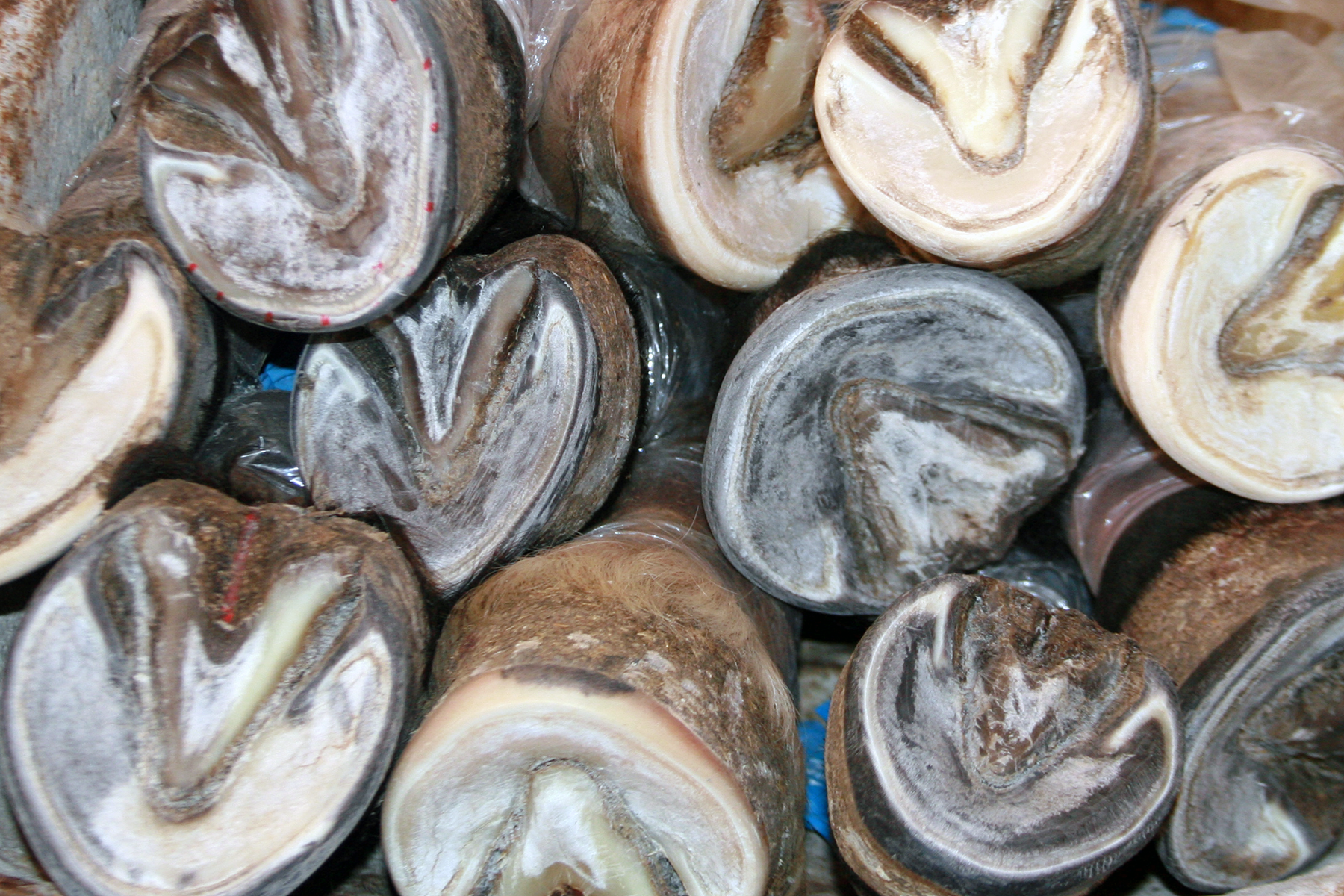
Cadaver hooves trimmed by students

As I’ve acknowledged before, one of the best things about my life has always been the opportunity to both teach and learn, and our recent Liberated Horsemanship clinic in La Llacuna, Spain was no exception. With people gathered from Spain, France, Austria, Russia, England, Scotland, and, of course, the United States, we all had a marvelous time seeing, hearing, and sharing with some top-notch presenters and students on a wide range of topics. But now that I’m back home, I need to mention an important update to my writing on a subject very near and dear to the hearts of most horse owners this time of year: laminitis.

Laminitis is a particularly serious and painful condition and is the number 2 killer of horses, so if you’re not particularly familiar with it, I’d recommend you first read my previous posts on the subject:

As some of you know, last year I released an iPhone app to help horse owners assess the risk of their horses developing laminitis based on the work of Dr. Don Walsh, Director of the Animal Health Foundation and the veterinarian who authored a paper entitled Field Treatment and Management of Endocrinopathic Laminitis in Horses and Ponies. Shortly after the app was released, however, Don called to tell me he was very excited about the app but had noticed it was using the average caloric content values for grass given in his paper as if they were dry weight values, and not the grass-plus-moisture-content values I had assumed when I wrote the iPhone app as well as both the free Laminitis Risk Calculator spreadsheet and the Is Your Horse Eating Too Much? charts found under Tools in the sidebar. That meant that all 3 items were overestimating the number of grass calories your horse is consuming by a considerable amount!

And so, after consulting with a couple of my nutritionist colleagues at the university, plus some very helpful advice from Paul Sirois of Dairy One/Equi-Analytical, I revised all of them to use a “wet weight” equivalent of 20% of the dry weight grass calories. Arguably, it may be even smaller than that, but the experts feel it’s a defensible number that errs, if at all, on the conservative side. In other words, it’s a value that represents the “worst-case” situation for your horse. So the prediction of whether or not your horse is at high risk for suffering an episode of laminitis would almost certainly err on the side of caution, telling you your horse is at risk when he’s really not, rather than tell you he’s not when he really is! But after I rewrote the app code, I then spent a frustrating year trying to get the company who compiles my code for the Mac (I’m a PC guy) and actually posts it to the App Store to get the app updated. It’s now finally happened, so if you’ve purchased the app you’ll see an Update appear in the App Store. And if you’ve downloaded either the MS Excel spreadsheet or the graph, please download them again. You can watch the video about the LRC app by clicking on the image below –

Laminitis Risk Calculator Video

I’ll also mention again that this app is a great help in quickly calculating the amount of calories a horse requires to maintain body weight for a particular work load, which makes it very easy to see how changes in feed, hay, and amount of pasture time affect his caloric intake. It makes planning and adjusting every horse’s diet a straightforward task, not just the ones where there are possible laminitis concerns. And if you don’t have an iPhone, you can still take advantage of the same information for free with either the Laminitis Risk Calculator for MS Excel or the caloric intake and requirement charts in Is Your Horse Eating Too Much?

I sincerely hope you’ll consider using one of these tools to help manage your horses’ diet and reduce his risk of suffering from the terrible pain of laminitis. Back to my The Myth of the Heel-First Landing series soon…