The Ohio State University ATI Campus

I’m very excited to announce that Liberated Horsemanship will be returning to our campus June 6th-10th for another Gateway Clinic! With an ever-increasing global interest in so-called “natural” hoof care on the part of both horse owners and hoof care providers, this clinic offers an unparalleled opportunity to learn proper hoof trimming theory and technique from industry-recognized experts.

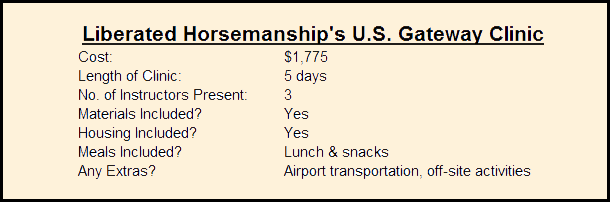
Why would you choose this particular training program over any of the others out there? Well, rather than point out what’s wrong with other hoof trimming training opportunities (which, to some extent, I’ve at least alluded to in previous articles), let’s take a look at some of the specifics of this clinic –

Liberated Horsemanship Clinic Information

While all of these factors undoubtedly figure into a person’s decision to choose a particular program, the most important issue in my mind has nothing directly to do with any of them. The deciding factor for me is the material being taught!

Unlike most, if not all, other training programs out there, Liberated Horsemanship’s teaching is absolutely consistent with the lessons learned about the determining factors of hoof form from the feral horses through the early efforts of natural hoof care pioneer Jaime Jackson; in other words, true natural hoof care. As such, this training program will equip the student to trim every hoof form successfully, regardless of size, breed, use, or pathology present.

The organization itself is unlike any other as well. Here are some statistics about just a few of its distinguishing characteristics –

Current number of program faculty:

Thirty (30)

Existing areas of specialization and research among the faculty:

Agronomy, architecture, biomechanics, booting, dentistry, endocrinology, engineering, ethology, hoof care, hoof pathology, laminitis, nutrition, parasitology, physiotherapy, veterinary medicine

Types and levels of certification currently offered:

Certified Hoof Care Practitioner, Certified Booting Specialist, Master Hoof Care Professional

Current instruction delivery methods:

Clinics, workshops, field instruction

For many people, two of the greatest benefits of this training program are the ongoing option of re-attending any previously-taken clinic or workshop at no additional cost (as many times as you want!), and the availability of the faculty as a support network. Quite a few of our students avail themselves of both of these; it’s fairly common to have students retake clinics 2 or 3 times, and receiving emailed or texted photos of unusual or problematic hooves along with questions is also a regular occurrence. And with such a diverse faculty, getting answers from recognized experts on difficult questions of not only hoof care, but on practically any equine-related issue, is relatively easy!

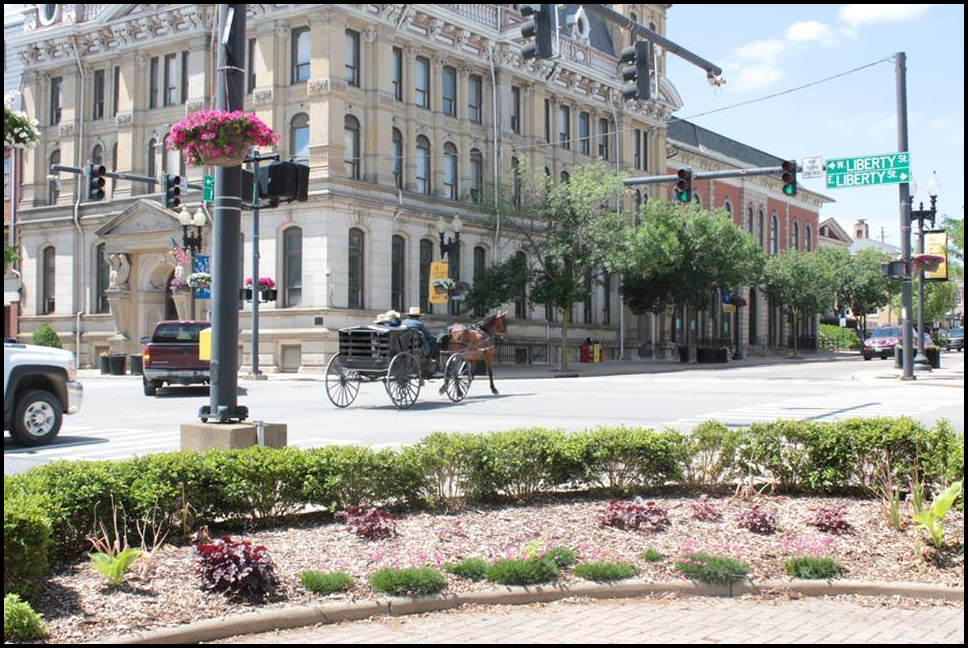
The learning environment for this clinic is also extremely pleasant. The agricultural branch of The Ohio State University, where the clinic is being held, is located in the small city of Wooster, Ohio, with a number of easily-accessible shops and restaurants on the edge of the largest settlement of Amish in the United States. Horse-drawn buggies and picturesque farms abound, and we’ll make at least one visit into Amish country to a very large farrier supply shop.

Downtown Wooster

As part of the clinic offering, there will also be a free, open-to-the-public event on Friday evening, June 10th featuring both Liberated Horsemanship and university faculty. Dr. Jessica Bedore will discuss the feeding issues associated with many older horses who have trouble maintaining body weight and condition. Master Hoof Care Professional Ann Corso will talk about hoof quality and its relationship to a horse’s overall health and happiness, and Dr. Bruce Nock will explain why obesity and insulin resistance – increasingly-common problems in our equine population – are not simply a matter of overfeeding. This promises to be an entertaining and informative evening, so regardless of whether or not you attend the entire clinic, please consider joining us for this special Friday night event!

Why Liberated Horsemanship YouTube Video

I strongly believe in this training program, and not just because I’m one of the faculty! As I explain in the brief YouTube video above, I truly believe this program offers unrivaled learning opportunities for everyone: prospective hoof care professionals, existing hoof care providers, and horse owners who wish to further their knowledge of proper horse management methods. Will you leave any clinic an “expert?” Of course not. But I guarantee you’ll walk away from this one with a whole lot more knowledge about horses and their hooves than you came in with, along with new friends beside you and an entire support network behind you.

Won’t you consider joining us?

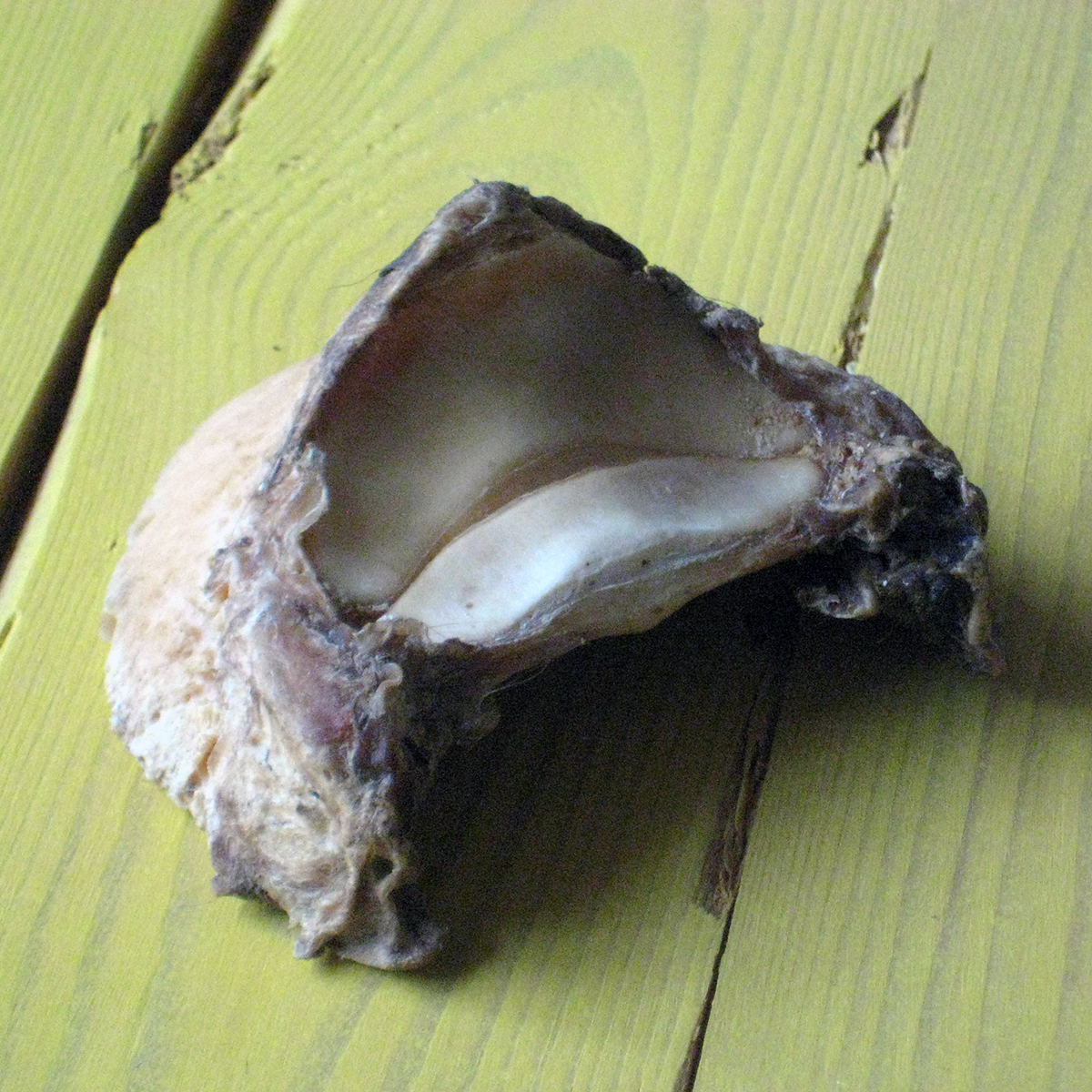
Photo of Coffin Bone with Navicular Bone

It’s a relatively small bone – about the size of a human thumb in the average horse. It bears no direct weight, doesn’t join any other bones together, and is rarely broken. And yet, it’s the alleged culprit in many, many cases of equine lameness. Without a doubt, no part of the equine hoof is as misunderstood, yet subject to incrimination for every bad step a horse takes, as the navicular bone. To quote Dr. James Rooney, the renowned equine pathologist –

Despite thousands, or perhaps millions, of words, navicular disease remains a subject of confusion and error.

There’s been a “method to my madness” in my past three articles (plus The Hoof Landings Tower of Babel, which wasn’t part of the original plan!) entitled The Myth of the Heel-First Landing. In addition to addressing the commonly-held misconception that horses are “designed” to land heel-first, the material was presented to help prepare the reader for coming to terms with the information I’ll be presenting on navicular disease. In this series of three articles, I’m going to attempt to shed some light on the navicular bone and hopefully allay some of the fears the horse owner experiences when he or she hears a diagnosis of “navicular” by the veterinarian. This particular installment will concentrate on an explanation of the role of the navicular bone in support and locomotion, and discuss how and why damage can occur. Part 2 will describe how navicular disease is diagnosed (and misdiagnosed), and the final article will focus on how to treat and/or manage the “navicular” horse.

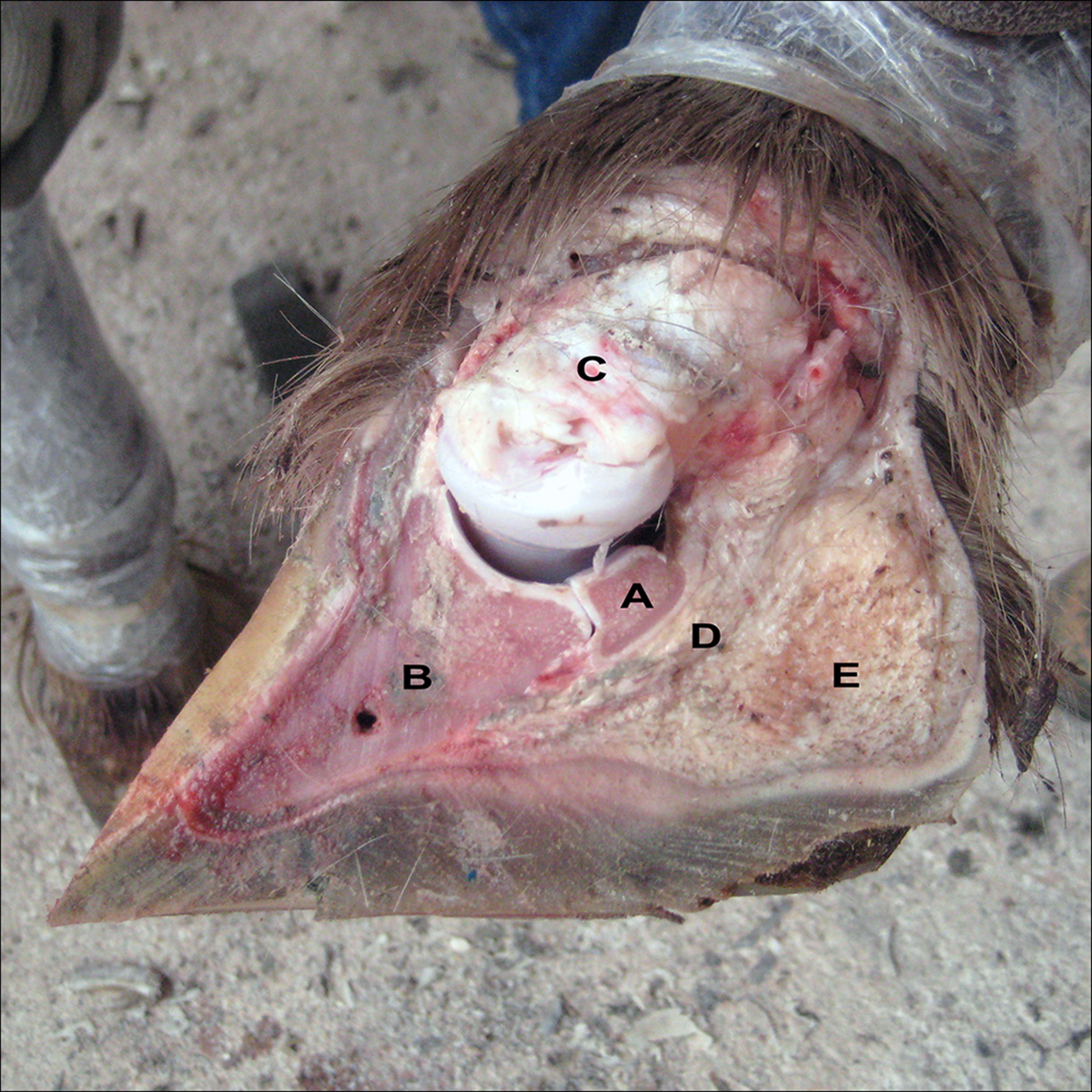
photo of cutaway hoof

As you can see in the photo at the beginning of this column, and in the above photo of a cutaway cadaver hoof, the navicular bone (A) lies right behind the coffin (pedal) bone (B) and forms part of the coffin joint along with the short pastern (C). You’ll also note the band of grey-white tissue running down the back/bottom surfaces of the bone that connects into the bottom center of the coffin bone. This is the deep digital flexor tendon (D), often abbreviated “DDFT” or simply “DFT,” which is responsible for both helping to stabilize the foot and flexing the foot towards the back of the horse. It also forms part of the “stay apparatus” of the horse – the horse’s suspension. Beneath the DFT is the largest structure in the foot – the fatty-fibrous mass of the digital cushion (E).

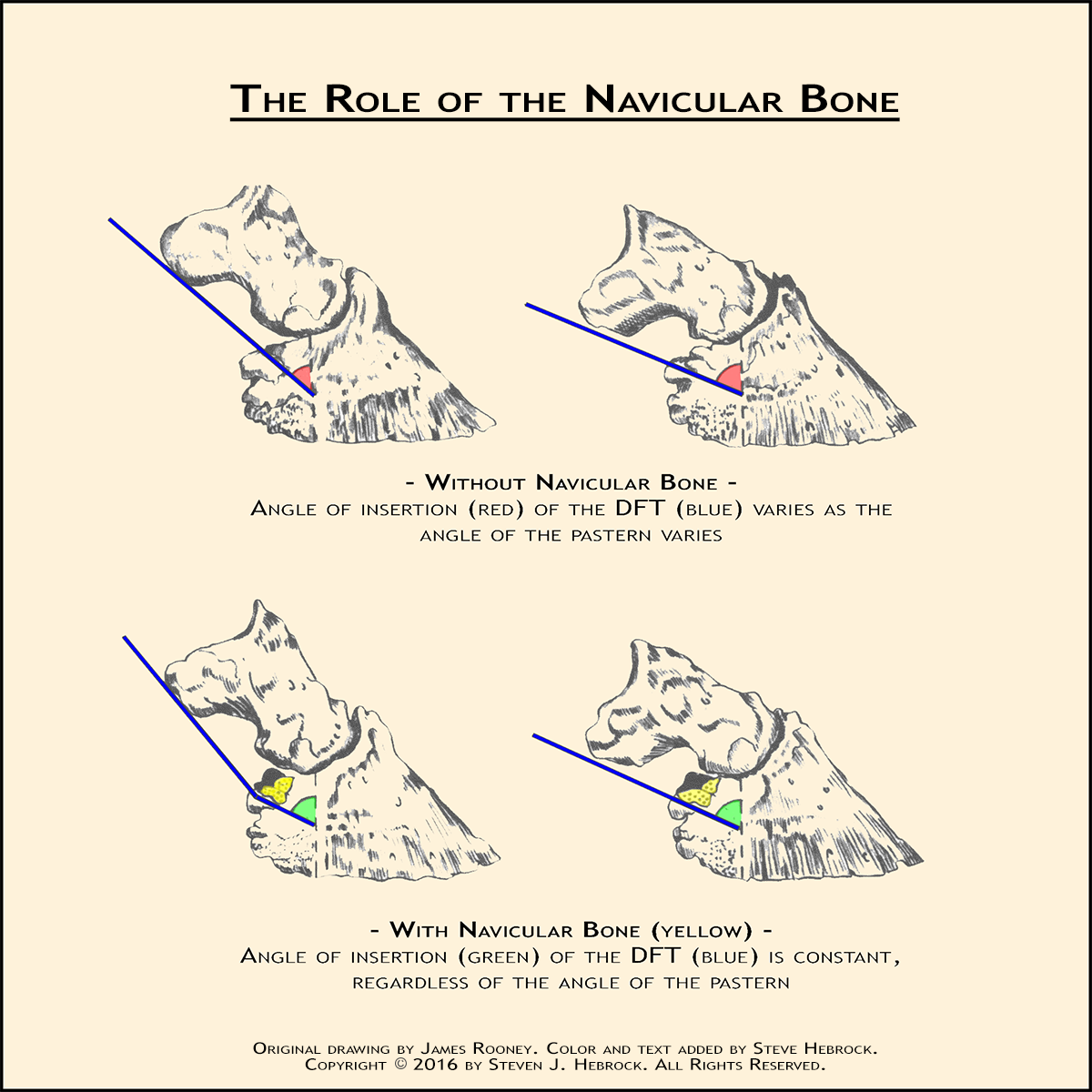
The navicular bone is one of three sesamoid bones found in the equine limb – the other two being the pair of small bones at the rear of the fetlock known as the proximal sesamoid bones. The purpose of a sesamoid bone is not to bear weight, but instead to change the direction of the pulling force being applied to a tendon. In this instance, the distal sesamoid bone, or navicular bone, ensures that the pulling force on the bottom of the coffin bone is always from the same direction, regardless of the angle of the pastern bones. Check out the following illustration –

The Role of the Navicular Bone

As you can see, without the navicular bone in place, the direction (and therefore the effective magnitude) of force exerted by the DFT would be highly dependent on the orientation of the long and short pastern bones with respect to the coffin bone. But with the navicular bone acting as a “pulley” to redirect the motion of the DFT, the force on the coffin bone will not change direction when the leg changes position.

So now we have a pulley (the navicular bone) with a rope (the DFT) running across it. Next, consider what Dr. Rooney wrote in Biomechanics of Lameness in Horses about what happens in the foot when the horse lands correctly (i.e. “flat”) –

As the hoof impacts, palmar flexion (rotation) of the coffin joint begins from zero acceleration. If the ground is hard, it will not yield under the hoof impact (will not absorb energy of impact), and the hoof may bounce, hit the ground, bounce again, etc. This bouncing, of course, would not be grossly obvious, but would involve oscillation of the coffin joint by a few millimeters. If the hoof as well as the ground were inelastic, the effect would, of course, be exaggerated. Neither ground nor hoof could yield sufficiently to quickly convert kinetic to potential energy. The energy would remain kinetic, oscillating back and forth between hoof and ground.

For the record: how do I know he’s describing a flat landing in the preceding quotation? The answer is simple: because he states “rotation of the coffin joint begins from zero acceleration.” And the only way that’s possible is if the hoof is contacting the ground flat. So even with a proper landing, there is some amount of vibration (oscillation) of the hoof, relative to the hardness of the landing surface and the inelasticity of the hoof capsule.

In contrast with the equine hoof, there is a considerable body of research on the effects of oscillations on humans’ hands and arms, although there is some dispute over various researchers’ conclusions – largely because differences in the types, frequencies, and durations of exposure used in various studies make analysis difficult. But the symptoms of hand-arm vibration syndrome (HAVS) among people who use various types of vibrating powers tools include destructive joint changes as well as vascular, neural, and muscular problems. In fact, you may be interested to know that it’s considered a serious enough health risk that the limits for vibration exposure for human workers are specified by the International Organization for Standardization (in ISO standard 5349-1)!

In the horse, when the coffin joint oscillates, the deep digital flexor tendon is moving very rapidly and repeatedly across the surface of the navicular bone. Why does that matter? Because when one surface moves rapidly over another surface, the friction between the two generates heating of the surfaces. Think warming cold hands, or starting a fire, by rubbing two things together – same idea. The more rapid and/or more sustained the motion, the higher the resulting temperature. Conversely, with slower and/or less-sustained movement, things don’t get nearly as hot. So, terrain and footwear being equal, a horse that’s moving at low speeds is experiencing less DFT/navicular bone friction, and therefore less heating, than the horse who is moving at higher speeds.

The problem gets much, much worse for the horse who has been trimmed or shod to contact the ground heel- or toe-first. In addition to the lesser amounts of vibration described above, he also experiences very rapid and more prolonged acceleration of the coffin joint at the instant of ground contact, called third-order acceleration, when the hoof “slaps” down as it comes under load. And the more pronounced the heel- or toe-first landing, the more rapid the acceleration and the greater the consequent heating. and landing heel-first or toe-first. That’s pure mechanics: the DFT of the horse who’s landing heel- or toe-first will be sliding farther, longer, and faster across the navicular bone than in a horse who’s landing correctly (flat), even at slower speeds. This is what Dr. Rooney had to say about third-order acceleration resulting from non-zero coffin joint acceleration at the moment of hoof contact i.e. a heel-first or toe-first landing –

In case it has not been said often enough, sudden changes of acceleration cause third-order acceleration, which is vibration: increased friction, turbulence, cavitation, heating, etc. The general case…is that third-order acceleration occurs between the DF and the navicular bone. Vibration, which is third-order acceleration, causes tendon degeneration and navicular arthrosis. The third-order acceleration, in turn, will occur because the coffin joint does not begin rotational movement from zero acceleration.

Sound familiar? It bears a striking resemblance to what’s been well-documented in humans experiencing HAVS, doesn’t it?

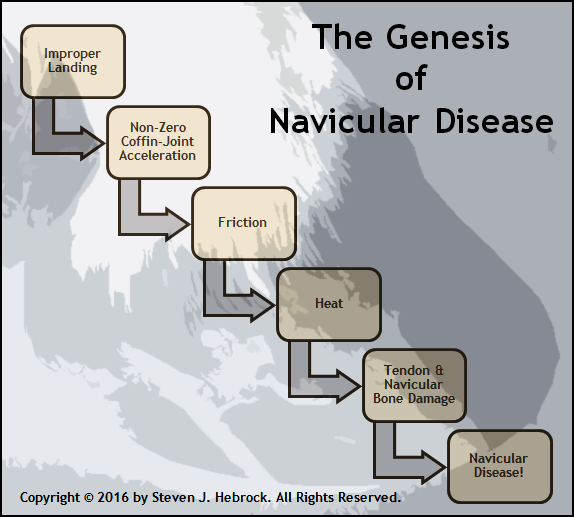
So in the simplest terms possible, folks, and in spite of what many people (including many veterinarians) believe, navicular disease is damage to the deep-digital flexor tendon and navicular bone caused by heat, which is caused by repeated heel-first or toe-first landings. In fact, Dr. Rooney, who spent a considerable amount of time researching this subject, reported that he was able to duplicate the physiology of navicular disease (bone and tendon damage) by using an external source of heat on cadaver limbs. Here, then, is an illustration of how and why navicular disease occurs –

The Genesis of Navicular Disease

This is also why feral horses don’t develop navicular disease. As I’ve explained in The Myth of the Heel-First Landing series, the feral horse’s hoof continuously wears itself such that, in general, the hoof (and therefore the coffin joint) does not experience rapid rotation as it makes contact with the ground i.e. it lands “flat.” And because the feral horse lands without the sudden “jerk” that occurs when many of our domestic horses make initial ground contact with the heels or toe and then “slap” the foot down as it comes under load (see the YouTube video accompanying The Hoof Landings Tower of Babel), the navicular bone in the feral horse doesn’t experience nearly as much rapid movement of the DFT across it with every step.

To summarize: whether or not a particular horse will develop navicular disease depends on not just one or two factors, but on a set of conditions that result in enough heating of the area of contact between DFT and navicular bone over a period of time to cause damage. It’s not a matter of any singular event causing the problem, but rather the cumulative effects of repeated “exposure” to vibration, similar to hearing loss or heavy-metal poisoning. All else being equal between horses, those factors include:

  • The degree of front-to-back imbalance in the hoof
    • The more pronounced the heel- or toe-first landing, the greater the distance the DFT travels across the navicular bone, resulting in higher/more-sustained temperatures.
  • The stiffness of the hoof
    • As the inelasticity of the unbalanced hoof increases, the less it can deform to mitigate the forces of impact, resulting in more vibration and consequent higher/more-sustained temperatures.
  • The hardness of the terrain upon which the horse moves
    • Like the stiffness of the hoof, the less the unbalanced hoof is able to penetrate the terrain at the instant of contact, the greater the vibration and resulting higher/more-sustained temperatures.
  • The speed at which the horse moves
    • The faster the horse is moving, the more frequent the coffin-joint rotation, and the greater the buildup of heat.
  • The duration of the horse’s movement
    • As with speed of movement, longer periods of movement of the unbalanced foot will result in higher/more-sustained temperatures.
  • The size of the navicular bone and deep-digital flexor tendon
    • The smaller the size of these structures, the less effectively they can dissipate heat buildup.

Looking at this list should make it apparent why “true” navicular disease (more on that subject later!) rarely occurs in horses that don’t either jump, or trot on paved roads. Those two activities, particularly when coupled with improper hoof care, experience the highest magnitude of (jumpers), and most prolonged (road horses), third-order acceleration of the coffin joint.

I also feel compelled to add that this explanation of the cause of navicular disease is by no means new. Dr. Rooney wrote The Biomechanics of Lameness in 1969! And while that particular book is admittedly quite technical and often difficult to read, both versions of his subsequent book The Lame Horse (1974 and 1998), which are intended more for the horse owner than the veterinarian, also describe this logical, evidence-based theory. Why, then, does there continue to be such a prevalent and profound misunderstanding of the cause of navicular disease among veterinarians, hoof care providers, and horse owners, with its consequent misdiagnoses and illogical “treatments” that cannot possibly succeed?

And that concludes Part 1 of this series! But after reading about the effects of vibration on humans (HAVS), I’m also very curious about whether or not some of the other consequences of vibration, like numbness, may occur in horses as well. Wouldn’t it be interesting to know if, over time, the unbalanced horse was actually losing sensation in his feet, and therefore allowing more damage to occur without his being aware of it?

One more thought to leave you with, which will undoubtedly be good news to many, but bad news for others –

In my experience, the overwhelming majority of horses diagnosed with navicular disease or navicular syndrome do not, in reality, have any issues with their navicular bone or deep-digital flexor tendon.

I’ll explain why I feel confident making that statement, as well as why so many horses are misdiagnosed, when I cover diagnosing navicular disease in the next article in this series.

Till next time…

Mary E. "Ginger" Hebrock
Mary E. “Ginger” Kuhn Hebrock 8/26/1934 – 9/14/2015

This Post has nothing directly to do with horses, so you may decide to ignore it. But, as I did for my father John Hebrock and for my best friend Gerald Bremseth, who both passed away in 2013, I must now do for my mother, who left this world on September 14th.

As I’ve often said about horse feet (ok, I did get horses in here!): it’s all about the balance. The same is true of nearly every aspect of life, and, in my life, my mother was in many respects the offsetting force that counterbalanced both my father’s strong drive towards perfection in everything he did, and his admitted lack of patience with anything and anyone that fell short of the mark.

Unfortunately, my father was also a very busy man, so projects around the house would often get started but not finished in any sort of a timely manner – simply because he didn’t have the time to do things exactly right, yet couldn’t bear to do things that weren’t perfect (I, too, suffer from this particular malady). My mother, on the other hand, was far more concerned with getting things done, whether they were perfect or not. A great example of this “difference in styles” could be seen in the main bathroom of the home I grew up in.

In 1962, my parents decided to purchase an unfinished house – the framing was completed, but nothing else – to finish themselves, which involved many, many trips to various lumberyards and supply houses with a trailer in tow. Because the bathroom was fairly narrow, my father spent a great deal of time and effort building a curved vanity with a matching cabinet door so one wouldn’t immediately walk into a sharp corner upon entering the bathroom. He spent hours on that cabinet, trying a wide assortment of construction techniques to achieve a door with an absolutely perfect arc. And the result was, indeed, perfect, and the rest of the bathroom came together quite nicely.

Except for the shelves and molding in the closet. Somehow, finishing them ended up a very low priority for my father, who had moved on to other projects once the rest of the bathroom was in hand. But not for my mother; she wanted the entire bathroom done, so although she’d frequently pester him about finishing, he never managed to return to it. So she finally took matters into her own hands, and cut the remaining pieces of lumber, nailed them up, and painted them. All blunt cuts, mind you – no miters! But it was done. And although my father was furious about her less-than-perfect work, that bathroom was still the same when the house was sold last year – 52 years later!

To be fair: she, too, was a perfectionist when it came to the things she was passionate about. Unlike his largely technical undertakings, my mother leaned heavily towards pursuits involving compassion for those in need. Trained as a registered nurse, she spent her life helping others: working in the pediatric ward of the local hospital, managing the needs of mentally and physically challenged children and adults in a county-run facility, caring for patients during ambulance transport, and other humanitarian efforts. It even extended to more “public” public service: she was the first female Village Trustee and Deputy Mayor of our small town in western NY.

And she had a great sense of humor! When we were kids, our grandmother (her mother) would often sew shirts as birthday or Christmas gifts for my brother and me, which we really enjoyed and appreciated. But shortly before one particular Christmas, my mother very solemnly sat us down to explain that our grandmother had also decided to give us bow ties with our new shirts, which my mother knew we intensely disliked. “Just pretend to be surprised and pleased,” she said. “You don’t want to hurt her feelings, after all.” Over the next days, we worried a lot about those bow ties and how we were going to manage to fool my grandmother into believing we were happy about them. And so, that Christmas morning, when our grandmother handed us the packages containing the shirts and bow ties, we both steeled ourselves to act pleased with the new additions to our wardrobe. And when we opened the boxes, we found our new shirts sporting bow ties…made out of $20 bills! They both had a terrific laugh over that!

But for many, one of her most memorable characteristics was her bright blue eyes, which often seemed to sparkle as if she were enjoying the most pleasant experience in the world that no one else was privy to. I remember seeing them shine many times in my younger days, especially when one of us accomplished something special like earning a good grade or playing an especially good concert. Indeed, her pride in her family and our achievements was always obvious, and shared with anyone who would listen.

Tragically, my mother was robbed of much of her vitality on a dark road one night in December of 1984, when my parents’ car struck the unlit trailer of a log truck a few miles from their home. Although both of them sustained multiple serious injuries in that crash, my mother suffered a head trauma that left her forever physically and emotionally impaired, and hastened the onset of dementia. A stroke in 2008 made things considerably worse, and necessitated her remaining in a nursing facility for the remainder of her life.

Still, she did what she could. Just a couple of years ago, one of the workers in the nursing home mentioned that my mother had been helping her study for her nursing exams, quizzing her on symptoms and treatments for cardiac disease. I wasn’t surprised by the news, because that was my mother – always helping others.

As anyone well-acquainted with my mother certainly knows, there’s a great deal more I could say about her. But this will have to suffice for now. Without a doubt, she touched the lives of many, many people in ways both acknowledged and unknown; as one of her caregivers of the last few years wrote to me, “I’ll miss your mother. She was a remarkable person.” And, along the way, my mother showed me over and over again that having compassion for others, and helping them to the best of one’s abilities, is an honorable and right and rewarding way to live.

I’m eternally grateful for what you so freely gave, mom. I will always miss you, but I’m glad you’ve finally found the peace you so richly deserve.

You were, indeed, a remarkable person…

The Lesson - Blank

I had to laugh. One of my clients was recently recounting the resistance she faced from other boarders after making the decision to pursue natural hoof care with me. “And I hope you’re not paying extra for that ‘mustang roll,'” one woman said. “Any farrier can do that!”

Her story ended up coinciding rather nicely with the theme of this particular article. My goal in writing has always been to correctly explain why hoof care based solely on the lessons provided by nature – in other words, “natural” hoof care – is, logically, the only possible approach to caring for every domestic equid’s feet. But a reader’s response to my recent Unnatural Practices article, reinforced by my client’s story, made me realize that my assumption everyone was grasping a very fundamental piece of the hoof care puzzle without my directly stating it was quite probably flawed. After all, you know what they say about assumptions! And that makes this article long overdue, for which I sincerely apologize.

The reader’s comment dealt with the relevance of Jaime Jackson’s observations of the feral mustangs of the U.S. Great Basin to the hooves of her domestic horses – specifically, how she failed to see any. And that’s a very important question that deserves an explanation. Why? Because the apparent differences between feral and domestic horses are often used by skeptics and critics, who really don’t understand how the two are connected, to dismiss the entire concept of natural hoof care outright. And because understanding the answer will also give you insight into a great many things about how our world works. So regardless of what you currently believe to be correct about hoof care, it’s in everyone’s best interest to thoroughly understand the answer to her question.

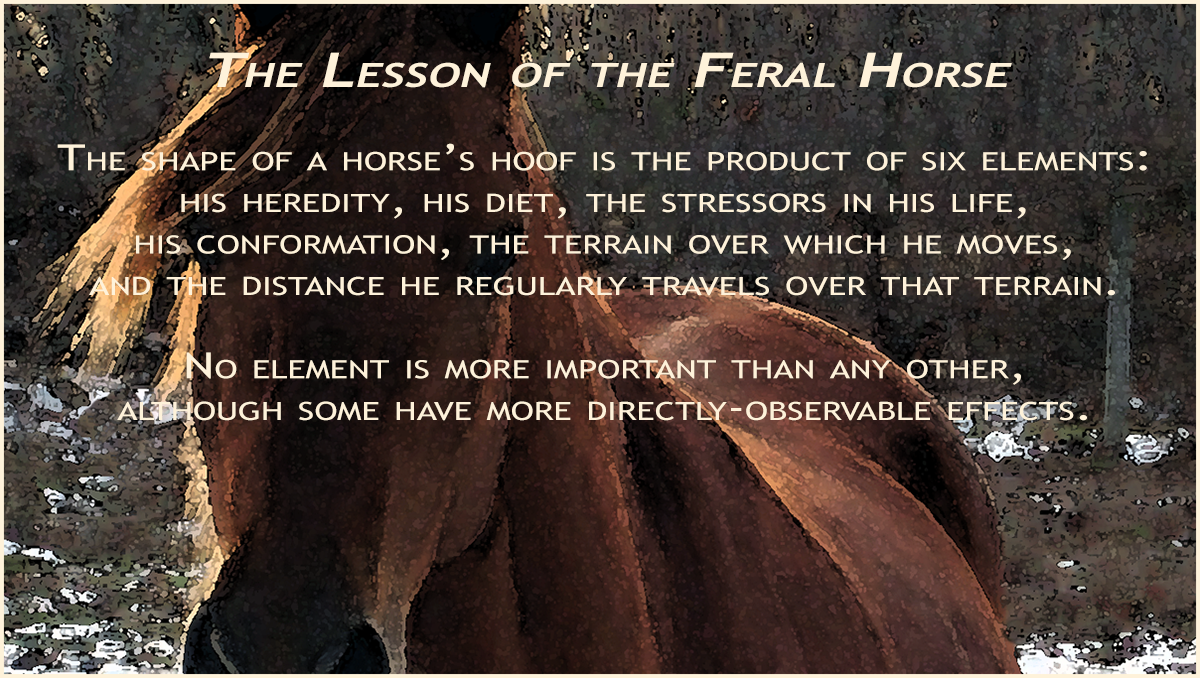
The Lesson - First

The answer turns out to be remarkably simple; in fact, it can be summed up quite accurately in a single word! But let’s first state the question in a reasonably-complete form –

Question: What do the hooves of the feral horses of the U.S. Great Basin – who live in an arid and abrasive environment; eat dry, bunch grasses and other indigenous plants; and aren’t ridden – have to do with the hooves of my domestic horses – who live in confinement in a much wetter environment; eat various types of hay and processed feeds; and are ridden or driven?

Answer: Everything.

“Ok, Steve,” you’re probably thinking. “Not very helpful. Way too Yoda-esque!” But give me a few minutes, and hopefully you’ll see why I responded as I did.

First, though, permit me to caution you: many of you are going to face genuine difficulties with my explanation because, as humans, we all have certain subjects – usually ones we’re very passionate about or otherwise heavily invested in – we’re unwilling or unable to be objective about because of education, experience, and/or peer pressure. We see and hear what we want and need to see and hear, and close our minds to other possibilities. Close our minds to the idea that we may, in fact, be mistaken. And that’s just human nature; we all view the world through our own set of “glasses.”

This seems to be very much the situation when it comes to challenging traditional points of view in the horse world. For example, when I first began teaching hoof care at the university, students would often ask questions like, “What does this type of horseshoe do?” And I’d answer with, “Well, it’s generally believed that it (fill in the blank), but studies have shown it has no real effect on that particular characteristic.” And then the student would be angry with me, because the data conflicted with his or her view of the world. So I’m well aware of the difficulties with asking people to see things from a new perspective. Nevertheless, I’m going to attempt a clear, thorough, and logical answer; I only ask that you, in turn, attempt to put aside any and all preconceived notions you may have about hooves. And also please remember that I’m trying to help, so don’t shoot the messenger! Here goes…

The traditional view of hoof care, as endorsed by nearly every veterinarian and farrier as well as a great many so-called “natural” hoof care providers, is one based not only on shapes and numbers, as I pointed out in Unnatural Practices, but also – and most significantly – one where hoof form is viewed as the means of causing proper movement. Many volumes have been written on this subject, filling page after page with trimming and shoeing methods that emphasize trimming to particular forms and dimensions for “making” horses move in particular ways or for “correcting” “deficiencies” in conformation and movement. Here are a few examples from The Horse – Second Edition, by J. Warren Evans –

In the base-narrow, toe-in fault in foreleg conformation, the foot breaks over and lands on the outside wall, and if the horse is unshod, the outside wall will be worn down. It is necessary to lower the inside wall to level the foot, and then several corrective measures can be used to force the foot to break over the center of the toe.

Horses with a base-wide, toe-out conformation tend to break over and land on the inside toe. The fault is corrected by modifying the shoe to make it difficult for the foot to break over the inside toe but easier to break over the center of the toe.

Cow-hocked horses tend to break over the inside toe and thus place a strain on the inside of the hock….The main objective in correcting the fault is to force the hind foot to break over the center of the toe by braking the inside of the hoof when it lands and rotating the toe inward.

Consequently, this ends up being the usual mindset of the horse owner as well: hoof care providers can and do “create” either good or bad movement by how the hoof is trimmed. So when “natural” hoof care came along, many people (naturally!) applied this same pattern of thinking to it, equating “natural” hoof care with the feral horse hooves’ physical characteristics such as the “mustang roll” or the toe angle. And, because of this type of thinking, they reasonably assumed feral hoof form would not be of benefit to, or perhaps even be harmful to, the desired movement of their domestic horses; hence, the comments of my reader and my client’s fellow boarder.

The problem is – and please listen carefully – the traditional understanding of hooves and hoof care is seriously flawed at its most fundamental level.

So now I’ve said it. And probably many of you can already feel the adrenaline rising as you prepare to argue the point. But please hear me out!

You see, contrary to what you’ve heard or read or thought, “The Lesson” of the feral mustangs is not about the way their hooves look. It’s not about the “mustang roll.” Or how much concavity they have. Or how short their hooves are. It isn’t about any of those things, or any other specific physical characteristic. And yet, it’s also about all of them.

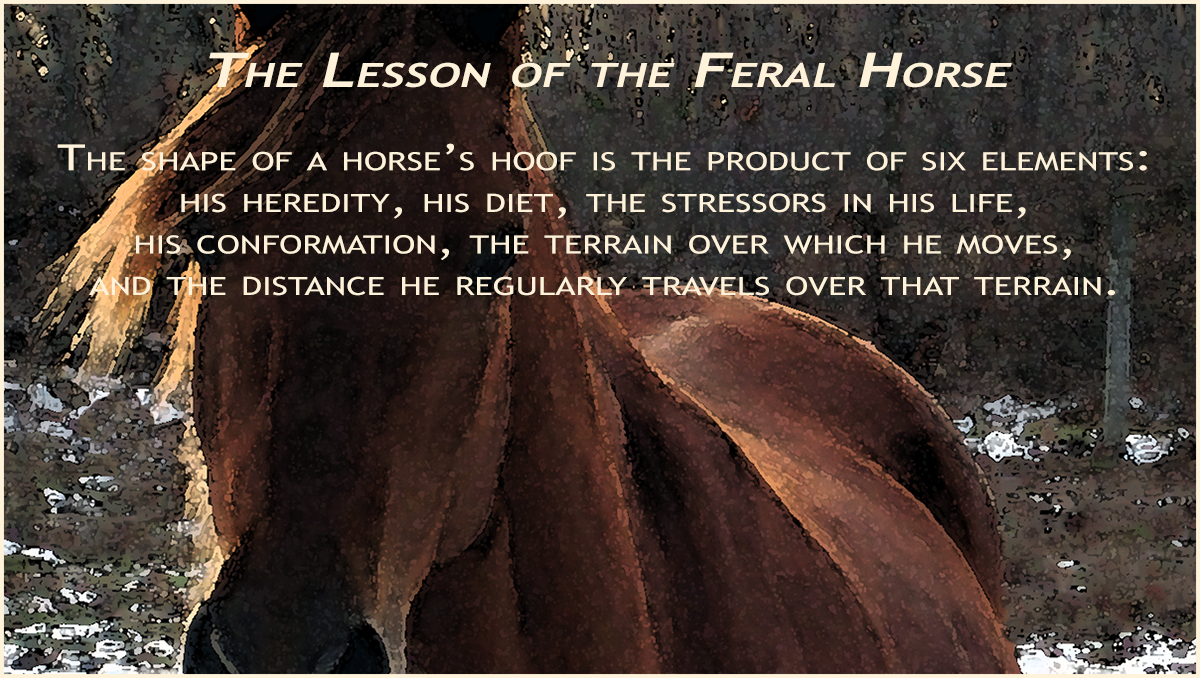
The Lesson - Second

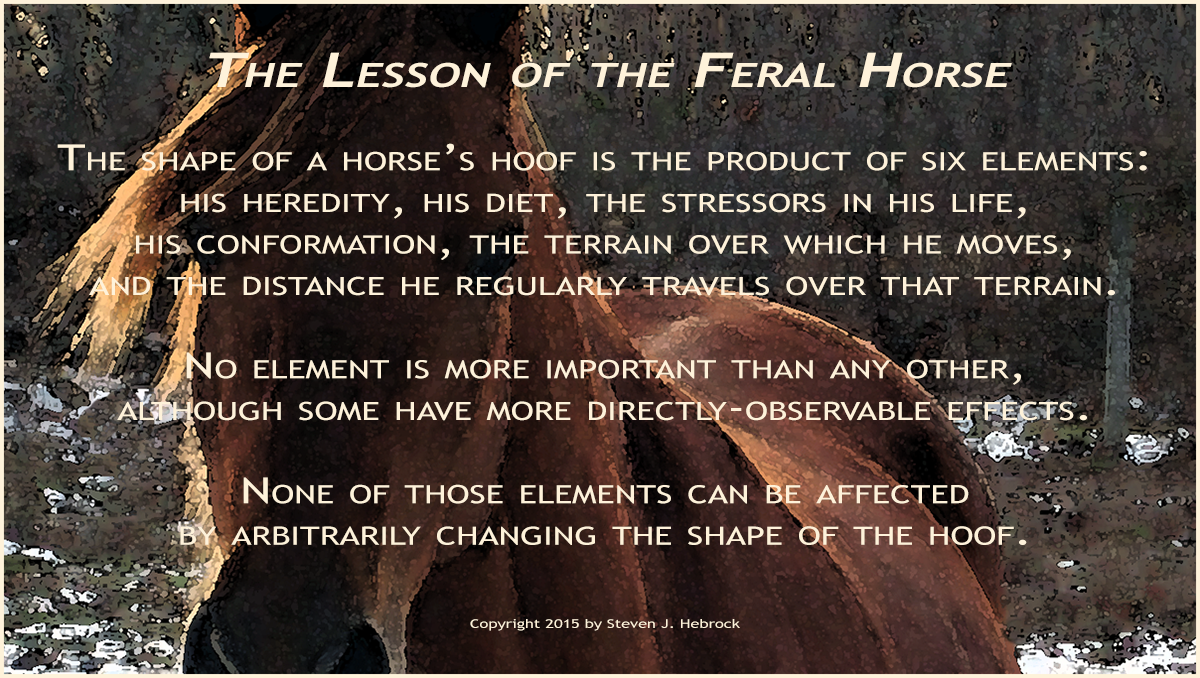
In reality, “The Lesson” of the mustangs we were given through the work of Jaime Jackson is about cause and effect. It’s about understanding that hoof form is merely the effect of several different things, including movement, but is never the cause of correct movement. When we see a group of feral horses, whose hooves have not been shaped by people, we’re seeing the pure product of genetics, diet, stress, conformation, environment, and movement. These factors work in concert to produce the ideal hoof form for that particular horse – without any assistance from us. Indeed, from the moment a foal is first conceived, these elements begin to shape the hoof into its best possible form. And when one or more of those elements changes, such as the horse begins to be ridden, the terrain becomes wetter, or the foal starts walking with the herd, the hoof form will reflect those changes as well. So it makes no difference whether it’s a feral mustang or a domestic grade horse, the forces that determine hoof form are exactly the same for every horse.

And once you come to terms with this list of elements as the only determining elements in hoof form, the next logical conclusion that follows from it is this:

Changing the hoof’s shape cannot possibly change any of the causes of the hoof’s shape.

Look at the list. How could I hope to significantly affect any of them through trimming? Shape doesn’t determine shape – that makes no sense! Does anyone seriously believe, for example, that putting a tire of a particular shape on a bent axle will straighten the axle?  And yet, we blindly buy into the notion that a horse’s conformation or genetics can be altered by changing the shape of his foot.

Why is that?

The Lesson - Third

I realize it’ll probably take a while for all of this to sink in, but the truth of proper hoof care is actually quite simple: we cannot – ever – improve upon a horse’s movement, and therefore his hoof form, beyond what he’s already capable of if he were left to his own devices under suitable circumstances. Period. People can only stand in the way of good movement by creating trimming or shoeing out of harmony with those six elements I mentioned, because those forces are absolutely relentless.

Consider the example of a horse with one front foot more upright than the other: assuming he’s been properly trimmed thus far (admittedly a big assumption), making his hoof angles match through trimming will not accomplish anything, because the forces that caused the more upright foot are still at work and cannot be mitigated through trimming. And so, with every step he takes, his body will be “fighting” the trim, making his movement worse, not better. Think of it like skipping rope: the rope can continue to turn normally only as long as the jumper is in harmony with its movement. But as soon as the two get out of sync – disaster!

The Lesson - Final

So that’s “The Lesson” of the feral mustangs. The “wild horse model” is not about a particular hoof form – it’s really about understanding the forces at work that result in every hoof form. And what they’re teaching us is that the traditional approach, as well as many so-called “natural” methods, espouse hoof care that’s “bass-ackwards,” as my mother used to say!

Proper hoof care, which can only be based on the laws of nature (physics and biomechanics, if you prefer), comes down to having a solid grasp of three things: 1) understanding hoof form cause and effect, 2) understanding what constitutes proper hoof form for a particular horse at a particular moment in the horse’s life, and 3) knowing how to allow that hoof form to emerge by trimming in a manner consistent with the six elements I’ve described. Any other approach can, at best, only impede proper movement and limit your horse’s potential, and, at worst, cause irreparable damage to joints and bones.

Does your hoof care provider understand?

Bell Hoof

The natural hoof is uniform in terms of its fundamental front and hind shapes throughout wild horse society, but it is also uniquely endowed with endless subtle variations in angle, size, and color that set the hooves of one horse off from those of the next.

– Jaime Jackson, The Natural Horse

Back in the “good ol’ days” of natural hoof care, all of us practicing this specialized and then-very-uncommon form of trimming had learned it from its originator: Jaime Jackson. He’d called his technique “natural” hoof care because it duplicated the trim Mother Nature imparted on the feral horses of the U.S. Great Basin, as documented in his book entitled The Natural Horse. And so, applying the term “natural” to Jaime’s hoof trimming process was perfectly logical because the results of his trim were hooves that very closely resembled those of the “wild” mustangs. And horse owners could safely assume the trim their horse received from any one of his certified hoof care providers would be very much the same as the trim they’d get from any other.

Unfortunately, those days of hearing the phrase “natural hoof care” used only for those techniques that yield hoof forms congruous with the forces of nature are clearly behind us. It appears that “natural” is now routinely employed by many to mean practically any trimming style that doesn’t involve horseshoes (and perhaps some that do!), regardless of the fact that most are anything but natural! These alternative trim techniques generally fall into two rather distinct categories: 1) those which use some sort of measurement- and/or template-based approach to trimming without regard for variations in individual hoof form, and 2) those which acknowledge each hoof as an individual, but deviate from natural hoof care practices in one or more aspects of their trimming. And although variations from proper trimming can be extremely problematic and harmful regardless of which group they fall into, this article will focus on the measurement-based techniques.

Whether it’s trimming to specific numbers for characteristics such as toe angle and length, a particular hoof shape, and/or a fixed set of hoof proportions, the mistaken notion that there’s some sort of “universal hoof form,” and therefore a “universal trimming truth” which can be successfully applied to any and all horses, is certainly far from new. For example, Dr. Deb Bennett writes the following about the very influential American “Professor” William Russell and his textbook called Scientific Horseshoeing (7th edition, 1903):

…we find that although there is a correct grasp of anatomy, there is no real concern with maintaining normal feet. There is a concern that masquerades as concern for the horse….Russell’s beautifully engraved plates memorialize engineering ideals, not biological realities. They show perfectly symmetrical hooves being measured with gauges – “proof positive” of the superiority of the scientific approach advocated by the author.

She goes on to add:

Constant observation opens the eyes [of farriers firmly grounded in the biology of the horse] to individual variation and compels them to respond to individual needs, rather than following…a set, “standard,” or mechanical program of trimming and shoeing learned by rote and applied “by the numbers” irrespective of the needs of the individual horse. (“Principles of Equine Orthopedics”, 2003)

So even in 2003, when hoof care providers who specialized in barefoot horses were relatively rare, Dr. Bennett was expressing serious concerns about the increasing popularity of trimming and shoeing methods based on numbers or ideals rather than “the biology of the horse.” Many of those “by the numbers” methods she eschewed have their origins in the work of farriers Dave Duckett and Gene Ovnicek from the latter part of the last century. They (and others) attempted to correlate points on the bottom of the foot with the location and orientation of the foot’s internal structures. Once these points were properly identified, they could allegedly then be used to determine “proper” hoof proportions, toe length, and breakover point by creating a sort of “map” of the bottom of the foot. However, the relationship between internal and external was apparently (but not surprisingly) tenuous, since descriptions of how to locate these reference points often contained lots of words like “usually,” “approximately,” and “typically!”

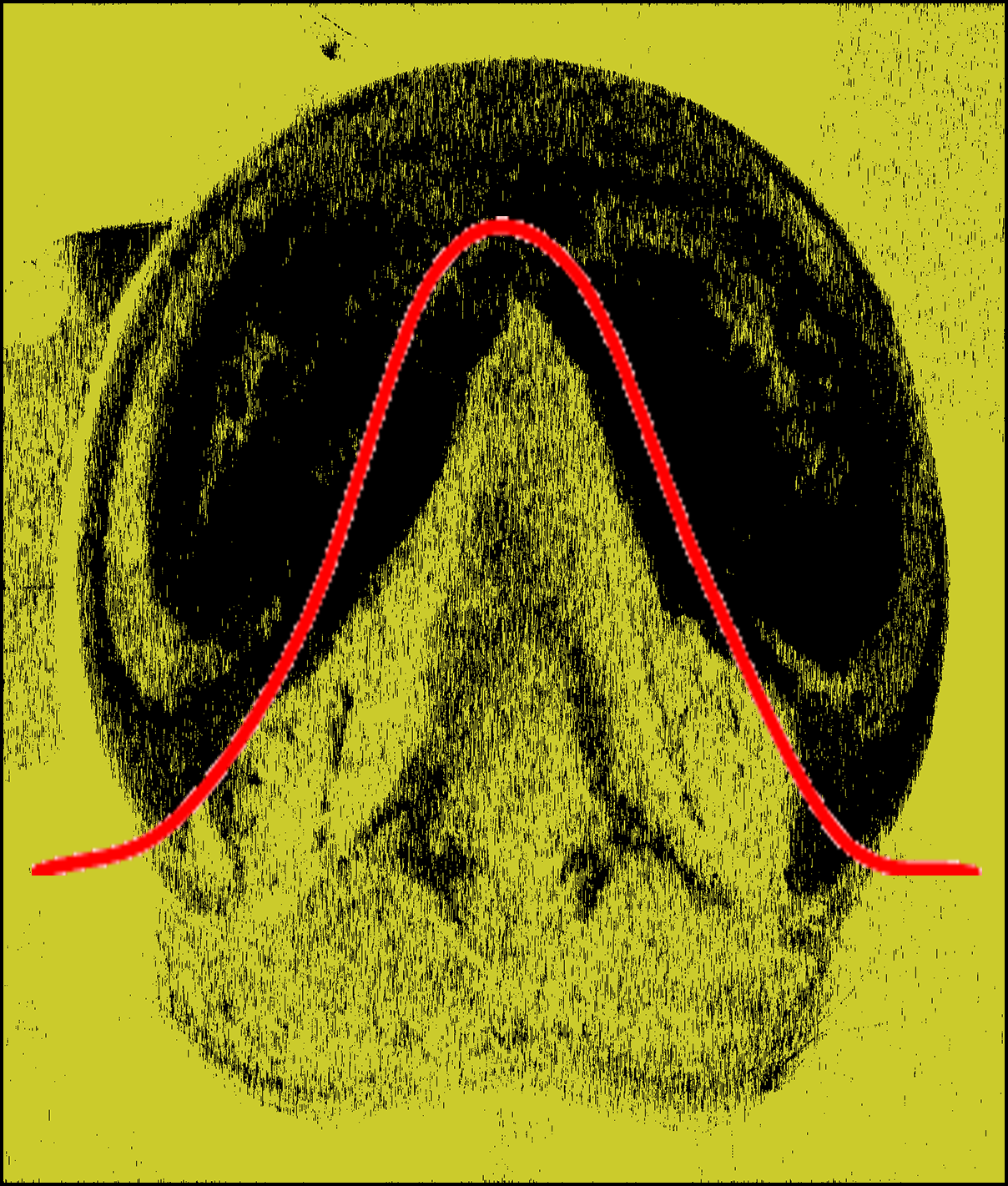
There’s a simple, logical reason for that: as any scientist or engineer will tell you, no physical characteristic, or set of characteristics, can be described as absolutes. You can only talk about how close to, or distant from, a given size or shape is from “typical.” Measurements of any particular physical characteristic found in nature can be found to follow a curve of normal distribution – a “bell curve” – such as the one superimposed over the hoof shown at the beginning of this article. As an example, let’s look at a summary of Jaime Jackson’s hoof measurements of over 100 feral horses from the U.S. Bureau of Land Management’s Litchfield, CA holding facility –
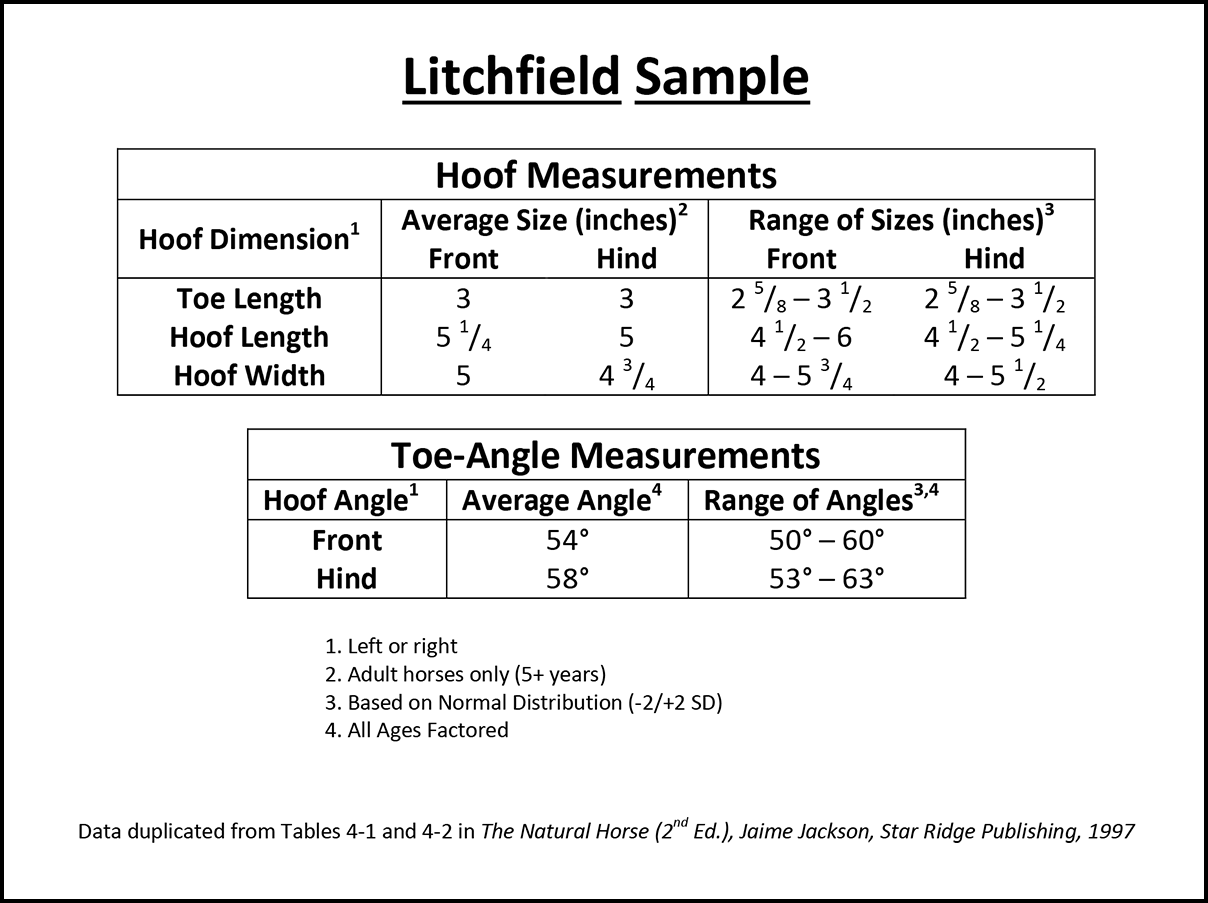
An examination of this data gives us some useful insight into the difficulties with “template trimming,” starting with the fact that, considering the large number of horse breeds and the often substantial differences between them, 100 or so measurements on a group of feral mustangs is not very likely to be representative of the entire range of hoof sizes and shapes to be found among equines as a species. After all, one typically sees far more variation in animal size and conformation in most boarding barns than in a group of mustangs.

And yet, even given the homogeneity of the sample group, the data in fact shows a surprising amount of variation in hoof measurements! Although it may not be obvious unless you have a working knowledge of statistics, footnote #3 above tells us that approximately 95% of the horses measured fall into the specified ranges. So, for example, the probability that the toe angle of a front hoof – one of the characteristics many “by the numbers” advocates hold to be a constant – will be any particular value can also be more fully described like this –

  • <1% of horses will be less than 48°
  •   2% of horses will be between 48° and 49°
  • 13% of horses will be between 50° and 51°
  • 34% of horses will be between 52° and 54°
  • 34% of horses will be between 55° and 56°
  • 13% of horses will be between 57° and 59°
  •   2% of horses will be between 60° and 62°
  • <1% of horses will be greater than 62°

Quite a range of possibilities, especially given how many people think front hooves should all have the same toe angle! So if your trimmer believes that all front hooves should be, say, 53° but your horse’s actual angle should be 59° – of which there is greater than a 1-in-10 chance of being true – your horse is going to have a pronounced toe-first landing. He’ll therefore not only not be performing at his best, but he’ll also be causing joint damage that will affect his long-term comfort and soundness. And I really need to point out that he has a greater than 66% chance of a toe angle other than the 53° your trimmer thinks he should have. The same concepts hold true for the other measurements as well. And that’s why number- and shape-based techniques ultimately cannot be successful.

And yet, the use of “number-based” and “shape-based” trimming is on the rise, especially among barefoot advocates who also try to sell these as “natural” methods. But if you carefully observe the results of these trim styles, you’ll fairly quickly be able to spot the problems. Two of my favorite examples…

A client asked me to give her my opinion of a YouTube video which showed a woman demonstrating her trimming technique. She carefully measured and drew a series of lines on the bottom of a pony’s hoof, explaining how this “mapping” process determined exactly where to trim the hoof. After a few lines, it became obvious that she couldn’t possibly safely cut the hoof at the places indicated by this method. Nevertheless, she went on to explain that although her method wasn’t going to work on this hoof, it was still the “correct” way to trim hooves.

If a “method” doesn’t work on 100% of hooves, it’s obviously not a viable method.

A clinic participant, who was a “by-the-numbers” trimmer, showed me before and after video of a client horse that was landing acceptably before it was trimmed, but was landing decidedly heel-first after she “correctly” trimmed it. Another example of “method breakdown;” if the horse isn’t landing properly when you’re done, then you didn’t trim it correctly – period.

If the results of a “method” don’t conform to what nature would do, it’s obviously not a natural method.

So why the popularity, particularly when these techniques are so clearly in violation of the evidence provided by nature? A complete answer to that question would probably require an entire book, but I think it comes down to two primary reasons: convenience and fame.

To truly learn something well takes time and (usually) money. Learning is often not easy, and learning to properly trim hooves is no exception. In fact, Dr. Bennett states the following as essential skills for a trimmer or horseshoer in “Principles of Equine Orthopedics”:

  • Training in physical assessment
  • Knowledge of the physiology of body tissues
  • A concept of what is normal in stance
  • Prepared to relate the principles of physics or biomechanics to his work
  • Taught how to develop a long-term treatment plan

This is quite a list, and the prospect of acquiring such an extensive skill set to “just” trim horse hooves would definitely put many people off. After all, you’re talking about a very serious temporal and financial commitment, and the list doesn’t even include the other necessary skills such as tool use and horse handling! It’s so daunting, in fact, that Dr. Bennett believes the overwhelming majority of hoof care providers lack the necessary skills to properly care for horse feet. I won’t repeat the lengthy quotation here, but check out her assessment of providers’ abilities in A Matter of Conscience.

But imagine if, instead, you could just attend a day or two of clinics to learn how to apply a “formula” to trimming that could be used for every horse. Or watch a couple of videos. Wouldn’t that be a whole lot easier and cheaper? And a lot more appealing as well, because people really take comfort in well-defined, step-by-step processes. Kind of like paint-by-numbers rather than art school. But will it still be a masterpiece?
And, human nature seems to be such that many people have a strong desire to be recognized for making some sort of “contribution.” There’s certainly nothing wrong with that. So they change one or more aspects of the natural trim, experience some amount of success with it, and all of a sudden it’s a “new” trimming technique!

Why, you may ask, would they experience successes if their methods are incorrect? For two reasons. First of all, it’s imperative to understand (as I’ve pointed out a number of times in earlier articles) that the vast majority of horses are relatively insensitive to how they’re trimmed in the short term. Will these alternative trims affect their performance? Almost certainly, but if you’ve never felt the performance possible when a horse is correctly trimmed, how would you know? Will it make them lame? Probably not today, but it will affect their long-term comfort and soundness. For most horse owners, though, if their horse isn’t outright lame, they’re content to believe the horse is correctly trimmed. And second, it’s once again a matter of probability: statistically speaking, nearly any trim variation will be correct for some number of horses.

When all of this is considered, it’s easy to understand how and why these techniques continue to surface and gain in popularity. But please remember:

  • By definition, they are not “natural” trimming and should not be promoted as such.
  • Statistically speaking, most of them will work on some horses, but they will not work on all horses.
  • By design, they disregard the uniqueness of each hoof and the causal relationship between conformation & movement and hoof form, instead promoting the incorrect notion that trimming to a specific form or set of measurements will cause proper movement instead of recognizing that hoof form is the consequence of proper movement.

Genuine natural hoof care optimizes hoof function for every hoof as an individual by optimizing hoof form in accordance with the principles demonstrated to us by nature. This can be accomplished only through a solid working knowledge of what constitutes biological normality for the horse, the hoof, and the tissues of the hoof; and the relationship between conformation, movement, and hoof form.

And so, if you’re using a hoof care provider who claims to be practicing “natural” hoof care, please do yourself and your horse a favor and check to make certain he or she is really following the principles nature has repeatedly demonstrated to be correct, and not just reaching for the protractor or the template.

And if you’re a hoof care provider who’s reaching for the protractor or the template, but telling your client you’re providing “natural” hoof care, then shame on you…because you’re not!