I love numbers! More correctly, I suppose, I should say that I love the fact we can always learn something useful from numbers because they can be relied upon to tell the truth if we let them. But when things don’t make sense – when the numbers don’t “add up” – it’s time to start asking why!

This all began when recent events prompted me to revisit a topic I touched upon several years ago in The (High?) Cost of Hoof Care: the huge disparity between what farriers charge to shoe a horse, and what farriers (and, consequently, horse owners) perceive to be the value of a properly-done trim. Part of the impetus comes from a client in the process of opening a small full-service horse retirement facility who wanted to offer her boarders another hoof-care option; problem was, the farrier she contacted wouldn’t come out just to trim a single horse! So I decided to do a little investigating into pricing strategies, looking first at data for shoeing versus trimming costs.

According to a survey conducted by The American Farriers Journal of its readers last year, the average nationwide price for trimming four hooves and applying four keg (machine-made) shoes by a full-time farrier was $131.46, while, interestingly, the same work performed by a part-time farrier averaged $94.49. Trimming and resetting those same shoes by a full-time farrier averaged $125.52. To trim a horse, full-time farriers charged an average of $43.13, while part-timers averaged $37.22.

A couple of things to keep in mind about the people who subscribe to The American Farriers Journal i.e. participated in this survey:

  • They’re farriers, not hoof trimmers. I often read this journal in the university’s library – mostly between 1997 and 2014 – but stopped reading it due in large part to the obvious disdain for so-called “barefoot” hoof care and its providers that permeates the magazine’s articles and letters.
  • About 70% of full-time farriers went to a farrier school, for an average of 12 weeks, according to this same survey.

I also found the following results of an earlier survey conducted by the same journal, along with one farrier’s explanation of how he prices his work. Note that the article was published in 2015, but the survey results shown on this graphic from the article are for their 2014 survey –
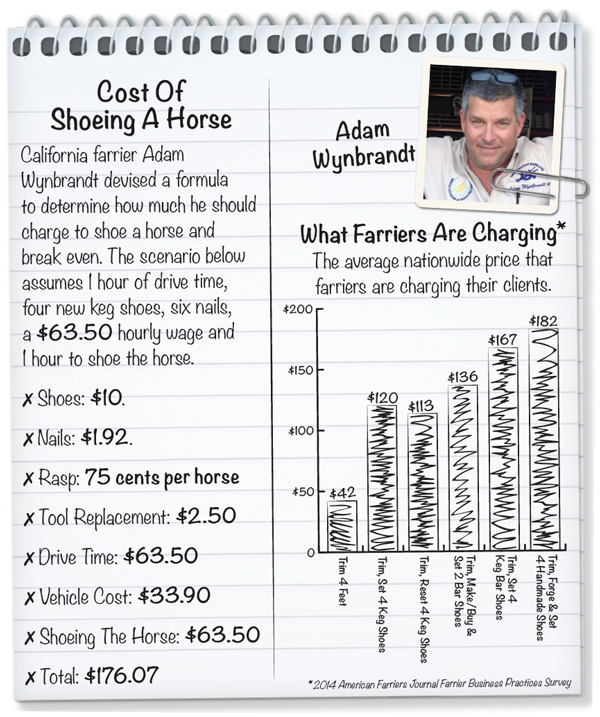
– from Costa, J. “Pricing for Success.” American Farriers Journal. 11/30/2015

Armed with Mr. Wynbrandt’s formula and numbers, and the 2015 average nationwide shoeing price of $120.19, we should then be able to calculate the 2015 national average cost of trimming a horse. But first let’s find the national average hourly wage for shoeing –
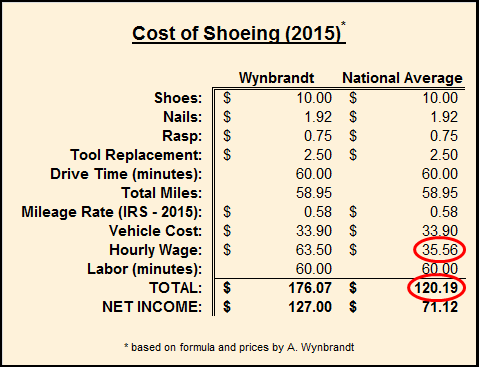
So to obtain the national average, we have to reduce the Hourly Wage to $35.56 per hour. Note that nothing else has changed, because everything else on the list is essentially independent of location.

Armed with our new national average Hourly Wage, we can now calculate the cost of a trim, but first we need an idea of just how long the typical farrier spends trimming a horse. Although I have no hard statistics on that, I’ve often had new clients remark that their previous hoof care person already had the horse completely trimmed in the five minutes or so I spend on each foot! In fact, years ago I asked an experienced farrier how long she takes to trim a horse, and, interestingly, she replied “Five minutes!” And so I’ve used five minutes as the average time it takes for a farrier to trim a horse, which admittedly may be a bit short, but I’ll talk more about that later. So here’s our new average trim cost –

A couple of explanations are in order:

  • I’ve left the Rasp and Tool Replacement amounts the same, although one might argue that the tools required for trimming-only are fewer than those needed for shoeing. However, the tools that wear and need to be regularly replaced – the hoof knife and nippers – are the same for both situations.
  • I’ve calculated the Total Miles by dividing the Vehicle Cost by the 2015 IRS mileage allowance of $.575/mile.

As you can see, even with a severely-reduced labor time, the calculated average cost of a trim still comes out to over $75; yet, according to the survey, the national average that year was only $42.06! Let’s see what we’d have to do to make our trim cost total that number, still pretending that it’s possible to properly trim a horse in only five minutes –
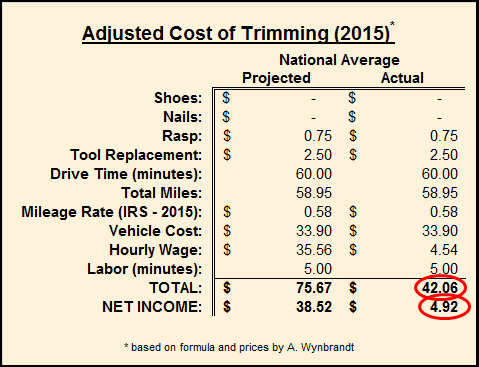
Wait! So in the above scenario, collecting the national average cost of $42.06 for trimming a horse entails driving for an hour and wrestling with a horse for 5 minutes (ha!), but, ultimately, pocketing only $4.92? I’d do far better at MacDonald’s, and (probably) wouldn’t even have to risk my life! That would explain why farriers don’t want to drive to a barn to trim a single horse, but what it doesn’t explain is why farriers themselves believe that (only) trimming a horse is so much less valuable and/or important than trimming and shoeing. After all, the cost differences come down to shoes, nails, and the time required for the actual work, with the “hardware” costs representing a rather small portion of the total picture (contrary to what many horse owners are led to believe, by the way!). So why the huge disparity; why not charge the $75.67 common sense and their own formula prescribe?

One possible answer may be hinted at by an examination of the course of study undertaken during that 12 weeks of farrier school by some 70% of full-time farriers: At what many consider to be the best farrier school in the U.S., anatomy, conformation, and biomechanics appear to comprise only about 3% of the total course content of their Advanced Horseshoeing and Blacksmithing program, with no study of trimming apart from shoeing even mentioned on their web page. And yet, I daresay not a single instructor at this or any other horseshoeing school would argue that the best handmade shoe in the world could possibly make a correctly-balanced hoof when placed on top of an unbalanced trim!

As an interesting contrast, I know that in the Liberated Horsemanship hoof trimming training program, for example, the introductory clinic alone consists of approximately 40 hours of trimming theory along with directly-related topics such as biomechanics and nutrition, and practice. From there, students go on to study individually with field instructors for another minimum of 24 hours, and then typically spend another year or more trimming their own client horses to gain experience before final assessment for certification. When it comes to understanding the hows and whys of proper trimming, that’s a pretty marked difference in education and training as compared to the horseshoeing school’s 12-week advanced training program. And when it comes to the actual process of proper trimming, it also makes it extremely difficult for horse owners to compare skill sets between those who have gone to farrier school and those who have studied in one of the (admittedly very few) dedicated natural trimming training organizations. More recently, the problem has been further compounded by the ever-growing number of “weekend-style” trimming workshops that allege to teach proper trimming in a scant few hours. But, back to the numbers!

So, one might argue that perhaps farriers devalue trimming as much as they do simply because it was only a small part of their studies, and instead see their value as being more directly in the area in which they received the overwhelming majority of their education – making,  modifying, and applying, horseshoes.

Likewise, I might also argue that the work of those hoof care providers who have gained their knowledge about proper trimming techniques through a similarly-in-depth course of study should be worth just as much (minus the hardware costs, of course!) as the farriers’, especially when a more realistic figure for performing a proper trim is considered.

In my opinion – and this is after doing thousands of trims myself, as well as training hundreds of other trimmers from all over the world – one cannot do a proper trim in less than 20 minutes, even on a quiet horse with a minimum amount of hoof to trim. Realistically, I’ve found the average trim time to be somewhere between 30 and 45 minutes, so here’s another look at our numbers with the Labor at 30 minutes and, consequently, the Hourly Wage necessarily adjusted downward again to maintain our national average of $42.06 –
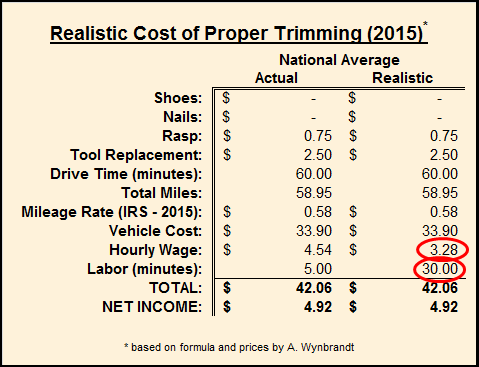
So, realistically, the hopefully-well-trained hoof care provider working for far less than minimum wage still only pockets $4.92 for his/her hour-and-a-half time commitment!

On the other hand, if horse owners (and farriers!) were to consider the skill set of the properly-trained hoof care provider to be commensurate with those of the advanced farrier, albeit in trimming rather than metalworking, the numbers would/should look more like this –
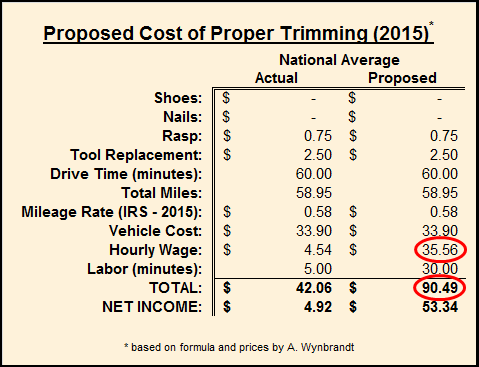
So, what do you think? Is the expertise of your hoof care provider worth it? Would you expect to pay less for a doctor’s visit for a cold rather than a case of bronchitis? Doubtful, because you’re not paying “by the disease;” you’re paying an expert in his/her field for the best diagnosis and treatment possible, regardless of the disease. On the other hand, you would (and should) probably balk at paying the same amount to a dentist for his/her diagnostic abilities with regard to your cold, because there are significant differences in their educations. In fact, I suspect it’s highly unlikely you’d even consider going to the dentist about your cold!

So if the best and healthiest option for your horse turns out to be “only” a trim, then it seems logical that it be carried out by a properly-trained hoof care provider. And if the cost of shoes and nails is really just a few dollars, why would/should you expect to pay the trimmer significantly less than the farrier?

Just some food for thought…
Yes, I’m fully aware that it’s been way too long since I’ve posted anything, and I apologize for it. But life has been, well, crazy these past few months, so I do have something of an excuse for my apparent neglect. But I assure you I have a variety of interesting articles under way,  several hoof research projects I’m working on, and a number of hoof-related products I’m in the middle of designing, so I definitely haven’t been sitting around on my hands. And as each of these comes to fruition, you’ll be (almost) the first to know – I promise!

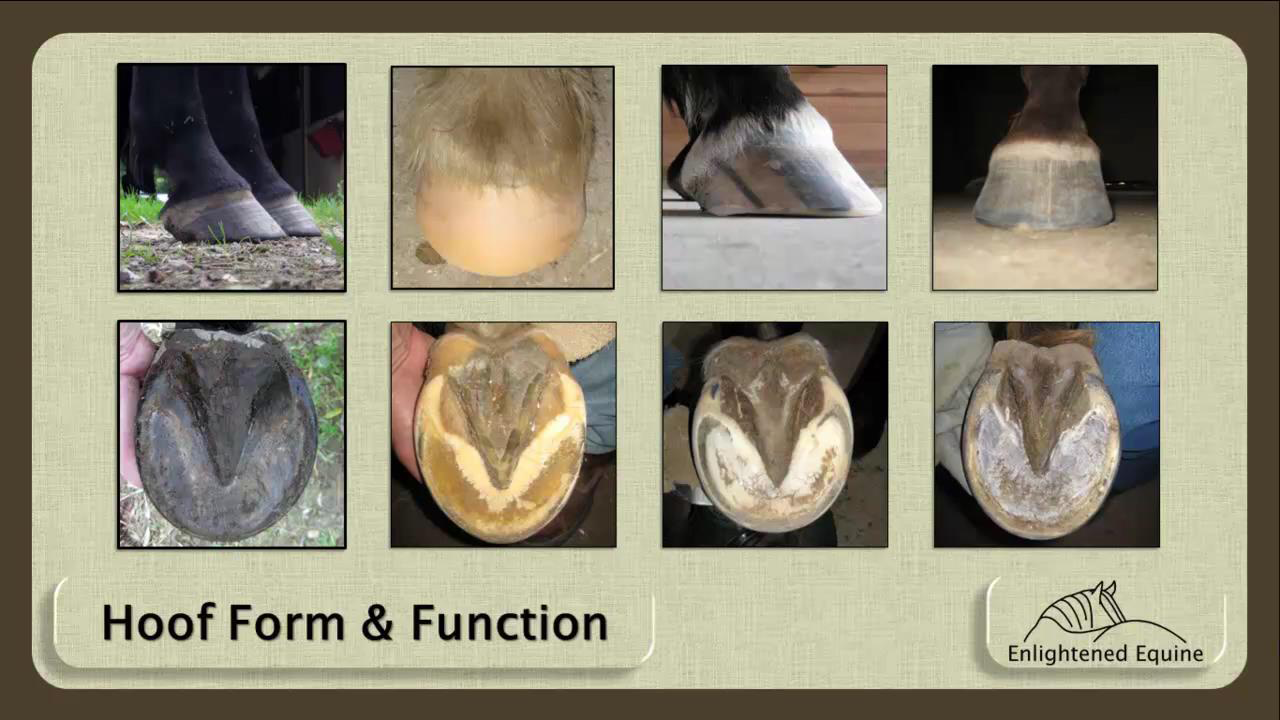
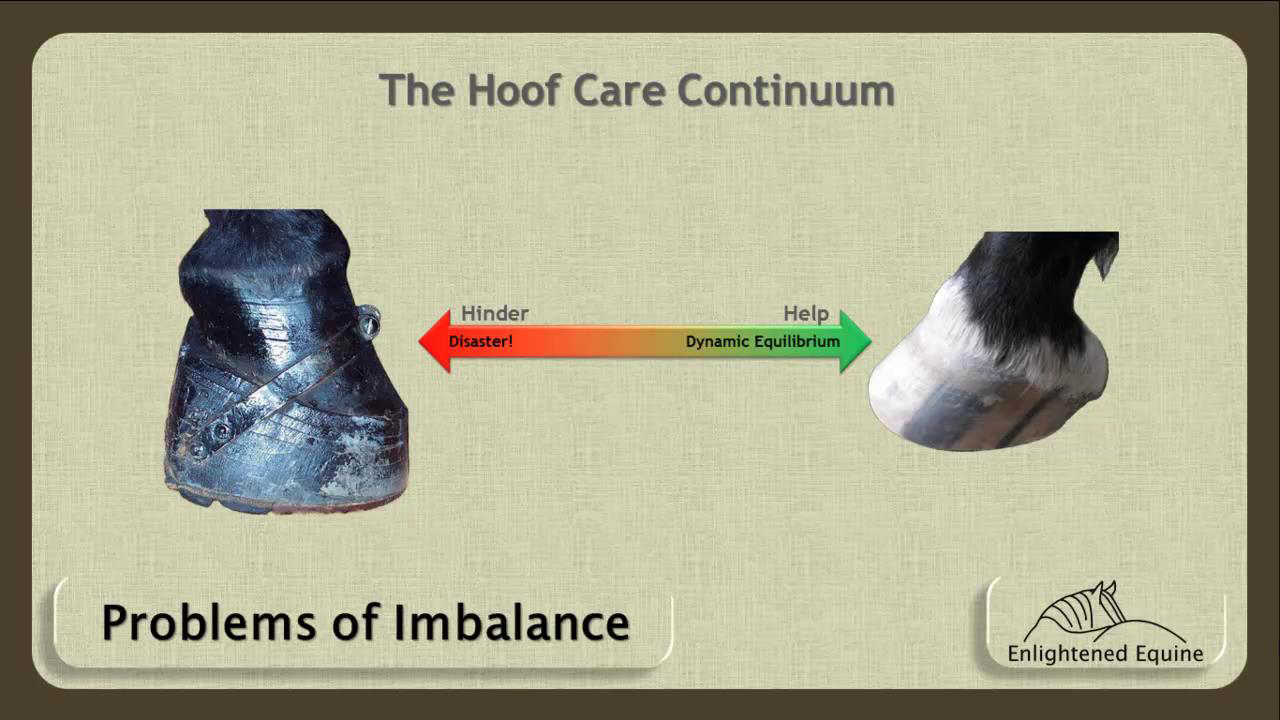
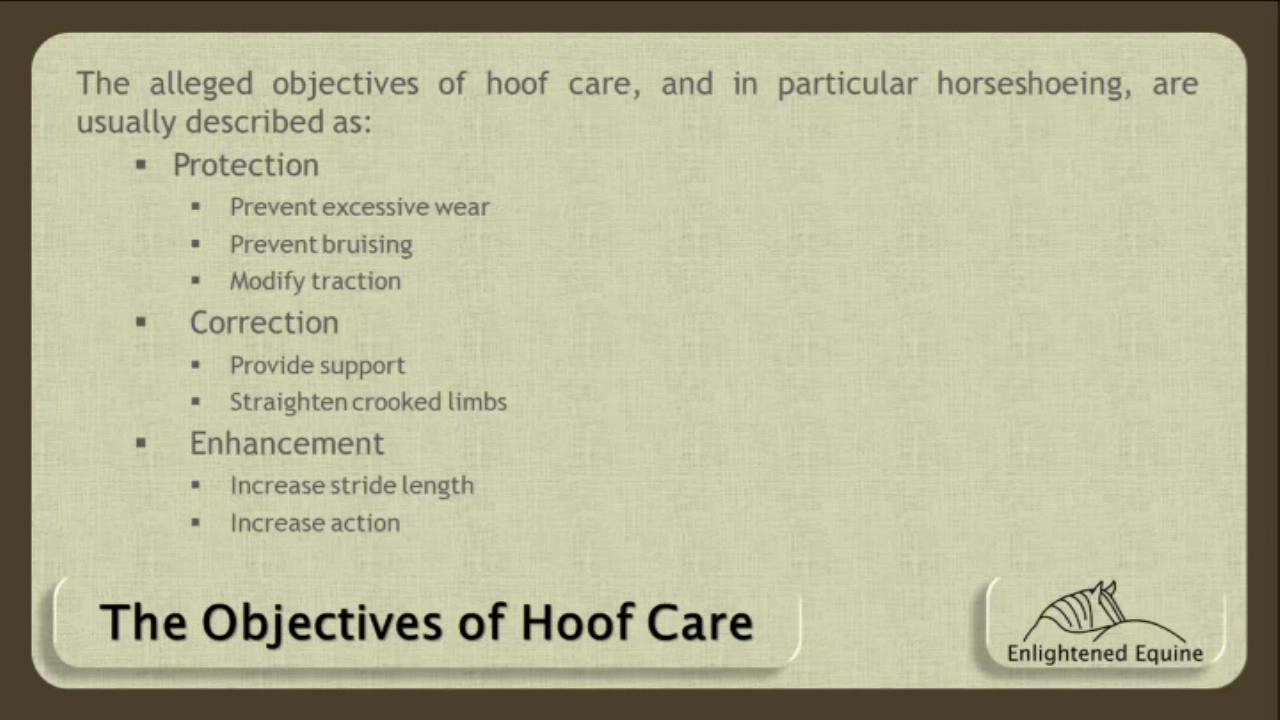
Meanwhile, I’ve also spent many, many hours planning, recording, and editing this video on the basics of hooves and hoof care, which I created for several reasons: first and foremost because I wanted to provide a solid resource for the horse owners out there who truly want to understand what I call the “why” of hoof care so they’re in a better position to know whether or not their hoof care provider or veterinarian is telling them the truth; second, because I’ve long desired to try making a video in what I call the “Cosmos” style (remember Carl Sagan?); and third, because I knew going through the process of producing such a lengthy video would help me decide if I’m willing to do it again. The jury may still be out on that last reason!

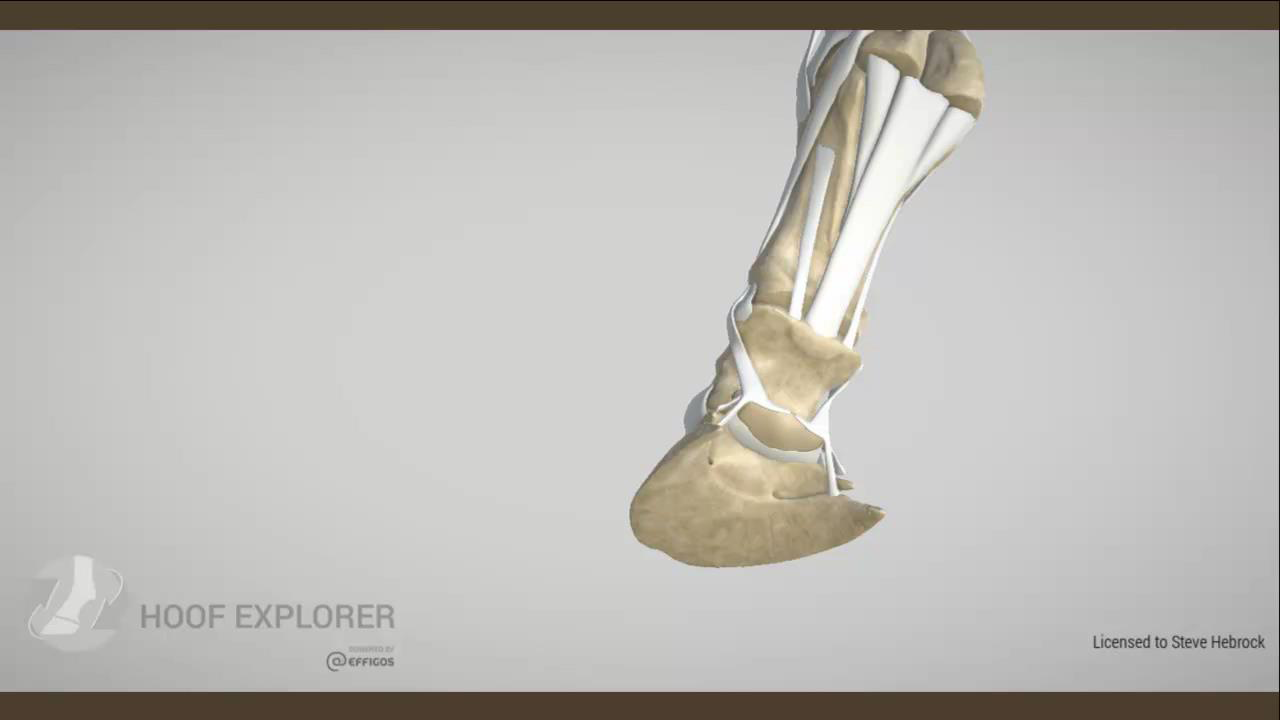
This 1hr 16min video begins with a look at the knowledge gap of both hoof care providers and horse owners, punctuated by some quotations from Dr. Deb Bennett, followed by a description of the external and internal anatomy of the horse’s lower limb. For this part of the video, I used images from a program called Hoof Explorer, which, although useful for learning basic leg and foot anatomy, uses an incorrectly-trimmed hoof with bad bone placement in its model. Its user interface also suffers from some serious flaws, and I plan on writing about my experiences with it in a review of this product in a later article.

It continues with a discussion of the role of the hoof in the life of the horse, including some great footage of feral horses provided through the U.S. Bureau of Land Management, and then focuses on the causes of hoof form and the characteristics of properly-trimmed hooves. There’s some slow-motion video of proper landings as well.

And then there’s a description of hoof imbalances and their consequences; what can and cannot be accomplished through trimming and shoeing, and why; and some slow-motion video of bad landings.

It finishes up with a brief examination of why people believe horses are trimmed or shod in a particular style, and how other management issues can adversely affect a horse’s feet. Finally, I discuss what to look for in a hoof care provider, as well as describe some of the challenges faced in transitioning a horse to barefoot.

I’m convinced every horse owner, hoof care provider, and veterinarian can benefit from watching this video, regardless of what he/she believes they already know about hoof care. I also hope you’ll find it enjoyable, and that you’ll share it with as many of your “horse friends” as possible.

And I realize it’s extremely short notice, but if you really enjoy learning about the equine foot, please consider joining us at the Liberated Horsemanship Gateway Clinic 2017 June 5th through June 9th in Wooster, Ohio. There will be much more in-depth coverage of not only the hoof, but also of the other management issues affecting your horses’ well-being. I guarantee you won’t regret it!

(Special thanks to production assistance from Dora, Scott, Andy, Kim, and Woody!)

I’m told people don’t say it often enough, but I have to admit to hearing it on a fairly regular basis. In fact, I heard it again not long ago when one of my clients introduced me to a friend of hers with a couple of horses she was having some hoof difficulties with. And so, as I trimmed my client’s horse, her friend watched while I explained what I was doing and why. This particular horse – a Mustang – has wonderful feet that made an excellent aid as I described how some valuable insight into proper hoof wall trimming can be found through careful observation of changes in hoof tissue as the wall is trimmed, and how that relates to the abrasive forces the feral horse is subjected to by nature.

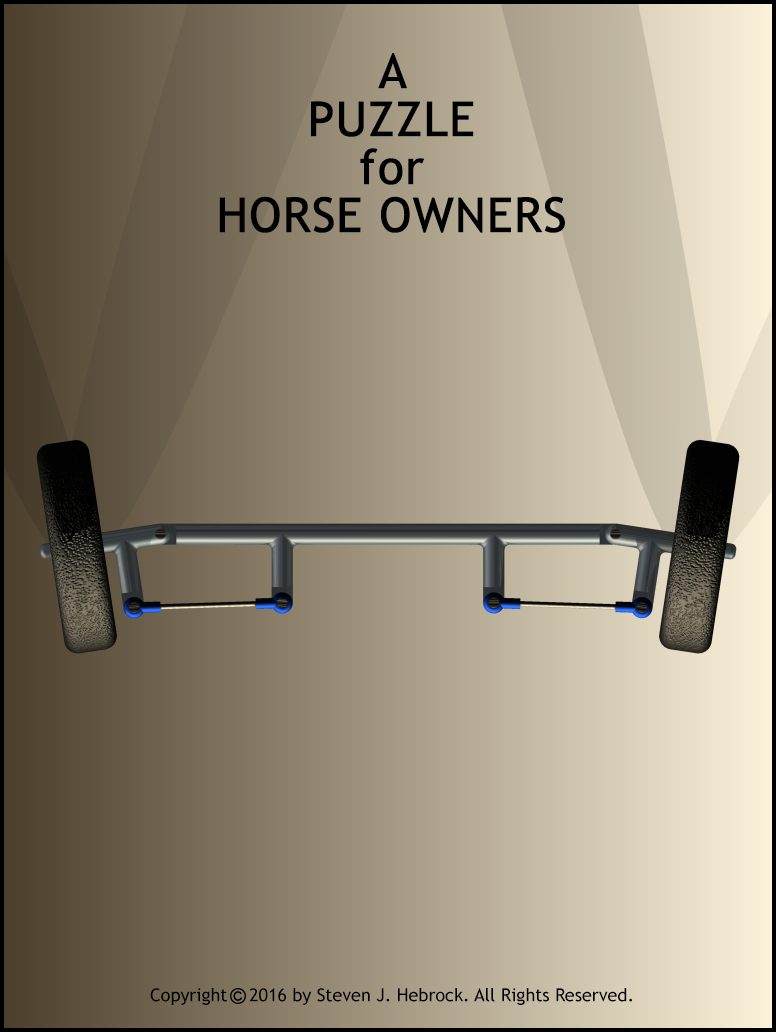
a-puzzle-for-horse-owners-1

Not surprisingly, this was news to her, although it probably shouldn’t have been since her horses were being trimmed by another “barefoot professional.” But maybe I’m different than most in that I view every trim as not only an opportunity to help the horse, but also the chance to help educate the owner (and any innocent bystanders!) as well.

Unfortunately, there’s way too much bad information out there – thanks, in a large part, to the Internet. The Web has made it all too easy for anyone and everyone – educated or not – to share their brand of “expertise” with the world. I’ve discussed some of these problems with the “expert” side of this bad-information-propagation equation before (see The “Expert Syndrome” and The “Expert Syndrome” Revisited). Much of this seems to be a deliberate effort on the part of the propagators to set themselves apart in the world of hoof care by promulgating variations on a (logically-sound hoof care) theme that manifest themselves as what can only be described as patently illogical theories and practices. Fortunately, most of their information won’t stand up to close scrutiny by even a moderately logical thinker.

Consider, for example, the popular trimmer who uses the rather cryptic phrase “the heels follow the toe” as explanation for her belief that horses’ heels shouldn’t be trimmed. Seriously? No wonder her “after” photos show more distortion of the hoof capsule than the ones taken before she began “helping” them! Others may sound more reasonable at first blush, like another popular trimmer who claims that if the bars of the hoof “grow back quickly” after being trimmed, they must “want to be there,” as if his mere saying-so offers a reasonable alternative explanation for what is simply normal growth not subjected to the same abrasive forces in the typical domestic equine environment as they are in the feral horse’s. My fingernails grow pretty quickly, too; I guess they must “want to be there,” so I’d better stop trimming them!

While it’s extremely unlikely we’ll ever see an end to this plethora of uninformed/misguided “experts” and their bad information, I can’t help but wonder about the recipient side – the horse owner – and why so many of them are so quick to buy into and share such information without carefully thinking it through. Just a few examples…

One of my clients recently told me about a Standardbred in her barn that apparently “paddles” when he walks. His owner carefully explained to my client how these horses are “bred to walk that way so they don’t interfere when they race.” And how her farrier is now attempting to “correct” the gait by deliberately unbalancing the feet.

Or how about the new client whose friend told her the bars, sole, and frog shouldn’t be trimmed because “whatever should come off will be worn off by the horse walking around.”

Or maybe the client-for-a-single-trim whose veterinarian told her she really needed to put shoes back on her sound horse “just in case.”

Or perhaps the client’s friend who cannot accept that her horse’s ever-increasing lameness issues could possibly be due to her farrier’s (bad) work, because he’s on the board of directors of a prominent farrier organization.

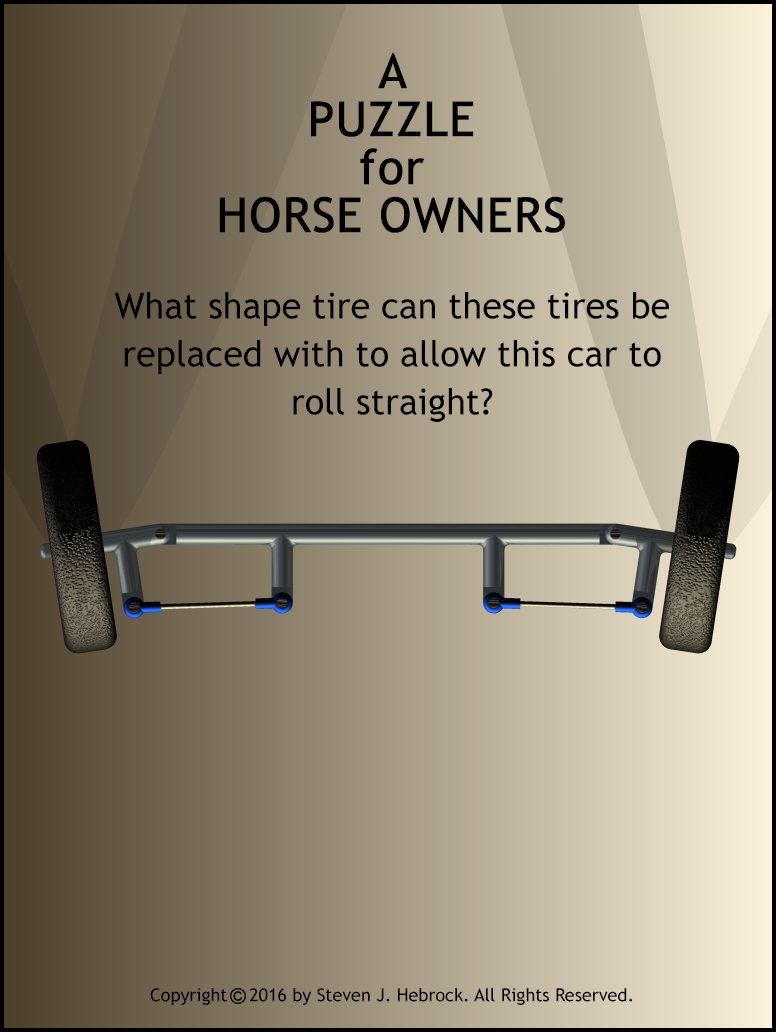
a-puzzle-for-horse-owners-2

Perhaps the most potentially-serious example of this bad-information problem I’ve personally encountered of late was with my client whose horse’s normally-healthy hooves had begun losing sole concavity, developing white-line separation around the entire hoof wall, and frequently abscessing – all signs of a dietary problem leading to laminitis.

His veterinarian and barn manager both dismissed the idea of diet issues, instead blaming the horse’s problems on his hoof care. The vet carefully “explained” to him that the horse’s feet weren’t trimmed to “look like Quarter Horse feet,” and that the abscessing was caused by the forces at breakover traveling up the “long” toes and constantly bruising the tissue at the coronary band. I’m not going to describe the details of her recommended treatment now, because I may want to write a more detailed article about this entire experience in the future, but let’s just say it involved surgery, reshaping the hooves to “look more like a Quarter Horse,” and shoeing!

Fortunately, this horse owner isn’t one to merely accept what others say, regardless of their level of education, experience, or presumed expertise. He dismissed the vet’s explanation and advice as illogical, and, after discovering the barn manager had been feeding his horse three pounds of vitamin/mineral supplement a day instead of the recommended amount, he decided to move his horse to another facility. Within a few short weeks, the white-line separation had nearly disappeared, the sole concavity had reappeared, and no further abscessing had occurred – all with only dietary changes and without following any of the veterinarian’s recommendations.

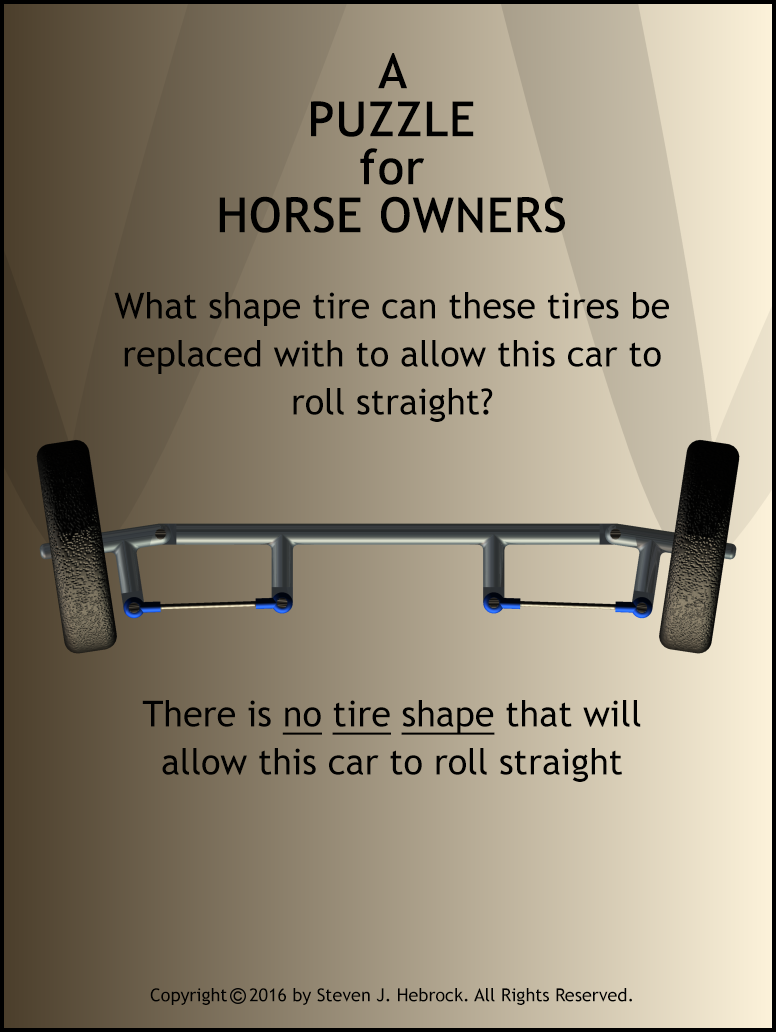
a-puzzle-for-horse-owners-3

My point in bringing up this particular client’s experience is only to hopefully reinforce to you my strongly-held belief that one must always question advice, no matter the source! (For a more in-depth look at bad advice from “experts” that nearly cost one horse his life, check out Toy Story.) Insist any advisor explain his or her recommendations until you feel confident that the logic behind them is sound. Avoid courses of action that strain credibility, or seem unduly complicated and counter-intuitive. The design of the horse’s limbs makes sense; so, therefore, should any advice about caring for them.

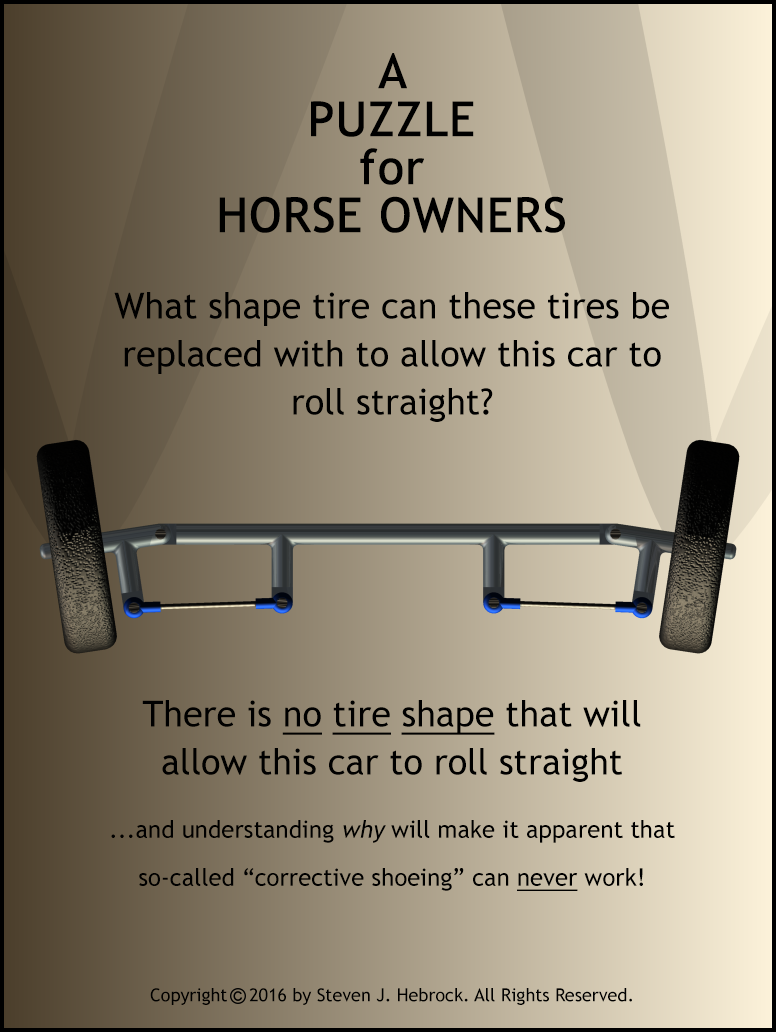
The graphics I’ve included in this article illustrate a fine example of a very common practice endorsed by many, many veterinarians and farriers that completely falls apart under close scrutiny. Most people will readily grasp the absurdity of believing tire shape can somehow fix the bend in the axle, yet many will just as quickly accept exactly the same premise when “special” trimming and/or shoeing is touted as a “treatment” for their horse’s splayed or pigeon-toed legs. What, exactly, compels someone to out-and-out reject the former, but never question and, instead, accept the latter? If every horse owner would just take the time to think through every piece of advice, carefully considering not only the source, but also what’s actually being offered, I believe our horses would experience far more freedom of motion and long-term soundness.

a-puzzle-for-horse-owners-4

I encounter many different types of people from many different walks of life in my hoof care practice. Like the woman I mentioned in the first paragraph of this article, a large number of them have suffered through my sometimes lengthy explanations of how and why I do what I do when I care for horses. And what, besides their love for horses, do most of these folks have in common? It’s those “three little words” they utter after the explanations have been offered and considered, most often in light of others’ prior offerings on the same subject:

“That Makes Sense!”

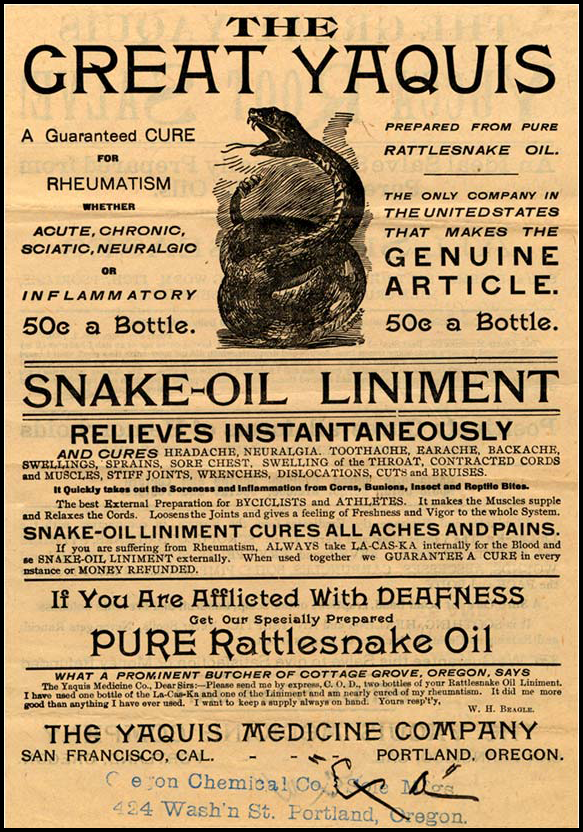
Snake oil poster

“Once begun this disease process is irrevocable and unremittingly destructive. There is no cure, no return to normal….It is no doubt true that “cures” of navicular disease with any form of treatment reflect an incorrect diagnosis. One does not cure bona fide navicular disease.”

– James R. Rooney, DVM

Difficult words to hear and accept, to be sure, from a man who was undoubtedly one of the few in a position to make such a statement. But before losing all hope for your “navicular” horse, please keep in mind the two very important points I made in Navicular Disease – Part 1: Background and Navicular Disease – Part 2: Diagnosis:

  1. Genuine navicular disease is damage to the deep flexor tendon and the attendant surface of the navicular bone caused by repeated heating of the tendon and bone from friction of the tendon moving across the bone, and,
  2. Genuine navicular disease is much less common than the very large number of (mis)diagnosed horses would lead us to believe.

Understanding and acknowledging both of these points is absolutely crucial to appreciating the existence of so many claims of “curing” navicular disease. According to Dr. Rooney, any such claim of a cure can only mean one thing: the horse in question never actually had navicular disease!

A moment’s thought will reveal why this surely must be true. While the DFT damage might, conceivably, heal if the damage to the navicular bone could somehow magically go away and not perpetuate the damage to the DFT, curing the damage to the articular surface of the navicular bone is no more likely in horses than it is in humans. Why would we see so many knee and hip replacements in people if joint damage could be undone with a dietary supplement or special shoes? Obviously, research into the treatment of various diseases is ongoing, but until someone demonstrates an effective, non-surgical approach for regenerating human cartilage and bone, I certainly wouldn’t expect to see anything that works for navicular disease in horses.

So, at least for the time being, if a horse truly has navicular disease, that damage must be considered permanent. And while it can certainly be managed to some extent, depending on the severity of the disease, it cannot be cured. So since we can’t undo what’s been done, our only viable options are to concentrate on slowing the disease’s progression and minimizing whatever pain is already present. And although I’m certainly not qualified to offer advice on pain management through drug therapy, I do want to briefly comment on one of the most commonly-prescribed drugs for “navicular”  horses: isoxsuprine.

Dr. Rooney pointed out in several of his publications that the most common competing hypothesis to his evidence-based belief that navicular disease is caused by mechanical problems is that navicular disease is, instead, a vascular (blood vessel) disease. In those same publications, he also made some very compelling arguments as to why the vascular hypothesis cannot be correct. Regardless, others’ belief that the disease has vascular origins explains why isoxsuprine – a vasodilator – is so frequently prescribed. After all, if the disease is caused by blood flow problems, it might seem logical to prescribe a drug that purports to increase blood flow. Unfortunately, as pointed out in “The Effect of Oral Isoxsuprine and Pentoxyfilline on Digital and Laminar Blood Flow in Healthy Horses” (Ingle-Fehr, J.E., and Baxter, G.M., Veterinary Surgery, 28 (1999): 154-160), isoxsuprine apparently doesn’t increase blood flow in the horse’s foot! Specifically:

No statistically significant increases in DBF (digital blood flow) or LP (laminar perfusion) were detected over the 10 day treatment period with either isoxsuprine or pentoxyfilline….Neither isoxsuprine nor pentoxyfilline increased blood flow to the digit or dorsal laminae in healthy (non-laminitic) horses.

Granted, because their primary concern was with the use of these drugs in the treatment of laminitis, their study was conducted on what they determined to be laminitis-free horses without regard to other possible foot pathologies. I suppose one might argue that perhaps the drug does, indeed, work on horses with compromised foot circulation but not on normal horses, but that strikes me as highly unlikely. The researchers went on to conjecture as to why isoxsuprine appears to make some laminitic (not “navicular”) horses more comfortable, and concluded that the drug must have a very mild analgesic (pain-relieving) effect unrelated to circulation, since isoxsuprine apparently doesn’t affect blood flow.

For the “navicular” horse owner, therefore, the implications of this study are quite clear: whether or not your veterinarian believes navicular disease is caused by, or related to, circulation problems, isoxsuprine has been demonstrated to have no effect on blood flow in the equine foot. Refer him/her to the aforementioned article if he/she doesn’t believe you. Why give your horse an expensive, unnecessary, and ineffective drug? And if your horse does need relief from pain, there are far more effective and less expensive drugs readily available.

Through understanding the true cause of navicular disease comes the answer to slowing its progression: since the disease is the consequence of repeated heating of the tendon and bone from friction of the tendon moving across the bone, we must minimize the friction and consequent heating. How? Well, let’s review the list of factors that affect friction and heating from Navicular Disease – Part 1: Background:

  1. The degree of front-to-back imbalance in the hoof
  2. The stiffness of the hoof
  3. The hardness of the terrain upon which the horse moves
  4. The speed at which the horse moves
  5. The duration of the horse’s movement
  6. The size of the navicular bone and deep-digital flexor tendon

Given that we’re now talking about real-world horses with less-than-optimal hoof care, we have to add yet another factor that affects the “navicular” horse:

0. The actual length of the hoof relative to its optimal length

When a hoof is properly trimmed, it will be at its shortest possible length without compromising its structural integrity or increasing its sensitivity to terrain variations. Any length in excess of this optimal length, whether from growth or from the addition of a shoe, will increase the amount of time required for the hoof to leave the ground (breakover time) during maximum DFT tension across the navicular bone. Although this probably doesn’t contribute to friction and heating, it does place more strain in the damaged area of the foot we’re trying to protect.

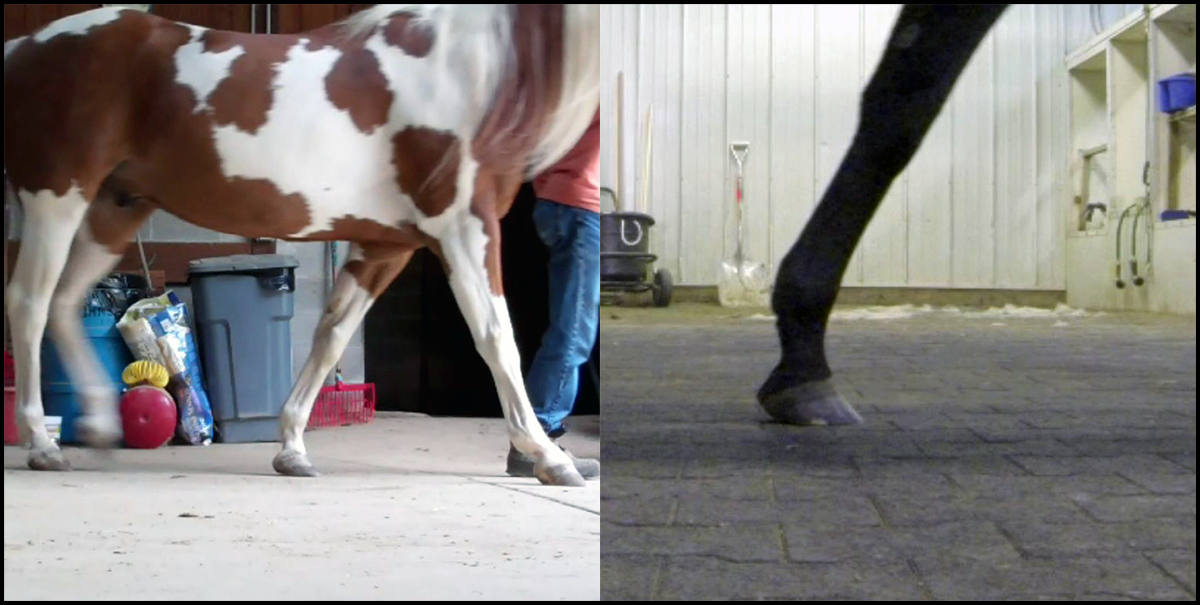
Be aware also that the common practice of using “special” shoes on these horses, such as rolled, rocker, or squared-off toes, has not been found to significantly shorten breakover time; only proper hoof length can minimize breakover time (Back, W., and Clayton, H., Equine Locomotion, (2001): 146 & 149). Note these photos of left front legs at the moment of maximum DFT tension, just before the heels leave the ground –

maximum-dft-strain

Adding length to these feet would only add to the time required for the hoof to leave the ground, thus prolonging the period of maximum strain across the navicular bone.

When managing the horse with navicular disease, we obviously have greater control over some of these factors than over others. For example, we cannot change the size of the horse’s bone and tendon, so number 6 can be eliminated from the onset. On the other hand, smart choices for the hardness of the terrain we ride on, coupled with how fast we ride and for how long we ride (numbers 3 through 5), can certainly minimize the amount of friction and heating of the bone and tendon. Remember: slower movement over softer terrain for shorter periods of time causes far less friction than faster movement over harder terrain for longer periods of time, just as less frequent jumps over shorter obstacles causes less friction than more frequent jumps over taller obstacles.

Far and away, though, our best opportunity for slowing the progression of the disease can be realized by minimizing numbers 0, 1, and 2 through proper hoof care. In concrete terms, that means:

  1. Properly trimming the horse so the hoof is optimally short and the coffin joint experiences minimal acceleration at landing i.e. a flat landing, and,
  2. Keeping the horse barefoot to maintain optimal hoof length, allow the foot to deform and absorb energy during initial ground contact and as it is loaded by the weight of the horse, and permit the most rapid breakover possible to minimize DFT strain across the navicular bone.

Unfortunately, these absolutely essential management measures are in diametric opposition to the advice of nearly every veterinarian and farrier. In fact, the most common advice given for the management of the “navicular” horse is the exact opposite of the above: use wedge shoes to elevate the heels and lessen the tension of the DFT across the navicular bone. While at first blush that course of action may seem logical, raising the heels of a horse makes only a small, temporary reduction in the tension of the DFT while simultaneously increasing the tension of the superficial digital flexor tendon, suspensory ligament, and extensor tendon. Much more problematic, however, especially for our “navicular” horse, is the increase in friction and consequent heating of the tendon and navicular bone that occurs with the resultant heel-first landing. In other words, elevating the heels (re)creates the very situation that caused the navicular disease in the first place!

The only situation where I could envision heel elevation as possibly being helpful to a horse with navicular disease would be if the horse were to be kept strictly on a hard, flat surface and limited to brief speeds of no greater than a walk. Think about it: if the horse were kept on a soft surface, the wedges would penetrate the surface with no net elevation of the heels, and if the horse were to move on the hard surface at any appreciable speed, the damage caused by the friction at the DFT/navicular bone interface would be greater than any benefit gained by the slight lessening in DFT tension through raising the heels.

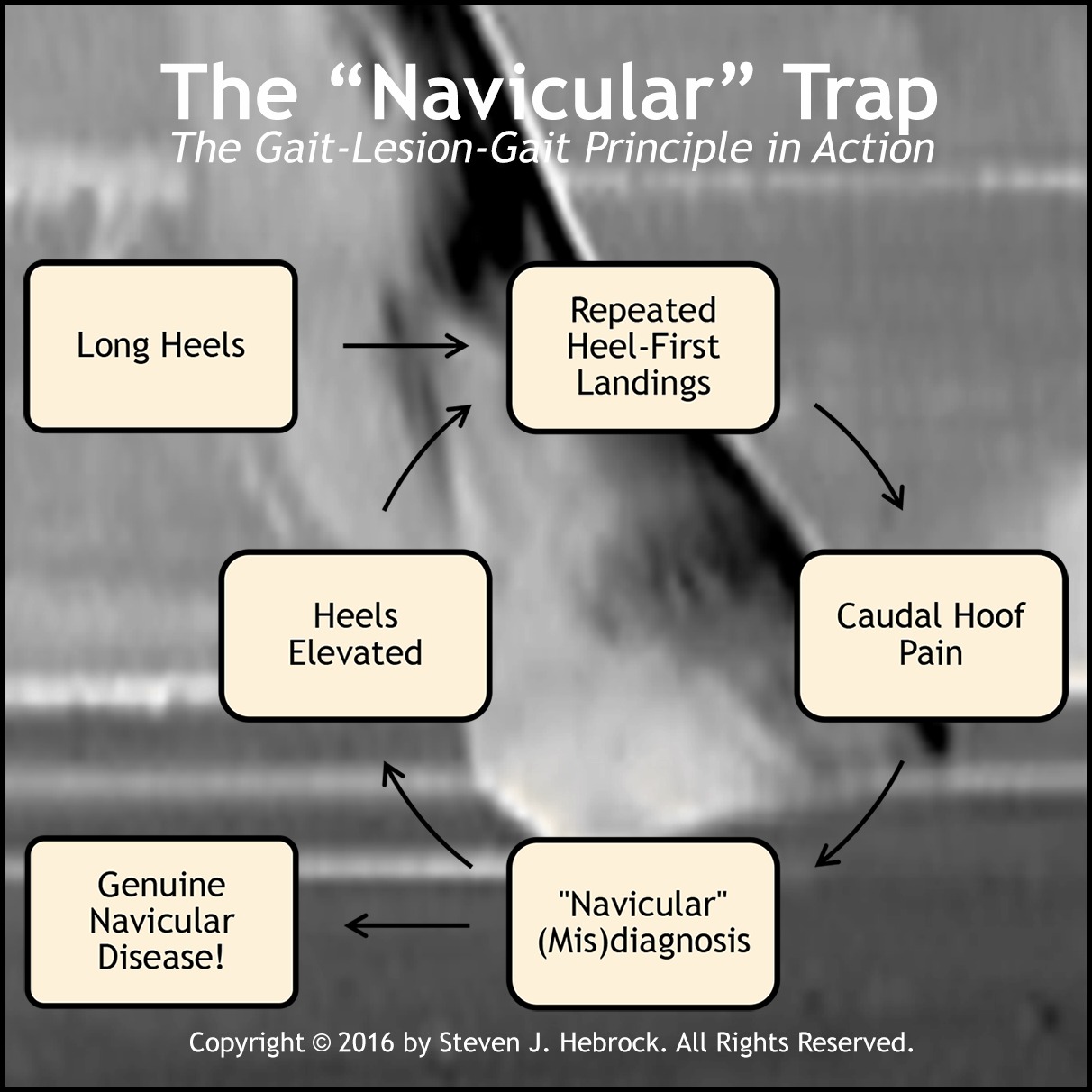
So the first priority in managing the horse with navicular disease must be stopping the progression of the disease by not doing what’s probably been done, in terms of hoof care, for the majority of the horse’s life. Because of the widely-held, but incorrect, belief that horses are “supposed” to land heel-first (see The Myth of the Heel-First Landing series for more information on why this is incorrect), the product of many – I would even say “most” – hoof care providers’ efforts are feet that are incorrectly balanced in the front-to-back (A/P) direction and therefore experience a heel-first landing. As I’ve tried to make clear through this series of articles, long-term heel-first landings are the underlying cause of navicular disease, and the problems begin when horse owners fall into what I’ve termed “The ‘Navicular’ Trap” –

The Navicular Trap

Here’s how it usually plays out:

  1. The horse’s (front) heels are left too long by the hoof care provider
  2. As a result of working on harder ground, the horse becomes heel-sore from repetitive pounding
  3. The vet or hoof care provider diagnoses “navicular,” and raises the heels to allegedly reduce pain
  4. The horse becomes increasingly heel-sore because of increased pounding
  5. As a consequence of the repeated friction and attendant heating at the DFT/navicular bone interface, the horse ends up developing genuine navicular disease

This is a perfect illustration of the so-called gait-lesion-gait principle in action. As Dr. Rooney phrased it in his Biomechanics of Lameness in Horses –

The gait abnormality caused by a specific lesion is the gait abnormality which will cause the lesion.

What does that mean? Well, I interpret it like this: if a horse (or anything else) is forced to move in a manner that mimics the gait of a particular pathology, continued movement in that manner will eventually cause the very pathology the gait is indicative of! Specifically, if a horse’s heels are left too long for too long, he will become heel sore and his stride will be foreshortened (a temporary gait abnormality indicative of navicular disease). If his heels continue to be left too long – or worse, are further elevated with wedges – he may eventually develop navicular disease (the lesion), which will then cause permanent heel pain (and a permanent gait abnormality).

So preventing navicular disease and managing the horse with existing navicular disease are actually one and the same process: ensure the horse is experiencing minimal coffin-joint acceleration to the extent possible, using the guidelines above. By doing so, both the sound horse and the “navicular” horse will be moving with minimal resistance and (therefore) maximal efficiency, giving him the best chance possible at long-term comfort and soundness. And that’s the goal!

To reiterate the most important points of this series of articles:

  • True navicular disease is damage to the deep flexor tendon (DFT) and the attendant surface of the navicular bone.
  • Navicular disease is the result of repeated heating of the DFT and navicular bone surface caused by the friction resulting from non-zero-acceleration coffin-joint landings i.e. toe-first or heel-first landings.
  • While it definitely does exist, instances of true navicular disease are far less prevalent than commonly believed.
  • Diagnosing navicular disease cannot be done via radiographs unless the disease is already in its advanced stages, and instead is best diagnosed with MRI or less accurately with a combination of techniques including a thorough patient history.
  • True navicular disease cannot be cured.
  • The two most common treatments for navicular disease – isoxsuprine and wedge shoes – are ineffective (isoxsuprine) and cause further damage (heel wedges).
  • Effectively managing navicular disease and preventing navicular disease both depend on minimizing the underlying cause of the disease (friction) through proper hoof care, which means an optimally-short hoof experiencing a flat landing at the walk.

Above all, don’t lose hope if your horse is diagnosed with “navicular;” in my experience, odds are he doesn’t really have it! It’s much more probable he’s sore from excessive heel length, bad side-to-side balance (i.e. “corrective trimming”), sheared heels from radically different heel lengths, or an infection in his frog – all problems related to improper hoof care. Carefully consider his history and symptoms as well; your halter horse or brood mare isn’t a likely candidate for navicular issues, and a diagnosis of “navicular” in a single front foot or hind feet is probably not correct, either. Find someone who truly understands what proper hoof care is all about (admittedly challenging!), and allow him/her to help you rule out other far more likely possibilities.

In wrapping up this series, please allow me to make just one more point: I’m well aware that much of what I’ve presented – indeed, much of what I present on a variety of subjects, not just on navicular disease – flies in the face of popular thinking and advice. But what it absolutely doesn‘t fly in the face of is logic. If you’ll set aside your beliefs and carefully consider the evidence I’ve presented, I think you’ll agree…

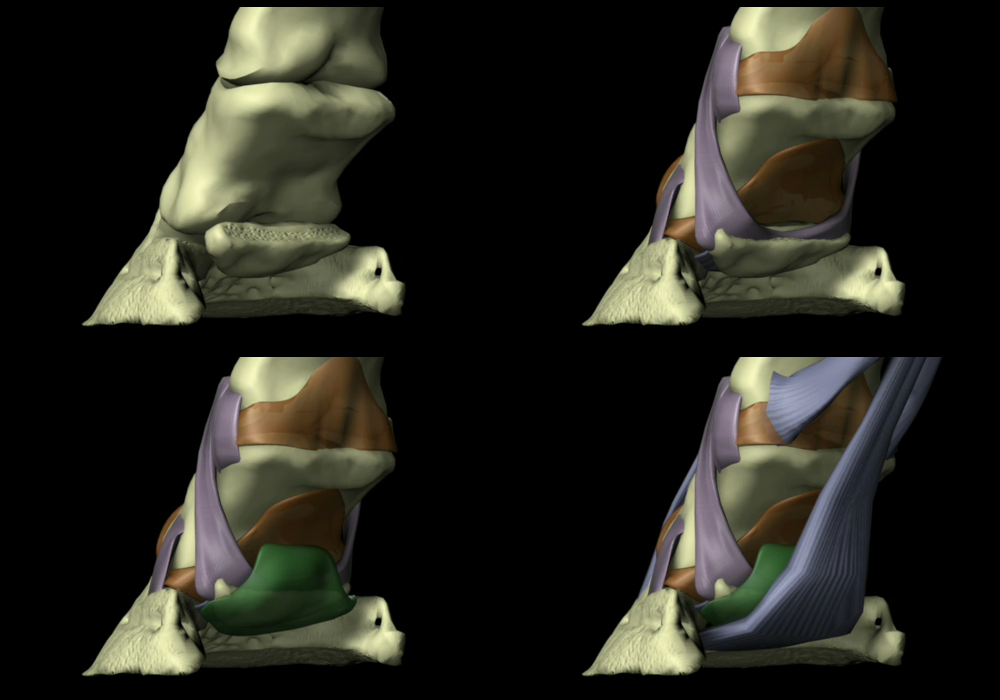
Glass Horse Navicular Composite
– still image captures from The Glass Horse: The Equine Distal Limb

As established in Navicular Disease – Part 1: Background, navicular disease is damage to tendon, cartilage, and bone at the interface of the deep digital flexor tendon (DDFT or DFT) and the navicular bone as the consequence of heat generated from friction. The friction is the product of slow and/or fast vibration from improper (non-zero-coffin-joint-acceleration) landings, and the disease is the cumulative effect of the heat over a long period of time rather than the result of a singular incident.

As anyone who’s been around the horse world for any length of time undoubtedly knows, a diagnosis of “navicular” is incredibly common. Many veterinarians diagnose navicular syndrome or just plain “navicular” in situations where they see pain in the caudal (rearmost) portion of the hoof they can’t otherwise explain, and diagnose navicular disease whenever they see caudal hoof pain coupled with any sort of radiographic anomaly with the navicular bone.

In my experience, these diagnoses are wrong far more frequently than they’re right. Over the past 20-something years, I’ve examined many horses that have been diagnosed with some sort of “navicular” problem; yet, only 2 or 3 of those horses have had any evidence of what Dr. Rooney would’ve called “genuine” navicular disease. The rest have, in reality, been suffering from other issues – and, I might add, recovered from their lamenesses once the real causes of their problems were identified and properly treated. Just a few examples…

  • I was asked to examine a horse the veterinarian had declared to be in pain due to either her right stifle or her right front navicular bone. She arrived at this diagnosis purely through observation and a flexion test on all four limbs – no physical examination, nerve blocks, or other diagnostic techniques were used. More disturbingly, she apparently didn’t realize that navicular issues would be very far down the list of possible diagnoses for this horse – a middle-aged Morgan broodmare with alleged symptoms in only one foot. As it turned out, the alleged “symptom of pain” ended up being nothing more than normal equine behavior, much to the relief of the owner!
  • I received a call from a horse owner whose veterinarian had diagnosed “navicular,” and instructed the owner to have “special shoeing” used on the horse to “cure” the problem. After a year of following the veterinarian’s advice with no improvement in the horse, the owner contacted me through the university to see if anything could help his horse. Again – there was nothing about this horse that should’ve led to a diagnosis of “navicular;” she was only 6 or 7 years old, and had only been used for trail riding. A 30-second examination revealed that the horse had a very bad infection in the frogs of all four feet. The horse returned to complete soundness after treating the infections.
  • One of the most glaring and nearly disastrous cases of misdiagnosis I’ve yet encountered has already been recounted in Toy Story. In that instance, a diagnosis of navicular disease by several veterinarians, including a so-called “hoof specialist,” nearly cost this horse his life. Once the real problem was diagnosed (White Line Disease) and treated, this horse went on to win a state championship!

Unfortunately, these are by no means isolated cases, but relating more of them here won’t serve any particular purpose. The above anecdotes are absolutely not meant to suggest that navicular disease isn’t real – it definitely is. But it’s certainly not the first or the second or the third thing horse owners or veterinarians should suspect when a horse presents with a lameness, and correctly diagnosing it, particularly in its early stages, entails a thorough understanding of its causes as well as what it is not. And so, when I speak of “genuine” navicular disease, I’m referring only to the condition resulting from actual DFT/navicular bone damage, and not the myriad other presentations of symptoms that end up labeled as “navicular” but really aren’t.

So how is genuine navicular disease diagnosed? Let’s start with the typical symptoms. In the beginning stages of genuine navicular disease, a horse:

  • Will exhibit some degree of vague forelimb lameness affecting both limbs
  • May alternately “point” his front feet
  • May exhibit a foreshortened stride

Obviously, any number of conditions may account for these same symptoms, including mild laminitis and, especially, a horse that’s heel-sore from excessive concussion (much more on that later!). At this point in the diagnostic process, your veterinarian should be thoroughly palpating the limbs for any heat, swelling, and/or tenderness, as well as examining the hooves for signs of bruising, frog infection, and/or abscessing. Just bear in mind that although it’s unlikely (but not unheard of) to have simultaneous abscesses in both front feet, it could also be a combination of problems, such as an abscess in one foot and a pulled tendon in the other leg. Watching the horse move forward, backward, and turn is also very important to help rule out soft-tissue injuries higher up in the body, like sore shoulders or hips.

It’s imperative that any diagnostic work also include the horse’s history. Things like a recent change in hoof care providers or yesterday’s turnout in the mud after being stalled for a week can provide valuable insight into where to look – and, just as importantly, where not to look – for the potential source(s) of lameness.

Assuming other possibilities above the foot have now been eliminated and the horse’s symptoms are consistent with the preceding indications, the answers to the following questions will help include or eliminate genuine navicular disease from the list of diagnosis possibilities:

  • How old is the horse?
  • Does the horse have disproportionately-small feet for his body size?
  • Is the horse shod?
  • Does the horse have an obvious heel- or toe-first landing at the walk?
  • Has the horse been extensively used for jumping, or on pavement or hard ground at speeds faster than a walk?

As mentioned in my examples above, this “equine profiling” process of evaluating risk factors will tend to “stack the deck” either against, or in favor of, a (correct) diagnosis of navicular disease. Since this condition is the result of repeated high-speed or high-tendon-travel-distance (as in jumping) heel- or toe-first landings, a young horse used only for flat work on soft ground is an extremely unlikely candidate for navicular disease; for example, a reining horse. On the other hand, an older horse with a lifetime of “corrective shoeing” that’s been used extensively for cross-country work, or a shod horse with an obvious heel-first landing and a history of extensive use pulling a cart on pavement, is much more likely to have genuine navicular disease.

If the horse’s physical characteristics and history still haven’t ruled out navicular disease, then your veterinarian may suggest nerve blocks as a “next step” in the diagnostic process. By injecting a small amount of a local anesthetic such as mepivacaine HCl into and around the palmar digital nerve, sensation in the hoof can be blocked. In horses with foot pain, the horse will generally “block sound,” or cease to show the lameness, regardless of the cause of the lameness. Because navicular disease is nearly always a bilateral condition i.e. one affecting both legs, the apparent lameness of a horse with genuine navicular disease will move to the opposite leg when either leg is nerve blocked. If it doesn’t, the cause of pain is very probably not navicular disease!

Note that radiographic evidence hasn’t been mentioned at all, and for a very good reason. According to Dr. Rooney –

The x-ray is of little or no use other than to muddle and confuse the picture in the early stages of navicular disease. It can be diagnostic, however, in advanced cases….The first true sign of navicular disease on x-ray is the osteophytes forming around the margins and radiolucent foci in the central area of the navicular bone (where the bone is being reabsorbed and replaced by connective tissue).

And Dr. Rooney isn’t the only one to recognize the potential problems with relying on radiographs to diagnose navicular disease. Take a look at this PowerPoint slide from Dr. Federica Morandi’s VM855 Veterinary Radiology class at the University of Tennessee –

Navicular Degeneration

So the “bottom line” on the use of radiographs for diagnosing navicular disease is this: if it’s an early case of navicular disease, x-rays will not give you a definitive answer either way. The only instance where a radiograph might be useful, then, would be to help differentiate between advanced navicular disease and some other pathology severely affecting both forelegs, such as two fractured coffin or navicular bones.

I also haven’t discussed the use of hoof testers in diagnosing navicular disease, for several reasons – most of which apply to using hoof testers in general. First of all, with sufficient force, a response can be elicited from nearly any horse. Second, since they aren’t calibrated, their use relies heavily on the ability of the person doing the testing to apply a consistent amount of pressure to the suspect and the “normal” hoof. And third, their use also depends on comparing the relative amount of force required to elicit a response on the suspect foot versus the “normal” foot, which, in the case of navicular disease, should be very similar as it’s a bilateral condition! So I think there are more accurate and reliable ways to determine whether or not a hoof is foot-sore.

On the other hand, one extremely useful diagnostic test in cases of suspected navicular disease that’s rarely done in the U.S. is the board test. I’m not certain why it’s so uncommon here; perhaps because it’s noninvasive and easily done using only a plank, veterinarians don’t feel they could justify charging enough for it! But according to Dr. Rooney, it’s a very simple way to eliminate DFT/navicular bone issues from the list of possibilities. If you’ve ever seen a flexion test, you’ve watched the veterinarian deliberately over-flex the coffin, pastern, and fetlock joints for some period, and then immediately walk the horse off and watch for lameness. A board test is essentially the same type of test, except we’re flexing the DFT/navicular bone interface. Here’s Dr. Rooney’s description of the board test in The Lame Horse (1998) –

Place a stout board on the ground in line with the horse and one front foot. Place the foot on the end of the board and lift the other end to about knee height and hold it. Eventually, the horse will take his foot off the board. If he puts the foot flat on the ground, the test is negative. If he immediately stands toe-first on the ground, it is positive and suggests navicular disease. The board test increases the pain because it increases the tension in the deep flexor tendon and the pressure exerted by the tendon on the surface of the navicular bone.

Note that this test, like others, will have false positives because horses can be heel-sore for a variety of reasons. But a negative test, even in one foot, will practically rule out navicular disease as a possible diagnosis, which is precisely why I like this simple, noninvasive test!

Probably the single most useful test for diagnosing genuine navicular disease, particularly early in the course of the disease, is magnetic resonance imaging (MRI), because both the soft-tissue (DFT) damage and the beginnings of damage to the cartilaginous surface of the navicular bone can be seen. Unfortunately, MRI facilities for horses are not (yet) very common, and the test is quite expensive. Even so, diagnosing navicular disease still requires that the veterinarian understand what navicular disease is and isn’t.

So, when trying to come up with an answer as to why a particular horse is lame, the possibility of navicular disease will almost certainly cross someone’s mind if the cause isn’t immediately obvious. Just keep in mind this devastating disease is actually much less common than many believe, and reaching a correct diagnosis in its early stages can be greatly helped by understanding why a horse’s physical characteristics and history either support or refute this diagnosis. And keep in mind that, as Dr. Rooney states, “no single test will permit diagnosis of navicular disease,” so if your veterinarian or hoof care provider is suggesting otherwise, or not asking the questions listed above, consider another opinion!

In the last installment in this series, we’ll discuss options for the horse who does, in fact, have genuine navicular disease.

More later!