(Note: This is a much-expanded version of an article originally written for the 2018 edition of the Ohio Equestrian Directory.)
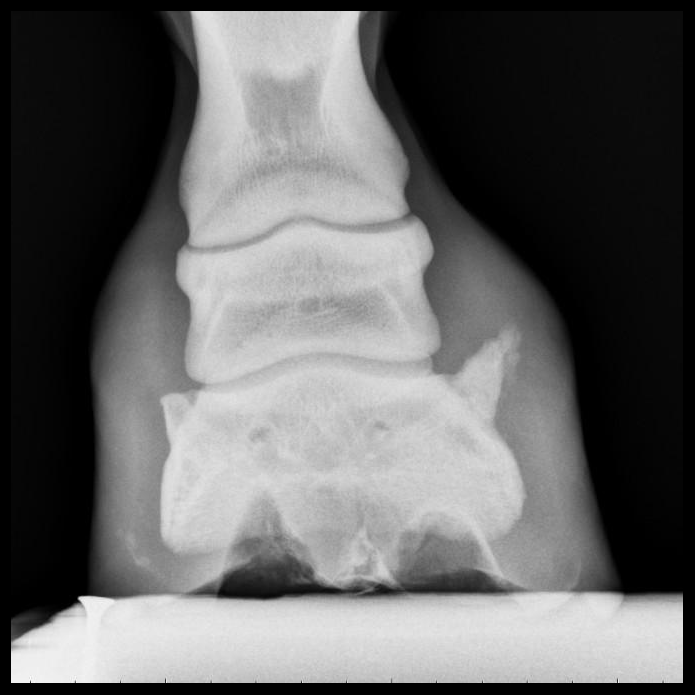
Radiograph of a hoof with sidebone because of deliberate long-term M-L imbalance
Radiograph of a hoof with sidebone due to deliberate long-term M-L imbalance

When a knowledgeable hoof care provider talks about a horse’s hoof being “in balance,” he or she is referring to a hoof making contact with the ground without rocking or twisting in either the side-to-side (medial-lateral, or M-L) or front-to-back (anterior-posterior, or A-P) direction as it comes under load. Why is this an issue? Because any horse that experiences significant movement on surfaces such as hard ground or pavement – particularly at speeds faster than a walk – will eventually suffer from health issues directly related to the extent of imbalance of their hooves. I’ve devoted quite a lot of space to describing the problems related to A-P imbalance in the form of heel- and toe-first landings in The Myth of the Heel-First Landing and Navicular Disease series, so this article will focus on medial-lateral imbalance and its consequences.

Understanding the basic construction of the joints of the horse’s lower limb, and how it differs from our own, is key to grasping why medial-lateral imbalances are so damaging to the horse. Try a little experiment: Stand up straight, and put most of your weight in one of your feet. Now, while keeping your opposite foot flat on the ground, but not shifting your weight onto it, try rotating that foot so the toes point first towards the 10 o’clock and then the 1 o’clock positions on the face of an imaginary clock on the ground under your foot with 12 o’clock being straight ahead. Not much of a challenge, right? Now try the same thing with your hand flat against a wall and your arm parallel to the floor. Again – pretty easy! That’s because in humans, the distal (farther away from our body) parts of our limbs i.e. the forearm and lower leg are constructed to allow that particular type of rotatory motion via the radius/ulna (forearm) and tibia/fibula (lower leg) bone combinations; in essence, their arrangement permits one bone to “spool” over the other.

If you then take a trip to the barn, pick up a foot, and attempt to either rotate the foot or tilt the foot from left to right, you’ll quickly discover that neither is really possible. A glance at the bones of the horse’s lower limb reveals why: Unlike our own wrists and ankles, all of the joints below the shoulders and hips of the horse are designed to allow for movement only in the plane defined by the centers of the unloaded and loaded fetlock joint and the center of the coffin joint (the center of the carpus and tarsus i.e. “knee” and hock also lie on this plane), as shown below –
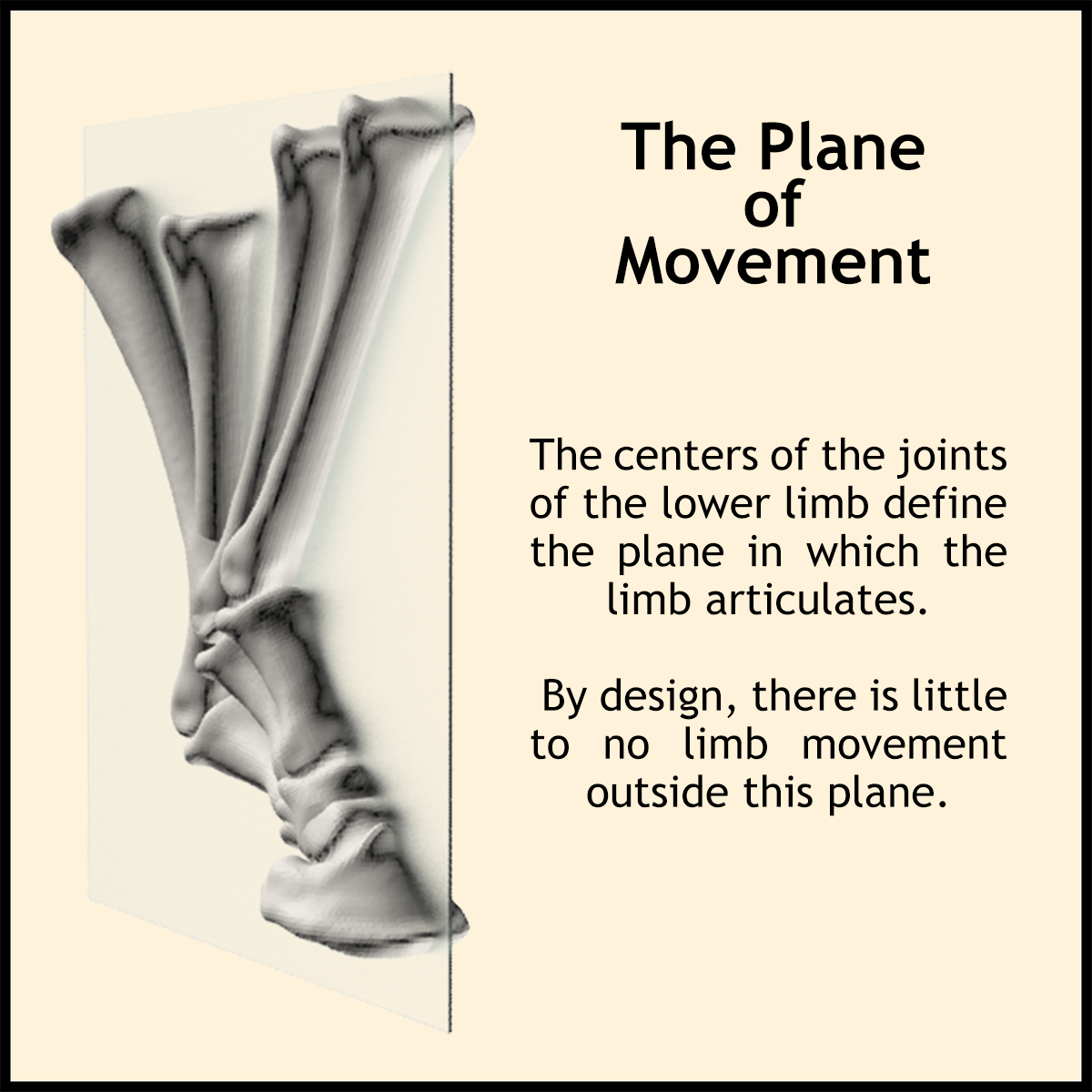
The Plane of Movement

Thus, there is practically no side-to-side variation in how the horse presents his hoof to the ground; on any given surface, the hoof will always make ground contact in essentially the same way. This is very important to the health of the horse’s lower limb. As you can see in the above illustration, if the hoof were to make uneven medial-lateral ground contact, there would be considerable stress on the joints of the lower limb with every step, because they cannot articulate in a side-to-side direction.

Unfortunately, deliberately unbalancing the hoof is extremely commonplace, often advocated by veterinarians and hoof care providers in a well-meaning but misguided attempt to “correct” a limb whose foot points in a direction other than perfectly in line with the horse’s body. These methods leave one “side” of the hoof wall long with respect to the other side to twist the foot as it comes under load, sometimes giving the appearance of a straighter limb when the horse is standing still, as has been attempted by the hoof care provider for the horse in the radiograph at the beginning of this article. Since the “set” of the limbs is determined by the shoulder and hip joints, however, it’s simply not possible to truly correct such a condition through trimming or shoeing; the shoulder or hip cannot actually be changed, and the horse ends up paying a heavy price for the false impression of being “more correct.”

In most of the cases I’ve seen, no actual “straightening” has occurred; the shoulder or hip joint is sufficiently flexible to allow enough rotation of the entire limb from the torsion applied by the foot imbalance as it comes under load to make the toe point more forward while it’s on the ground, thus giving the appearance of a straighter limb. But as soon as the foot is unloaded, the leg “unwinds” and travels in the plane in which it was designed to travel. And in the much-less-common cases where actual limb twisting has occurred, such as when this technique has been carried out on a still-growing youngster, the turn is limited to the bones and joints of the lower limb, leaving a leg whose digit points in one direction but elbow or stifle points in another. The actual plane of limb motion, of course, remains unchanged.

The consequences of smaller imbalances may initially be subtle, and may show up as an unwillingness or difficulty in performing certain movements on harder surfaces, or being a bit “off” after doing such movements. But the damage caused by the stress placed on the joints with every step eventually takes the form of osteoarthritis – deterioration of the cartilage that lines the joint, often accompanied by calcium deposits (bone spurs) around the joint – and lameness. Larger imbalances may result in more pronounced lameness and a definite hastening of joint damage, resulting in career-ending conditions such as articular ringbone. And by the way, the good news for barefoot horses is that minor imbalances will eventually “self-correct” through wear; conversely, the bad news for shod horses is that no such self-correction can occur, and the effects of imbalances are actually intensified by the presence of the shoe.

Interestingly, in the course of writing this article, I had the opportunity to hear not one, but two, stories about so-called “corrective shoeing” that I think are useful to share.

The first was from a woman thanking me for writing Horseshoes: A Means to What End? who mentioned she is a believer in having horses barefoot, and is currently having some “corrective shoeing” done on one of her horses with the ultimate objective of having this horse barefoot as well. According to her, the horse is wearing one side of the hoof wall down faster than the other, and is therefore more comfortable with shoes on.

While this indeed may be true, her implied cause-and-effect between preventing the wear and the horse’s comfort is indeed a tenuous one. There are only two explanations for why the horse would be wearing as she describes: either the foot is not being properly balanced when trimmed, or something higher up in the horse’s limb or body is causing the horse to contact and load the foot in an asymmetrical manner. In either case, merely preventing the horse from asymmetrically wearing the foot by means of a horseshoe is not only not addressing the problem – it’s actually causing damage to the joints as described above. It’s certainly not “correcting” anything! So why is the horse more comfortable with a shoe on the foot? Almost certainly because the sole is being over-trimmed, the sole is not yet properly conditioned to be barefoot on the types of terrain being ridden on, and/or there’s a problem with the horse’s diet – none of which have anything to do with preventing uneven wear. And if one’s objective is to have a barefoot horse, the process of doing so is never going to include a horseshoe; we don’t “prepare” a horse for being barefoot by using what we’re trying to move away from! Sorry – not logical.

The other situation is a woman who’s spent the last year or so following the advice of her veterinarian and farrier to “correct” the turnout of one of her horse’s forelegs through deliberately unbalancing the foot. And now, guess what? Radiographs of the lower limb, which showed no joint damage a year ago, now show significant damage, and the horse is lame. And yet, she still can’t bring herself to accept that her hoof care provider and veterinarian have caused the problem, and haven’t “corrected” anything!

Remember: While the use of a horseshoe to prevent excessive even wear of the bearing surface of the hoof wall may be one thing, using a horseshoe to inhibit asymmetrical wear can only ultimately result in joint damage.
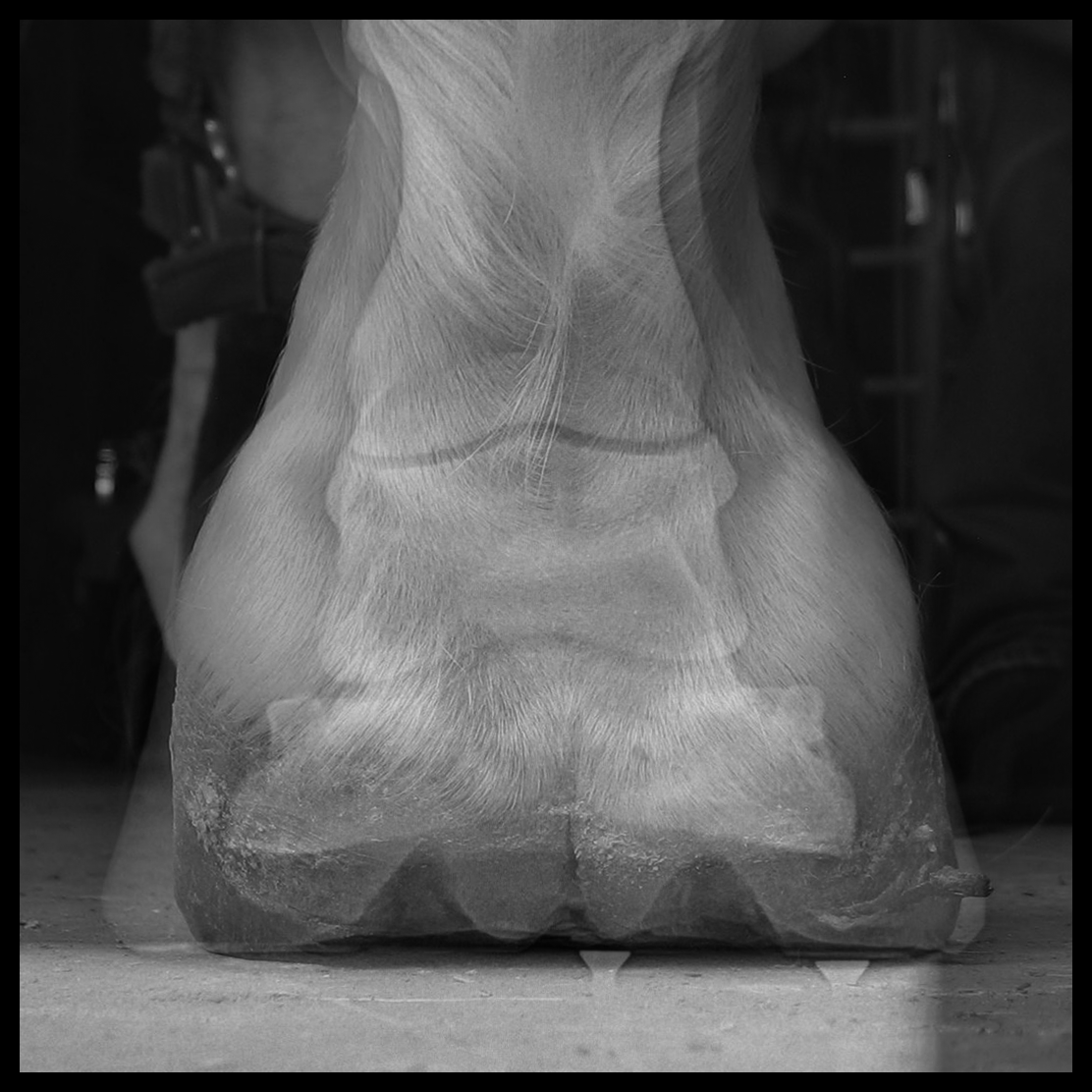
Composite Hoof & Radiograph
Composite image of a photograph and radiograph of a balanced foot

Determining whether or not your horse is in medial-lateral balance isn’t difficult, but it can require a bit of practice to develop a “feel” for it. Be aware, though, that the natural limitations of our vision will make small hoof imbalances difficult-to-impossible to see, especially in the less-than-optimal lighting conditions that are found in nearly every barn in the country!

On an unyielding flat, level surface, such as concrete or asphalt, and with as much light on the situation as possible, carefully watch each of your horse’s feet as he walks both towards and away from you. No part of the hoof or shoe should make ground contact before any other part, and there should be no rocking or twisting as the foot is loaded, although some horses will twist a (usually hind) foot just before it leaves the ground. Listening to ground contact is even more useful; the sound of a balanced foot will be distinct, with no “double-tap” or “smearing” evident. And slow-motion video is an even better and more definitive method: Video your horse at ground level from the front and back, and then either slow the video down to about 1/5 normal speed or step through each hoof contact frame-by-frame to determine if the feet are making even contact.

In addition to visual and aural observation of hoof landings, horse owners and hoof care providers can develop an “eye” for balance by understanding the relationship between the coffin bone and hairline at the heel bulbs. As illustrated in the composite image above, both the hairline at the back of the foot and the bottom of the coffin bone are M-L ground-parallel in an M-L balanced foot for the vast majority of horses. In rare instances (in my experience), the hoof capsule/coffin bone of certain hind feet will not be ground parallel, but will be tipped very slightly toward the lateral side for a proper (flat) landing; this, however, can only be determined by properly balancing the foot initially, and then carefully observing the consequent landings and adjusting the trim if necessary.

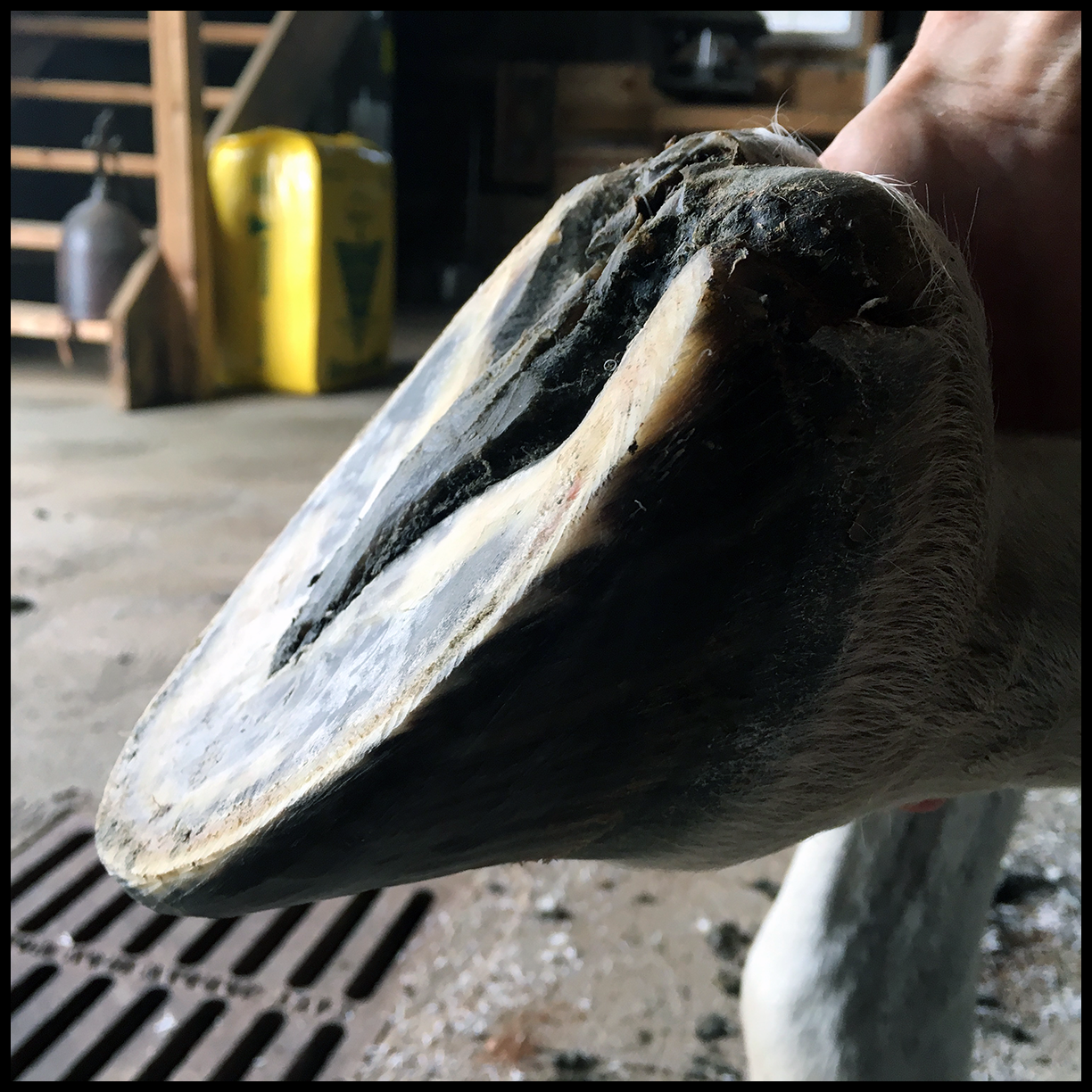
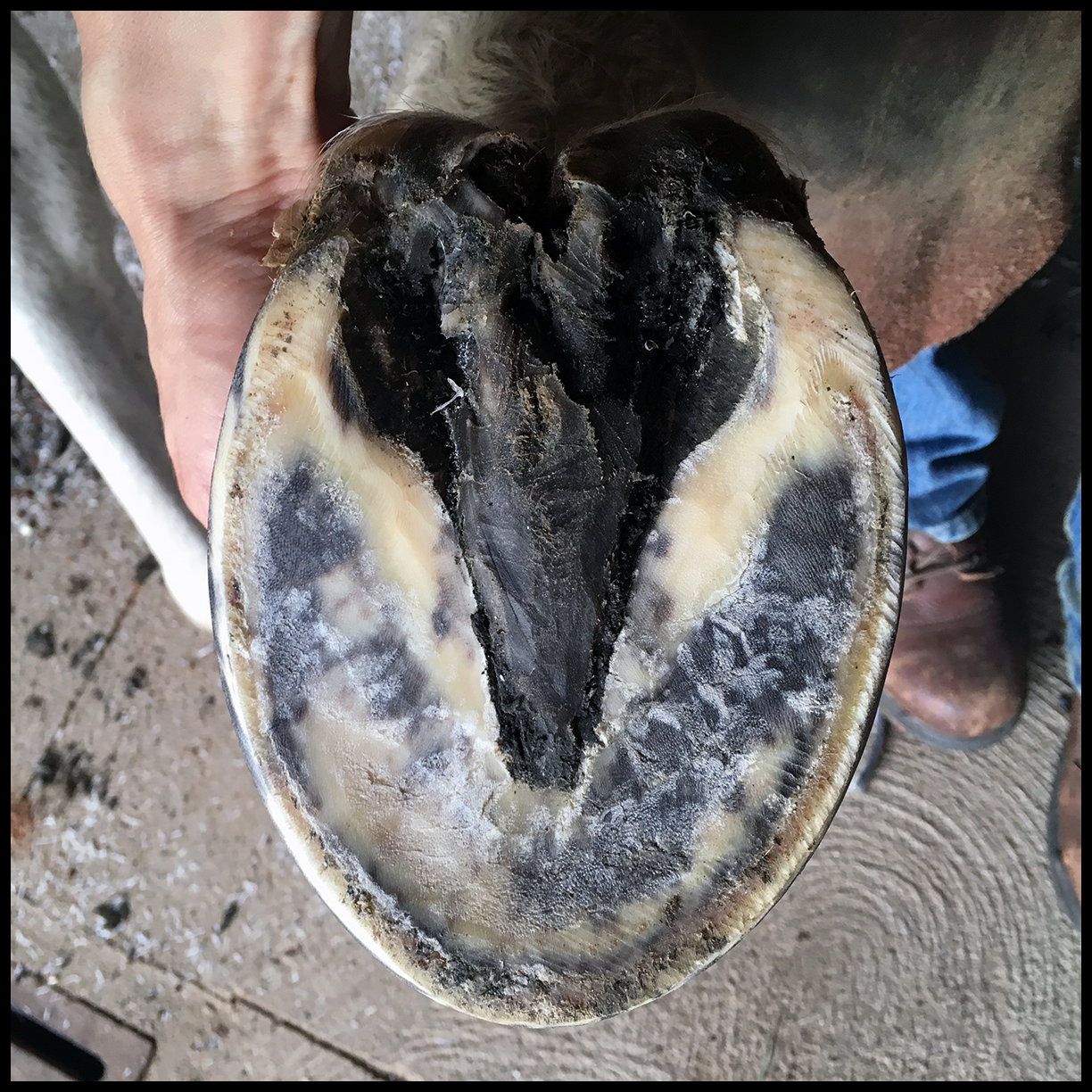
A potentially more serious imbalance condition referred to as sheared heels can occur when one heel buttress is left chronically long with respect to the other of the same foot. Rather than the entire foot tilting one way or the other, the entire half of the hoof capsule with the longer heel may instead end up vertically displaced with respect to the other. Although some limited research by others shows that the actual coffin bone position in these imbalances apparently remains unchanged because the coffin bone only occupies a very small part of the back part of the hoof, this type of  imbalance can nevertheless cause severe lameness, promote wall cracks, and contribute to frog infections, and should therefore be taken seriously. Although the horse in the following two photos taken before his most recent trim has been under our care for a relatively short time and has greatly improved, the evidence of years of improper M-L balance remains in the form of a “shoved up” lateral heel and quarters –
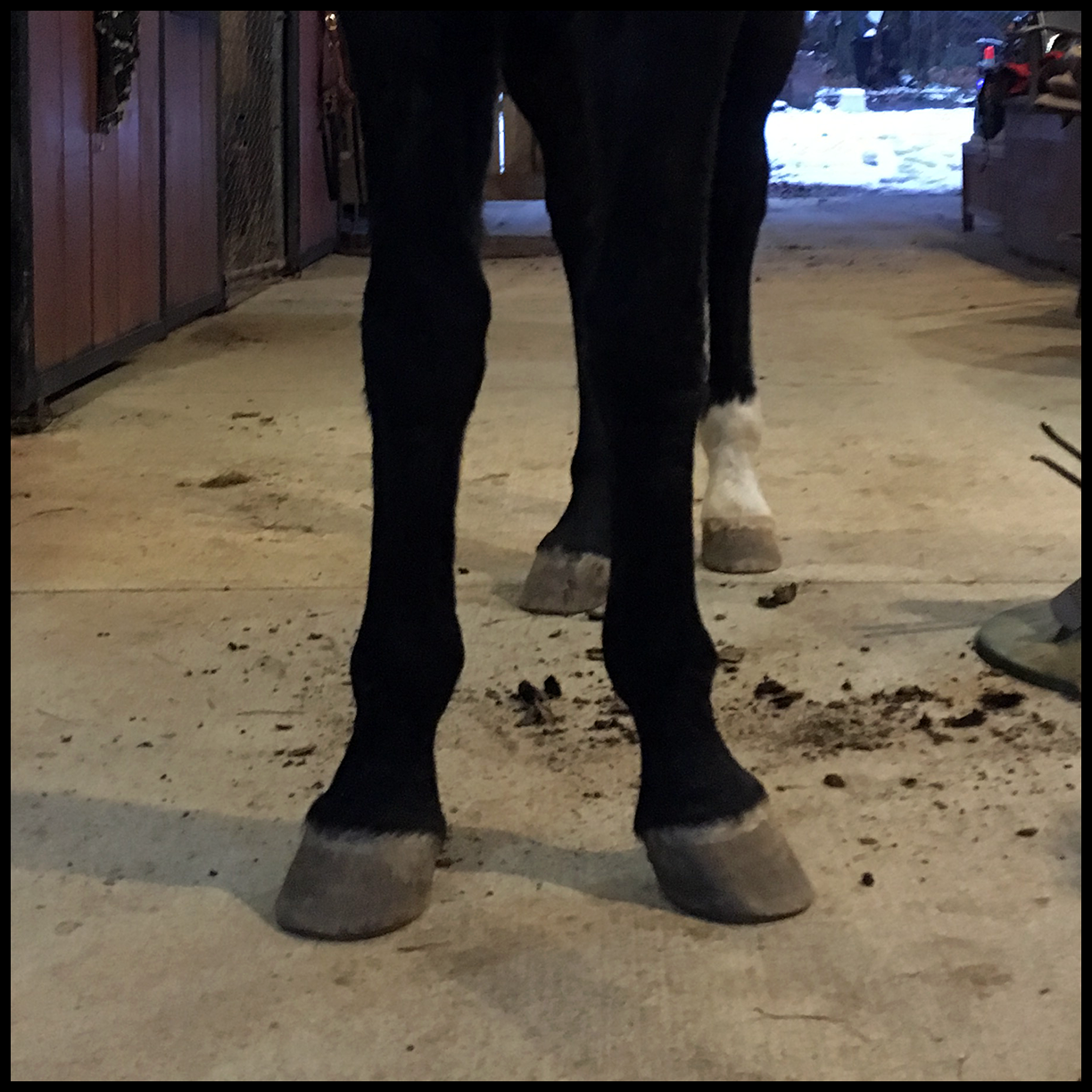
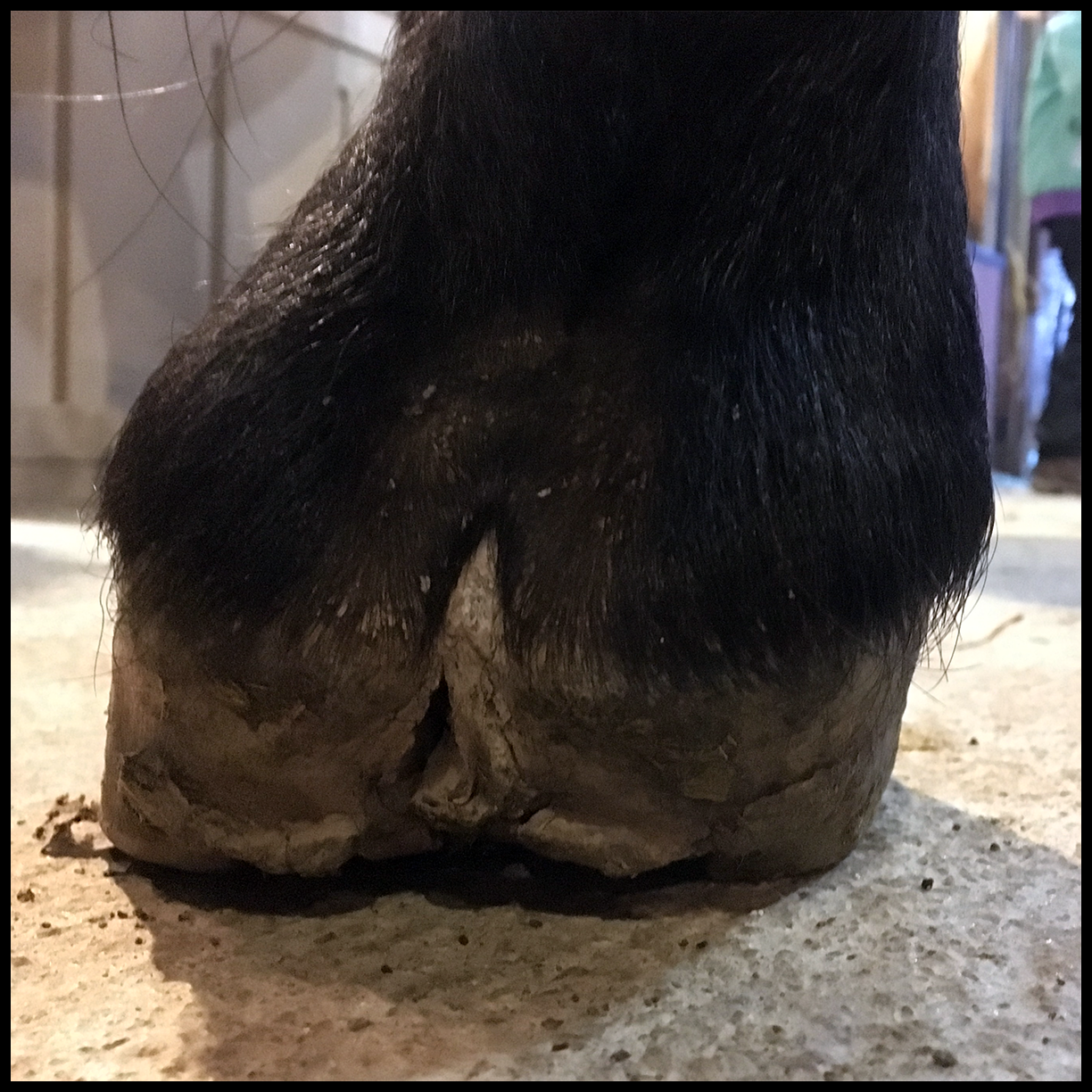
Photo of splay-footed horse
Horse with profoundly – but naturally – turned-out forelegs. Note that the carpus (“knee”), fetlock, and toe of each foreleg all point in the same direction.
Photo of sheared heels
…and a rear view of the left foreleg. Although some would consider this foot properly balanced because the heel buttresses and toe define a plane reasonably perpendicular to a vertical plane passing through the central sulcus of the frog, the hairline (among other things) indicates that the entire lateral side of the hoof is, in reality, (still) a bit longer/higher than the medial side. A work in progress, with some distance yet to go…

If the hoof had continued to be improperly trimmed, the hairline on the longer-heel side of the foot would have continued to be shoved upward. Imagine facing the horse and wrapping your hands around each side of the hoof – fingers on the bottom, with your palms against the sides of the hoof wall – and twisting in a vertical direction; that’s exactly what has happened! Yet, because many hoof care providers are taught that a foot is in balance if the bottom of the heel buttresses describe a plane 90° to the so-called “median plane” – a vertical plane passing through the apex of the frog and continuing through the central sulcus of the frog (i.e. through the “middle” of the foot – see the plane shown in “The Plane of Movement” graphic above) – they fail to recognize this form of imbalance.

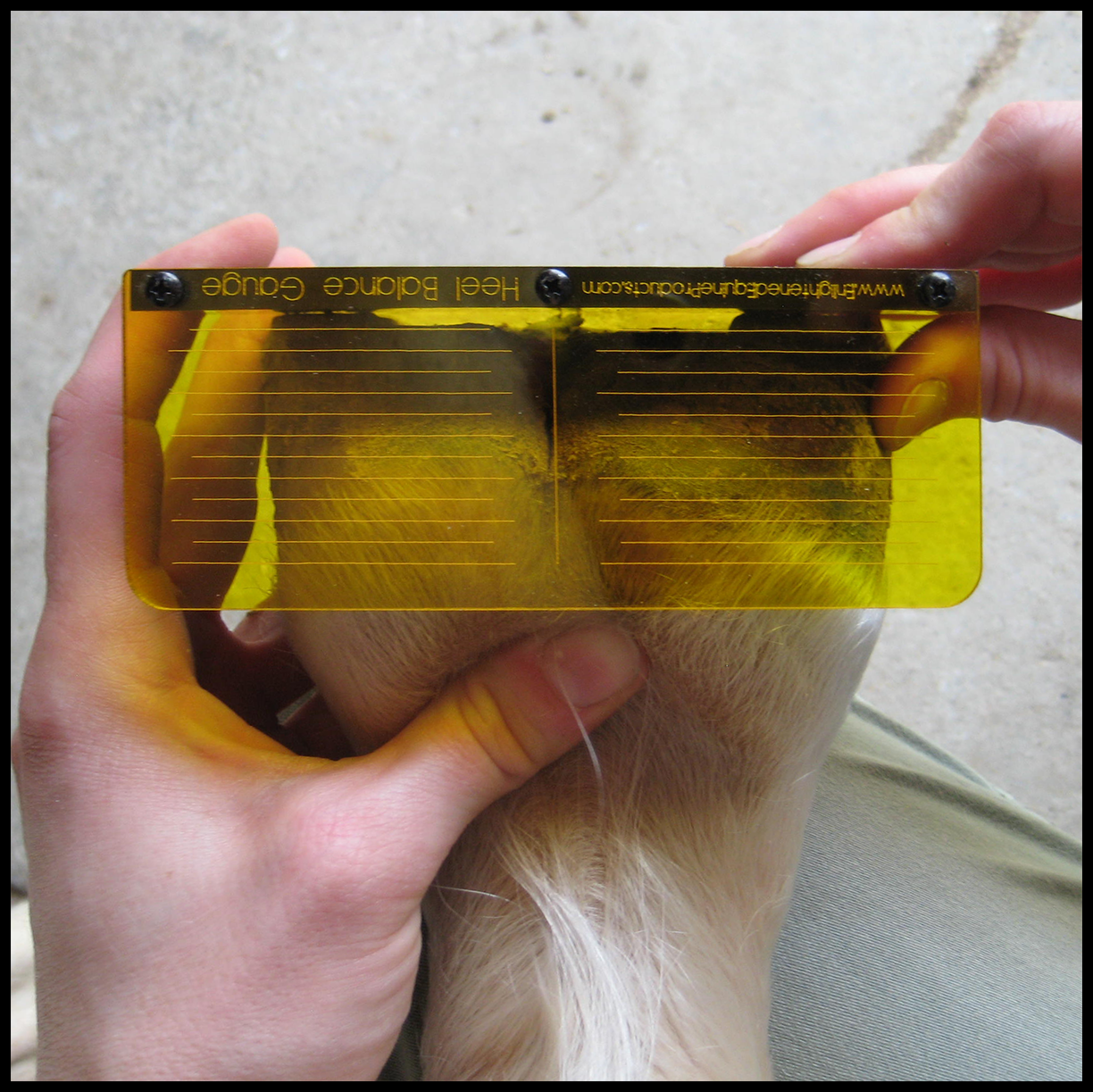
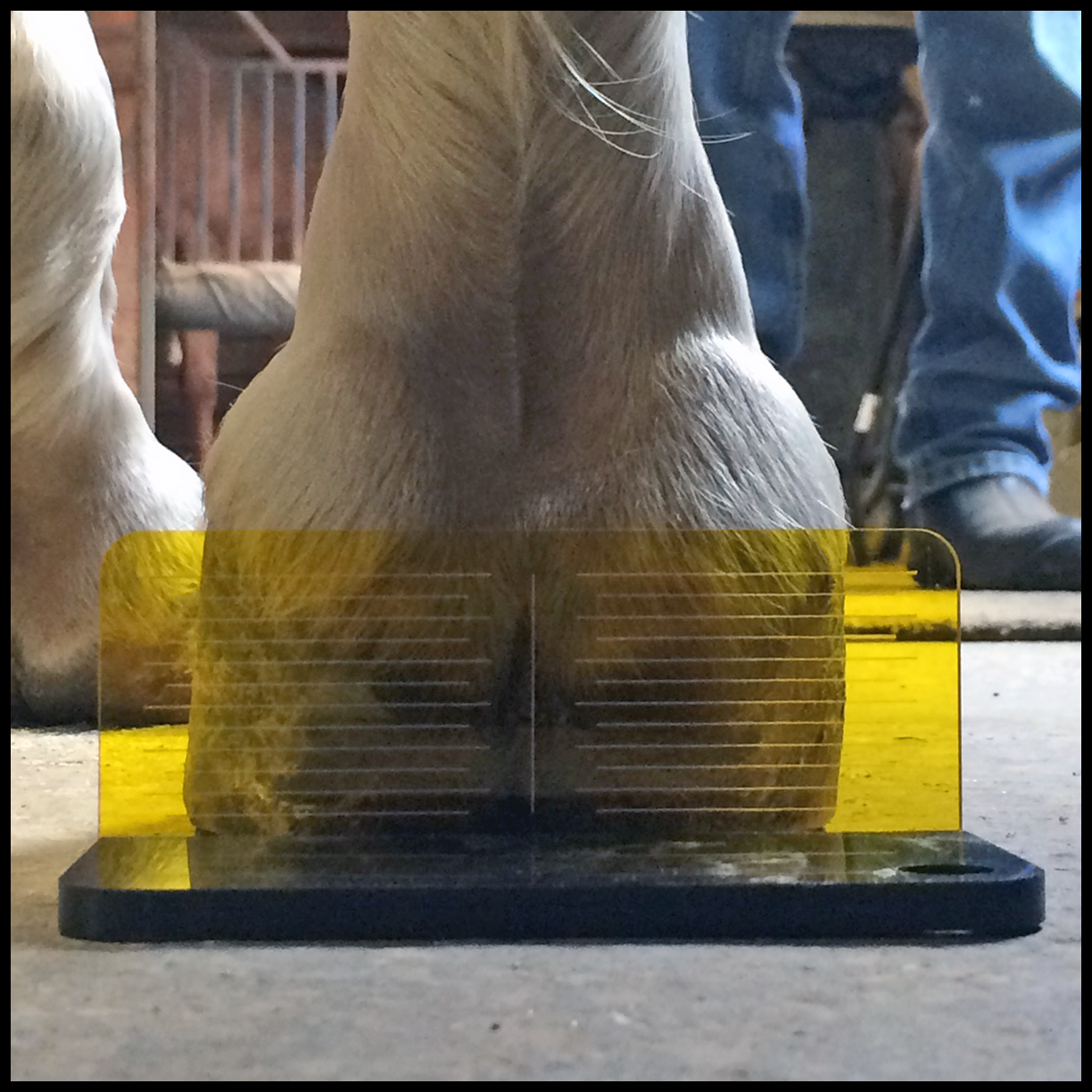
To help check M-L balance, I’ve developed a simple tool that will allow both horse owners and hoof care providers to easily determine if a horse’s hoof has been properly trimmed. As shown in the photographs below, this Heel Balance Gauge can be used in two different manners to determine whether or not the heel buttress height is equal.
Heel Gauge - In Air
Heel Balance Gauge being used directly on the bottom of the elevated hoof
Heel Gauge - On Ground
Heel Balance Gauge being used on the ground behind the hoof

Eliminating M-L hoof imbalances can be challenging – not because of the actual trimming involved, but because many hoof care providers are simply unaware they’re not properly balancing the hoof, and the ones that are deliberately unbalancing the hoof are usually convinced they’re doing the right thing! So while it may be possible to explain to your hoof care provider that you want your horse’s feet to be in balance, it may ultimately be necessary to change hoof care providers to actually accomplish that objective. But your horse will thank you for it – by performing better and by staying healthier for a longer time!

“No one ever suggests we use some sort of tire to fix a crooked truck axle. Why would anyone suggest we use some sort of horseshoe to fix a crooked horse limb?” – Steve Hebrock
Superhero Fiction graphic

Years ago, I was invited to speak at a “natural” horse training and care event put on by a large horse farm. I began my talk to what turned out to be primarily American Saddlebred owners with a phrase I’ve often used as an introduction to what I do: “My overwhelming concern in hoof care is for the long-term health and comfort of your horse.” Much to my shock and dismay, several of the attendees were quick to point out that the horse’s well-being was a non-issue for them; their only concern was to win at shows, regardless of what it might mean for the horse, and were therefore willing to do practically anything to their horses’ hooves in an effort to gain some alleged advantage in the show ring.

When I purchased my first horse back in 1993, I really didn’t have any opinion about horseshoes one way or the other; I was relatively new to horses, and figured some needed them and some didn’t. My new horse was a Peruvian Paso – a breed that is traditionally not shod, are reputed to have congenital “good feet,” and cannot be shown wearing shoes in a Peruvian Paso show – and so I just automatically put him in the category of “doesn’t need shoes.”

Included with the documents that accompanied the registration papers for my new horse was a sheet warning registrants about the importance of choosing a qualified farrier. Because the PP is a fairly uncommon breed (there were only 12,000 registered Peruvian Pasos in the U.S. when I bought him), and because they typically have a much lower pastern and toe angle than the more common breeds, the folks at the registry were concerned that an improperly-educated farrier might try to “stand up” the horse i.e. leave the heels too long and/or cut the toe too short in a misguided effort to make the horse’s feet look more like a Thoroughbred or American Quarter Horse.

And so, after consulting with my friend Tom Wolfe, the now-former director of the Montana State Horseshoeing School (and whom, I learned in the course of writing this article, was inducted into the International Horseshoeing Hall of Fame in 2011 for his contributions to farrier education – congratulations, Tom!) whom I’d befriended several years earlier on a riding trip to Montana, I decided I had more faith in the devil I knew than the devil I didn’t, and would therefore learn how to do my own trimming. As Tom said, “It isn’t rocket science, and you are an engineer, after all!” So I set out on a journey that’s now lasted 25 years, with no signs of slowing down.

I read books and magazine articles on horseshoeing and hoof care. I talked with every farrier and veterinarian I crossed paths with, hoping to glean some new and useful piece of information about horse feet. I spoke to other owners about their horses’ foot problems, trying to understand the various “treatment” options they’d pursued and rates of success. But mostly I just listened and pondered. And the little voice of the engineer in me soon started whispering in my ear, “You know that can’t be true; it’s not logical.” “His advice directly conflicts with her advice; both can’t be right.” “The laws of physics tell you it doesn’t work that way; the shoe couldn’t possibly be doing that.” And on and on, until I finally realized that with respect to what could or couldn’t be accomplished with a horseshoe, the only logical conclusion I could reach was that people really didn’t know what they were talking about!

I’ve spent a lot of time over these past 25 years trying to sort out fact from fiction for myself, for horse owners, and for other hoof care professionals. Not only has this meant trying to keep up with what little hoof research is actually being conducted, via academic journal articles, but doing my own research as well, in combination with many, many hours of discussion with both other academics in the horse world along with “non-horsey” engineers and other technical people.

The Emperor's New Clothes graphic

As a result, I can say with a very high degree of certainty that there are only four (4) parameters of a hoof that can be successfully modified by a horseshoe, regardless of the specific type of shoe utilized, that could arguably be considered advantageous over a properly-trimmed bare hoof under certain circumstances and with caveats. I’m not going to go into all the theory and rationale for these statements at this time, but I promise I will do so at a later date. In the meantime, please note that science tells us that in comparison with a properly-trimmed bare hoof, adding a horseshoe can only:

  • Eliminate wear of the bearing surface of the hoof wall
  • Increase clearance between the ground and sole/frog
  • Increase or decrease the foot’s traction
  • Delay the timing of, and increase the height of, the peak in the foot’s flight arc

This is certainly not to imply that other things cannot be negatively affected by the presence of a shoe, nor am I saying that a particular shoe may not have more or less of an impact on these four parameters than another type of shoe. The above is simply stating that any other hoof characteristic, conformation or movement characteristic, or pathology, alleged to be improved by the presence of a shoe, such as support, breakover, or navicular disease, is a complete fiction.

Each of these four possible advantages also has one or more trade-offs associated with the presence of a shoe. First and foremost on the list is that any type of shoe placed on an incorrectly-balanced hoof will put stress on the joints of the lower limb, with no chance of “self-correction” because wear has been eliminated. The consequences of that stress will be a hastening of arthroses of those joints, causing various types and degrees of unsoundness. This is far and away the most common cause of lameness problems we see in our practice: well-meaning farriers who either do not know how to properly balance hooves, or who deliberately unbalance hooves with the mistaken belief they can “correct” something by doing so.

Likewise, the shod horse will always have an increase in hoof length, weight, and concussive forces over the properly-trimmed barefoot horse – all of which intensify joint and soft-tissue stress any time the hoof is in motion. And the longer and/or heavier the shoe, the greater the stress, which means any shoe heavy enough to significantly affect flight arc peak i.e. “action” is going to cost the horse in terms of energy required and long-term joint/soft-tissue damage.

While increasing ground clearance may be advantageous for riding on certain terrain types, the loss of stimulation through ground contact causes the foot to produce softer sole tissue, which is why the horse who loses a shoe is often sore on rough terrain while his barefoot companion is not. This tissue quality difference is often dramatic, and can be particularly apparent on a horse that’s shod only on the front.

And even traction modification is a two-edged sword. Although it can be a useful short-term tool for specific situations (such as on ice, or in a reining show), it can also result in minor and even major (mostly soft tissue) injuries if the amount of traction isn’t appropriate for the terrain/application. Many horse owners are still astonished when I tell them a plain steel shoe provides less traction on harder surfaces than a bare hoof.

A friend once said to me, “Oh, that’s right – you don’t believe in horseshoes,” as if belief has anything at all to do with it! Please understand this is not some sort of “crusade” against horseshoes. These conclusions aren’t based on emotion; they’re based on science. On data. On logic. I’m simply acknowledging shoes for what they are – a piece of metal, a spacer, a wear inhibitor, a weight. And trying to get people to understand what they are not – a panacea for hoof and horse issues. I’ve generally come to regard them like this: A horseshoe is a tool for which I have yet to find a genuine need.

Revelation graphic

If a particular horse truly needs to minimize wear and/or have sole protection for a specific situation – things like: an endurance ride, a ride over rough terrain, sensitive feet due to flat soles/dietary issues, or an injury – then, by all means, protect his feet. He absolutely deserves to move pain-free. But if you decide to do it with shoes, the only approach that’ll guarantee minimal adverse effects is to do as my friend Don West does: Shoe the horse immediately before the ride, and pull the shoes when you return. And, to be done correctly, that will mean using the thinnest, lightest shoe available, placed on a foot trimmed in strict accordance with proper natural hoof care principles.

Doesn’t it sound like an impossible situation, since most of us aren’t trained to trim hooves, and shape and nail on a horseshoe? Yep. And that’s why hoof boots are the far better choice when hoof protection is necessary. They modify the same four characteristics as a shoe, but minimize or eliminate the trade-offs because they’re only used for the time period when the need for protection actually exists. Plus, because they cover the sole and frog as well as lift them off the ground, they provide superior protection over any horseshoe.

So what’s my point in all of this? Well, with that “logical thinking” thing in mind, consider the following –

Since a horseshoe is limited to modifying only the four characteristics listed above, and, even under ideal trimming/shoeing circumstances, there are long-term negative health consequences to anything but very short-term use, then why use them? Why not see them for what they are…and are not? Why not do everything in your power to give your horse every possible health and comfort advantage, and keep him sound for as long as possible?

Think about it…

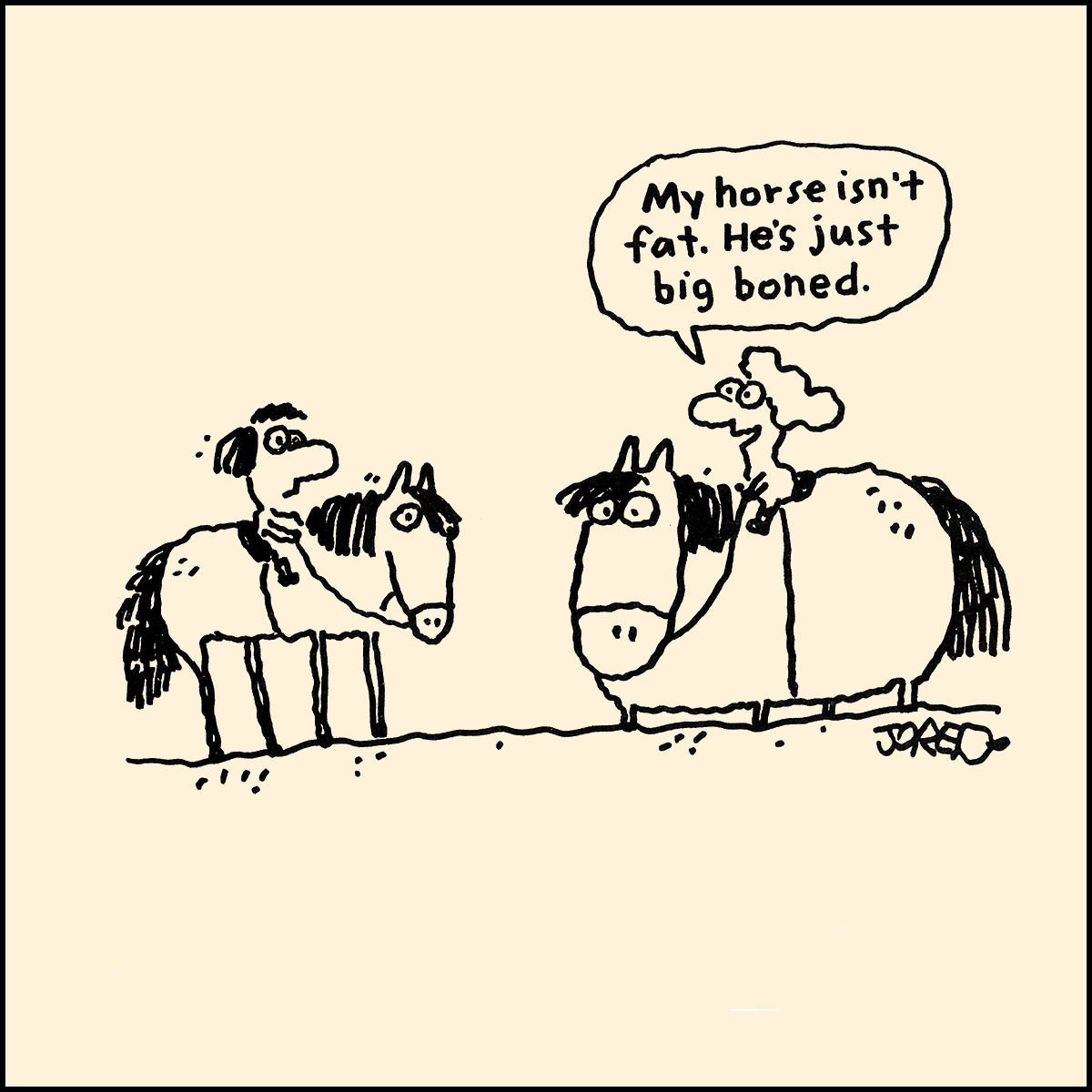
Jared Lee Cartoon "Big-Boned"

“You’re killing your horse!” I exclaimed. The woman had just related how her geriatric Morgan was on constant grass pasture, with continuous access to hay, and now also being fed what she described as “just over twelve pounds of feed a day.” “But the vet told me I need to put weight on him!” she protested. Dora and I weren’t concerned about his weight at that particular moment; we were worried about what we were seeing in his feet: flat soles, very stretched white lines, sore to the point of being unwilling to lift his feet, and – most disturbing of all – soft, squishy sole tissue directly beneath the coffin bones. And if he continued on that course, we knew it would only be a short time before his coffin bones penetrated his soles…

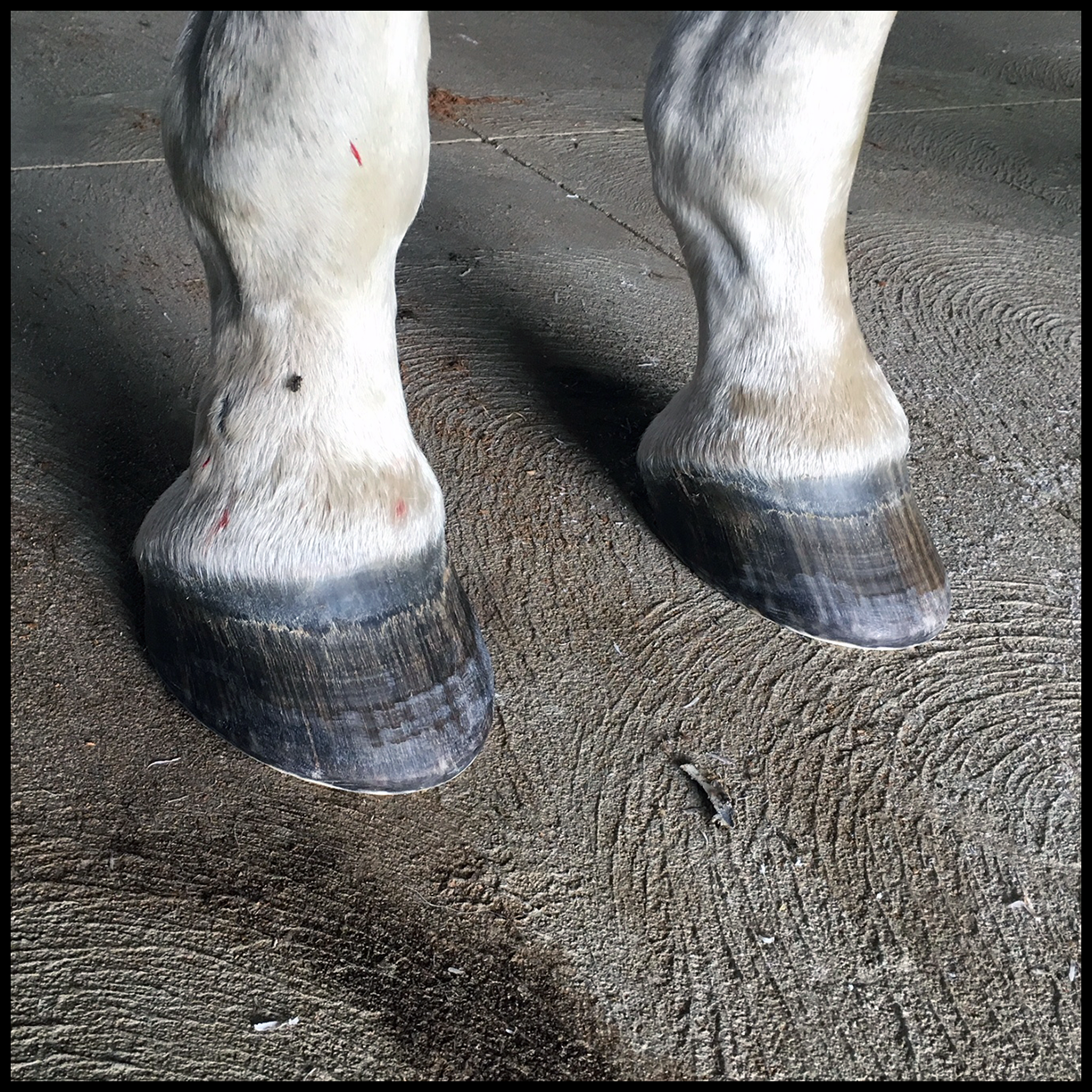
EL - Front Feet
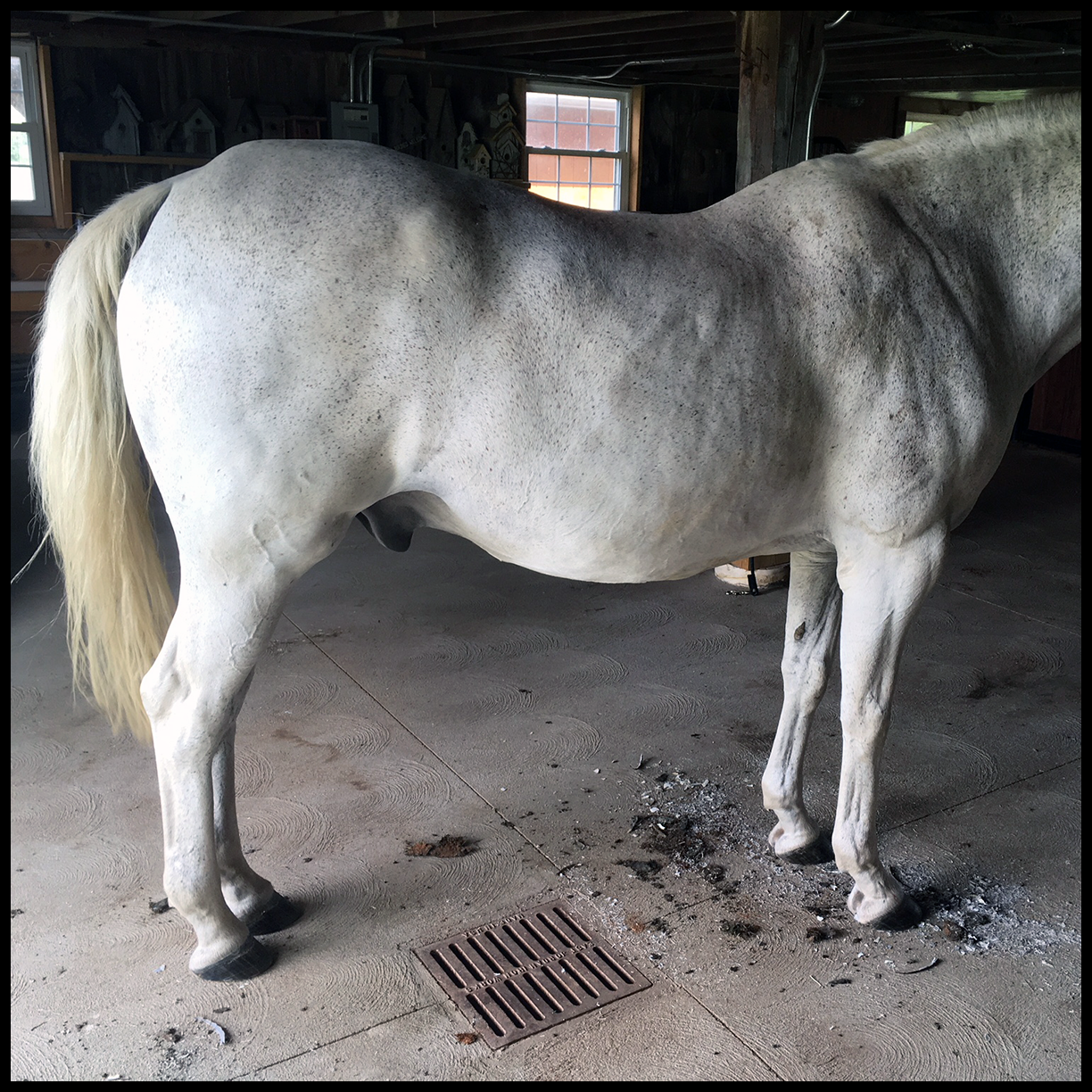
The feet of this big warmblood may appear fairly normal, but…

Four years ago, I wrote an article entitled How Much is Too Much? that described research done by one of my university colleagues on the question of how much weight a horse can carry without evidence of muscle damage. And while riders too heavy for their horses continue to be a serious problem (for their horses, certainly!), overweight horses such as Jared Lee’s “big-boned” cartoon horse and the very real horse described above are all-too-typical examples of what we now see on a near-daily basis.

EL - Body
…the body suggests all is not right! A quick glance at the bottoms of the feet…

“So what’s the big deal about a few extra pounds on my horse?” you may ask. Well, it’s because these “big-boned” horses have taken the first (or second or third) step on the path toward a condition known as endocrinopathic laminitis – an extremely common form of laminitis now recognized as distinctly different from the laminitis caused by the sudden excessive intake of carbohydrates that occurs, for example, when a horse gets into the feed room. So when we encounter an overweight horse accompanied by word that he was “a bit sensitive” after his last trim, we can pretty well predict what his feet are going to look like before we’re even close enough to see them properly. Along with increased post-trim sensitivity, they’ll often exhibit:

  • A loss of solar concavity i.e. flattening of the soles as the coffin bone descends
  • Sole bruising, particularly below the coffin bone
  • Separation of the white line at the toe, eventually extending all the way around the hoof
  • Flaring of the hoof wall at the toe, eventually extending all the way around the hoof
  • Horizontal rings and waves in the hoof wall rather than normal straight growth
  • Frequent hoof abscessing
EL - Hoof Oblique
…reveals a near-complete loss of solar concavity…

Unfortunately, and to the disservice of horses and horse owners (and hoof care providers), many veterinarians have been slow to keep up with research on this condition, instead clinging to the outdated belief that horses presenting with clinical symptoms consistent with laminitis (some of which are listed above) but without an “obvious” cause for laminitis must actually have some other condition. Yet, as a recent article in The Veterinary Journal points out –

Endocrinopathic laminitis is now recognized as the most common form of naturally occurring laminitis in horses and ponies presenting primarily with lameness in developed countries….An earlier misconception that laminitis was predominantly associated with sepsis or SIRS arose from its prevalence in equids treated at veterinary referral hospitals, where laminitis research is concentrated….This misperception was highlighted by a large epidemiological study in the USA, which showed that grain overload, retained placenta, colic or diarrhoea accounted for only 12% of owner-reported cases of laminitis; the remainder were associated with dietary problems or obesity, or were of unknown cause. Subsequent, more convincing studies from the USA and Europe identified endocrinopathies (i.e. “hormone problems”) in 90% of cases of laminitis in horses/ponies presenting for lameness. (Patterson-Kane, J.C., et al. “Paradigm Shifts in Understanding Equine Laminitis.” The Veterinary Journal, vol. 231, 2018, pp. 33–40)

EL - Hoof Bottom
…and the beginnings of a stretched white line at the toe!

Please be aware that improper trimming can also cause some of these same symptoms, and it can occasionally be challenging to sort out the real culprit! But if you haven’t changed hoof care providers and your horse is now showing signs of having sensitive feet, you should first consider whether or not any or all of the following are true.

If your horse is:

  • Objectively overweight i.e. a Body Condition Score (BCS) of 6 or higher,
  • Regularly consuming more calories than are required to maintain his body weight,
  • No longer doing as much work as he was previously doing, but his caloric intake hasn’t been reduced,
  • Being fed differently than when he was sound, including treats and supplements, and/or
  • Consuming any grass,

there’s an extremely good chance the sensitivity he’s experiencing is a symptom of the early stages of endocrinopathic laminitis. Again – your vet probably won’t recognize it as such, because most veterinarians simply don’t have the experience or expertise to recognize the subtle (at least to them!) changes in the feet that signal potential disaster looming over the horizon. But the foot is a marvelous “early warning system” for dietary and other health/management issues, so if your hoof care provider is properly trained – admittedly a big “if” as well – he/she should see what the vet and others may not. So ask questions, and listen carefully to the answers. I can’t emphasize this enough: endocrinopathic laminitis, like any other form of laminitis, is an extremely painful condition, yet the condition can usually be avoided if the diet is properly managed. And while it’s definitely treatable, with full recovery possible, it’s certainly much easier to spare you and your horse by attempting to prevent it in the first place by ensuring your horse stays at a healthy weight (4.5 – 5.5 BCS).

Contrary to what most horse owners I talk to seem to think, it’s really neither difficult nor time-consuming to do the math to figure out approximately how many calories your horse requires to maintain a proper body weight for the amount of work he’s doing. But keep in mind that all calorie information and feed calculations are based on weight, not volume, which means that whoever feeds your horse should be weighing his hay and feed. And although you should only need to correlate weight with volume once for a given brand and type of feed e.g. “this orange scoop full of HappyHorse Brand SuprGood Feed has a net (feed) weight of 3 pounds,” hay varies tremendously and each feeding should be weighed!

Remember: In order to help prevent possible endocrinopathic laminitis problems, it’s extremely important that you be objective about your horse and his situation:

  • Be honest about your horse’s current weight and BCS
  • Be honest about how much work your horse is actually doing
  • Be honest about what your horse should weigh
  • Be honest about what and how much your horse is consuming

I realize many horse owners think horses are “supposed” to be round-looking, or that horses look “healthier” or “cuter” with “a few extra pounds.” But believe me: they’re not, it’s not, and they don’t! So please do the right thing and do right by your horse.

I intend to cover treatment options for the horse who does develop laminitis in a future article. But for now, let me just mention that putting shoes on a laminitic horse – even a mildly laminitic one whose only obvious symptom is foot sensitivity – is absolutely the wrong thing to do, and will actually increase pain and delay healing in spite of what others may try to convince you of! So if you find yourself in that situation, do your horse a huge favor and resist the urge to shoe him; I promise you I’ll provide a well-thought-out and logical explanation in an upcoming article.

And what of the Morgan described at the beginning of this article? Well, after a great deal of discussion with the owner, including assurances that her horse wasn’t going to starve to death any time soon, we managed to convince her to eliminate the “just over twelve pounds of feed a day” from her horse’s diet. And just as has been the case with other clients’ horses, his feet recovered fairly quickly. In fact, by the time his next trim came around a few weeks later, the sensitivity was gone and the sole tissue was a normal consistency with obvious returning concavity!

I do feel compelled to say that in this particular situation, I place a lot of the blame for the horse’s pain on the veterinarian’s lack of proper education, although I cannot say for certain whether the feeding regimen was the vet’s idea, the owner’s idea, or a combination of both. Regardless, even a few minutes of contemplation should lead any reasonable person to figure out that adding nearly 19,000 calories per day to any horse’s diet – particularly one whose caloric intake should be in the 13,000 – 14,000 total calories per day range – makes absolutely no sense at all.

As I keep saying: Question everyone and everything, no matter the source of the advice…and don’t overfeed your horse!

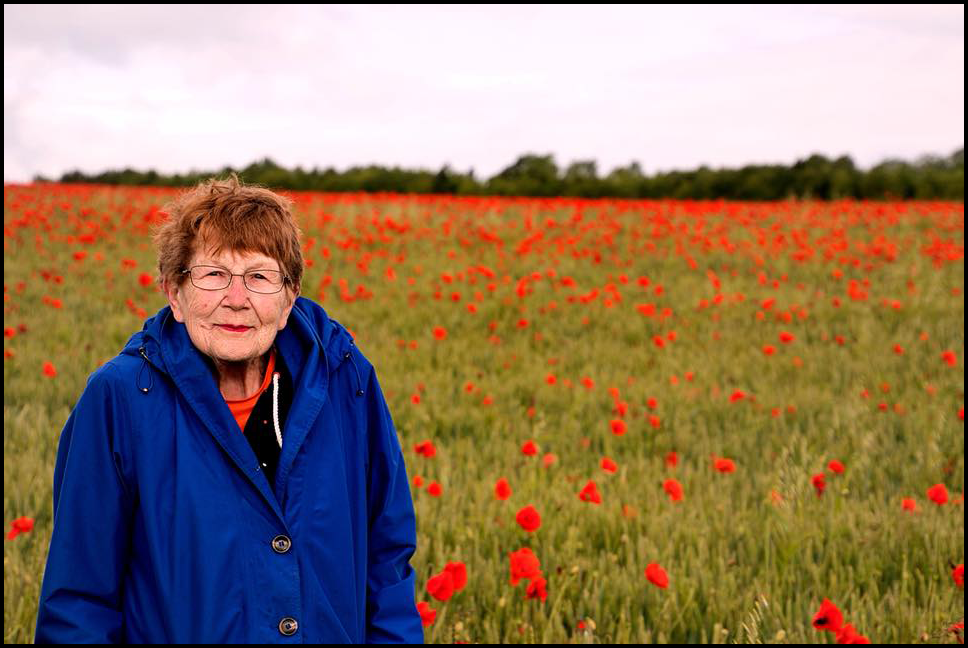
Vera Ellen Bremseth photo
Vera Ellen Bremseth 1939 – 2018

In 1982, as an unintended consequence of accepting an engineering position with Altec Lansing in Oklahoma City, OK, I had the exceedingly good fortune to become acquainted with the Bremseth family: three individuals who would arguably become the most important people in my life for the next thirty-some years.

I previously wrote about my relationship with the husband/father Gerald, a truly brilliant engineer and remarkable human being whom I continued to work closely with until his untimely demise in 2013, in my Post called Tribute to an Unsung Hero, so I won’t say any more about him here. Sadly, the focus of this Post must now be on his wife Vera, who passed away mere days before my recent trip to the UK to conduct a Liberated Horsemanship Gateway Clinic.

How do you sum up the granddaughter of a respected physician/state senator and princess of the Chickasaw tribe, and daughter of an Army lawyer stationed all over the United States with his family, in just a few sentences? Vera probably had the richest and most varied set of life experiences of anyone I’ve ever met! A teacher by training, she spent much of her life working with and for various arts- and education-related organizations such as the National Cowboy & Western Heritage Museum, the Ouray County Historical Museum, the Foothills Craft Guild, and the McClung Museum of Natural History and Culture, establishing education programs, managing gift shops and shows, and handling public relations and marketing tasks.

But mostly, for myself and for many, many others who were fortunate enough to have their lives touched by Vera, she helped people. Without question, she was the most generous person I’ve ever known; she would’ve given a total stranger her last dollar or the clothes off her back if she believed they were truly needed. But she was so much more as well – a genuine force of nature: always the polite, well-turned-out lady, intelligent, wise, and inherently benevolent, she was also fiercely loyal to, and supportive of, her friends and family. Being at odds with Vera was definitely done at one’s own peril (a position I somehow always managed to avoid).

In fact, the last time I saw Vera, we were attempting to have dinner together in Maryland at a very busy restaurant. The hostesses kept putting us off, and, after a very lengthy wait, finally told us our table was ready and then seated another party at it instead. By this time, I had complained to the hostess several times about the delay, and then about giving our table away, but without any obvious effect on the situation. Finally, Vera decided she’d had enough. I have no idea what she said to the hostess, but the next thing I knew, we were being shown to a table by multiple people who were practically falling over themselves apologizing! As I said, it never paid to cross her!

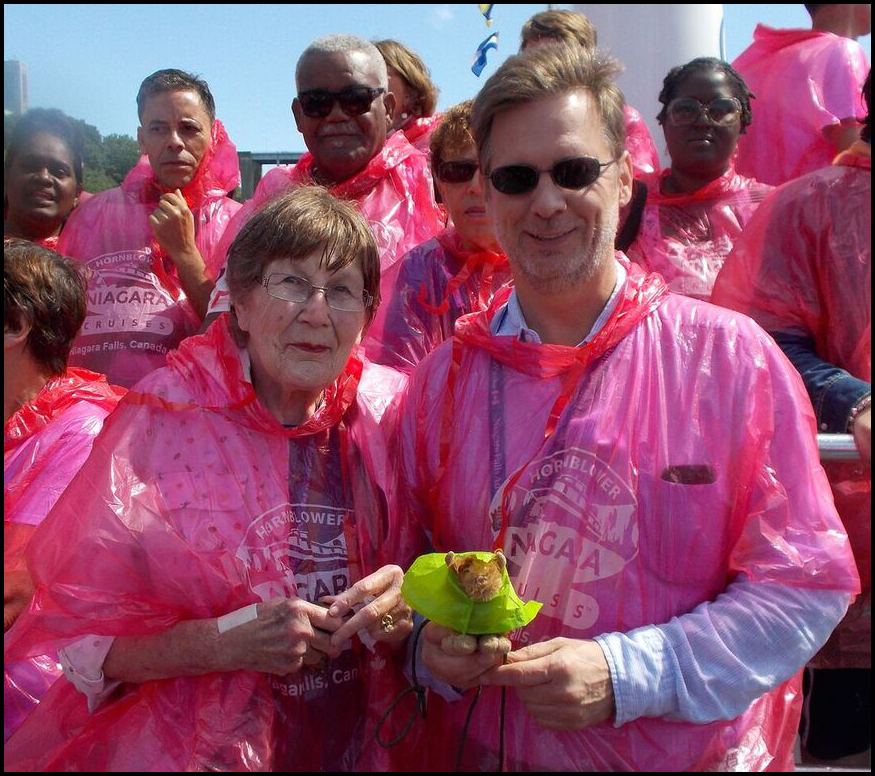
Vera and I had a wonderful relationship consisting of every positive aspect of one between mother and son coupled with that of the best of friends. We spoke multiple times each week, and, like it or not, I cherished her advice because I could always count on her to tell it to me straight and it was nearly always spot-on. And she definitely had a sense of humor as well, as you may glean from the photograph below. After all, how many people do you know who’d willingly pose for a portrait wearing a pink plastic raincoat while holding a friend’s stuffed Highland cow wearing a (custom-made!) raincoat?

Photo of Vera & me
Vera & Me at Niagara Falls, Ontario – 2015

This wouldn’t be complete without mentioning that Vera loved real animals as well, and at times they had as many as five dogs and two cats in the house. Most were strays of one sort or another; just as with people, Vera looked for opportunities to help animals too – to the extent that Gerald used to say he hoped to come back as one of Vera’s dogs because she took such good care of them!

But for me, one of the most memorable things about Vera was her laughter. The four of us – Gerald, Vera, their daughter Victoria, and myself – spent a great deal of time together over these past thirty-six years, and Vera would regularly laugh as I regaled her with one of my crazy stories about my own crazy life! I really liked that she said I always made her laugh, and I know she looked forward to those visits and conversations as much as I did. She was a very special person to me, and one particular kind of conversation we had many times over the years sticks in my mind. I’d frequently return to the house at 2AM or so, having been out listening to jazz in one or more of the clubs in Knoxville, and I always feared waking her as I came in through the front door and crept up the stairs to my room:

Me: “I hope I didn’t wake you up this morning. Sorry it was so late when I came in.”

Vera: “Nope. Didn’t hear a thing. And I’m not your mother.”

You’re absolutely right, Vera: you weren’t my mother. You were so very much more to me than that. Thanks for all the wonderful memories and everything else you’ve given me these many years, and I trust you can still hear my crazy stories and you’re still laughing…somewhere…

…and Always With Love.

This coming year promises to be an exciting one, for a variety of reasons that should be of interest to my readers!

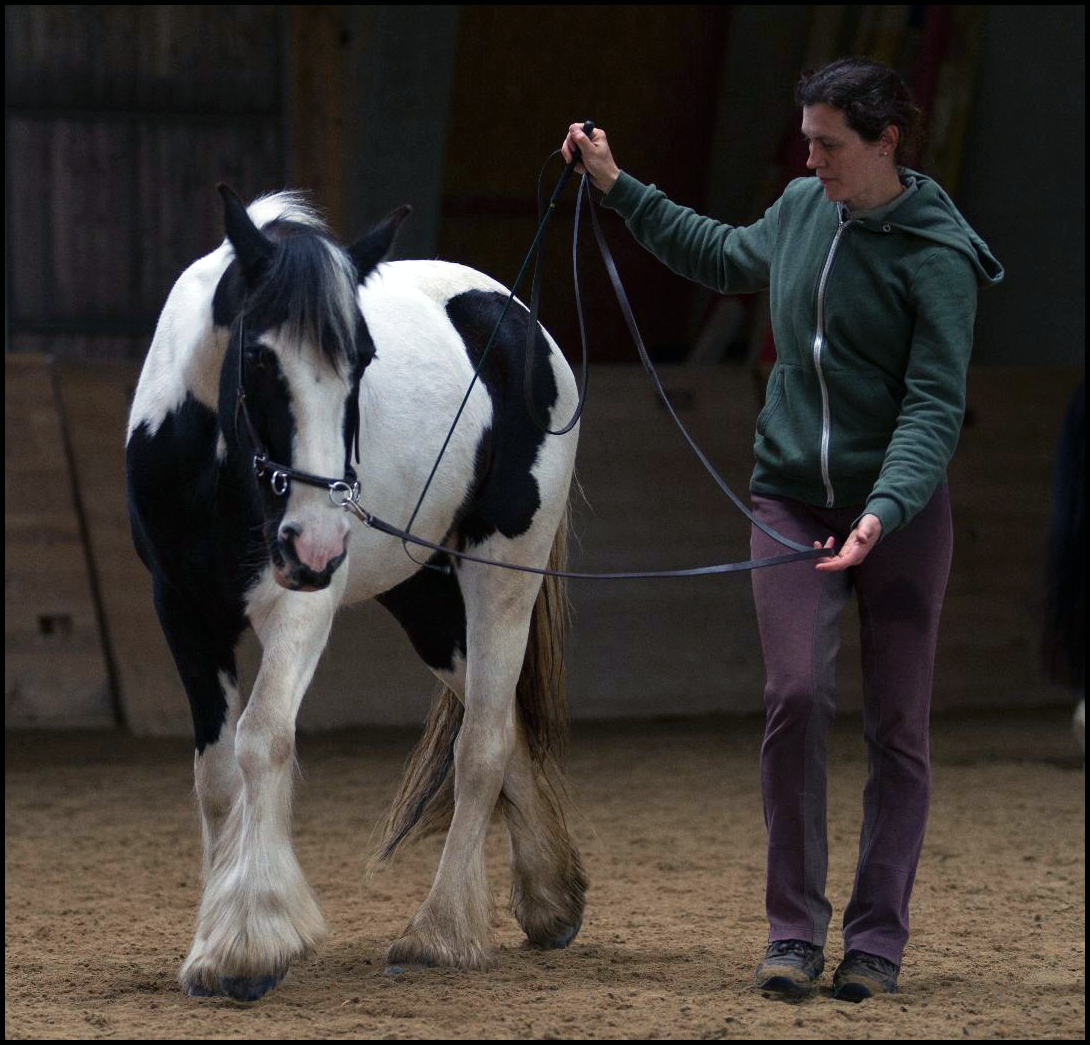
First of all, I’m extremely happy and proud to announce that my new Austrian-born wife Dora has completed her instructor certification in Straightness Training, making her only the second person in the United States to earn the instructor designation. This method of training, established by Marijke de Jong of the Netherlands, is all about working towards overcoming the horse’s natural asymmetry through carefully-designed ground and riding exercises to allow them – not force them – to comfortably achieve proper collection and movement. Having watched the profound improvements in my own horse and others, I cannot say enough positive things about this method of bringing a horse into balance; if you want the most from your horse in terms of performance and behavior, please consider checking out Straightness Training!

Dora working with a horse

Interestingly, but not surprisingly, we’ve noticed that as the horse’s body becomes more symmetrical, the hooves become more symmetrical as well (Dora is also a Certified Hoof Care Professional). As I’ve said many times in the past, hoof form is the effect of movement and not the cause; long-term balanced movement will produce symmetrical hooves, whereas asymmetries in hoof form can nearly always be traced to conformation and movement, and/or improper trimming. This is but one of the research topics I hope to embark upon in this new year.

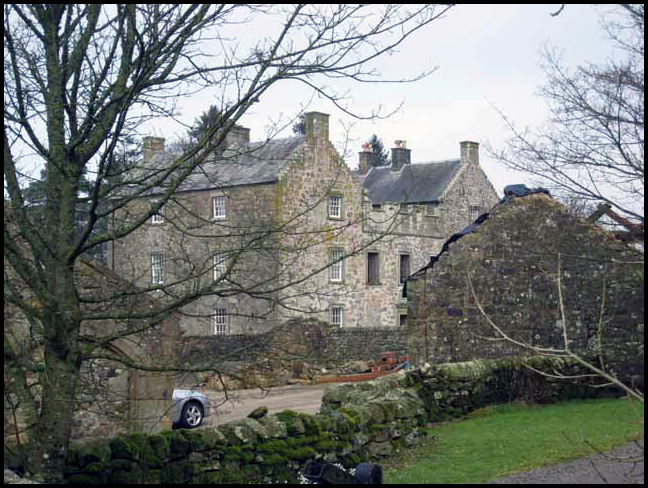
But there are lots of other exciting things in the works as well! I’m particularly looking forward to Liberated Horsemanship‘s upcoming hoof clinic in northern England in March, up near the Scottish border. People have been asking us to do a clinic in the UK for years, and I’m very pleased that we’re finally able to make the trip. We’ve put together a brief video about the Liberated Horsemanship clinics that describes the clinics and their content in more detail, with interviews with three of the instructors. And please share the video with your friends and associates. But…we only have a few UK spots left, so please register soon for what promises to be a great experience!

Stonegarthside Hall - site of the upcoming LH clinic in northern England
Stonegarthside Hall – site of the upcoming LH clinic in northern England

We’ve also produced a version of the video for our German-speaking friends, featuring Dora speaking her native language with the instructor interviews subtitled in German. As I discovered while doing hoof lectures in Austria, there is a great deal of interest in natural hoof care in both Germany and Austria, and I’m hopeful that some of our German-speaking friends will consider joining us in the UK, especially since Dora will be along to offer language support as necessary. Links to the English and German version videos, respectively,  are below –

http://www.youtube.com/watch?v=SAIyCqYvc6g

https://youtu.be/eP5zr2ZJqqY

For those of you who aren’t able to join us in the UK, we’ll once again be offering our Gateway Clinic in the U.S. this June, in our fourth appearance at The Ohio State University ATI in Wooster, Ohio. Please consider joining us for one of these clinics; I promise you won’t be disappointed!

And I have several research projects I hope to be able to report on this year, including my ongoing movement and landing analysis, some product reviews, and several new products of my own aimed at both horse owners and hoof care providers. Plus, I’ve resolved to get back to writing more articles.

That’s enough resolutions! All for now…