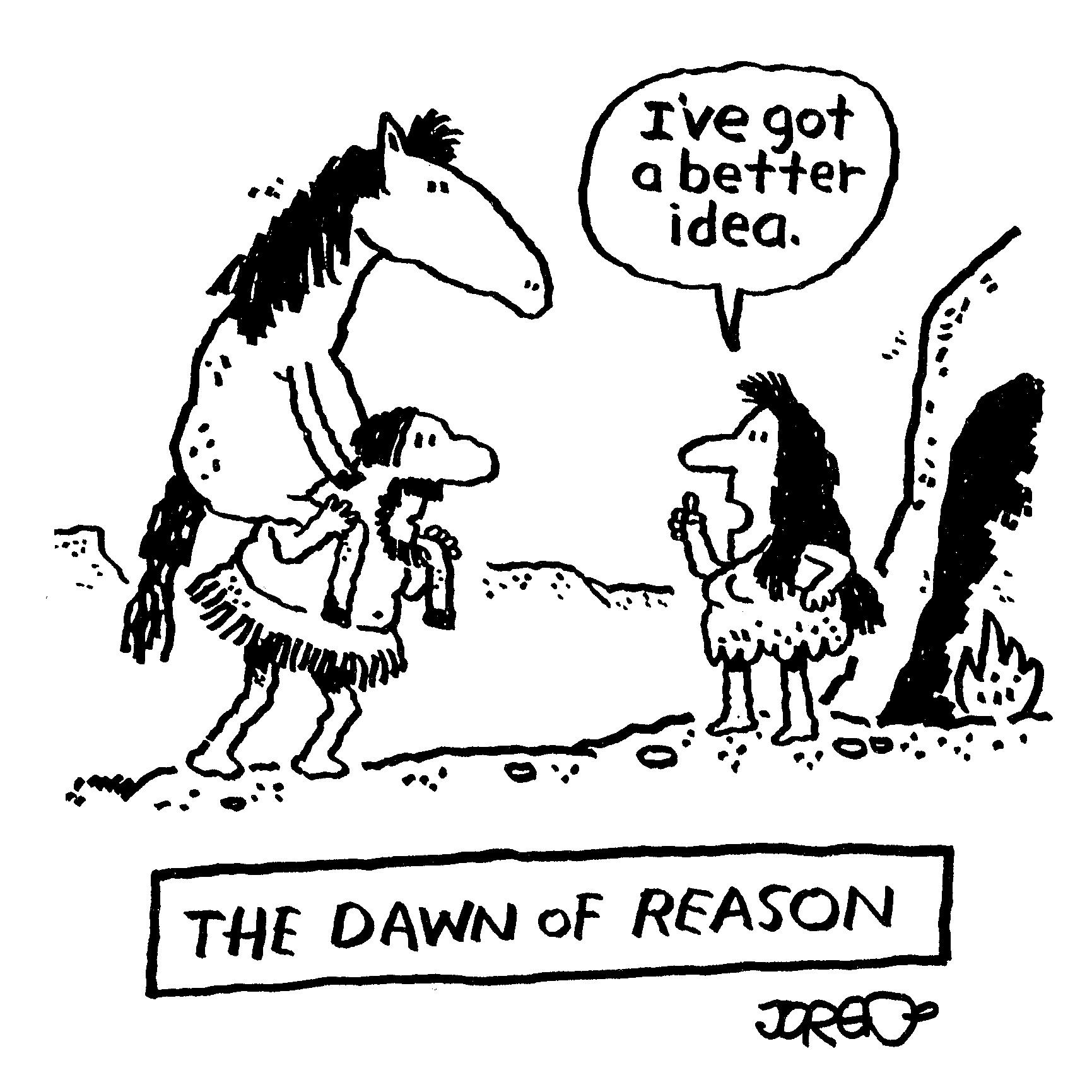
"The Dawn of Reason" cartoon b y Jared Lee

Jared Lee’s cartoon makes light of what is pretty obvious to most of us: the horse is far better equipped to carry people than the other way ’round! And yet, as the size of our population continues to increase, the shrinking weight difference between horse and rider is definitely having an impact on the horse world. For example, one of the owners of the guest ranch I frequent in Arizona (the White Stallion Ranch) told me that although they don’t have an upper weight limit for riders (unlike most guest ranches, by the way), they’ve had to buy increasingly-larger horses to keep up with the changes in guest size. Likewise, my travels to various horse farms have led me to the same undeniable conclusion: there is a growing number of larger riders.

At this point, I realize some of you may be thinking “Oh no! I don’t think I like where this is headed!” But as I’ve mentioned before, my commitment is to the long-term comfort and soundness of the horse. And that includes not only proper hoof care, but nearly every aspect of equine management. So please understand that I’m just delivering information; what you choose to do (or not do) with it is up to you! On we go…

A few years ago, this subject caught the attention of a couple of our equine professors who were interested in finding research in support of some particular method of determining the maximum weight-carrying capability of a horse, particularly the common assertion that a horse should carry no more than 20% of its body weight. But as with many of the horse world’s popularly-held ideas, they found very little actual data to support any specific method or assertion. And so they decided to design a study of their own to investigate the effects of a horse carrying 15%, 20%, 25%, and 30% of its body weight. The resulting paper, entitled “Evaluation of Indicators of Weight-Carrying Ability of Light Riding Horses” (DM Powell et al) was published in the Journal of Equine Veterinary Science (Vol 28, No 1  (2008)). Their publication forms the basis for the information presented in the first part of this article.

I won’t go into great depth on their methodology here, but a brief summary is as follows:

  • Eight fit, mature horses – geldings and mares – of light horse type were used, with feed intake adjusted weekly to maintain initial body weight
  • During the course of the study, the horses were housed individually in stalls, with daily turnout
  • Each horse carried 15%, 20%, 25%, and 30% of their body weight in a series of randomly-assigned trials, with 14-day rest periods between trials
  • After a standardized warmup, each horse performed a standardized exercise test with one of three experienced riders, with the load adjusted by means of lead weights added symmetrically to the saddle
  • Twenty-four hours before and after each exercise test, muscle soreness and tightness changes were evaluated by the same professional animal massage therapist in 40 consistent locations on each horse
  • Blood samples were collected immediately before and after exercise, with additional samples taken 10 minutes, 24 hours, and 48 hours after exercise
  • Heart rate, respiration rate, and rectal temperature were measured immediately before and after exercise

Both the subjective and objective results showed statistically-significant differences indicating greater work rates when the horses carried 25% and 30% of their body weight compared to 15% and 20%. More importantly, when horses carried 30% of their body weight, their serum creatine kinase activity – an indicator of skeletal muscle damage – was elevated immediately after exercise, and remained higher when measured 24 and 48 hours after exercise. So the recommendation that a horse carry no more than 20% of its body weight does, indeed, seem to have some defensible logic behind it!

For heavier riders, then, it might seem logical to use larger horses, right? Well, unfortunately, only to a point, because there’s also arguably an upper limit beyond which a horse’s congenital soundness is in question. Read what Dr. Deb Bennett, noted equine anatomist and author, has to say about equine size and soundness in Principles of Equine Orthopedics –

 Before horses were brought into domestication more than 5,000 years ago, the species averaged 13 hands, 2 inches in height and around 800 lbs. Until as late as 1820, horses over 15 hands, 2 inches and about 1100 lbs. were an absolute rarity – and this, by the way, is the maximum size that any wild equine ever attains. Only after the advent of railroad transport did teamsters see an advantage to utilizing cart and carriage horses that were in the 16- to 17-hand range and drafters going as high as 2200 lbs. (And no – despite what you may think you have learned from Hollywood, there were no knightly chargers as big as the modern Shire; the Medieval “Great Horse” stood 14 hands, 2 inches and weighed around 1000 lbs.). The modern Shire is twice as massive as the largest wild equine that ever lived, and the average riding horse which stands 16 hands and weighs 1400 lbs. is itself “pushing the design envelope”….It is sheer foolishness not to recognize massiveness as a significant contributor to abnormalities of the bones, joints, ligaments, tendons, and dentition of modern horses. A good rule of thumb: any horse standing over 16 hands, 2 inches, or weighing in excess of 1450 lbs., is automatically and congenitally unsound for any use involving prolonged trotting, cantering, or jumping. In terms of horseshoeing, even when large horses are used for walk-activities such as pulling wagons or other heavy loads, their massiveness implies a need not merely for correct work but for constant orthopedic prophylaxis or “preventive and supportive medicine.”
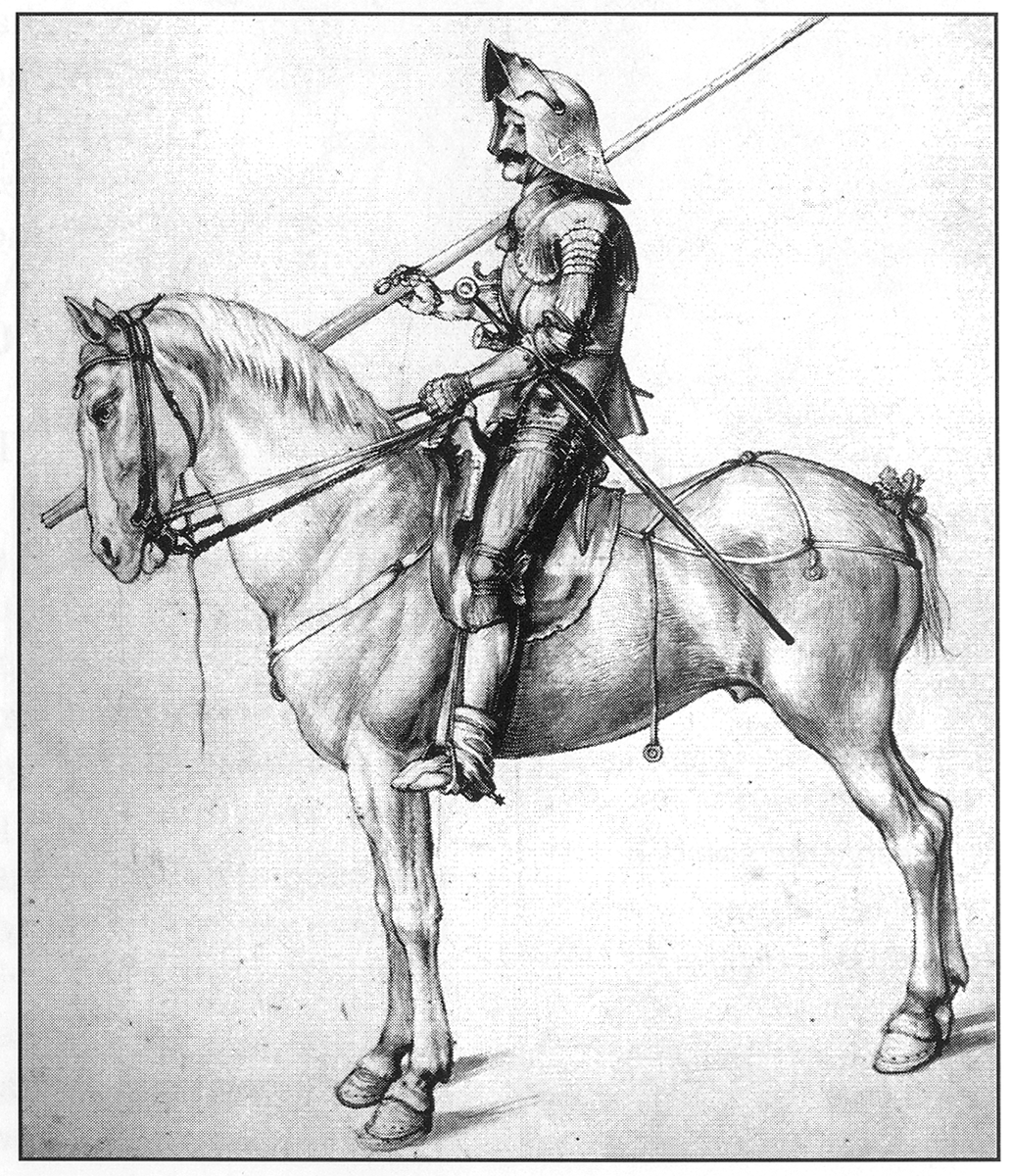
Drawing of a mounted knight prepared for battle ca. A.D. 1500 by Albrecht Durer
Drawing of a mounted knight prepared for battle ca. A.D. 1500 by Albrecht Durer. Note the relatively small size of the horse vs. rider, and the evidence of strain on the horse’s back. From Conquerers: The Roots of New World Horsemanship by Dr. Deb Bennett.

Now, I realize some of you may be inclined to argue that certain breeds have denser bones than others, and are therefore better equipped to carry heavier riders. But Dr. Bennett also did some measurements and calculations of bone density using skeletons at the Smithsonian Institution, with the following results:

  • Horses that weighed (in life) 1000 lbs. or less had normal bone density. There was no consistent trend as to breed; they all fell within a single, fairly tight, cluster.
  • Horses that weighed 1500 lbs. or more had below-normal bone density, and although there were a few individual exceptions, the density tended to drop with increasing weight.
  • Horses between these two weights showed a weaker tendency for below-normal bone density. The majority of animals had normal bone density, but there were some which were as low as the lowest in the heavyweight group.

So although some breeds and individuals obviously have larger-diameter bones than others, and are therefore probably better suited to carrying more weight than other breeds, there’s no scientific basis to support the notion that, for a given bone diameter, the bones of a particular breed are stronger than those of another breed. In fact, based on Dr. Bennett’s evidence, one might argue that the less-dense bones of very large horses are probably weaker on a per-inch-diameter basis, in spite of their being bigger.

I also feel compelled to mention two other factors affecting weight-carrying ability:

  •   The horses used in the study were fit horses. So if your horse is out of shape and heavy, it seems logical that some percentage of that excess weight must be deducted from his weight-carrying ability. Because the extra body weight is fairly evenly distributed, it’s probably not the full amount, but I’m willing to bet that it’s at least 50% of the excess amount. For example, if his ideal weight (Body Condition Score of 5) is 1,000 pounds, but he weighs 1,100 pounds instead (Body Condition Score of approximately 6), his weight-carrying ability for rider and tack (assuming a 20% maximum load) would be reduced from 200 pounds to 150 pounds.
  • There’s no weight-carrying “bonus” for riders with good equitation skills, but the poorer the rider, the more of a reduction in weight-carrying ability would seem to be necessary to account for the added weight moving out-of-sync with the horse, which increases peak forces (and therefore strain).

I might also add that although proper foot care is always important for long-term comfort and soundness, Dr. Bennett’s research points out the absolute necessity of it for larger horses. So be certain to use a hoof care provider who not only truly understands the concepts of correct hoof form and function, but who also appreciates the necessity of minimizing unnecessary stresses on these horses’ joints by keeping them barefoot and properly trimmed. That will give your horse the absolute best chance at long-term comfort and soundness.

To help you more quickly determine a given horse’s weight-carrying ability, I’ve created the following charts – in pounds and kilograms – that cover a range of horses from small ponies to those at the upper limit of Dr. Bennett’s recommendation –
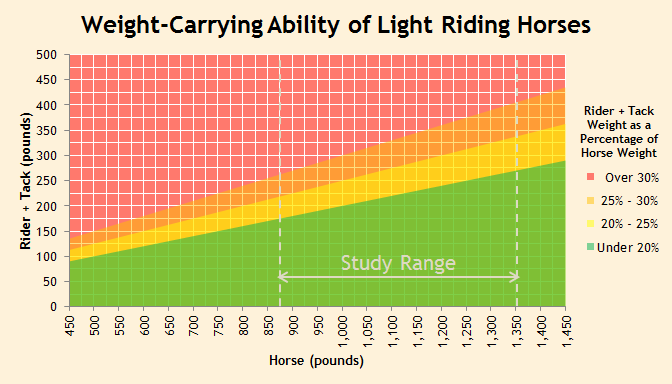
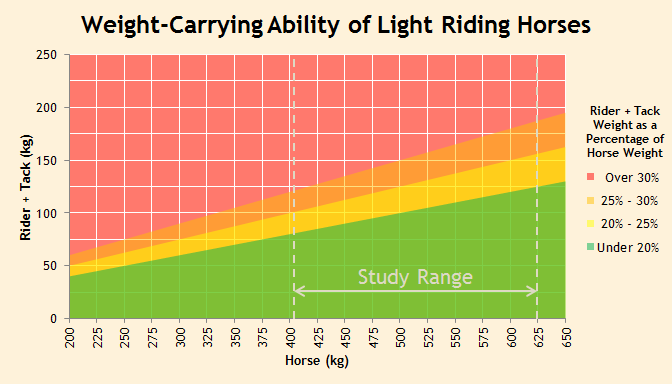
Graph of weight-carrying ability of light riding horses in pounds
Chart in pounds
Graph of weight-carrying ability of light riding horses (kg)
Chart in kilograms

I’ve also put printable versions of the charts here (pounds) and here (kilograms), so print one out and hang it in your barn. But don’t be too surprised if it makes some people uncomfortable! For our horses’ sake, it would be far better if we were all “in the green,” but I realize a great many of us are not. So please carefully consider what’s best for all concerned parties. And keep in mind that one fairly simple solution for many riders may be to get rid of that 40-pound Western saddle!

Meanwhile, guess I’d better think about doing away with the Fanta…
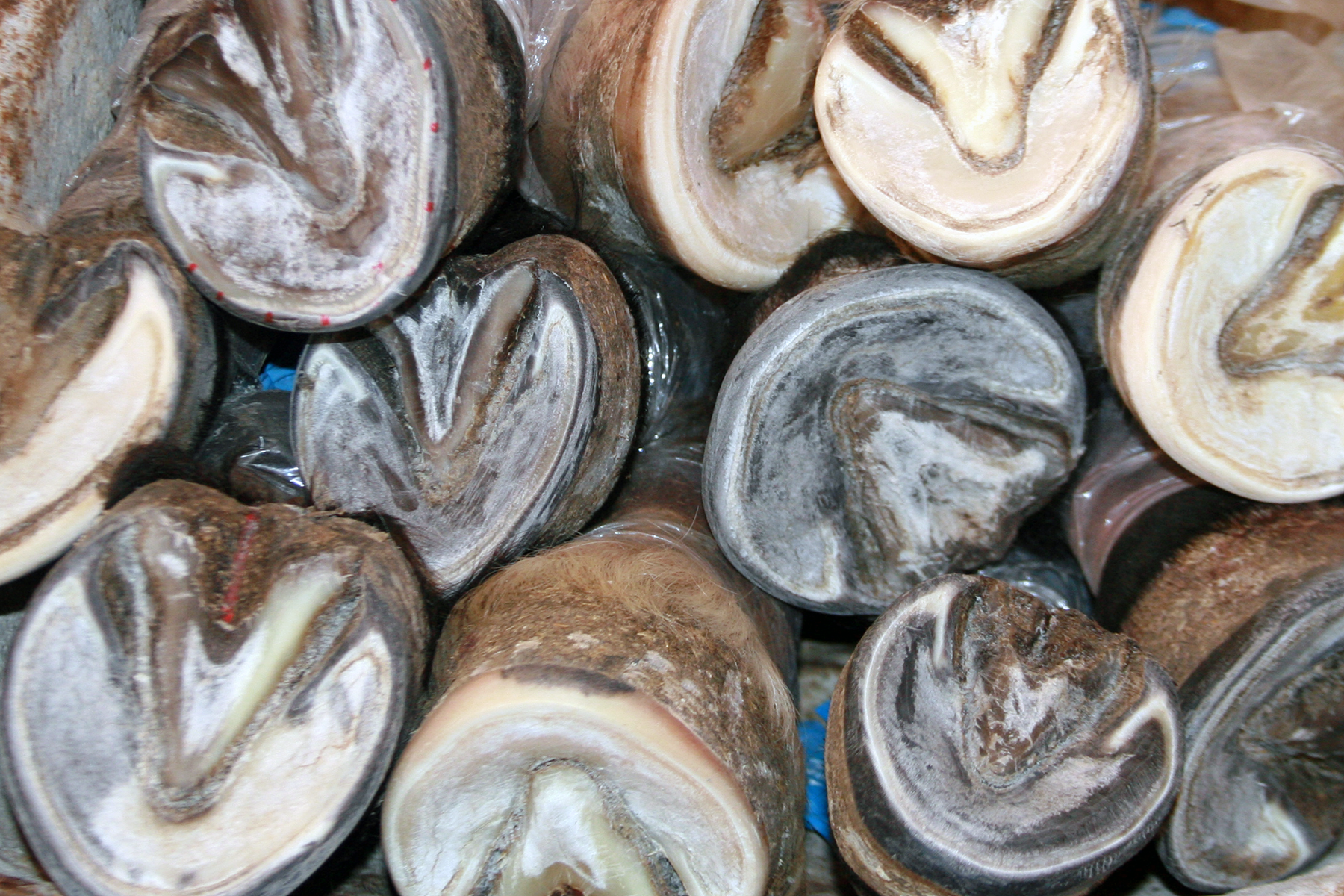
 

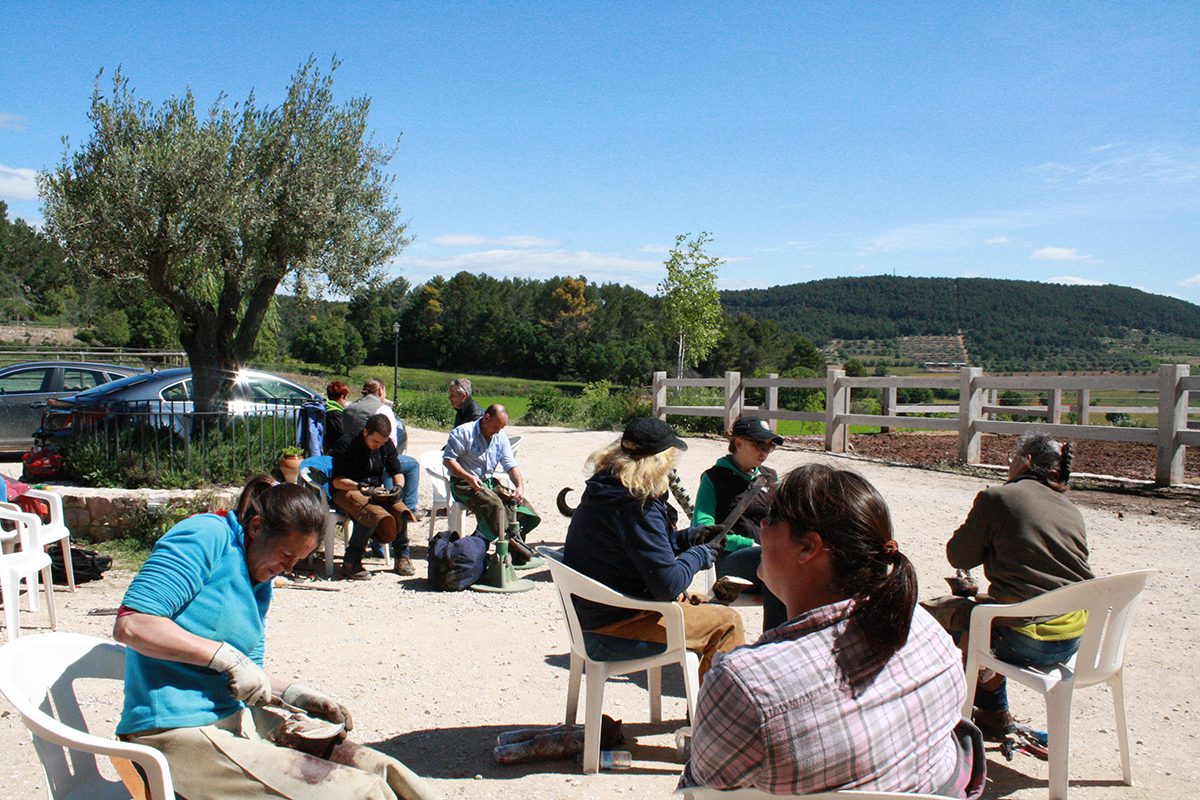
Cadaver hooves trimmed by students

As I’ve acknowledged before, one of the best things about my life has always been the opportunity to both teach and learn, and our recent Liberated Horsemanship clinic in La Llacuna, Spain was no exception. With people gathered from Spain, France, Austria, Russia, England, Scotland, and, of course, the United States, we all had a marvelous time seeing, hearing, and sharing with some top-notch presenters and students on a wide range of topics. But now that I’m back home, I need to mention an important update to my writing on a subject very near and dear to the hearts of most horse owners this time of year: laminitis.

Laminitis is a particularly serious and painful condition and is the number 2 killer of horses, so if you’re not particularly familiar with it, I’d recommend you first read my previous posts on the subject:

As some of you know, last year I released an iPhone app to help horse owners assess the risk of their horses developing laminitis based on the work of Dr. Don Walsh, Director of the Animal Health Foundation and the veterinarian who authored a paper entitled Field Treatment and Management of Endocrinopathic Laminitis in Horses and Ponies. Shortly after the app was released, however, Don called to tell me he was very excited about the app but had noticed it was using the average caloric content values for grass given in his paper as if they were dry weight values, and not the grass-plus-moisture-content values I had assumed when I wrote the iPhone app as well as both the free Laminitis Risk Calculator spreadsheet and the Is Your Horse Eating Too Much? charts found under Tools in the sidebar. That meant that all 3 items were overestimating the number of grass calories your horse is consuming by a considerable amount!

And so, after consulting with a couple of my nutritionist colleagues at the university, plus some very helpful advice from Paul Sirois of Dairy One/Equi-Analytical, I revised all of them to use a “wet weight” equivalent of 20% of the dry weight grass calories. Arguably, it may be even smaller than that, but the experts feel it’s a defensible number that errs, if at all, on the conservative side. In other words, it’s a value that represents the “worst-case” situation for your horse. So the prediction of whether or not your horse is at high risk for suffering an episode of laminitis would almost certainly err on the side of caution, telling you your horse is at risk when he’s really not, rather than tell you he’s not when he really is! But after I rewrote the app code, I then spent a frustrating year trying to get the company who compiles my code for the Mac (I’m a PC guy) and actually posts it to the App Store to get the app updated. It’s now finally happened, so if you’ve purchased the app you’ll see an Update appear in the App Store. And if you’ve downloaded either the MS Excel spreadsheet or the graph, please download them again. You can watch the video about the LRC app by clicking on the image below –

Laminitis Risk Calculator Video

I’ll also mention again that this app is a great help in quickly calculating the amount of calories a horse requires to maintain body weight for a particular work load, which makes it very easy to see how changes in feed, hay, and amount of pasture time affect his caloric intake. It makes planning and adjusting every horse’s diet a straightforward task, not just the ones where there are possible laminitis concerns. And if you don’t have an iPhone, you can still take advantage of the same information for free with either the Laminitis Risk Calculator for MS Excel or the caloric intake and requirement charts in Is Your Horse Eating Too Much?

I sincerely hope you’ll consider using one of these tools to help manage your horses’ diet and reduce his risk of suffering from the terrible pain of laminitis. Back to my The Myth of the Heel-First Landing series soon…

Happy Horse!

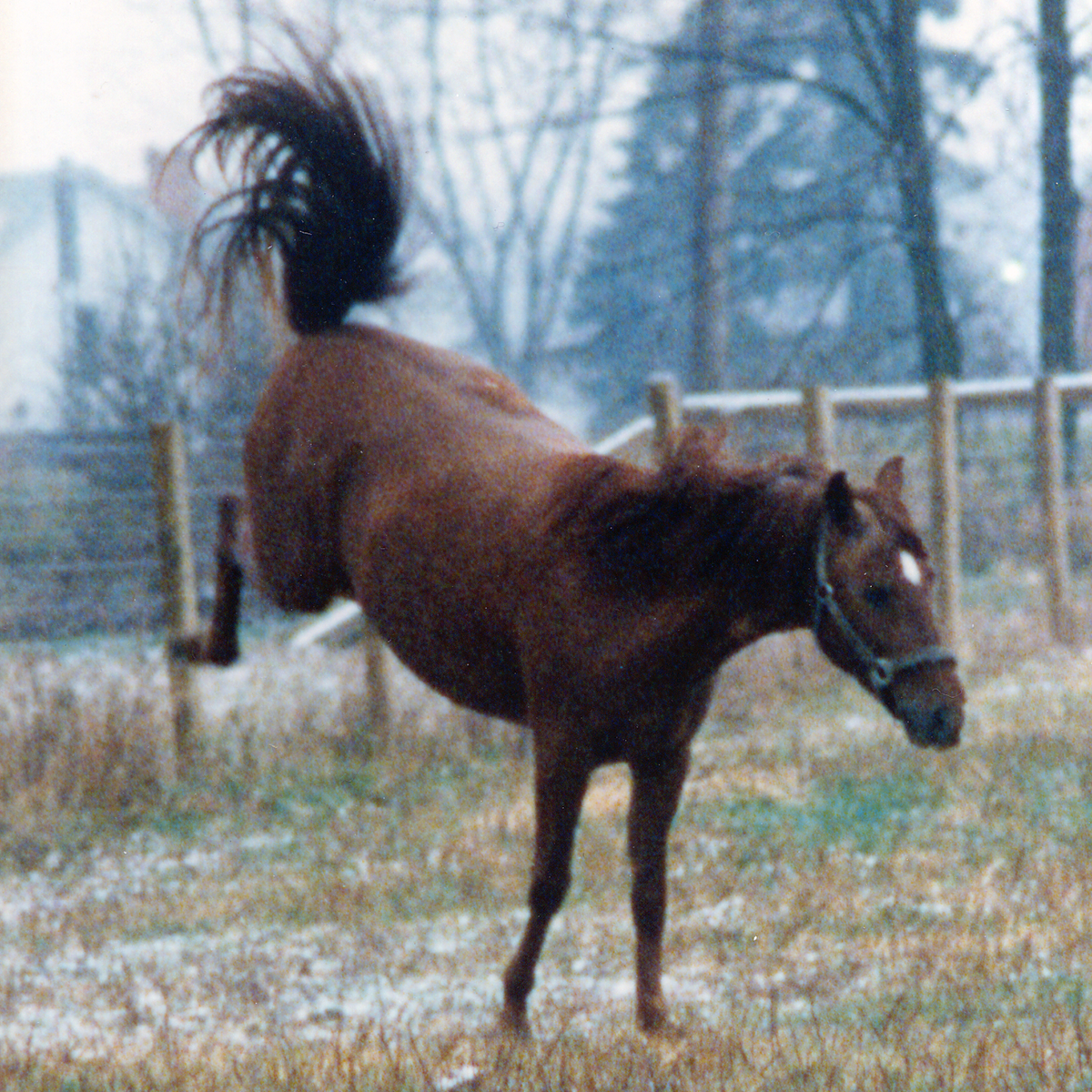
I know just how my horse felt when I took this photo many years ago. Following some surgery, he’d been stuck inside for a couple of weeks, so I carried a camera with me (pre-digital days, I might add!) as I turned him loose again for the first time. He was ecstatic!

The weather here in northeastern Ohio has been absolutely miserable this year, so I’ve been feeling rather trapped as well. But I’m fairly confident that soon the snow will disappear for good, the flowers will bloom, and another season of horse-related activities will begin! And to that end, I want to share some information about upcoming clinics and other appearances I’ll be making over the next couple of months.

First up is the Ohio Equine Affaire, held annually at the Ohio State Fairgrounds in Columbus, OH. Although I’m not a speaker at this year’s event, I’ll be both attending the show and spending some time in the university’s booth – #702. If you’ve never been to the Equine Affaire (either here or in Springfield, MA), it’s well worth a visit! There are always plenty of horses to see, seminars and events to attend, and a whole lot of shopping. So check out the show schedule on their website, and if you come, please stop by our booth to say ‘hello!”

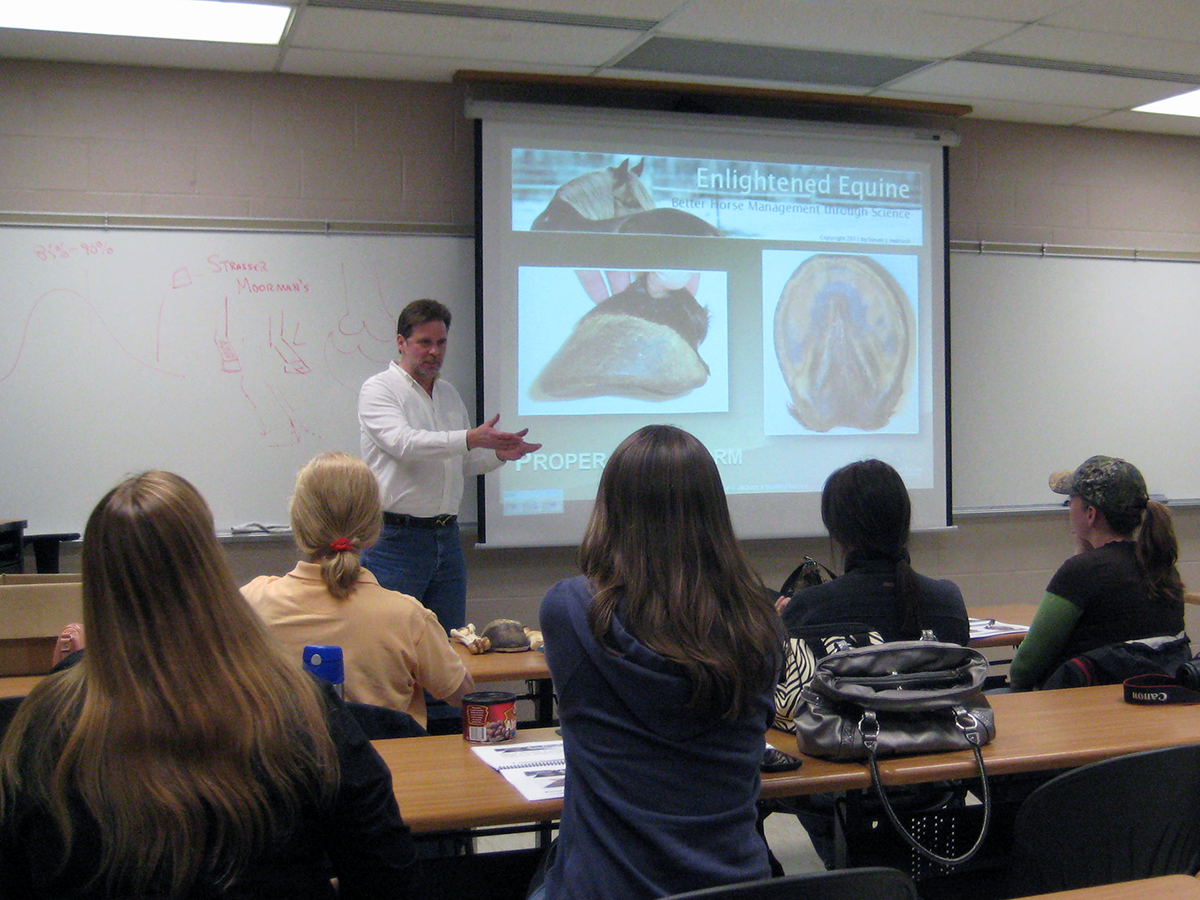
Introduction to Natural Hoof Care clinic

I’m once again offering my Understanding Natural Hoof Care workshop in May. This 5-hour lecture/demonstration is a wonderful introduction to the science behind proper hoof care, challenging the participants to set aside their preconceptions and watch as we reveal a logical, science-based approach to healthier hooves and happier, better-performing horses! And for those who’ve been curious about the actual trim experience, you can sign up for the full-day workshop version where we discuss the tools and techniques of proper trimming and conclude with cadaver hoof trimming. This is a great opportunity to share the advantages of “true” natural hoof care with others, so be sure to bring your friends!

Equine Hoof Pathologies clinic

I’m very excited about my new Equine Hoof Pathologies: Causes, Symptoms and Treatment Options clinic, which is an offshoot of the teaching I do for Liberated Horsemanship in Warrenton, MO! I talk to many horse owners whose animals are collectively suffering from a relatively small number of pathologies that are directly tied to management issues such as feeding and footing. This 6-hour lecture/demonstration takes an in-depth look at the origins, diagnosis, and treatment of laminitis/founder, navicular disease/syndrome, white line disease, hoof cracks, abscesses, and infections, with an emphasis on simple preventative steps for the horse owner.

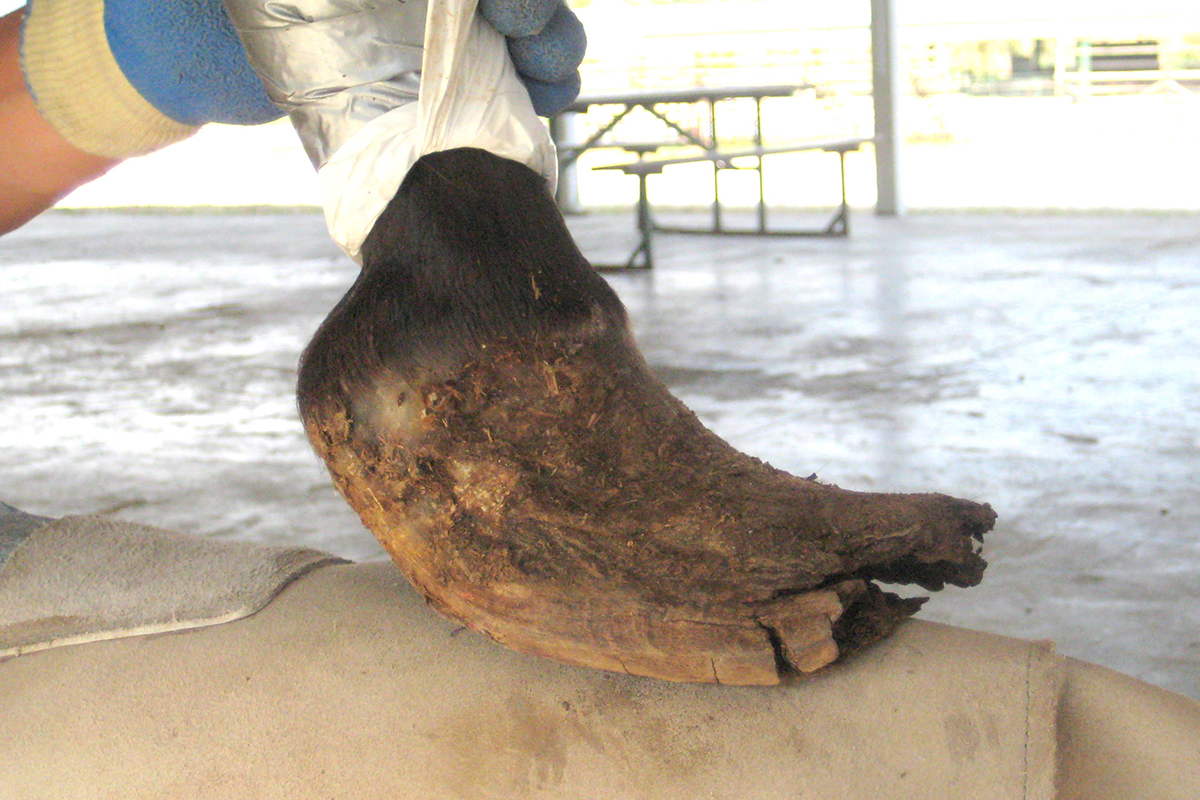
Cadaver trim class in La Llacuna, Spain

And I’ll once again be traveling to Spain for a presentation at Liberated Horsemanship’s Spain Gateway to Hoof Care for the 21st Century Clinic, where I’ll be doing a talk called Navicular Disease and the Forces of Impact: The Connection between Improper Landings and Long-Term Lameness. This 5-day clinic is a wonderful opportunity to learn from some of the most well-respected and highly-educated working hoof-care professionals in the world in a beautiful setting in rural Spain, and I hope to see many of my international readers there!

So, there are a few more possibilities for your “horse calendar!” We cover a lot of material in my clinics, but remember: once you’ve paid to attend a clinic, you can always retake that same clinic – any time or place it’s offered – as many times as you want for no additional charge.

Happy Spring!

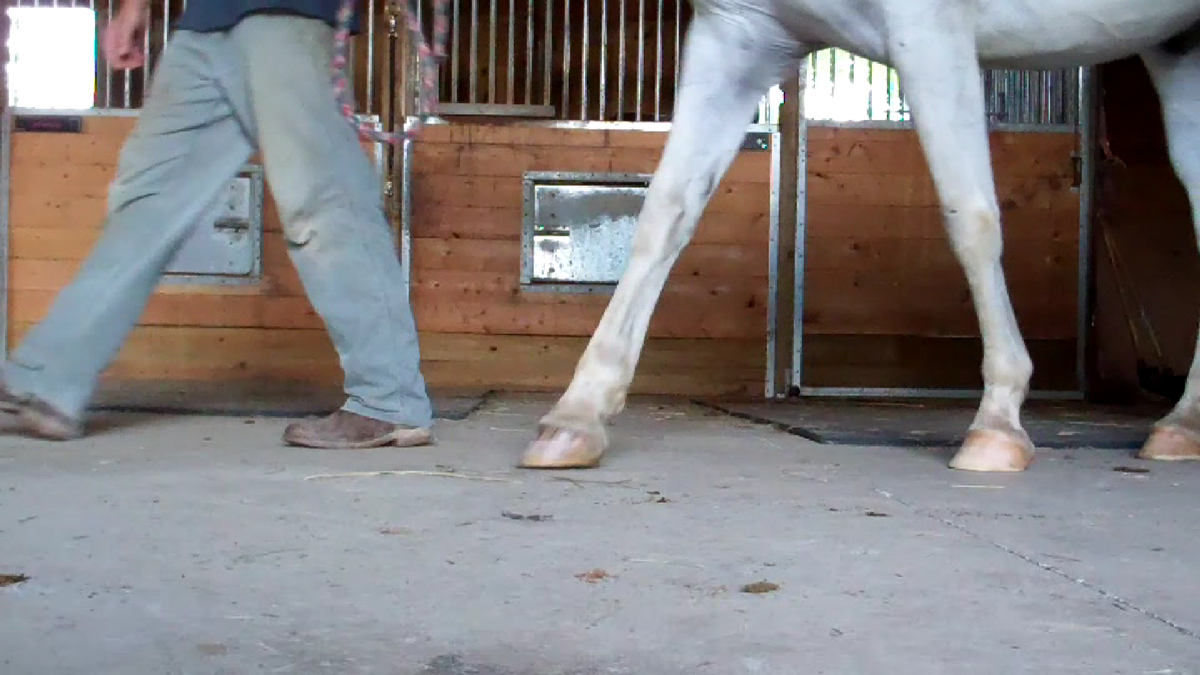
In the first article in this series, I started us down the path to understanding why the proper landing for a horse at the walk has to be flat-footed by describing the anatomical differences between humans and horses, and pointing out the limitations of our ability to perceive fairly significant differences in how the horse lands without using slow-motion video techniques. In this installment, we’ll continue on by examining the orientation of the foot as it travels through the flight arc and prepares to make ground contact.

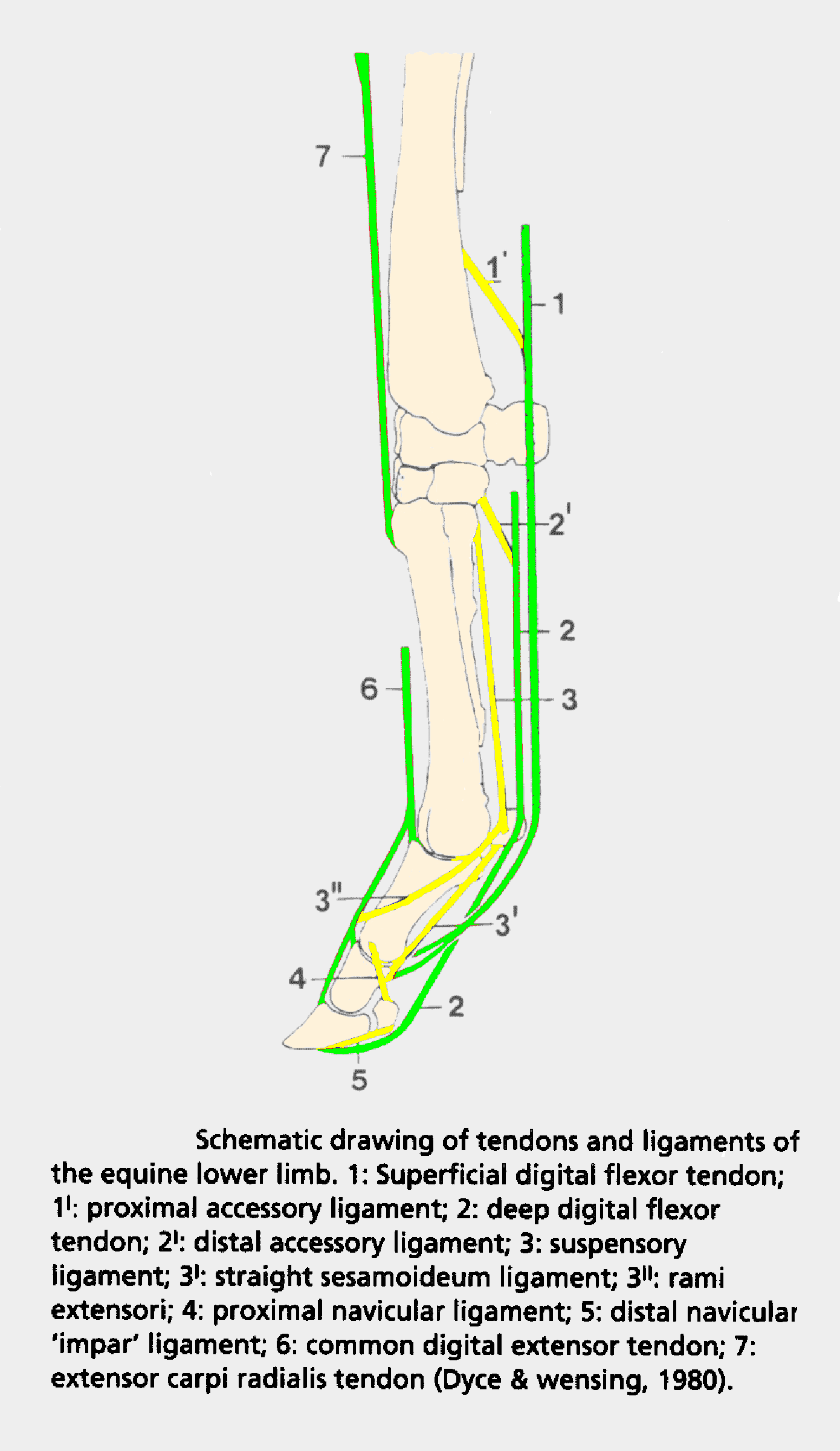
Diagram of major tendons & ligaments of the lower limb
– from Equine Locomotion, by Willem Back & Hilary Clayton. I added the color.

As you’ll note in the diagram above, the common digital extensor tendon (6) and the deep digital flexor tendon (2) both have insertions (attachments) on the coffin bone – the most distant (distal) bone in the horse’s limb that resides inside the hoof capsule. Like humans, the horse’s foot is stabilized by these tendons as well as ligaments, and, shortly after leaving the ground, its orientation to the rest of the limb immediately above it (long & short pasterns) remains essentially constant throughout most of the flight arc. And like us, horses don’t typically think about where to place the next foot when they walk. So although the tendons stabilize the position of the foot, the attached muscles do not actively pull or relax to reorient it as it prepares to land. In fact, James Rooney’s Biomechanics of Lameness in Horses, which I’ve referenced a number of times before, describes Dr. Rooney’s somewhat counter-intuitive discovery that transecting the extensor and deep flexor tendons in the vicinity of the short pastern really had no significant effect on the orientation of the hoof as it landed. He concluded, therefore, that (like humans) foot placement in “normal” walking is not an active effort. Keep in mind, by the way, that we’re talking only about A/P orientation in the horse; the M/L orientation, as we saw in Part 1, is dictated by the construction of the joint surfaces themselves.

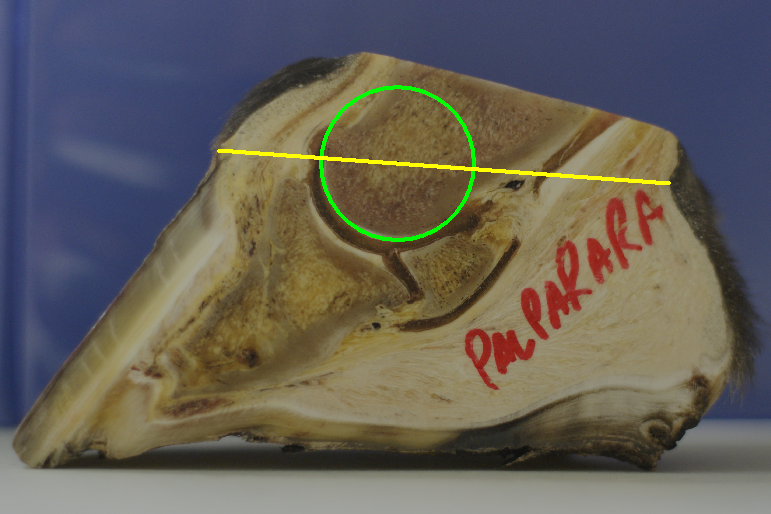
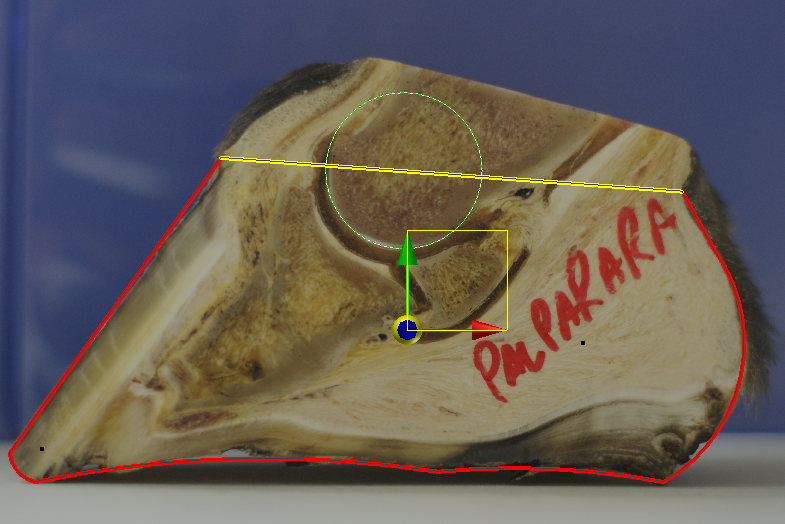
Dr. Rooney’s comments inspired to me look at the center of coffin joint rotation and the center of gravity of a properly-trimmed bare foot, which is fairly easy to do with my CAD system by importing an image of a sagittally-cut foot, visually noting the center of joint rotation, and tracing the foot’s outline so the software can then compute the center of gravity. Check out the images below of one of Brian Hampson’s feral horse feet from Australia/New Zealand. And as an interesting  aside,  also note the bone remodeling evident at the tip of the coffin bone –

Center of coffin joint rotation on a feral foot
The center of coffin joint rotation (the circle’s center) lies on a line indicating the top of the foot
Center of gravity of the foot
After outlining the foot, the software calculates the foot’s center of gravity, which lies directly below the center of joint rotation

The interesting thing about this observation is that it was consistent for all of the feet I looked at in cross-section, regardless of their toe angle. What this means is that the hoof balanced for a proper (flat) landing is quite literally “hung in balance” on the end of the limb! Thus, Dr. Rooney’s experience with the severed tendons makes sense; because the mass of a properly-trimmed bare foot is, by design, evenly distributed in the A/P direction, the tendons are only providing a stabilizing (damping) force rather than actively controlling pastern/foot alignment. This is similar in function to the shock absorbers on an automobile; they don’t determine the position of the car body, but they help the body more quickly return to a neutral position after being displaced.

The point I’m trying to make is that the horse isn’t consciously “aiming” his foot so it hits the ground a particular way based on what’s happening with the bottom of his hoof. Instead, the orientation of the bones of his foot and leg are the consequence of masses, muscle tensions, and joint construction – all under the influence of gravity and other external forces (we’ll get there in a moment!). As designed, the hoof itself is bare, quite short, and (as we saw above) the mass distribution of the foot overall is quite even; therefore, it’s able to quickly accelerate and decelerate to a position of proper alignment with respect to the limb above it, aided by the “neutral” tensions in the tendons/muscles, as it travels through the flight arc. So given a properly-trimmed bare hoof, the net result is that the internal and external structures of the foot will be in proper alignment as the hoof prepares to contact the ground. Check out the following photo, taken from a video of a client, in which the hoof position has been captured as close to the ground as possible just before making contact –

Properly-trimmed hoof about to make contact

Note, however, that I’ve been using the phrase “properly-trimmed bare hoof.” Within some particular range of variation from “proper,” the internal structures of the foot will still be in the correct orientation with respect to the leg and the ground, but the external structures will not be. You have only to look at the preceding photo to understand that if some part of the hoof is left long with respect to the other parts, the longer part will end up striking the ground first. So a long toe will yield a toe-first landing, and long heels will produce a heel-first landing. As you’ll learn in later articles when I discuss the origins of navicular disease, this is an extremely problematic situation because, by design, the coffin joint is not intended to be rotating at the instant of contact! But if a horse is contacting the ground any way other than flat, the coffin joint will, necessarily, be rotating when the hoof “slaps” the ground as the leg comes under load.

But the situation gets worse. Once the hoof exceeds this range of variation from “proper” (and I don’t pretend to know precisely what those limits are), the internal foot/limb orientation, and therefore the internal and external foot/ground orientation, will be further mitigated by three factors, particularly at the beginning and end of the flight arc. These are: 1) hoof length, 2) hoof weight (mass), and 3) hoof weight (mass) distribution.

Remember Newton’s First Law of Motion?

Every object in a state of uniform motion tends to remain in that state of motion unless an external force is applied to it.

Because the coffin joint is fairly flexible, departures from this “intended design” of a short, properly-balanced bare hoof can have a significant effect on the motion of that joint during the flight arc, with profound consequences on the form of the landing. Probably nearly every horse owner has handled a horseshoe before, but relatively few have held a cadaver horse foot; I can assure you that most steel shoes are a significant percentage of the weight of a foot! And as we add weight to the end of the limb in the form of excess untrimmed growth and/or (more significantly) a shoe, we start changing the dynamics of the flight arc. In essence, the lower limb of the horse begins to act more and more like a double pendulum – the long & short pasterns forming one pendulum suspended from the fetlock joint, and the foot with whatever extra weight has been left or added suspended from the coffin joint. The resulting motion, and the mathematics describing it, can be quite complicated, but we can make some general statements about the effects of length, mass, and mass distribution:

  • As the length of the hoof increases, the time it takes to accelerate from the ground or decelerate for a landing increases. This is because the timing (period) of a pendulum is a function of its length; the longer the pendulum, the longer the period.
  • As the mass of the hoof increases, the time it takes to accelerate from the ground or decelerate for a landing increases. This is a consequence of both the center of mass shifting away from the coffin joint, effectively lengthening the pendulum and therefore the period; and the increase in the rotational force (moment of inertia) on the coffin joint, to which the period is also proportional.
  • As the mass distribution of the hoof moves away from being symmetrical, there will be increased unilateral A/P torsion forces on the joints, affecting both the effective length of the pendulum and the center of mass.

What does all that mean in practical terms? It means a foot designed to contact the ground in a particular orientation with respect to the limb above it may not be able to do so because whatever has been done (or not done) in the trimming/shoeing process has altered its dynamics. This is why a shod horse with obviously-long heels can have a reasonably-flat, or even toe-first, landing. The shoe, whose weight distribution has shifted the foot’s center of gravity toward the toe, is modifying the flight arc such that it’s keeping the toe from rotating properly right before contact. But when you remove the shoe, the horse immediately starts contacting the ground heel-first! Similarly, horses with any type of bar shoe, where the weight of the shoe is much more A/P symmetrical or even back-heavy (depending on the specific design – think about wedges!) tend to really come down heel-first, because the weight of the shoe is keeping the heel down plus the horse’s heels are already too long. And the added weight also increases stresses on joints and soft tissues, because that extra weight must be accelerated and decelerated with every step.

So we’ve now added yet another variable to the “landing picture.” Not only do horses not walk like humans, and not only can we not reliably observe landings at normal speed, but the landings we do observe can be a far cry from “proper” because of how the aforementioned factors can modify pastern/hoof alignment. But the problem is this: as Dr. Deb Bennett says, “What people come to see every day, they naturally come to consider ‘normal’…But what a culture or a nation comes to expect is usually common instead of normal.”

Please don’t fall into the trap of thinking that just because you observe a lot of heel-first landings, they’re supposed to land that way. Those landings are merely common, they’re not biologically normal! That’s simply not the way the equine limb is designed, and we’ll continue to provide further evidence to support this claim in the near future.

More to come…

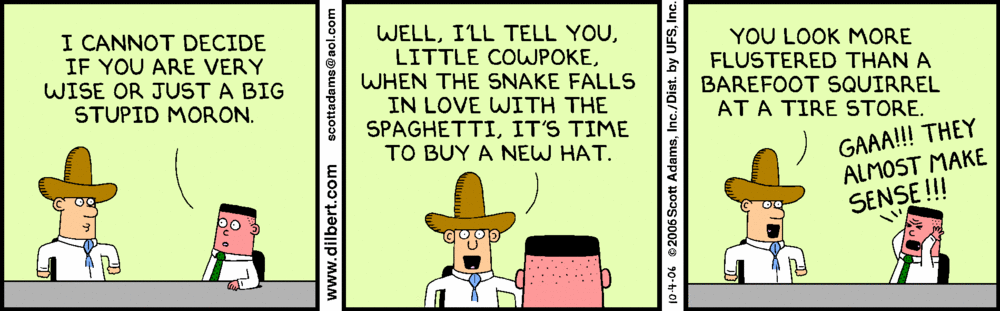
Dilbert cartoon about an "expert"

I hope Mr. Adams doesn’t mind me sharing “Dilbert” with you, but recent events prompted a return to the topic of experts in the horse world, and these particular cartoons seemed especially appropriate! I’ve commented about this problem before in my article entitled The “Expert Syndrome”, and decided to revisit it after a couple of experiences last week.

First, I was visiting the facilities of a trainer whom I’d never met before, and was listening to her talk with one of her clients. They were discussing how and why horses react in various situations when the trainer said, “Now, unlike human beings, the horse’s adrenal gland doesn’t work unless their head is up. Otherwise, it doesn’t secrete anything.”

Wow – that one really threw me! I’d never heard of “position-dependent gland secretion” before, and it seemed highly unlikely. But I am well aware that I am neither a biologist nor an endocrinologist, so I didn’t want to rule out the (seemingly-very-remote) possibility that the trainer was correct. So I called my friend Dr. Bruce Nock, who’s a professor of neurobiology in the psychiatry department of Washington University’s School of Medicine, where he conducts research on stress – the effects of which are intimately connected with the operation of the adrenal gland (Bruce also happens to run our Liberated Horsemanship training programs). And (after he finished laughing,) Bruce confirmed that the whole notion of the horse’s adrenal gland only working when his head is up is, indeed, complete nonsense!

On the surface, though, you can see how someone could relatively easily buy into that story because it sounds somewhat plausible based on our experiences with horses: they appear calm when their head is down, and excitable only when their head is up. But the perpetrator of this myth would seem to be confusing causation and correlation. Just because we typically experience events as occurring together does not mean that one causes the other to occur. And this episode ended up jogging my memory about a similar story from nearly 20 years ago…

Back when I was a relatively new horse owner, I was riding my rather-excitable horse in the indoor arena when another rider remarked that horses spook because they perceive objects as being “larger than they actually are,” which tends to frighten them. “For example,” she stated, “when a horse sees a dog, it looks to him to be the size of a pony!”

Frankly, I didn’t even know how to respond to that because it defied not only the most basic principles of optics, but of logic as well! And yet the woman said she’d recently read it in one of the more popular horse magazines. Back in those days, I was inclined to believe she’d simply misunderstood something the author had written, because I couldn’t imagine anyone with even a modicum of common sense writing anything so preposterous. But the next day, the woman brought me the feature article, written by a veterinarian, which “explained” how horses’ vision works and how they perceive the world. It certainly affected my vision – it was an eye-opening example of what I’ve come to recognize as a very real problem in the horse world.

Given the circumstances, I could hardly fault that horseperson for her confusion. Granted, she should have questioned such a patently absurd claim. But how can I blame her for repeating what she’d read in a leading publication that should have had procedures and policies in place to prevent this sort of thing? She had every right to expect accuracy in what she read. Yet, here was an article with not just a relatively minor and understandable mistake: a misplaced decimal point or an incorrectly-labeled drawing. This was an entire feature article whose fundamental premise was dreadfully flawed, written by some presumably well-intentioned person who should’ve stuck to writing about what she knew, instead of presenting illogical speculation as fact at the readers’ expense.

Dilbert cartoon about an "expert"

My point is this: real experts aren’t born; they’re created. They’ve had extensive education(formal and informal) and experience, and can always back up their claims with facts about their education, experience, and the subject matter under discussion. They never rely on the following three “credentials” or their variations as evidence of their expertise, as is all too common in the horse world:

  1. I love horses
  2. I’ve been doing this for many years
  3. I’m an expert in this subject, so I must be an expert in that subject

We all have an obligation to not just accept everything at face value, and, especially, to not pass it along without questioning its origins and accuracy. A few days ago, I noticed a Facebook post by my wonderful friend Jessica imploring people to stop sharing information about a particular group of horses because the situation had been resolved and the information was no longer correct. I admire and respect her for that, and wish more horsepeople took that initiative! And while that situation as well as the ones I’ve been sharing are probably relatively harmless in the grand scheme of things, other types of misinformation can lead to much more serious consequences, and not challenging it can very possibly put the safety and welfare of not only yourself and your horse, but of others and their horses, at risk. I’ll close with a much more serious and extreme example to really demonstrate this point…

I once spent a day helping a farrier fine-tune his trimming skills. This gentleman had been a shoer for quite some time, and had an impressive collection of leg and foot bones he carried around with him. As he was showing me his collection, he pulled out a pair of coffin bones with well-defined, nearly horizontal, grooves on their front faces. I’d never seen anything like that before, and asked him where the grooves had come from. He explained that a client had had a horse that foundered – extreme laminitis where the coffin bone has moved out of position – and a friend of the client told him that his horse’s pain was caused by “pressure building up inside the hoof.” So the client promptly pulled out his electric reciprocating saw, and sawed through the front of the horse’s hooves.

I absolutely cringe when I think about the pain that horse had to have experienced; already in the midst of the most painful condition a horse can endure, and someone decided it made sense to saw into his feet all the way into the bones! I can only hope they ended his life quickly and humanely.

What we choose to believe, and what we choose to share, matters, because actions nearly always have consequences, and lives may quite literally rest in your hands.

Please choose wisely…