You may have noticed I’ve added an item at the top of the Sidebar entitled Sign Up!, with a link below it that says “Stay informed and contribute to our knowledge.” That link will take you to a very simple, but very important, form I’d encourage every visitor to fill out. Not only will it allow you to receive emails from me when I put up new posts, it’ll also let you enter the email address of another horse owner whom you feel may benefit from the information I share here.
But perhaps more importantly, it informs me of your interest in possibly participating in various surveys and studies which I plan to begin conducting. As I’ve pointed out in the past, the horse world is absolutely full of misinformation about nearly every aspect of of equine management. That makes it extremely difficult for the horse owner, whether new to the equine world or an “old pro,” to find accurate and reliable sources of information. The remedy to that problem is data. And so it’s become one of my “life goals” (and certainly the goal of this site) to do my level best to provide only dependable and useful information.
To that end, I’ll be designing and conducting several programs of study, some of which will require information from horse owners about various aspects of their horses’ management. All such information will be completely anonymous, of course, and will only be used for the purpose of furthering knowledge so we can all make better choices for our animals. At the moment, I’m planning a survey on hoof care practices, a gait analysis study to examine landing forces, and the development of a library of 3D solid CAD models of the equine lower limb.
I sincerely hope you’ll sign up for updates and consideration for these projects, and pass on our site to your various “horsey” friends and acquaintances. A study can only be successful if there’s sufficient data to make the results statistically meaningful. That means every participant is important.
So please help out, and the horses thank you in advance!
When the owner led the horse out of the stall, my heart sank. This poor gelding was wearing a type of shoe known as a rocker, banana, or convex shoe, and although I’d read about them before, I’d never actually seen them “in action.” I wish I could have maintained that ignorance, because what a mess! This horse was among the sorest I’ve ever seen, and that includes a number of very-badly-foundered and injured ones. It was every bit as bad as what I’d imagined it would be; the horse had no sense of stability, and his entire body quivered with every step.
When I read about this shoe in the American Farriers Journal quite a few years ago, the first thing that came to mind was, “What sort of person could think that anything about putting a rocking chair on the bottom of a horse’s foot makes sense?” I mean, you don’t have to be a genius (or even an engineer) to understand how illogical it is to try to walk on curved surfaces. Talk about being hard on joints – these things affect practically every joint in the horse’s body as he tries to stabilize something that’s inherently unstable. And, bearing in mind my observations about the direction of breakover noted in A Closer Look at Breakover, think about the torsion (twist) on those lower leg joints when there’s even a slight mismatch between the direction the shoe attempts to force the leg and the direction the limb naturally wants to take. Ouch!
As I understand it, the intended purpose of this shoe is to allow the horse to “find” his most comfortable standing and walking hoof angle. Various “experts” advocate its use for horses with laminitis and “navicular,” as this particular horse was allegedly suffering from. Maybe, on a yielding surface such as soft dirt, shavings, or sand, the horse might be able to accomplish some degree of “angle adjustment” with shoes of this sort, although I would argue that the horse can accomplish exactly the same thing wearing flat shoes (or no shoes!). But on an unyielding surface such as concrete or hard-packed dirt, the horse’s foot ends up constantly rocking back and forth, alternately stressing the extensor and flexor tendons, as well as the suspensory ligament, as he attempts to stabilize his foot. So, at least on those types of surfaces, I would contend these shoes actually aggravate the problem rather than relieve it.
Of course, I would further argue that the entire notion of some unknown “correct” angle for a hoof is utter nonsense. I hear “angle” stuff all the time; owners want the hooves at a specific angle, or they want you to match the angles, or the vet tells them the heels have to be raised to accommodate some particular condition…on and on it goes. I’ll write more on this subject in the future because there’s such widespread misinformation about hoof angles, but in the meantime I’m here to tell you that except in incredibly rare circumstances, the correct angle for every hoof – regardless of the problem – is the angle that places the long & short pastern bones and coffin bone in proper alignment. When the bones are aligned through proper trimming, the tensions in the tendons are balanced, the hoof lands correctly, and the horse is at his most comfortable. There can be no “more correct” angle than this. And it’s no great mystery to figure out, either! So if you want to ensure the least strain on tendons and ligaments coupled with the best possible breakover, balance the hoof and don’t increase its length with a shoe – any shoe.
This horse continues to improve as his hooves begin to resume proper function. On the first follow-up visit, I saw a very different animal walk out of the stall. Although he still had some upper-body soreness, he wasn’t the complete mess I’d witnessed a few weeks earlier. And the owner paid me the highest compliment possible: “He’s moving so much better now! And, for the first time since I’ve owned him,” she remarked, “he’s actually happy!”
I was giving a lecture on the economics of hoof care to a class of university students when one of them asked me how much a particular pair of “specialized” shoes cost. Consulting the farrier supply catalog in my hand, I replied, “They’re $12 per pair.” “No they’re not!” she retorted. “My farrier says they’re $50 a pair!”
Times have changed, and prices have gone up a bit, but the fact remains that what you’re paying for is not merely the cost of the materials. In fact, those costs represent only a small portion of the bill. What you’re supposed to be paying for is the knowledge of the person doing the work. It’s not, in other words, the shoe, nails, pad, etc. you should be paying for, but the skill of the person you’re entrusting to know how to properly prepare that hoof and attach that shoe. And that makes me think of another story…
Working with a client's youngster before attempting to trim him for the first time - time well spent!
I was talking with a former university student of mine at the All-American Quarter Horse Congress several years ago when a client I hadn’t seen in quite some time walked up to say ‘hello.’ When I introduced the former student to the client, the client said, “Oh, you’re so lucky to know Steve, because he’s so good at hoof care (I didn’t pay her to say that – honest!)!” She went on to explain to the former student that two of her four horses had been chronically lame for years, but were now finally sound, thanks to my care. And as she walked away, her final comment to my former student was, “But he’s too expensive, and I just can’t afford him!”
How much is proper hoof care worth to you? Does it compare to the cost of owning a horse (or two) you can’t use? Jaime Jackson would argue (and keep in mind that he spent many years shoeing horses) that if the best thing for your horse involves not putting shoes on him, the value of the service shouldn’t be less than what you’d pay to shoe the horse. My customers know that the time I invest in their horses rivals that of the horseshoer, so, at least to me, Jaime makes a compelling argument.
But as the scenario above highlights, some people feel that even a modest amount for 2 hours of driving and 40 – 50 minutes of trimming per horse is simply too much. Admittedly, I haven’t asked them, but I suspect the two lame horses would probably disagree…
Last weekend’s trip to Santa Fe proved to be an interesting one. I met some very nice people and some very nice horses. I also worked on some rather unusual horses with respect to conformation and movement, which I may comment about in the future.
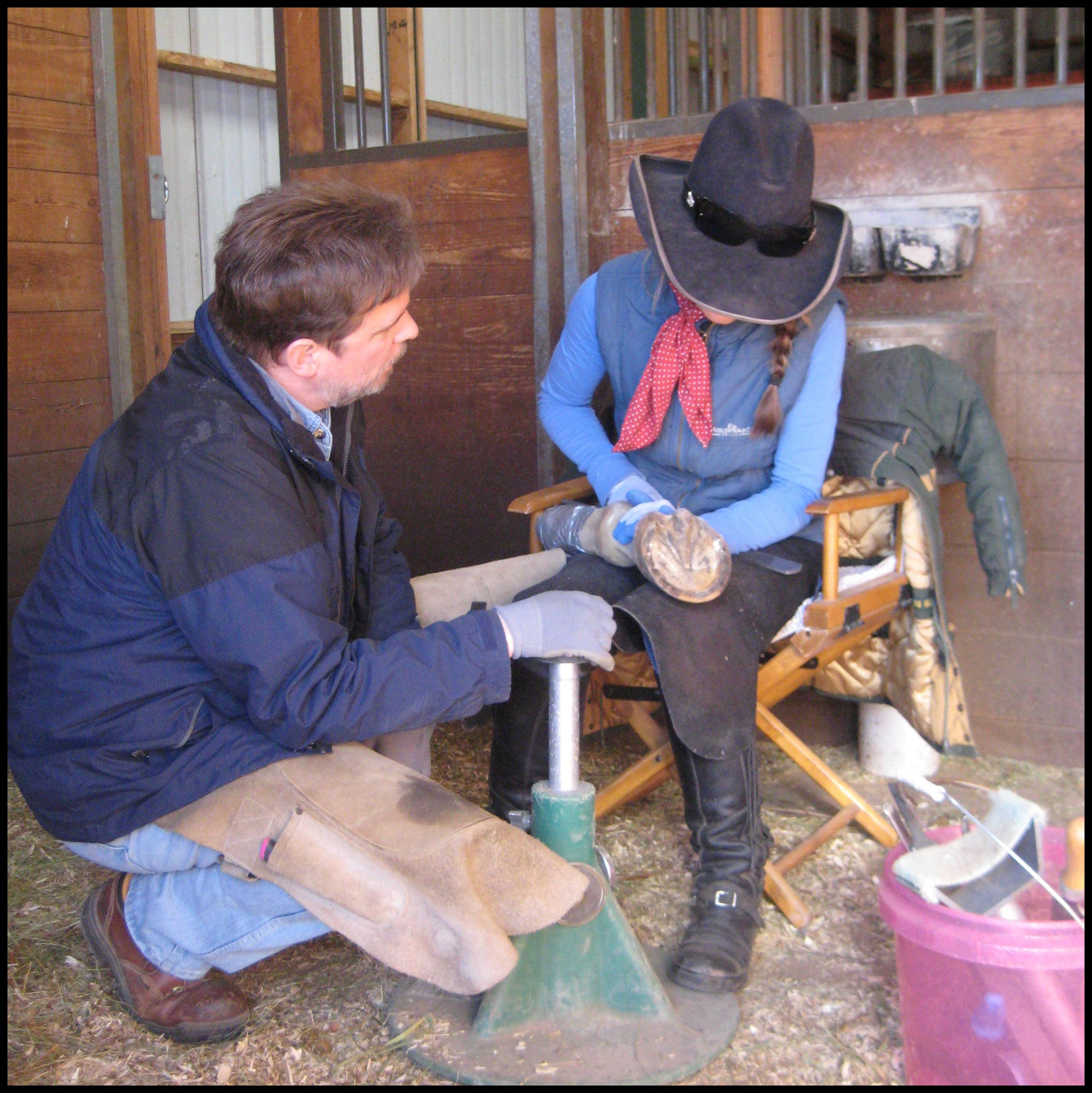
Cadaver hoof work with a student...
Most of the horses I saw, like many I see here at home, have been chronically overtrimmed at the toe. This seems to be a pattern with many farriers. In fact, I once had an older farrier watch me trim a couple of horses, and then, to my amazement (at that time, anyway!), express surprise that I hadn’t cut into live tissue. When I asked him about whether or not he cut into live tissue, he said, “Always! That’s the way we’re trained.” That little exchange really opened my eyes as to why people often ask the farrier how long it’ll be before they can ride their horse after trimming or shoeing; live tissue has been violated, and they’ve become accustomed to their horse being sore for a few days afterward. This gentleman, by the way, is a graduate of a very old and generally well-respected horseshoeing school, and he’s certainly not the only farrier who routinely pares away the sole until it can be flexed with thumb pressure! Logically, what are the consequence of such an invasive procedure? Well, if a human can apply enough pressure with his or her thumbs to deform the sole, then what happens when a thousand-pound animal steps on a rock with that thinned sole? And when you thin the sole by removing live tissue, you’re also destroying the natural concavity of the hoof, which defeats much of the shock-absorbing properties of the foot. The poor horse just can’t get a break!
This is why one requires proper training to do successful barefoot trimming. Simply removing the shoes and trimming the horse as if you’re going to put a shoe back on him is almost certainly not going to work. And that same trim with the addition of a “mustang roll” isn’t likely to be successful, either. The reason why so many people think his or her horse can’t be without shoes is because the owner is unknowingly continuing the pattern of improper and invasive hoof care – just without shoes – and neither horse nor owner ever has the chance to experience the many benefits of true natural hoof care. The horse is lame, the owner is unhappy, and the shoes go right back on the horse! But back to Santa Fe…
...a fine effort...
Although all of the hoof work went very well, I’d like to comment about a horse I had an opportunity to see, but not trim. As I understand it, two veterinarians recently examined this horse and pronounced that the bones/joints of the lower limbs were correctly aligned, the horse had practically “model hooves,” and the farrier was doing a fine job. And while I agree with the first of those assessments, I couldn’t disagree more with the other two!
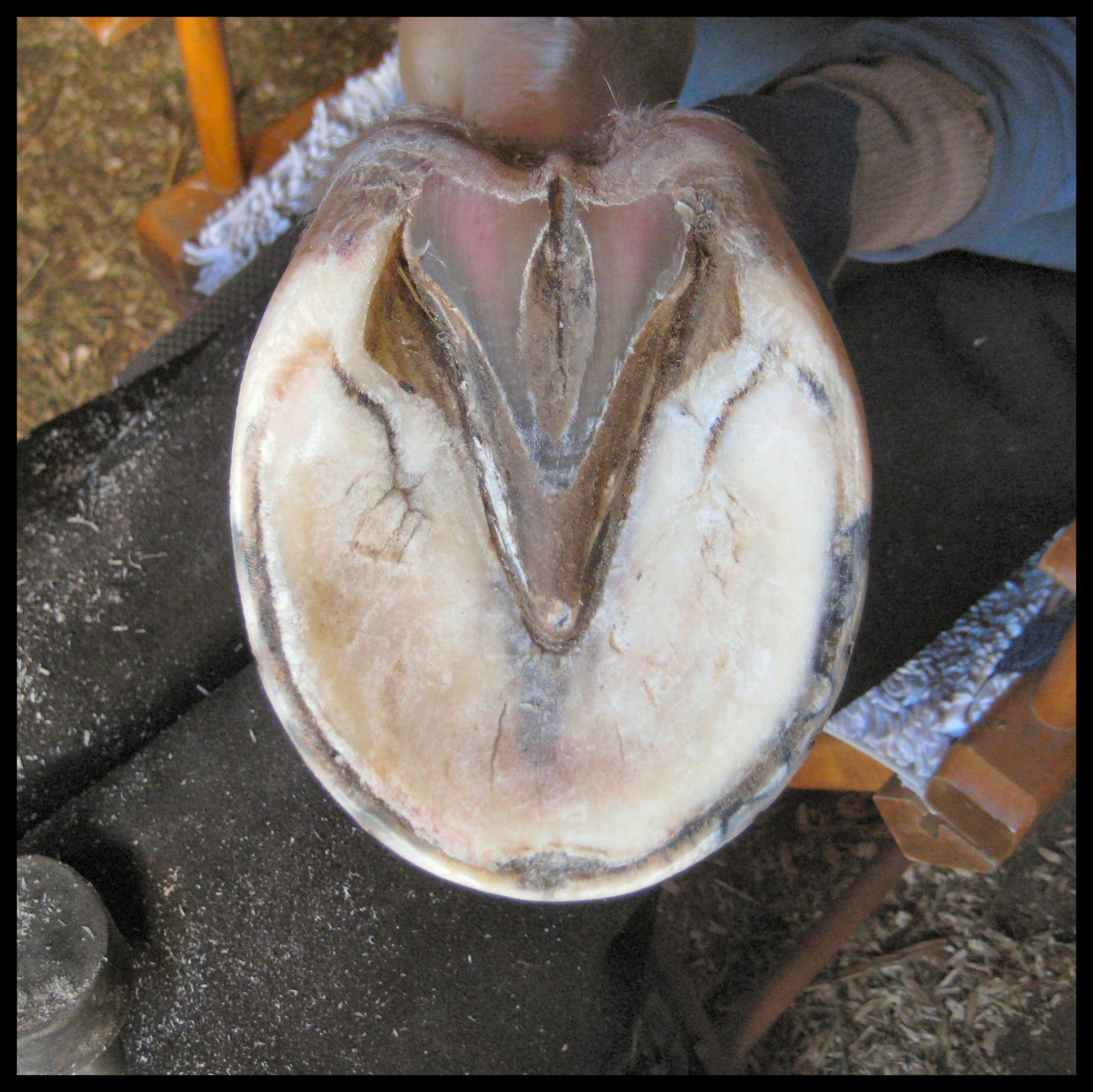
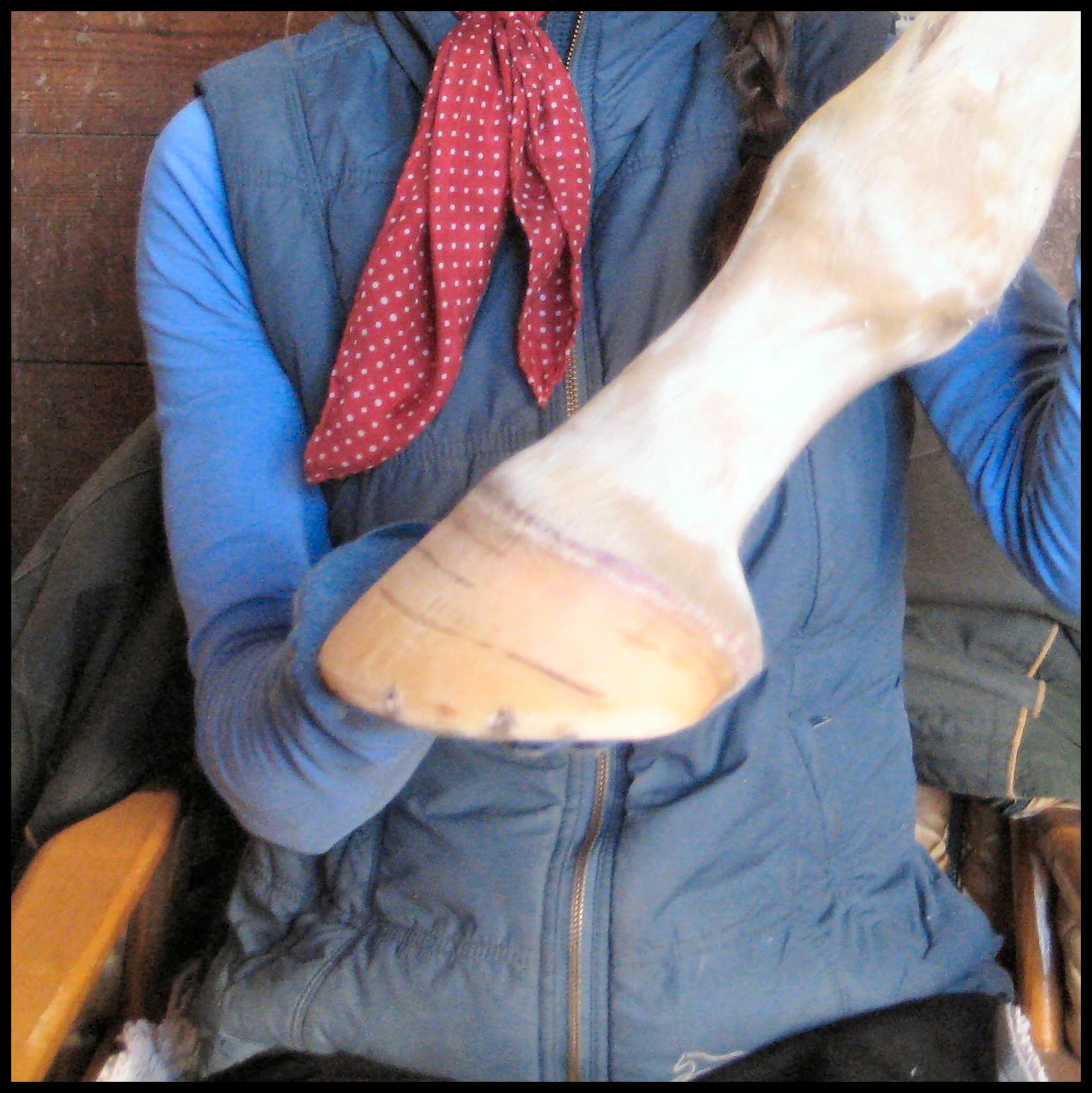
What I saw was a horse with otherwise healthy hooves but with very distorted hoof capsules. The reason the bones are in alignment is not because of anything particular the farrier has been doing; rather, it’s in spite of what the farrier has been doing. Like many horses, the heels have been left chronically too long. With every step any horse takes, the physical forces that shape the hoof are attempting to create what, for lack of a better term, I’ll call a “minimum-resistance” landing and breakover. As I’ve touched on in other posts, including The Shape of Things to Come and A Closer Look at Breakover, the lowest-impact hoof form is the one that facilitates a flat landing at a moderate walk, while the most-efficient breakover is the consequence of a short hoof with a rounded outer wall. For a couple of beautiful examples, see Functional Form.
...and a great finish!
When the forces of impact aren’t evenly distributed over the contact areas of the hoof (the heel buttresses and a horse-dependent region or regions at the toe), the hoof will respond by distorting its form. In this horse’s case, repeated concussion on hard terrain has literally bent the horse’s too-long heels so the hoof can land flat (hence, the bones/joints end up properly aligned). Here’s a quotation from an article by farrier John Scruggs entitled Hoof Balance – and Why Hoof Capsules Distort, in which he describes the symptoms and consequences of imbalance –
In order for a horse to stand, it must supply a force pushing up from the ground equal to or greater than the force of gravity that is pulling it down. Where these forces meet is the malleable medium with which [the farrier works] every day – the hoof capsule. When these forces are evenly distributed around the hoof capsule, there is no distortion. When there is an inequality in the distribution of force around the capsule (an area of the ground surface of the hoof capsule is higher/longer than necessary), the hoof capsule will distort until a state of equilibrium is reached….In order to equalize this greater load, the high portion will distort until it is loaded [equal to] the surrounding hoof horn. The action of this distortion in the hoof wall can be flare, separation, cracks, chips, crushed hoof horn, and/or contraction. Distortion is the hoof capsule’s only mechanism to equalize/normalize itself….The neat thing about all of this is that foot balance is not subjective. Feet are either distorted or they are not (emphasis added). If you have trimmed a foot in a manner that provides for a distortion-free capsule at the end of your shoeing interval, you have succeeded in balancing that foot for its conformation. If you get all four feet on the same horse distortion-free, that horse will “move” as well as its conformation, rider, and training will allow.
I couldn’t have said it better myself! In spite of what two veterinarians and a farrier may believe, this horse’s hooves clearly display several of Mr. Scruggs’ symptoms of chronic imbalance. And I’m not really singling out this particular horse, by the way; in my experience, the overwhelming majority of hooves exhibit one or more of these symptoms. But their absence does, indeed, indicate a horse receiving proper hoof care, and a horse that is thus able to move to the best of his or her ability.
Balance, balance, balance…as Mr. Scruggs says, it’s not subjective!
I’m headed out to Santa Fe, NM for a few days to do some one-on-one trimming training and to begin the process of transitioning a number of horses to being without shoes. I anticipate an interesting weekend in one of my favorite parts of the country! These are always very rewarding experiences because they allow me to provide more than a minimal amount of owner education, hopefully also in the presence of non-clients who aren’t quite certain if it’s possible/practical for their horses to be barefoot. Such a setting permits a “safe place” for education and discussion without the real or perceived pressures brought on by the presence of veterinarians or farriers. I’ll be sure to share my adventures, and perhaps some photos or videos as well, when I return.
 But perhaps more importantly, it informs me of your interest in possibly participating in various surveys and studies which I plan to begin conducting. As I’ve pointed out in the past, the horse world is absolutely full of misinformation about nearly every aspect of of equine management. That makes it extremely difficult for the horse owner, whether new to the equine world or an “old pro,” to find accurate and reliable sources of information. The remedy to that problem is data. And so it’s become one of my “life goals” (and certainly the goal of this site) to do my level best to provide only dependable and useful information.