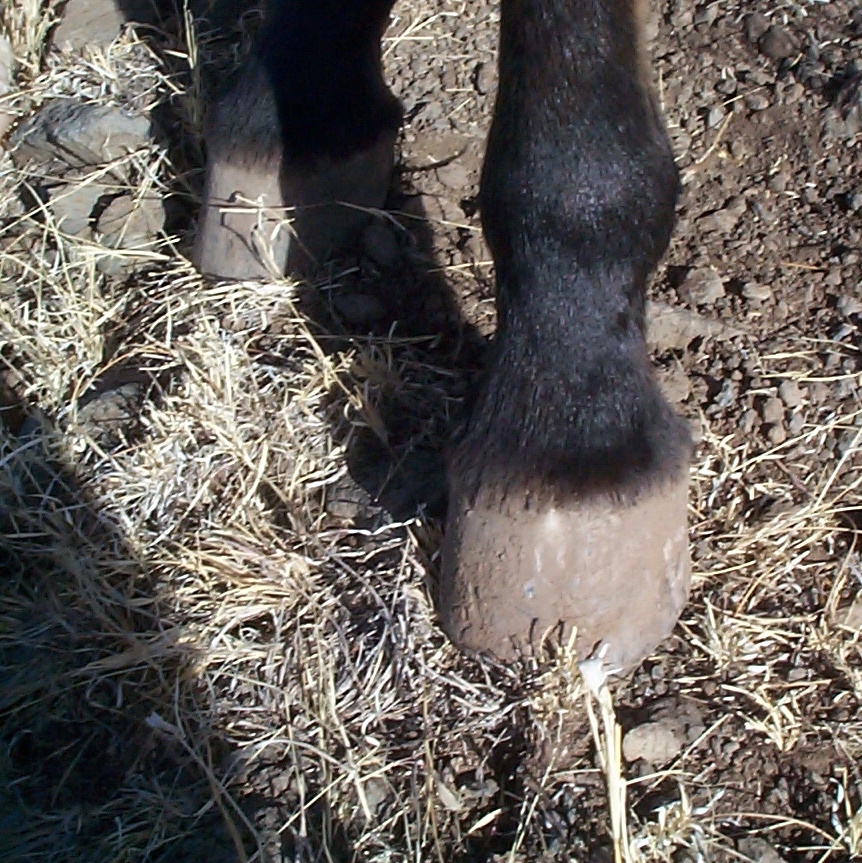
The title of this post may seem as if I’m about to reveal some connection between the laminitic horse and a common vegetable, and, in a weird sort of way, that’s correct. But it’s not what you think…

Some months back, one of my clients took on the care of a very sweet donkey who had been used as a guard donkey for a herd of sheep. It turned out she wasn’t especially good at her job, which may, in part, have been due to the moderately severe laminitis she presented with. At any rate, once she’d moved to my client’s farm, she began to improve with dietary changes and proper hoof care, and was moving about reasonably well. But it wasn’t the usual degree of improvement I’m used to seeing in these cases, which continued to puzzle me. And then, a couple of weeks ago, we found out about the Pumpkin situation. And here’s Pumpkin!

Obviously, the jenny was bred, but none of us were aware of it until just a few days before she delivered. And what a sweet little girl Pumpkin is! She’s the friendliest and most laid-back equid baby I’ve ever encountered.

And this was the missing piece of her mom’s laminitis puzzle. You see, laminitis is caused by stress, and stress comes in many different forms. Although laminitis is most commonly caused by a horse rapidly ingesting a high number of carbohydrates,  other physical stressors that can trigger a laminitic episode include illness and pregnancy. But that’s not the extent of it, because stress isn’t always physical. As I’ve learned from Dr. Bruce Nock, founder of Liberated Horsemanship and expert on the science of human and animal stress, the body responds to physical and psychological stresses in exactly the same way. So, ultimately, it may not matter whether you’re ill, or your child is ill and you’re worried about him/her – the effects on your body could be identical. Bruce illustrates this point with horses by describing a situation in which a large number of them in a single herd had been laminitic for a long period of time. After finding none of the usual dietary problems that would account for the situation, he realized the horses were being fed as a group in a relatively small outside area, and conjectured the competition for food was causing large amounts of psychological stress on the animals. And, sure enough, after the owner began scattering the hay around the pasture rather than feeding in a common location, the laminitis disappeared!

In Pumpkin’s mother’s case, it now seems obvious that the combination of stresses from both her former diet and her pregnancy were sufficient to bring about the laminitis, and although resolving the former led to significant improvement, the progression of her pregnancy continued to keep her in a less-than-optimal state. But following the arrival of Pumpkin, she’s made rapid improvement in both quality of hoof growth and comfort in movement.

So the next time you encounter a laminitic horse (or donkey!), remember: laminitis is caused by stress, and stress has many names. And while it’s important to consider the obvious causes, don’t rule out any possibility. Because things are not always as they seem!

This started out as what I had envisioned as a fairly straightforward post, written in response to some comments made by a reader and by a local horse owner. Instead, it turned into an extremely challenging one to write – I suppose because I have so much to say on the subject that the difficulty became knowing what to include and what to leave for another time. So it’s somewhat longer than I’d like, but here goes…

The first of these comments was from “David” regarding my “Promises, Promises” post –

Well written article. Any chance you will be writing an article on how horse owners can find a farrier who truly understands natural hoof care? For example, are there any specific questions that might indicate his or her level of experience/understanding in this area?

Right on the heels of David’s comment came some remarks from a woman who suggested I write more for those who are, in her words, “forced to shoe their horses” because of shoeing requirements (real or perceived) imposed by various equine disciplines, and who also wanted to know why I won’t train horseshoers how to do natural hoof care.

Thanks, David, for the kind words! Let me begin by saying, though, that people who do what I do generally don’t refer to themselves as “farriers” because a “farrier” is generally understood to be someone who shoes horses – a “horseshoer.” We, on the other hand, usually refer to ourselves as “hoof care professionals,” “natural hoof care providers,” or something similar, because the overwhelming majority of us won’t shoe horses. So, yes, although I can give you some basic guidelines on what to ask, I also have to tell you that I’m highly skeptical of anyone who claims to be doing natural hoof care and will also put shoes on your horse if you prefer. More on that in a moment, but here’s the list. It isn’t in any particular order, and isn’t comprehensive, but it should help you sort things out –

  • Determine whether or not the individual is certified as a hoof care provider by one of the two main organizations who do training and certification in natural hoof care: Liberated Horsemanship and the AANHCP. If he/she is, they’ll be listed on the organization’s website. These two groups teach strictly non-invasive hoof care as pioneered by Jaime Jackson. Although some other organizations have recently emerged, I can’t vouch for their training programs; these two, I can. There are also some groups who teach a very invasive form of trimming; be careful of them as well.
  • Find out how he/she feels about so-called “corrective” trimming. If they advocate it, run – fast! Because in spite of what anyone else may tell you, you cannot correct conformation issues through trimming or shoeing. You can certainly cause a lot of damage, though.
  • Talk to their clients. If you encounter anything other than a 100% success rate with their trimming, they may not understand the hoof as well as they think. But be careful with this one for two reasons: first, no trimmer has control over every aspect of the horse’s management, and clients, in spite of repeated warnings to the contrary, do some pretty harmful things; and second, because not every horse can be fixed by natural hoof care. Although proper natural hoof care offers every horse their best possible chance at comfort and long-term soundness, it can’t cure every problem. And if someone claims it can, it’s a good reason to avoid them.
  • See what they say about their trimming methodology. If they mention angles and lengths and matching pasterns – anything other than using the bottom of the hoof as the sole (no joke intended!) guide for trimming – they definitely don’t understand the hoof, and you should avoid them.
  • Ask them what makes the hoof look the way it does. If the answer is “I do,” look for someone else.
  • Inquire about what they remove when they trim a hoof. If the answer is something along the lines of “only the junk – nothing more, nothing less,” or “only what nature would remove under optimal environmental conditions,” that’s a good sign. If they say “only hoof wall,” “I never touch the frog (or sole or bars),” or “I pare out the sole,” they’re not doing natural hoof care.
  • Discuss how the hoof should land. At the walk, a proper landing is flat or very slightly (imperceptibly) heel-first. If they say otherwise, keep looking.
  • Visit a client or two and look at the work. Do the hooves have the characteristics of the feral mustang photos or client photos shown in some of my other posts?

Not counting the first one on the list, the remainder will eliminate over 99% of the farriers whose work I’ve seen, so don’t be surprised if it takes you a while to find someone! And for those who’d like to know a bit more, here’s some additional information on shoes and shoeing…

The whole “shod vs. barefoot” subject is a difficult one for me – a “matter of conscience,” as the title of the post says. If horseshoes actually provided the benefits people believe they do, there would be a great many happier and healthier horses and writing this would be easy. But the plain truth is, they don’t. After devoting the last nearly 18 years to working with the hoof at both the theoretical and practical levels, studying the research results of others, and talking to veterinarians, other hoof care professionals, and horse owners from all over the world – all viewed under the critical microscope of my 30+ years as an engineer – I can assure you the data absolutely convinces me of two things:

  1. Horseshoes do not truly offer the benefits they are alleged to offer by nearly every veterinarian and farrier, and,
  2. Any genuine benefit provided by a horseshoe, of which there are shockingly few, is nearly always more than offset by the negative consequences of shoeing a horse.

Yes, I’m well aware that horses have been routinely shod for hundreds of years, and they obviously haven’t all been lame. That’s the usual argument offered up against what I’m claiming here. But in the horse world (among other places), we have the unfortunate habit of confusing correlation – when two or more things are found together – with causality, which is when the presence or action of one thing results in an effect on another. And the gigantic assumption about horseshoes is that they cause soundness (or, at least, prevent lameness). So let me say that, in general, horses are sound not because of what’s typically done to their feet, but in spite of what’s typically done to their feet. In fact, they’re remarkably resilient animals in many respects. Nearly every day, I see horses putting up with absolutely lousy trimming and shoeing (which, by the way, I do my best to ignore so I can sleep at night – I don’t butt in where I’m not asked). The owners, unfortunately, often don’t recognize the problems because their horses seem to be ok and because some so-called “expert” told them that’s what the horse needed. Problem is, most of those “experts” really don’t have a sufficient understanding of the task at hand to not cause more harm than good. That’s not just my opinion; look at what Dr. Deb Bennett, well-known equine anatomist and author, has to say on the subject in her paper entitled Principles of Equine Orthopedics –

What concerns me – and it ought to be of concern to every horse owner – is that a person with little or no training in physical assessment; no knowledge of the development or physiology of body tissues; a vague or incorrect concept of what is normal in stance; who is unprepared to relate the principles of physics or biomechanics to his work; who has never been taught how to develop a long-term treatment plan, or even that this would be of importance – THIS person is going to be asked to design, manufacture, and apply an orthotic device (a horseshoe) to my horse’s limb….When the farrier does not know why to proceed, he cannot know how to proceed….if good work happens, it happens by chance.

Dr. Bennett goes on to say that this lack of understanding and training is what’s responsible for the many, many “schools of thought” about trimming and shoeing, and why they all seem to have less-than-wonderful success rates. If you don’t believe me, just ask five farriers how they’d shoe a particular horse – especially one with any sort of “issues” – and then try to sort out the five different answers you receive! But isn’t it only logical that if the horseshoers truly understood the forces that govern the horse’s movement and consequent shape of the hoof, there would be only one answer to that question? Proper trimming and shoeing is not a matter of opinion; there’s a correct way, and then there are all the other ways. The correct way is the one that takes into account all of the factors that cause the hoof to look and function as it does; Dr. Bennett would say you either understand them or you don’t. We both would say that the vast majority don’t. And that’s why it’s difficult for me to imagine how the same individual can successfully practice both shoeing and natural hoof care – the two are at odds with each other practically by definition. It’s also why I’m not comfortable with training anyone who continues to shoe horses.

And finally, let me close by addressing the “forced to shoe your horse” comment. While I realize there can be tremendous pressures exerted on horse owners by well-intentioned but uninformed friends, trainers, barn owners, veterinarians, and a variety of other “experts,” no one makes anyone else shoe his or her horse. If there’s a genuine need for sole protection, there are some wonderful boots out there that offer every real advantage shoes only allege to offer, without any of the negative consequences of shoeing. But if it’s because you’re involved in a discipline that requires you to shoe your horse to participate, and you accept the ever-mounting body of evidence that shoeing is not in your horse’s long-term, and often short-term, best interest, then perhaps you should consider finding another way to enjoy your horse. For his sake. But don’t claim that you have to shoe your horse. That’s a choice you’ve made. Maybe a difficult one, maybe an easy one, but a choice nevertheless.

Remember: you have a choice. Your horse doesn’t.

I’m always trying to better understand, and therefore help clients understand, the horse and hoof issues that cause them (the horse owners) any sort of stress. So when I received a call from a client the other day who was concerned about a chip in her horse’s hoof, I decided I’d take the opportunity to try to get a better handle on what goes through a client’s mind when he/she is confronted with this particular situation.

As you can see in the photos below, this big American Quarter Horse had broken out a piece of hoof wall on his right rear hoof; not particularly surprising since the owner does a fair amount of trail riding with him, and he was already scheduled to be trimmed a few days later. This horse, by the way, had received less-than-optimal hoof care before I had taken him on 2 or 3 years ago. In fact, his feet were trimmed along the lines of what I tend to call the “typical farrier trim,” which has all or most of the following characteristics:

  • The bearing surface of the hoof wall (the “bottom”) is trimmed flat
  • The toe is trimmed too short
  • The heel buttresses (“heels”) are left too long
  • The primary weight-bearing areas of the hoof wall (the heel buttresses and one or two areas in the toe region) are unbalanced – accidentally or intentionally – with respect to each other
  • The sole is not properly exfoliated
  • The bars are not blended into the exfoliated sole
  • The frog is too long

(Incidentally, I’m painfully aware that these need a lengthier and more detailed explanation, and I promise you I’ll being doing that in the very near future!)

As a consequence, his hooves weren’t functioning properly, and he had had problems with cracks. But since I’ve taken over his hoof care, and in spite of the fact that (like many horses) he’s somewhat sensitive to dietary and environment issues, he’s been growing well-functioning, good-quality hooves with no cracking.

After reassuring the client that I absolutely wasn’t ridiculing her for calling me out early, I asked her to be as specific as possible about what went through her head when she looked at this hoof. She told me she knew he wasn’t lame because of it, but was concerned that he might end up being lame if he didn’t have the hoof trimmed sooner rather than later. She also reminded me about his history with quarter cracks, and didn’t want to risk a repeat of those problems.

I picked up the foot and showed her that the broken-out portion hadn’t involved any living tissue. She seemed surprised by that news (which is my fault!), so I explained that, similar to a person’s fingernail, the hoof wall itself consists of dead tissue. As long as the living tissue that attaches the hoof wall to the coffin bone isn’t violated, there’s no problem. That, by the way, is why farriers are able to drive a nail into the hoof wall without causing any instant lameness, and also why a misplaced nail – one that encroaches on living tissue – does cause an instant lameness. Since the living tissue attachment ends at the sole, any chipping that occurs below the sole is never a cause for concern; it’s simply, as I’ve pointed out in previous Posts, nature doing my job for me by removing excess growth to facilitate efficient movement. The heel quarters are by far the most common area for chipping to occur in because the hoof wall is generally thinnest in that area. As you can see in the following pair of photos taken after trimming, the only remnant of the chip is the slight “tear” that extended up past the sole on the very outside of the wall. Note also that the bearing surface of the hoof wall is not flat – there’s a slight relief in the heel quarter area that reflects the natural arch of the foot. Nice hoof!

So next time you see a chipped-up hoof, please don’t panic. Don’t even worry. Just remind yourself that it’s nature trying to get a jump-start on the trimmer’s job, and it’s time for a trim…

Some further reflection on my last Post, coupled with conversations and comments from several readers and clients, has made me want to add a few other thoughts regarding what constitutes genuine natural hoof care.

In this case, I think it’s important (and, given the plethora of folks pretending to provide natural hoof care, becoming increasingly more so) to point out that natural hoof care is absolutely not a panacea. In spite of many claims and promises to the contrary, it will not cure every possible hoof ailment. How could it? Damage is damage, and while it does offer hope for comfort and a lessening of symptoms in every circumstance (more on that in a minute), it will not fix what’s truly broken. It won’t cure ringbone or sidebone or navicular disease – assuming the diagnosis is correct (admittedly a big “if” when it comes to anything “navicular”), those are very real pathologies with permanent consequences. And anyone who suggests otherwise is doing you and your horse a disservice.

I defined natural hoof care in my last Post, but, after having just talked about what it won’t do, let me now state that what natural hoof care does have going for it is this: natural hoof care offers the best possible chance at long-term comfort and soundness for your horse, regardless of what you do with him/her and regardless of when you begin the process. Now, I realize there are people out there who don’t care about that; their entire objective is to win at whatever they’re doing with their horse. And they try to accomplish it by putting their faith in trimming and shoeing techniques that are, at best, worthless, and, more commonly, extremely destructive to their horse.  And the fact that their horse is the real loser isn’t an issue for them. I’m not talking to those people here.

The people I am talking to are those who genuinely want the best for their horse. I met a rather “classic” example the other day – a woman trying to wade through the hoof care quagmire to get the best possible care for her horses. Three of them were barefoot (her preference), but the hoof care they’d been receiving was a far cry from natural hoof care. Instead, it looked like the usual prep to put on a shoe – flat bearing surface on the wall, too short in the toe, way too long in the heels, bad M/L (medial/lateral, or side-to-side) balance, and lots of bar and dead sole left on the bottom. Banging down on their heels with every step, causing not only heel pain, but upper-body pain as well. A hoof that can’t expand properly, limiting shock absorption, circulation, and sensation. And, of course, speeding up the arthritic process with the unilateral concussion. What a mess!

Her fourth horse needs (and will have) another Post devoted to fully describing his situation, but let me just say here that he’d been diagnosed with “navicular” and had been examined and “treated” by a number of vets and farriers, culminating in him being shod with things that had more in common with the Marquis de Sade than with hoof care. To make things really interesting, it was undoubtedly one of the worst trimming/shoeing jobs I’ve ever seen. This horse was sore!

These are the situations that make me angry. This is when I imagine seeing that vet and farrier subjected to the same torture they’ve put the horse through. Is ignorance a crime? No – of course not. But bad work, and, worse, recommending things that a 10-year-old with even a modicum of common sense could see are illogical, should be. Pretending to know things when you don’t should be as well. And the whole topic of knowing what you don’t know reminds me of an experience I had some years back…

When, after several years of contact with Jaime Jackson via email and telephone, I finally went to study with him in person, I’d asked him to bring along “challenging” cadaver hooves to trim since I was pretty confident about trimming “normal” feet. So after trimming a couple of pretty typical hooves, he pulled out the sorriest-looking mess of a hoof I’d ever seen – including in photos – and handed it to me. I studied it for a minute or two, and Jaime asked me how I was going to proceed. I started off my plan by saying, “I think,” only to have him interrupt me. “You think?” he said. “You THINK??? Listen, if you don’t know exactly how to proceed, you have no business touching this hoof!” After another minute of studying the awful thing, I simply handed it back to him. A big smile appeared on his face, along with the words, “That’s exactly what I wanted you to do!” I knew what I didn’t know, and he knew it, too! We then trimmed that hoof together – still the worst one I’ve ever seen – and dissected it when we finished. It didn’t even have a coffin bone left; it had been completely reabsorbed!

That was a very valuable lesson for me. No horse should ever pay the price for a care provider’s ignorance. The good news for these four is that it’s now over, and what a joy it was to see all of them walk off more comfortably after being properly balanced. Does the one horse truly have navicular disease? I don’t know yet – I’ve not seen any imaging, and it’s too soon to tell clinically. But he’s very obviously more comfortable, so, regardless of the ultimate diagnosis, he’s on the path to being as sound as he can be.

So, just a few more points about natural hoof care before I end this Post. The list, by the way, isn’t in any particular order and isn’t intended to be comprehensive. Also note that I’m still not describing the physical characteristics of a properly-trimmed hoof. That’ll have to wait for yet another Post.

  • Natural hoof care is right for every horse, but not for every owner. If your expectations are unreasonable, you’re not going to be happy even though your horse will be happier. The worst kinds of situations are those where the horse has been shod his entire life, stands 24/7 in a urine-laden stall eating the horsey equivalent of ice cream and bonbons (lots of processed feed and treats), and the owner wants you to “do that barefoot trim thing” so he/she can ride him 20 miles over rocks tomorrow. Not happening.
  • Natural hoof care makes sense, both viscerally and intellectually. If it didn’t, I wouldn’t be doing it. If it doesn’t to you, you shouldn’t be doing it either. Period.
  •  Natural hoof care takes time. The hoof grows fairly slowly, and achieving proper hoof form and function is very likely to be measured in months, not days or even weeks. The entire body often has to re-balance itself after years of uncomfortable and/or abnormal movement. Don’t expect to have a new horse tomorrow when you’ve both been living with the old one for years.
  • Natural hoof care is still atypical. Your horse’s hooves are likely to look very different from every other horse in the barn, so be prepared to hear about it from your friends, your trainer, the barn manager, and every other person anywhere nearby. Know that you’re absolutely doing the best for your horse, and remind yourself there’s plenty of data to support your position. Stand up for your horse’s right to be sound!
  •  Natural hoof care is a commitment. You can’t “sort of” do it – you’re either in or out. That means it matters whether or not you’re consistent in using the same (qualified) person, even if you have to wait a week or two longer than you might like. While it’s easy to tell yourself, “Oh my gosh, it’s been ___ weeks, and she’s got a couple of chips. I’ve got to get her trimmed today, so I’ll just get ol’ Charlie to give her a quick trim,” resist the urge. Your horse will be fine. Don’t risk undoing all the progress that’s been made by panic over what, to the horse, amounts to nothing.
  • Natural hoof care is a whole-body process. There are other factors besides trimming that contribute to hoof form, function, and quality, including what a horse eats, how much he/she moves, the type of terrain over which he/she moves, and (to a much lesser extent) genetics. Don’t imagine merely getting a proper trim is the end of it any more than buying a guitar makes me Jimi Hendrix.
  • Natural hoof care is about the balanced hoof, which leads to healthy hooves and balanced movement. Short and well-rounded for efficiency. All the dead sole material exfoliated for proper expansion and shock absorption. Absolutely minimal concussion at impact to stave off osteoarthritis and other joint and bone degradation. And no “corrective” anything – ever. The trim allows the horse to move properly; it does not make the horse move in a particular way. And it’s not about angles, lengths, or any other numbers, just so you know.

‘Til next time…

It’s not unusual these days to hear horse owners, farriers, and even veterinarians talk about so-called “natural” approaches to a wide variety of equine health and management topics, including vaccinations, deworming, feeding, and hoof care. Since (as I explained in my first post) my equine expertise lies primarily in the area of hoof care, that’s the only one of these I’m qualified to discuss. Hopefully, any advice you’re taking regarding any of the other issues is coming from someone equally well-educated in that particular discipline, and not just the ramblings found on so many websites! After all, a lot of folks (from altruistic to opportunistic) have eagerly jumped on the “natural” bandwagon without any credentials or data to support their claims. As usual, caveat emptor!

Sometimes it’s more effective to describe something by giving guidelines about what it isn’t, rather than describing only what it is. When educating horse people in any of the myriad circumstances in which I find myself, I always try to impress upon them that true natural hoof care is never a matter of simply removing the horseshoes and trimming the hooves as if they’re about to receive another shoe; there’s nothing even remotely “natural” about that type of trimming! Yet, that remains an extremely popular misconception. For example, I had an opportunity to speak with a horse owner the other day who described how her friend’s horse, who had been without shoes for quite a while, has developed sidebone. Sidebone, for those who may not be familiar with it, is ossification – the conversion of cartilage to bone – of one or both of the two so-called lateral cartilages. These fairly large, vertical plates of cartilage are found at the rear of the hoof on either “side” of the coffin bone, as can be seen in the following illustration –

Lateral Cartilages

These cartilages are normally fairly pliable, like a stiff pencil eraser; if you put your hand across the two “bumps” found at the top, rearmost part of the foot and gently squeeze, you’re flexing the lateral cartilages. But repeated unilateral concussion (meaning primarily on one side) hastens the ossification process. And so it was completely predictable when the horse owner went on to tell me that it appears her friend’s horse has been trimmed to leave one heel quite a bit longer than the other. This is something farriers do on a very regular basis, allegedly to “correct” conformation “problems.” Regardless of whether or not you believe it can possibly fix a twist in a limb that originates in the shoulder or hip (trust me – it can’t), it definitely creates a source of unilateral concussion which sets the horse on a path towards developing sidebone and ringbone (more about that one later). The fact that there’s no shoe on top of the unbalanced trim does not make this “natural hoof care.” It only means the situation is not quite as dire as it would be if a shoe were added to the mess, because a shoe would further increase the concussive forces as well as completely defeat any chance of the horse wearing off the uneven trimming. Again – merely being without shoes is but one step towards true natural hoof care. You can still have exactly the same disastrous consequences to your horse if the hoof care provider doesn’t fully understand what he/she is doing.

When it comes to hoof care, “natural” can be defined only one way: natural hoof care is hoof care done in complete accordance with what nature demonstrates to be true about the hoof and the forces that shape it. Indeed, nature’s name is…”physics.” Friction, mass, inertia, centripetal force, levers, equilibrium – all of these concepts, and many more, come into play when trying to grasp the realities of what makes a hoof successfully perform its primary function of facilitating movement while protecting its sensitive inner structures. There are, of course, other important roles the hoof plays in the life of the horse, but if the principal objective of efficient movement while protecting is honored, the rest will follow – naturally!

I’ll have to get into the specifics of the characteristics of a properly-trimmed hoof (whether by nature or by human) at a later time, but for now, consider what the effects of traveling miles every day over extremely abrasive terrain would be on a hoof, such as the ones shown in the following photo I took of a horse on Tomas Teskey’s ranch in Arizona –

Real Natural Hoof Care

Under these circumstances there can be no question of proper balance, since, with every step of the horse, his way of going on the rough ground will shape his hooves for optimal efficiency without compromising his comfort. There will be no excessive length, and no sharp edges to be found.

Since most of our horses aren’t fortunate enough to be kept in arid, 100-acre “paddocks” like those at Dr. Teskey’s, we must make up the difference by trimming for those same characteristics as if they were. That, coupled with proper diet and adequate movement, will ensure the healthiest, most problem-free feet possible.

And that is the essence of natural hoof care. If your hoof care professional is doing anything else – anything contrary to what your head and your gut tell you is true – he or she is not providing hoof care that’s in your horse’s best interest.

Caveat emptor!