
NOTE: This particular subject is of great interest to me because its exploration leads the logical person  to question the very foundations of modern farriery. Foolishly, I began the writing process thinking I could say what needed to be said in a single post. But after I started putting my thoughts down, it quickly became evident there was no way I could accomplish what I’d set out to do with only one post. And so I’ll be presenting it as a series of articles instead, beginning with some anatomical and biomechanical background theory and concluding with the consequences of artificially manipulating hoof angles.

—

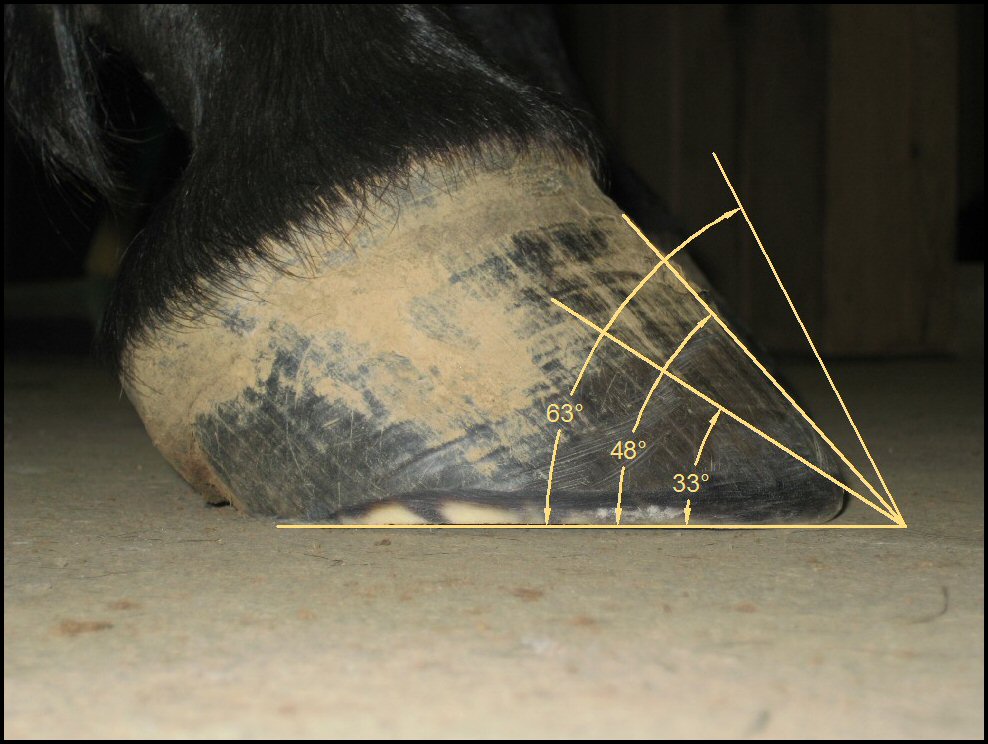
One of the most commonly misunderstood topics with respect to equine hooves is the subject of hoof angles. When hoof care professionals speak of “hoof angles,” they’re referring to the angle the dorsal hoof wall (at the toe) forms with respect to the ground, as shown in the following photo/diagram –
Hoof Angle Measurement

As I mentioned in Off His Rocker(s), many horse people place a great deal of emphasis on hoof angles. Owners think a particular angle is important for proper movement, or that the angles of hoof pairs must always match. Veterinarians and farriers are forever trying to enhance movement or increase comfort by deliberately manipulating hoof angles, which is accomplished by adjusting the relative amounts of bearing surface hoof wall at the toe and heel buttresses (“heels”) and/or by utilizing wedge shoes and/or wedge pads. Adding (or not removing) length at the toe relative to the heels will lower the angle, while (more commonly) adding or not removing length at the heels will increase the hoof angle. And yet, these angles are not arbitrary. As you’ll learn, there is only one correct angle for every horse’s hoof, and artificially varying that angle is not without consequences. But more on that later; we’ll spend the rest of this post covering some necessary background information and relevant terminology.

If you click below on what appears to be a tiny strip, you’ll see it’s actually a series of 33 sequential frames extracted from my upcoming video on hoof landings. In the leftmost frame, the horse’s front left hoof has just made contact with the ground, and in the rightmost frame, the front left hoof has finished one complete stride and once again made ground contact –

Stride & Stride Length

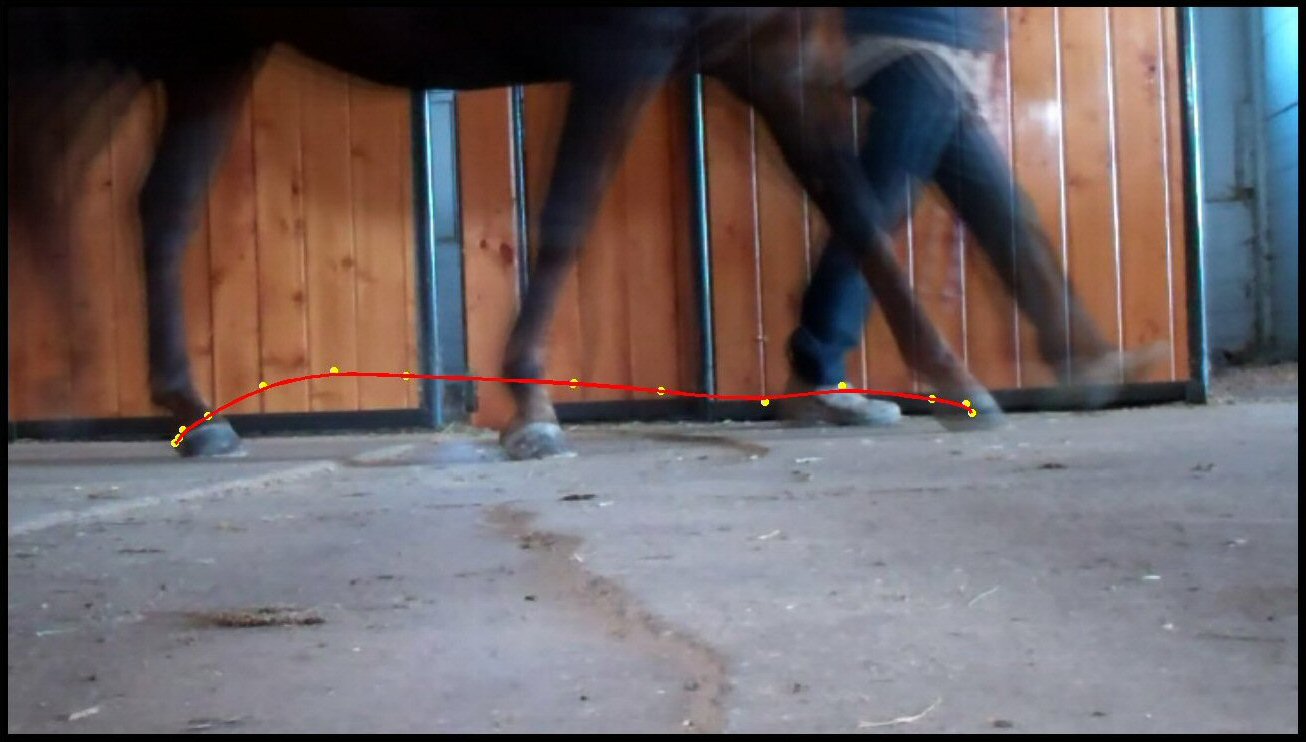
The distance traveled along the ground from one end of the photos to the other is defined as the horse’s stride length. For any particular hoof, one stride consists of two parts: the support phase (also called the stance phase), where the limb is bearing weight (shown in the first 2o images), and the swing phase, where the hoof has left contact with the ground and is in flight (shown in frames 21 through 33). If we were to then tape a light to the horse’s front hoof and view the path the light traces as the hoof leaves the ground and then lands, the result would look like the following composite photo/diagram –
Flight Arc of the Hoof

This path is known as the flight arc. Note there are several interesting things we can learn from this photo. First, the flight arc is fairly shallow, with no large excursion off the ground. This, of course, varies with the breed and conformation of the horse, but like many other horses, this horse has much more forward motion than vertical height apparent in the flight arc. Second, you’ll see that the gentle peak in the flight arc occurs soon after the hoof leaves the ground. And third, notice that the rear hoof’s contact point with the ground is slightly past where the front foot began its flight.

The next sequence of photos from the same upcoming video shows a (different) properly-trimmed horse at the walk. The top set is the landing and takeoff of a front foot, while the bottom set is a rear foot. To save space, I’ve put a break in the sequence between when the foot finally lands and when it again begins its rotation off the ground, evidenced by the radically different angles of the cannon bones –

Proper Landing & Takeoff - Fore & Hind

Notice how smoothly the hoof lands – perfectly flat – and then leaves the ground. The breakover (time) is the time difference between when the heels leave the ground (frame 7 in the top sequence) and when the toe leaves the ground (frame 9 in the top sequence).

Keep in mind that it’s not possible to calculate exact times and positions from these video excerpts because each frame is 1/30 of a second apart, and motion has occurred in between the captured images. Another interesting phenomenon apparent in these video stills is the blurring due to motion, most prominent when the hoof is farthest from the ground. That’s because the hoof decelerates to near zero as it prepares to make contact, and accelerates again as it moves higher in the flight arc.

Let’s now look at what determines the “parallelness” of the pairs of limbs i.e. whether or not the horse’s toes point directly forward, or whether they turn out or turn in. Interestingly, the plane defined by a limb’s motion is determined not by the joints of the lower limb, but by the construction of the horse’s shoulder or hip. I particularly like this illustration from Dr. Deb Bennett’s Principles of Equine Orthopedics –

Plane of Forelimb MovementThe reason for identifying these particular movement parameters is because these are the characteristics veterinarians and farriers endeavor to change through trimming and shoeing: the stride length, the flight arc, the landing, breakover time, and the plane of limb movement. Most of these are thought to be connected directly or indirectly with hoof angles. Over the next few posts, we’ll examine whether or not these connections are real, and see what the data actually tells us about changing, or attempting to change, these gait characteristics.

In closing, let me share yet another video excerpt with you; this time of the landing and takeoff of a horse who happens to be shod –

Bad Landing & Takeoff
Improper Landing & Takeoff - Fore & Hind

Unlike the previous two examples, you’ll see this horse literally “slams” his feet down, even at the walk. And most importantly: this bad landing cannot be detected under normal viewing conditions. To the eye, this horse appears to land perfectly fine; it’s only when capture the movement on video and slow it down do we see just how bad this landing really is. Think about the implications of that next time someone tries to convince you that you should see a horse land heel-first!

Stay tuned…


This is one of the real joys of my life – sharing knowledge with others. After some prodding from various clients, coupled with a student from the far east coast of Canada coming to study with me, I’m happy to announce that I’ll be offering two clinics in May. And it’s useful to know that once you’ve attended a particular clinic, you may attend that same clinic in the future at no cost (other than materials and lunch). If you’re attending for the second (or third or fourth) time, however, please contact me so I know to expect you.

Special Topics/Advanced Trimming

(NOTE: This all-day clinic is the one I present as part of Liberated Horsemanship’s hoof trimming training program in Warrenton, MO – a program I highly recommend for those interested in learning more about not only hooves, but other equally-important aspects of equine management as well. Be sure to check out their website for a schedule of their Gateway Clinics, which feature some outstanding equine professionals.)

Intended for the experienced hoof care professional, the first part of this dual-themed clinic challenges the audience to realign their approach to several of the equine world’s firmly-held beliefs and practices about horses and horse management, and equips them with the knowledge and tools necessary to present science-based alternatives. In the second part, the clinic familiarizes participants with the underlying anatomy and bio-mechanical theory necessary to successfully trim the abnormal hooves associated with certain pathological conditions such as severe laminitis, injury, and chronic imbalance, in accordance with natural hoof care principles. Large-screen live video is utilized to provide an unobstructed view of all clinic materials. Each attendee receives a booklet containing assessment and course of action information, including high-quality color photographs and radiographs of abnormal hooves.

Date:           Saturday, May 5th, 2012

Time:          9AM – 5PM

Location:    OSU Agricultural Technical Institute, Wooster, OH

FAQ Sheet:  Click Here

Cost:           $300 (materials & lunch incl.)

Register:     Click Here

[DKB url="http://enlightenedequine.com/wp-content/uploads/2012/03/Trimming-the-Abnormal-Hoof.pdf" text="Print a Flyer" title="Hang it in the barn or hand it out!" type="extrasmall" style="gradient" height="30" width="" opennewwindow="" nofollow="" color="#d5a251" textcolor="black"]

Understanding Natural Hoof Care

Given the overwhelming amount of information available to today’s horse owner, making well-informed decisions about hoof care can be a daunting undertaking for those interested in both short-term performance and long-term sound­ness. When facing abnormal conditions such as laminitis or navicular disease, the challenges are even greater, and the horse owner can suddenly find himself/herself at the mercy of conflicting advice from well-meaning veterinarians, farriers, and other horse owners.

Through the use of large-screen live video and other visual aids, this lecture/clinic presents anat­omy, biomechanics, and hoof care theory in a comprehensible and logical format that will equip the horse owner with the information necessary to make informed decisions based on fact, not sup­position. For those desiring a more intimate look at the actual trim experience in anticipation of further education, or just wanting to “get their hands dirty,” the clinic continues with a descrip­tion of tools & tool use, the step-by-step process of natural hoof trimming, and hands-on guided in­struction through the natural trim process using cadaver hooves.

Date:           Saturday, May 12th, 2012

Time:          9AM – 5PM (lecture portion ’til 2PM)

Location:    OSU Agricultural Technical Institute, Wooster, OH

FAQ Sheet:  Click Here

Cost:           $300 (materials & lunch incl., cadaver hooves extra)                             $75 lecture only (materials & lunch incl.)

Register:     Click Here

[DKB url="http://enlightenedequine.com/wp-content/uploads/2012/03/Understanding-Natural-Hoof-Care.pdf" text="Print a Flyer" title="Hang it in the barn or hand it out!" type="extrasmall" style="gradient" height="30" width="" opennewwindow="" nofollow="" color="#d5a251" textcolor="black"]

You may have noticed I’ve added an item at the top of the Sidebar entitled Sign Up!, with a link below it that says “Stay informed and contribute to our knowledge.” That link will take you to a very simple, but very important, form I’d encourage every visitor to fill out. Not only will it allow you to receive emails from me when I put up new posts, it’ll also let you enter the email address of another horse owner whom you feel may benefit from the information I share here.

But perhaps more importantly, it informs me of your interest in possibly participating in various surveys and studies which I plan to begin conducting. As I’ve pointed out in the past, the horse world is absolutely full of misinformation about nearly every aspect of of equine management. That makes it extremely difficult for the horse owner, whether new to the equine world or an “old pro,” to find accurate and reliable sources of information. The remedy to that problem is data. And so it’s become one of my “life goals” (and certainly the goal of this site) to do my level best to provide only dependable and useful information.

To that end, I’ll be designing and conducting several programs of study, some of which will require information from horse owners about various aspects of their horses’ management. All such information will be completely anonymous, of course, and will only be used for the purpose of furthering knowledge so we can all make better choices for our animals. At the moment, I’m planning a survey on hoof care practices, a gait analysis study to examine landing forces, and the development of a library of 3D solid CAD models of the equine lower limb.

I sincerely hope you’ll sign up for updates and consideration for these projects, and pass on our site to your various “horsey” friends and acquaintances. A study can only be successful if there’s sufficient data to make the results statistically meaningful. That means every participant is important.

So please help out, and the horses thank you in advance!

When the owner led the horse out of the stall, my heart sank. This poor gelding was wearing a type of shoe known as a rocker, banana, or convex shoe, and although I’d read about them before, I’d never actually seen them “in action.” I wish I could have maintained that ignorance, because what a mess! This horse was among the sorest I’ve ever seen, and that includes a number of very-badly-foundered and injured ones. It was every bit as bad as what I’d imagined it would be; the horse had no sense of stability, and his entire body quivered with every step.

Rocker Shoe - Side ViewWhen I read about this shoe in the American Farriers Journal quite a few years ago, the first thing that came to mind was, “What sort of person could think that anything about putting a rocking chair on the bottom of a horse’s foot makes sense?” I mean, you don’t have to be a genius (or even an engineer) to understand how illogical it is to try to walk on curved surfaces. Talk about being hard on joints – these things affect practically every joint in the horse’s body as he tries to stabilize something that’s inherently unstable. And, bearing in mind my observations about the direction of breakover noted in A Closer Look at Breakover,  think about the torsion (twist) on those lower leg joints when there’s even a slight mismatch between the direction the shoe attempts to force the leg and the direction the limb naturally wants to take. Ouch!

Rocker Shoe - Bottom ViewAs I understand it, the intended purpose of this shoe is to allow the horse to “find” his most comfortable standing and walking hoof angle. Various “experts” advocate its use for horses with laminitis and “navicular,” as this particular horse was allegedly suffering from. Maybe, on a yielding surface such as soft dirt, shavings, or sand, the horse might be able to accomplish some degree of “angle adjustment” with shoes of this sort, although I would argue that the horse can accomplish exactly the same thing wearing flat shoes (or no shoes!). But on an unyielding surface such as concrete or hard-packed dirt, the horse’s foot ends up constantly rocking back and forth, alternately stressing the extensor and flexor tendons, as well as the suspensory ligament, as he attempts to stabilize his foot. So, at least on those types of surfaces, I would contend these shoes actually aggravate the problem rather than relieve it.

Of course, I would further argue that the entire notion of some unknown “correct” angle for a hoof is utter nonsense. I hear “angle” stuff all the time; owners want the hooves at a specific angle, or they want you to match the angles, or the vet tells them the heels have to be raised to accommodate some particular condition…on and on it goes. I’ll write more on this subject in the future because there’s such widespread misinformation about hoof angles, but in the meantime I’m here to tell you that except in incredibly rare circumstances, the correct angle for every hoof – regardless of the problem – is the angle that places the long & short pastern bones and coffin bone in proper alignment. When the bones are aligned through proper trimming, the tensions in the tendons are balanced, the hoof lands correctly, and the horse is at his most comfortable. There can be no “more correct” angle than this. And it’s no great mystery to figure out, either! So if you want to ensure the least strain on tendons and ligaments coupled with the best possible breakover, balance the hoof and don’t increase its length with a shoe – any shoe.

This horse continues to improve as his hooves begin to resume proper function. On the first follow-up visit, I saw a very different animal walk out of the stall. Although he still had some upper-body soreness, he wasn’t the complete mess I’d witnessed a few weeks earlier. And the owner paid me the highest compliment possible: “He’s moving so much better now! And, for the first time since I’ve owned him,” she remarked, “he’s actually happy!”

How can you beat that?

I was giving a lecture on the economics of hoof care to a class of university students when one of them asked me how much a particular pair of “specialized” shoes cost. Consulting the farrier supply catalog in my hand, I replied, “They’re $12 per pair.” “No they’re not!” she retorted. “My farrier says they’re $50 a pair!”

Times have changed, and prices have gone up a bit, but the fact remains that what you’re paying for is not merely the cost of the materials. In fact, those costs represent only a small portion of the bill. What you’re supposed to be paying for is the knowledge of the person doing the work. It’s not, in other words, the shoe, nails, pad, etc. you should be paying for, but the skill of the person you’re entrusting to know how to properly prepare that hoof and attach that shoe. And that makes me think of another story…

Working with a client's youngster before attempting to trim him for the first time - time well spent!

I was talking with a former university student of mine at the All-American Quarter Horse Congress several years ago when a client I hadn’t seen in quite some time walked up to say ‘hello.’ When I introduced the former student to the client, the client said, “Oh, you’re so lucky to know Steve, because he’s so good at hoof care (I didn’t pay her to say that – honest!)!” She went on to explain to the former student that two of her four horses had been chronically lame for years, but were now finally sound, thanks to my care. And as she walked away, her final comment to my former student was, “But he’s too expensive, and I just can’t afford him!”

How much is proper hoof care worth to you? Does it compare to the cost of owning a horse (or two) you can’t use? Jaime Jackson would argue (and keep in mind that he spent many years shoeing horses) that if the best thing for your horse involves not putting shoes on him, the value of the service shouldn’t be less than what you’d pay to shoe the horse. My customers know that the time I invest in their horses rivals that of the horseshoer, so, at least to me, Jaime makes a compelling argument.

But as the scenario above highlights, some people feel that even a modest amount for 2 hours of driving and 40 – 50 minutes of trimming per horse is simply too much. Admittedly, I haven’t asked them, but I suspect the two lame horses would probably disagree…