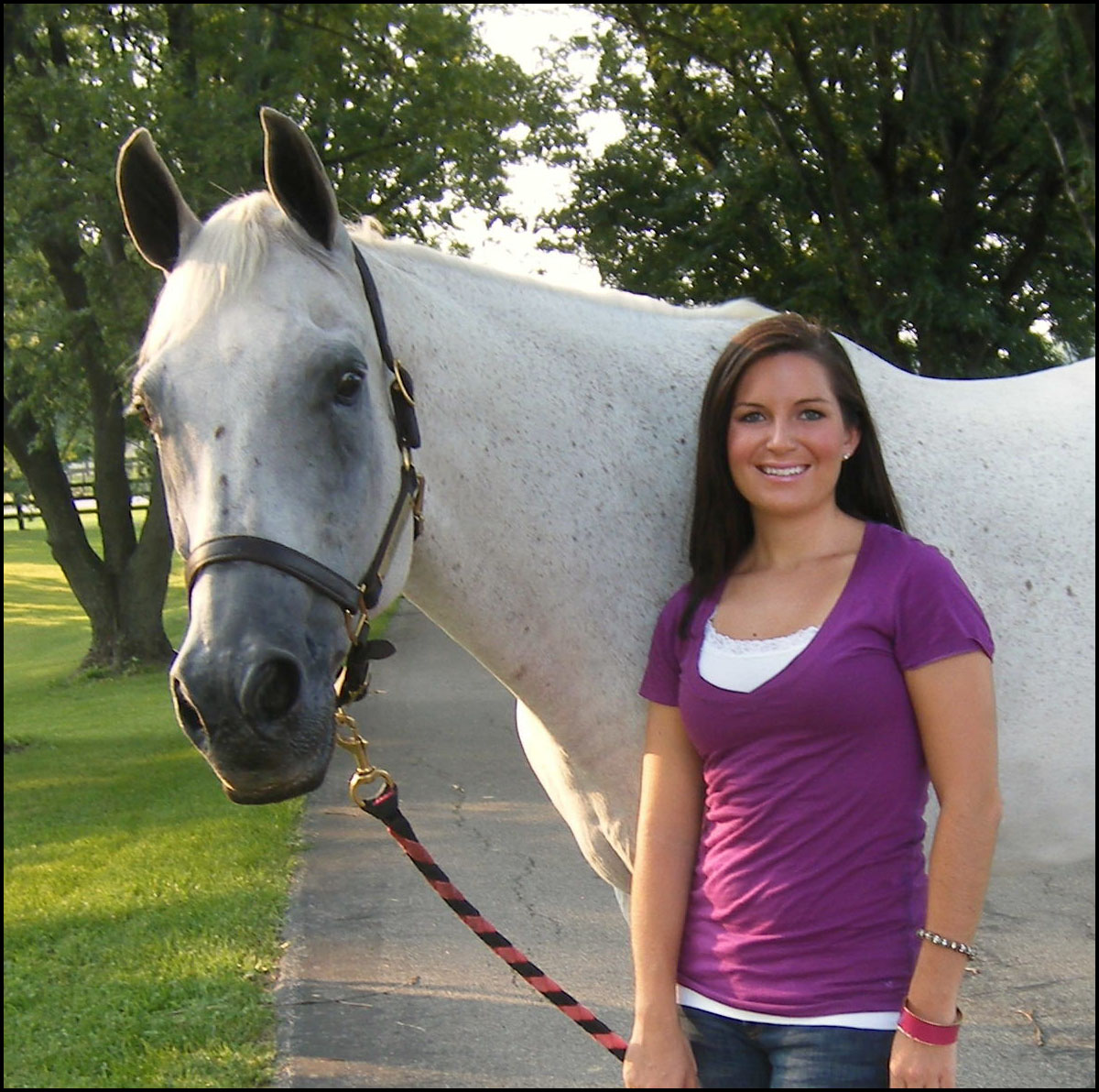
Toy and Aubrey
Toy & Aubrey

I want to share the story of a horse named Toy who recently reappeared in my life. I consider my experiences with Toy to be pivotal in my development as a hoof care provider because they were particularly eye-opening with respect to the knowledge of veterinarians and farriers. And I also hope his story may save other horses and owners from needless pain because his situation is not unique; I’ve since seen a number of horses suffer for very similar reasons. So here goes…

It was early 2000. Although I’d been trimming horses for a number of years, I’d just discovered Jaime Jackson’s first book entitled The Natural Horse, and was eagerly digesting its contents because I recognized that finally there was someone in the horse hoof care world who made sense! I met Toy’s owner Susan at a horse show, where she shared his very dire circumstances with me. But I’ll let her tell you in her own words –

Toy was a barefoot horse from birth until age 6 or 7. I always thought in the back of my mind there is just something not right about nailing metal to a horse’s feet, but I had no idea about proper barefoot trimming. I had a track farrier trimming him – the guy that did the whole barn.

Toy started coming up unsound. He was diagnosed with navicular disease around 6 or 7 by a vet in Johnstown, Ohio, and we started to shoe him then. We started out with just plates, and then over the years continued to get more and more aggressive with his shoeing in accordance with what the vet would tell us.

Then around 11 or 12, he started getting progressively worse. He was then put on Isoxsuprine by another vet in Delaware, Ohio, and we were told he now needed pads and high-heeled shoes. He would go sound for a while – or what we thought was sound – but then as that started to not work, the vet in Delaware did x-rays and said his navicular bone was full of holes and in terrible shape. He then told us to jack him up even more, and put wedge pads on him too. It was to the point where the farrier I was using said he didn’t want to shoe him anymore because he said if one of the shoes and pads came off, it could be a disaster because of the angles Toy was at, and he was very concerned. The vet at this point told us that Toy had reached the end of the line and that we needed to start thinking about putting him down and that he had had a great life.

This is the point where I entered the story. From her description, I thought navicular disease was a pretty far-fetched diagnosis, and urged her to consider de-shoeing the horse and getting him properly trimmed before taking the final, irreversible step of euthanasia. I loaned her my copy of The Natural Horse, and she contacted Jaime to see what he recommended. Jaime set her up with an appointment with Mike Lagrone – one of his very first students – who was doing a clinic in Kentucky the following weekend. So on the appointed day, we loaded up Toy and headed to Kentucky. Back to Susan –

Before the first visit with Mike, though, our vet caught wind of us taking Toy to a barefoot natural trimmer from someone up in Delaware, and he called me at work and told me that I was making a huge mistake. He said that if those shoes and pads were removed from Toy’s feet, he was in grave danger of the navicular bone completely crushing, and he would have to be put down on the spot. I chose to take my chances, as his only option was to put him down. I felt I had to try everything before that decision was made. This horse had carried my little girl as an infant, and taught her to ride and never made a wrong move with her. He was one of the most important things in her life at that time.

Everyone reading this probably knows what a “three-legged lame” horse looks like. Toy came off the trailer barely able to bear weight on his left front foot. He was wearing what I call “the usual hardware” in these situations: wedge bar shoes with full wedge pads, with silicone poured in between the pad and the sole. I’ve since taken this same combination off many, many horses – particularly those with laminitis or navicular syndrome/disease.

Mike looked over the radiographs and remarked that he didn’t see anything particularly problematic. He then removed the shoes and cleaned out the soles; so far, pretty routine stuff. His next move, however, was truly astounding.

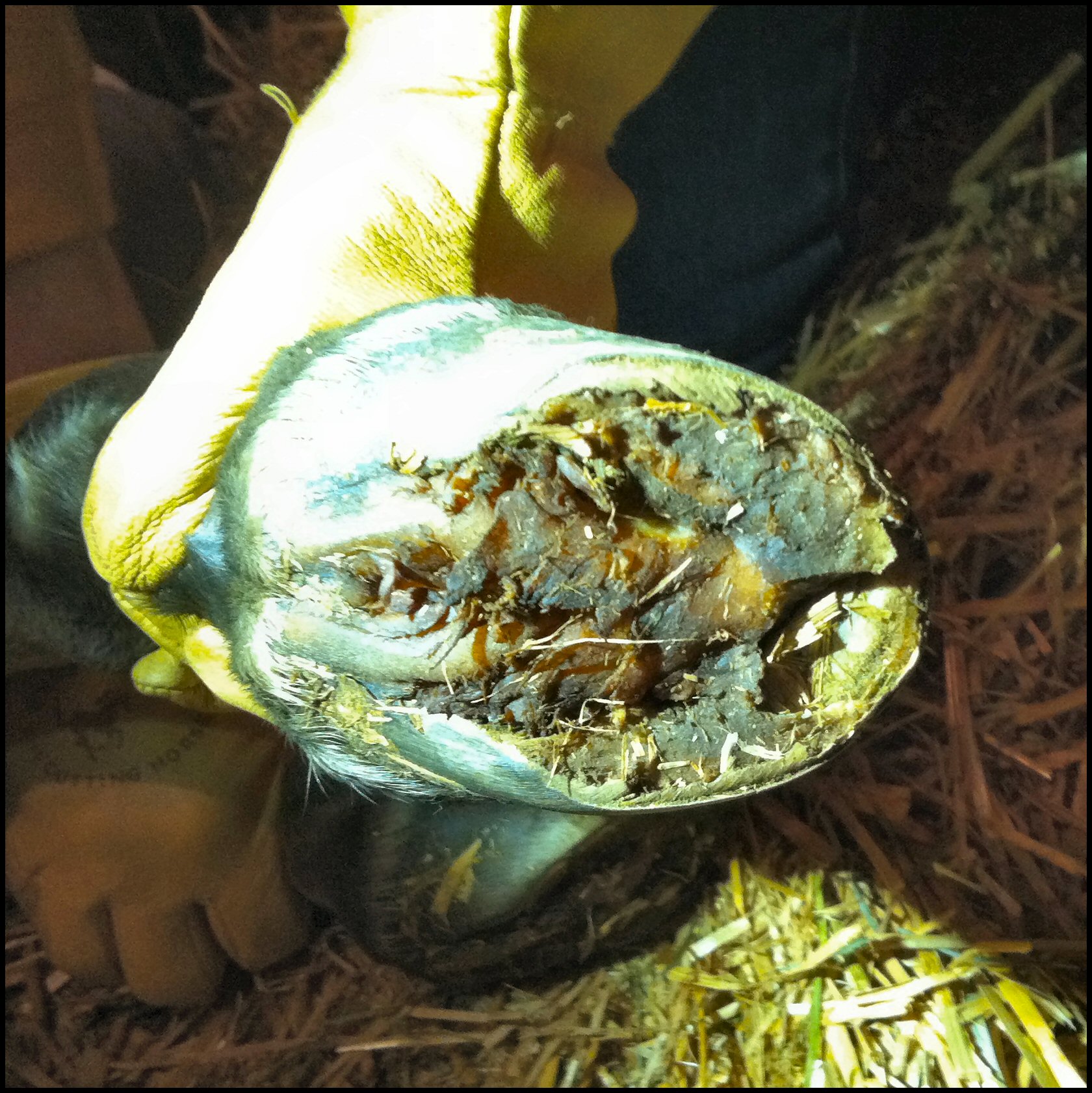
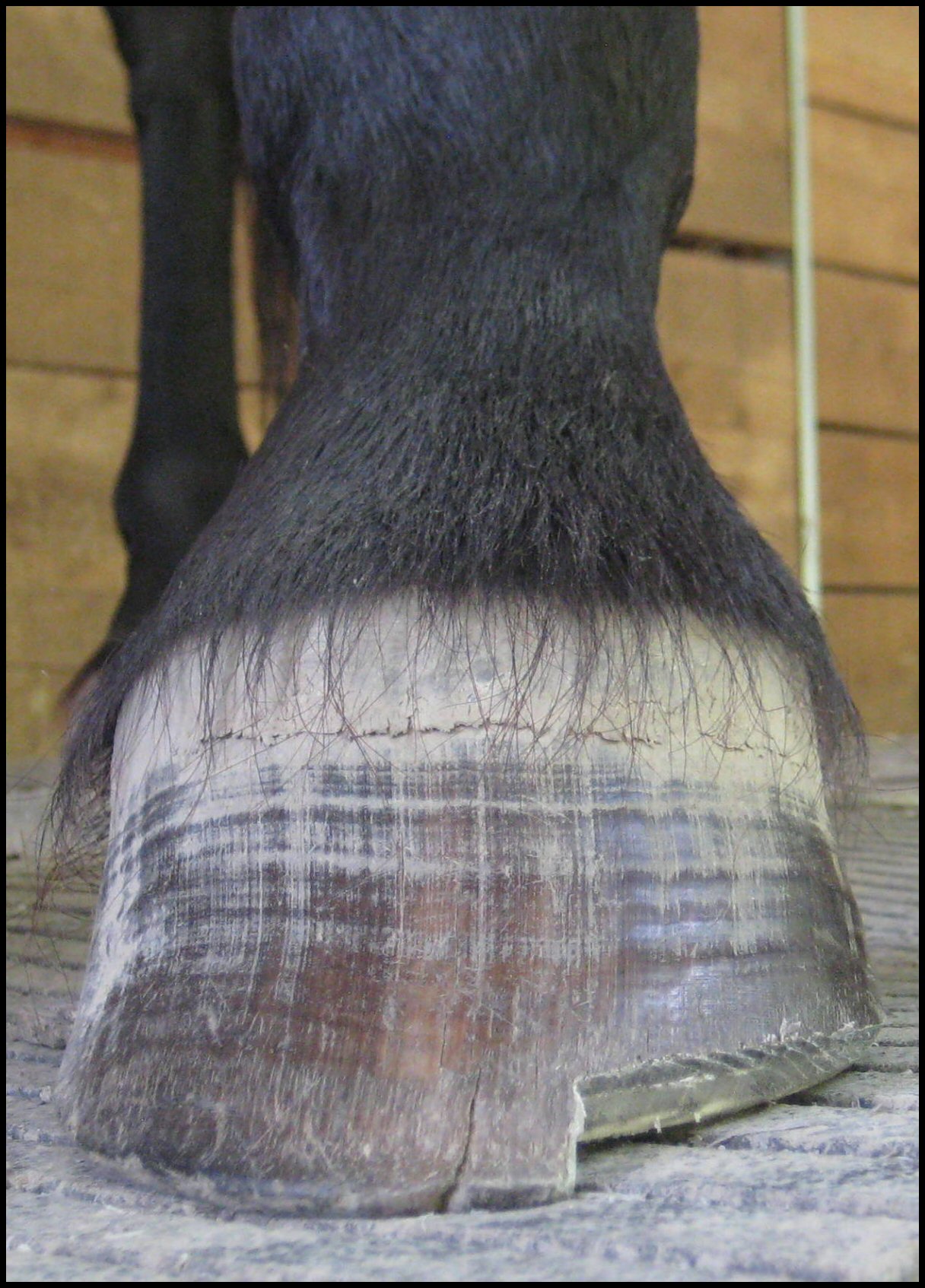
After examining Toy’s left front hoof, Mike picked up his nippers and proceeded to cut away hoof wall from the lateral heel quarter to the toe, about a third to half of the way up the hoof! When he was done, we were looking through the side of Toy’s hoof at his coffin bone. Although Susan was practically beside herself, Toy never reacted and there wasn’t a single drop of blood. You see, in spite of the veterinarians and farriers telling her otherwise, and in spite of their willingness to put this horse down, Toy didn’t have anything wrong with his navicular bone. Instead, he had a raging case of white line disease, and the disease had absolutely decimated the lamellar connections holding the hoof wall to the coffin bone in the area that Mike resected. And because the bottom of the hoof had been sealed up with the full pads and silicone, the anaerobic organisms present in white line disease had “gone to town,” wreaking havoc on the lamellar connections.

Mike told Susan to take Toy home, buy a wire brush and her favorite hoof cleaner, and scrub the affected area with the wire brush every day. He stressed how important it was to keep the area absolutely clean, and assured her that Toy would be fine! Here’s Susan again –

After being off for a year and doing the barefoot natural trim, Toy and Aubrey went on to win the State Championship in English Equitation out of 70-some horses. That day he was not on Isoxsuprine or bute, and was barefoot.

Today he is almost 27 years old. He has arthritis – probably from the ignorance of shoeing him and keeping his weight on his toes for all those years. I often wonder if we had gotten the correct information right off the bat how much better he would be today. But at least he is still with us, and my daughter had many more wins, trail rides, and her best friend, through junior high, high school, and college.

What a story! From death’s door to state champion, only because Susan was willing to go against the advice of her veterinarians and farriers and give Toy the chance she knew he deserved. I’ve not seen Susan, Aubrey, or Toy since that day. But I’m excited because Aubrey, now grown up, has relocated to my area and, by mere chance, found me through a referral. So I’ll get to take care of her new horse’s hooves!

As I mentioned at the beginning of this post, this was a key learning experience for me as well. Up until this point, I, like most horse owners, thought veterinarians had a generally good grasp of the equine foot. Toy’s situation really shook my confidence in that belief. How multiple veterinarians and farriers could miss such an obvious problem was, at that time, simply beyond my comprehension.

I’ve since found out that veterinarians typically don’t learn much about horse hooves in school, but instead rely on the knowledge of farriers and other veterinarians. That revelation, just so you know, was “straight from the horse’s mouth” from multiple sources, although I can’t go into details. This is an unfortunate circumstance; one that I sincerely hope will change in the near future. Until then, the horse owner has very few options when it comes to accurate, up-to-date knowledge of the equine digit and its unique problems.

All the best to Toy, Susan and Aubrey for their courage!


UPDATE: According to his owner, Toy passed away in 2020 at age 34 – 22 years and a good life after his near-death experience at the hands of incompetent equine health care providers!

I’ve mentioned Liberated Horsemanship in passing before, but I thought I’d take this opportunity to discuss our upcoming clinics at the end of next month (9/28 – 10/2).

Liberated Horsemanship logo

From my perspective, what’s offered a couple of times a year in Warrenton, MO (an hour west of St. Louis) is of immense potential benefit to every horse and owner, regardless of breed, discipline, or  hoof care philosophy. Every presenter has many years of education and experience in his or her particular area of expertise, and each offers a science-based look at an ever-increasing array of subjects related to the management of the whole horse. Although all of us share our love of horses and our commitment to natural hoof care, each of us also has one or more areas of specialization that combine to form an education program that I believe is unparalleled. Where else can you hear a board-certified veterinary surgeon give you the “straight story” on what veterinarians are (and aren’t!) taught about hoof care, or a PhD research scientist at one of the top medical universities in the country discuss the effects of physical and psychological stress on horses? Get advice about forage and feeding from an agronomist, not the guy down the street. Learn about laminitis and founder from the veterinarian who funds the top laminitis researchers in the world, not from a magazine article. Dissect a cadaver hoof and gain a real appreciation for the marvelous design of the equine digit. The list goes on and on, but I encourage you to visit the website and read the biographies for yourself.

I always have a great time there. It’s a warm, inviting atmosphere that fosters learning and encourages questions. And provides answers. Consider that in this one location, you’re in immediate contact with trained natural hoof care professionals with a (rough estimate) minimum of forty thousand natural hoof trims under their collective belts! Every location, every breed, every age, every discipline, every health problem. If you need answers, I can’t think of a better place to get them!

And…there’s a good barbeque place nearby! 🙂

Front View

A client of mine recently pointed me to the website of another “natural” hoof care practitioner. Always hoping to learn something new about the equine foot, I visited the site and did some reading about her trim philosophy. Wow! What a disappointment. Although what she describes definitely has some elements of proper trimming, her philosophy is marred by an incorrect understanding of the forces at work on the hoof. She builds a series of arguments in defense of her philosophy upon a flawed premise, throwing in bits and pieces of “scientific facts” that are anything but scientific in an attempt to rationalize a trim that’s anything but natural. Most amazingly, she offers up as “proof” a series of photographs of a hoof that, to me, clearly show an increase in hoof distortion because of her trimming! And so, at the end of the day, like countless others who’ve jumped on the “natural” bandwagon, she’s advocating a trim distinctly at odds with true natural hoof care and potentially harmful to her clients’ horses.

Bottom View

Unfortunately, I have neither the time nor the space here to address all of my concerns with her approach to trimming, but another client’s delay in getting her horses’ hooves trimmed ended up giving me a convenient way to describe what I see as the major flaw in this trimmer’s philosophy. This fault, which is shared by many others, centers on the notion that “natural” hoof care involves not trimming some particular part or parts of the hoof. For some, it’s the sole; for others, the bars or frog. In this person’s case, it’s the heels. She states: “While the advice of many is to trim the heels, my advice is to leave them alone.”

The role of the natural hoof trimmer is to provide the trim nature provides; specifically, to trim the hoof as nature would trim it given the right circumstances. We have very clear examples of the end results of nature’s trimming, and can see the effects of the abrasive forces at work on a consistent, whole-hoof basis. Yet, somehow, these folks manage to separate out various parts of the hoof to trim or not trim, based on criteria that are frankly beyond me. I’ve heard some very well-known trimmers make remarks like, “If I trim a hoof and part of it grows back quickly, then I figure the horse must need that part to be long, so I don’t trim it again.” Huh?

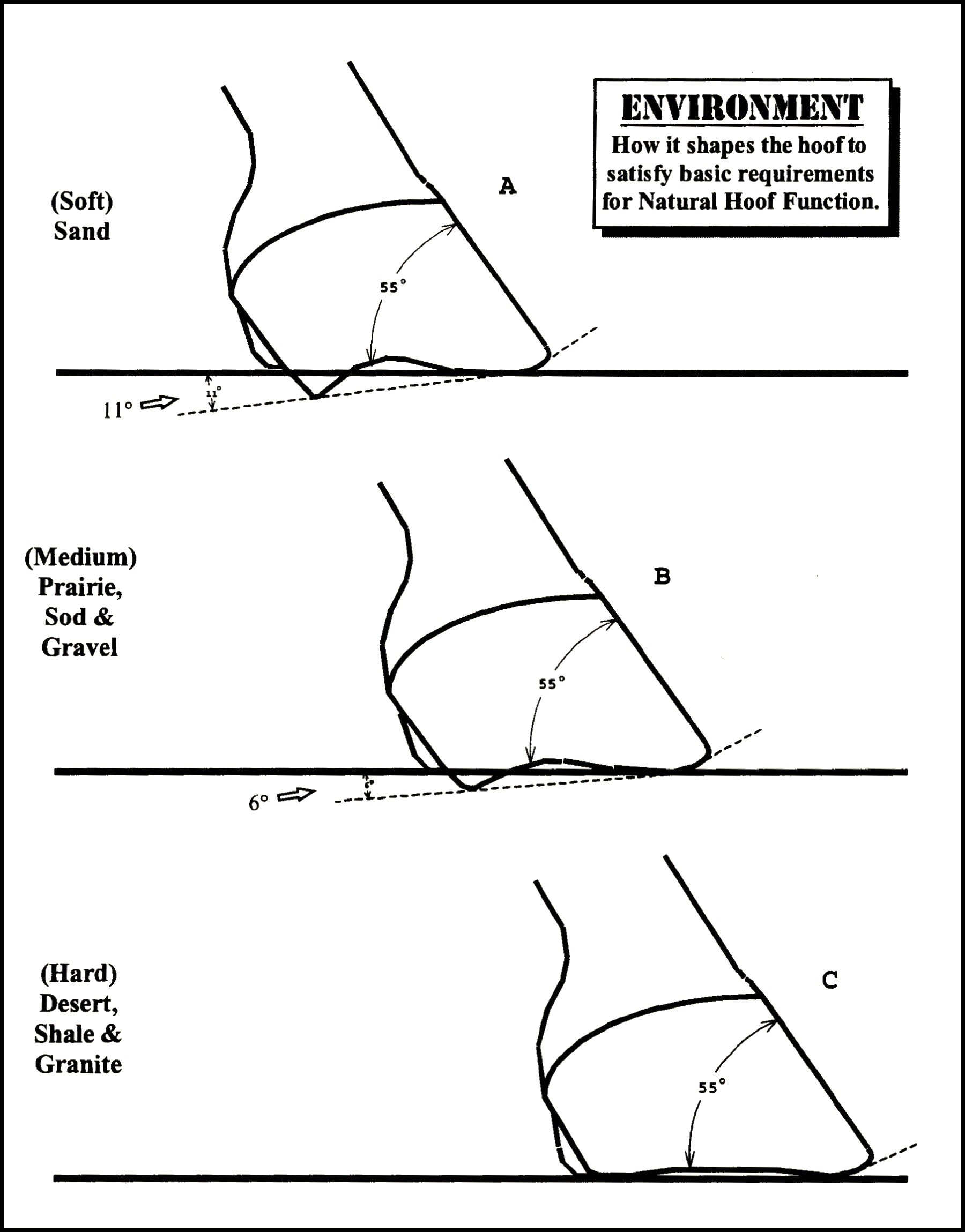
In this particular trimmer’s case, some of her comments lead me to believe her “no-heel-trim” philosophy is based on the fact that different environments produce different hoof forms. Take a look at the illustration below –

Ovnicek Environment Effects
– from New Hope for Soundness, Second Edition, by Gene Ovnicek

Given sufficient movement over suitably-abrasive terrain, every horse’s hoof will look like the bottom illustration, just as documented prior to Mr. Ovnicek’s efforts by Jaime Jackson. As the terrain gets softer, less and less abrasive forces are at work on the heels, and so they grow basically unchecked. But, as noted in the illustration, the hoof maintains the same functional angle because the heels penetrate the softer terrain. So one might conclude, as I suspect this trimmer did, that since many of our horses are kept on softer terrain, the heels should be left alone.

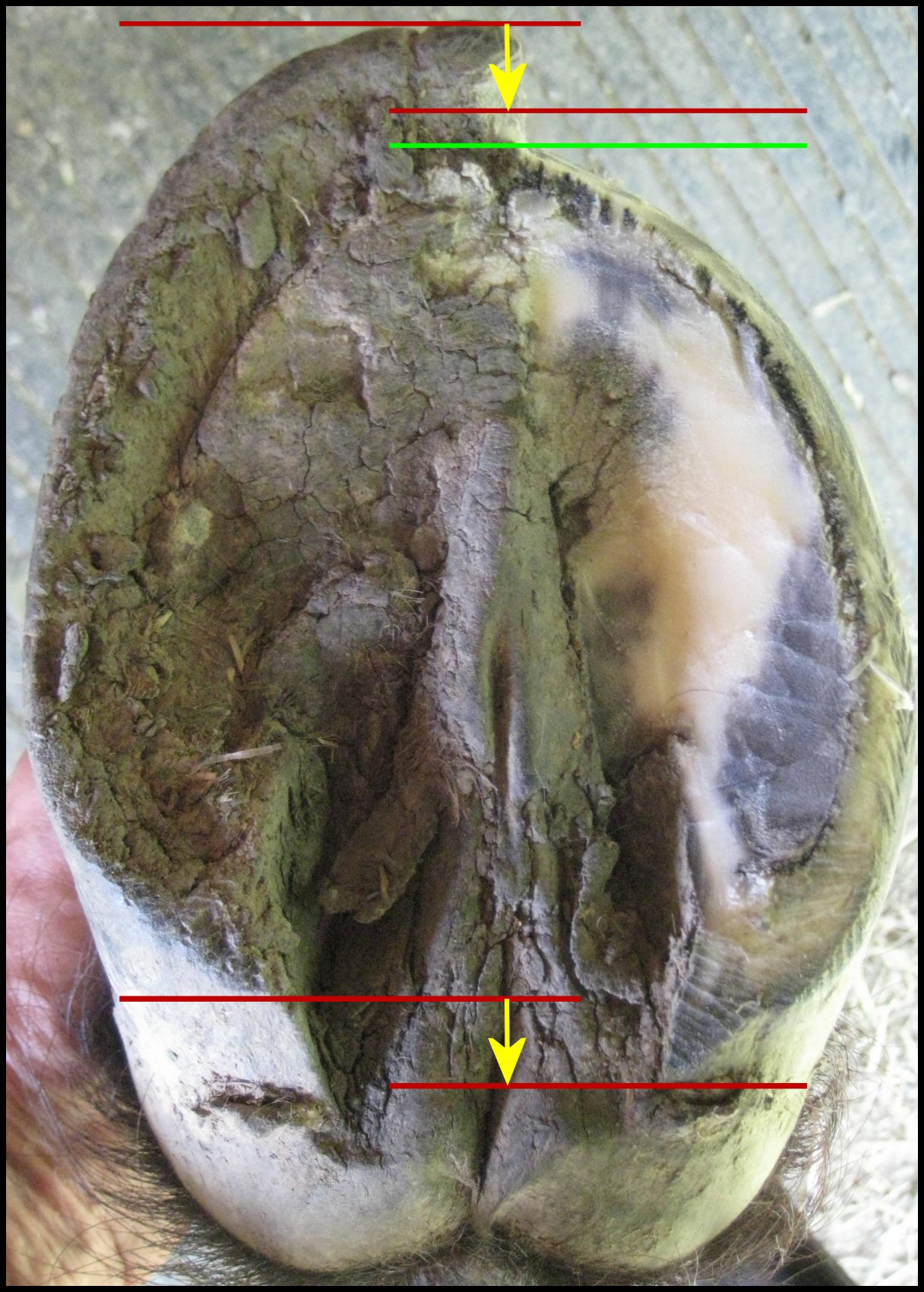
Examine the two photos at the start of this post. In the second photo, the red horizontal lines on the left half of the photo mark the ends of the toe and heel buttresses (“heels”). The red lines on the right are equidistant from the left-hand lines, and mark the trimmed position of the heels and an equivalent distance back from the untrimmed toe position. This helps illustrate the important concept that trimming isn’t just about shortening the hoof in the vertical direction; as you can see, the trimmed “footprint” of this hoof has actually moved towards the back of the Excessive hoof length illustrationhorse approximately 10% of the length of the foot, correctly placing the weight of the horse forward over his heels. So excessive length of the entire hoof, even if it’s balanced front-to-back (A-P) and left-to-right (M-L), is ultimately harmful. For a better look, check out the accompanying illustration – a revision of the one that appeared in Hoof Angles – Part 3 from Dr. Deb Bennett’s Principles of Equine Orthopedics. Incidentally, note that the contact point of the toe, indicated by the green line, has actually moved even farther back, somewhat shortening the “footprint.” Most, if not all, of that decrease is due to the “mustang roll” around the outer hoof wall. You can also, by the way, get a pretty good idea from the photo about what would happen to the “footprint” if we trimmed the toe and didn’t trim the heels!

That’s enough about why we trim the hoof, but I need to say more about why we trim the entire hoof. There’s a reason why there aren’t, and shouldn’t be, region-specific “natural trims.” And the reason is quite simple –

Trimming the hoof as if the horse lived in the extremely abrasive environment of the U.S. Great Basin, traveling many miles per day, will always offer every horse the best chance at long-term comfort and soundness because the worst-case riding environments we subject our horses to most closely mimic those conditions.

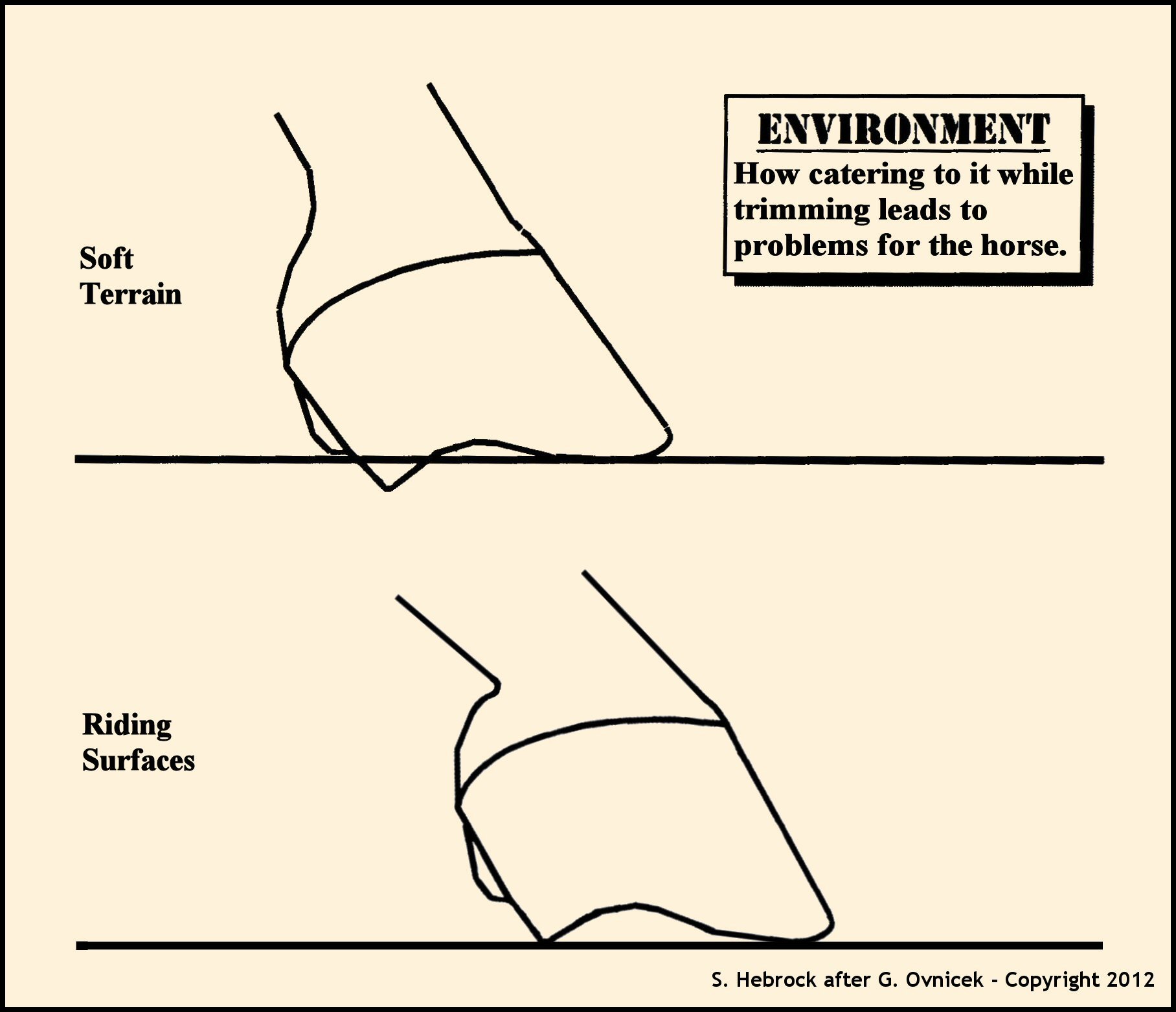
To say it another way: when we ride our horses on pavement, hard ground, or even well-packed sand, the heels cannot adequately penetrate the surface. So if the hoof isn’t properly balanced for a flat landing on an unyielding surface at the walk, the foot will be subjected to the damaging forces of jerk and concussion, as described in Hoof Angles – Part 4. So the practical form of Mr. Ovnicek’s illustration should look like this –

Ovnicek Comparison
Hooves kept on soft terrain and ridden on medium-hard or hard terrain

We cannot – we must not – pick and choose what parts of the hoof to trim or not trim, because the U.S. Great Basin feral horse model, combined with a bit of common sense, shows that to be wholly improper. And deliberately unbalancing the hoof, as advocated by the aforementioned trimmer, can have very dire consequences for a horse unless the horse is always used in exactly the same environment the trimmer has catered to in his or her trim (highly unlikely, I might add!). The safest and healthiest trim for your horse will always entail removing all excess growth, and not a bit more, as demonstrated by the U.S. Great Basin feral horse model.

In closing, I want to share an excerpt from a video I’m working on. The first clip is of one of my clients’ horses, chosen only because of the wide concrete barn aisle. As you’ll see, the horse lands flat at the walk. The second clip, which I did not record, is of a horse whose trimmer had been mimicking the trim style he saw in a well-known book on natural hoof trimming – or so, at least, he and the owner believed. Note how the hooves, most notably the front ones, literally slam into the ground heel-first. Ouch!

Landings Clip First Frame
– excerpt from an upcoming video about proper versus improper landings, showing the flat landing of a properly-trimmed horse followed by the heel-first landing of an improperly-trimmed horse

More soon…

In the last installment, I introduced you to one of my clients with very mismatched front hooves, with a promise that I’d explain the “why” of her radically-different hoof angles in the next article. Well, it’s time to do exactly that!

One of my best early lessons on cause and effect with respect to hoof form came from Carol Brett, co-founder and co-owner of BALANCE saddles in the UK. In her saddle-fitting clinics, Carol pointed out that any restriction in a horse’s shoulders will cause a hoof to become more upright i.e. “clubby.”

Newborn Foal Hoof
Newborn Foal Hoof

That really struck home with me, because before that time, I (like most of the horse world) had fallen into the trap of believing that hoof form dictated movement, rather than the other way ’round. But what she said was logical; if the hoof spends more time “under the horse,” rather than experiencing its full range of motion, it makes sense that it’ll compensate by changing form into something better suited to supporting a smaller range of motion. The foal shown above, born just a few hours before this photo was taken, has a very upright hoof because she’s not yet moved enough to have the hoof start showing changes in form that optimize her movement. Form always follows function!

I’ve now seen examples of Carol’s statements countless times. That’s not to say it’s the only reason a hoof may be more upright, but it’s definitely one very common reason. The same idea applies to M/L (side-to-side) balance as well; the more a horse carries his or her hoof towards the mid-line of the body, the more upright the lateral (“outer”) wall will be and the more angled the medial (“inner”) wall will be.

In the case of my client’s horse, there are several forces at work that cause one hoof to be more upright. For one, she paws with that hoof, and pawing seems to promote an upright hoof capsule. She also grazes in the same position every day: the upright hoof behind and the other hoof in front. Again, that stance makes for mismatched feet. And, she has some stifle issues on one side, which probably cause some degree of asymmetry to her gait, and, therefore, to her hooves. Could there be other factors at work as well – maybe a congenital tendon and/or ligament condition causing a more upright hoof? It’s certainly possible, but since I haven’t known the horse since birth, I can’t really say.

Regardless of the causes, this horse’s feet are sound. And any attempt to “fix” what amounts to a cosmetic – not a functional – problem by trimming into live tissue  is only going to make her lame until she regrows exactly the same hoof again!

It’s not always the case, however, that a pair of hooves like this is supposed to be mismatched. That has to be sorted out over the course of several trims. I’ll give you an example of what I mean…

A few years ago, I started helping the trainer at an American Saddlebred farm transition all of their horses to barefoot. One horse in particular stood out because he had horribly mismatched hooves – probably worse than the horse we’ve been discussing. The trainer explained to me that it’s common for Saddlebreds to have radically different feet, and that he used a wedge pad to make the hooves match and the shoulders the same height. My only response was “uh huh,” which is short for “Steve doesn’t yet have enough data to either agree or disagree”! And so I proceeded to trim each hoof as an individual, just as I always do.

A few months and trims later, along with a lot of instruction, the trainer took over all of the trimming, which was the original goal. I visited him about 6 months after that, and he pulled out the same mismatched horse. Except now, the horse’s feet were obviously a matched set. “You know,” the trainer said, “there really wasn’t anything wrong with his feet after all! They’d just been mis-trimmed before you started doing him, and you got him straightened out!”

I just smiled.

Sorry for a bit more of a delay in getting this posted than I’d intended, but between managing clients, the end of the school Quarter, and attending the Berkshire International Film Festival with Annie last weekend, time has been tight. But hopefully you’ll find it was worth the wait!

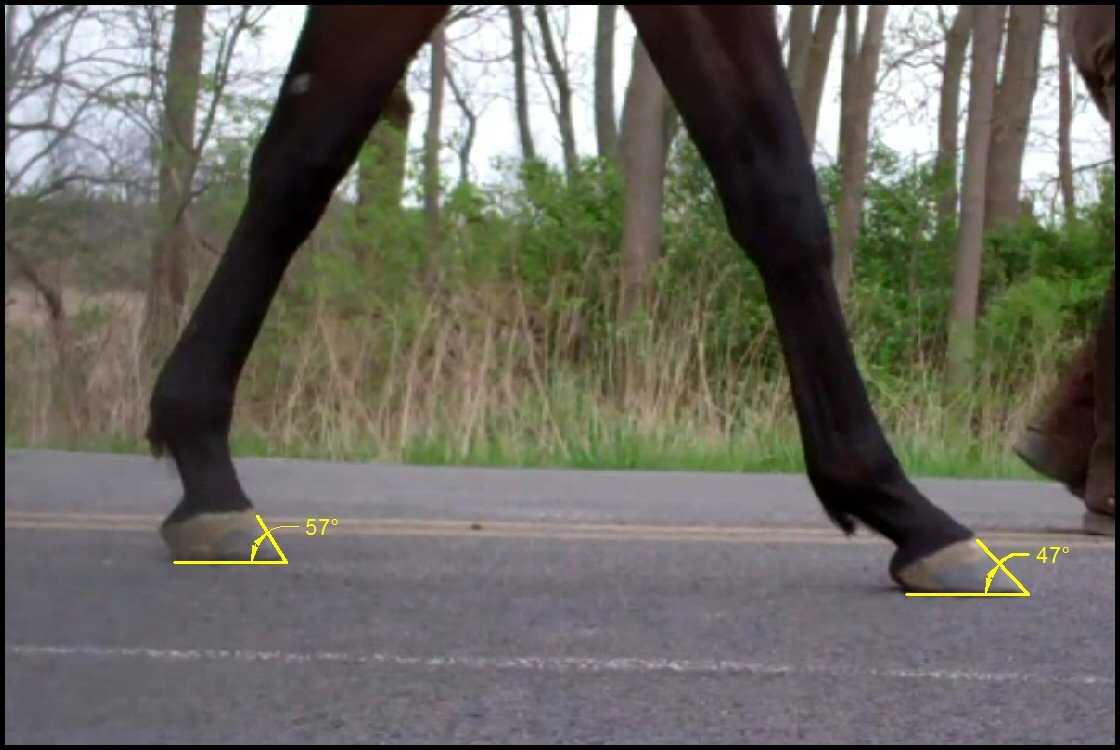
I’ve discussed some of the effects of deliberately manipulating hoof angles before – particularly in Hoof Angles – Part 4, where I described some of the consequences of imbalance on bones and joints. And while I firmly believe proper balance and length are absolutely crucial to the long-term comfort and soundness of a horse, that doesn’t mean appearances can’t be deceiving. Take a look at the following photograph of a client’s horse –

Differing Hoof Angles

At first glance, you might conclude this horse is out of balance. After all, a 10° difference in a pair of hooves is pretty significant! But in reality she’s not. Remember: hoof form is the consequence, and not the cause, of movement. So when we see this situation in a horse that’s properly trimmed, we have to look at what, in her stance or movement, might be causing this particular asymmetry between her hooves. Now, a logical question at this point would be to ask how I know this horse is properly trimmed. And the answer, at the clinical level, is because her hooves grow straight, without any flaring, thickening, or other distortions, and because she lands flat at the walk. That confirms proper balance; it’s not subjective, and it can’t be faked.

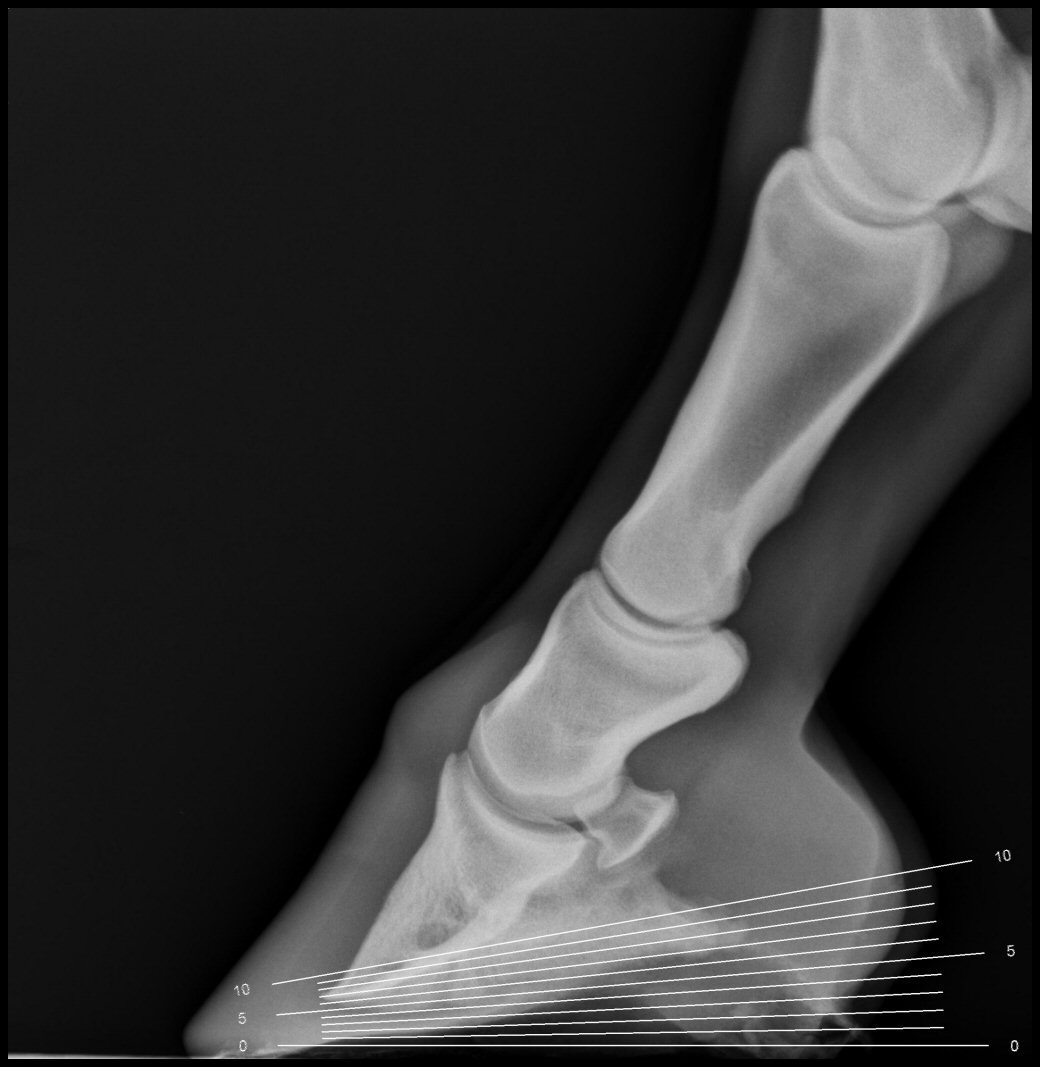
As further evidence of proper balance, let’s take a look at a radiograph of the upright hoof, which the veterinarian labeled a “club foot” –

Radiograph of the Upright Hoof

It’s generally acknowledged that the plane defined by the bottom of the coffin bone should form a 3° – 5° angle with respect to the ground surface. As you can see on my protractor overlay, this angle appears to be just a bit higher than that – about 6°, or 1° higher than what’s considered correct. Not 10°. Not even close!

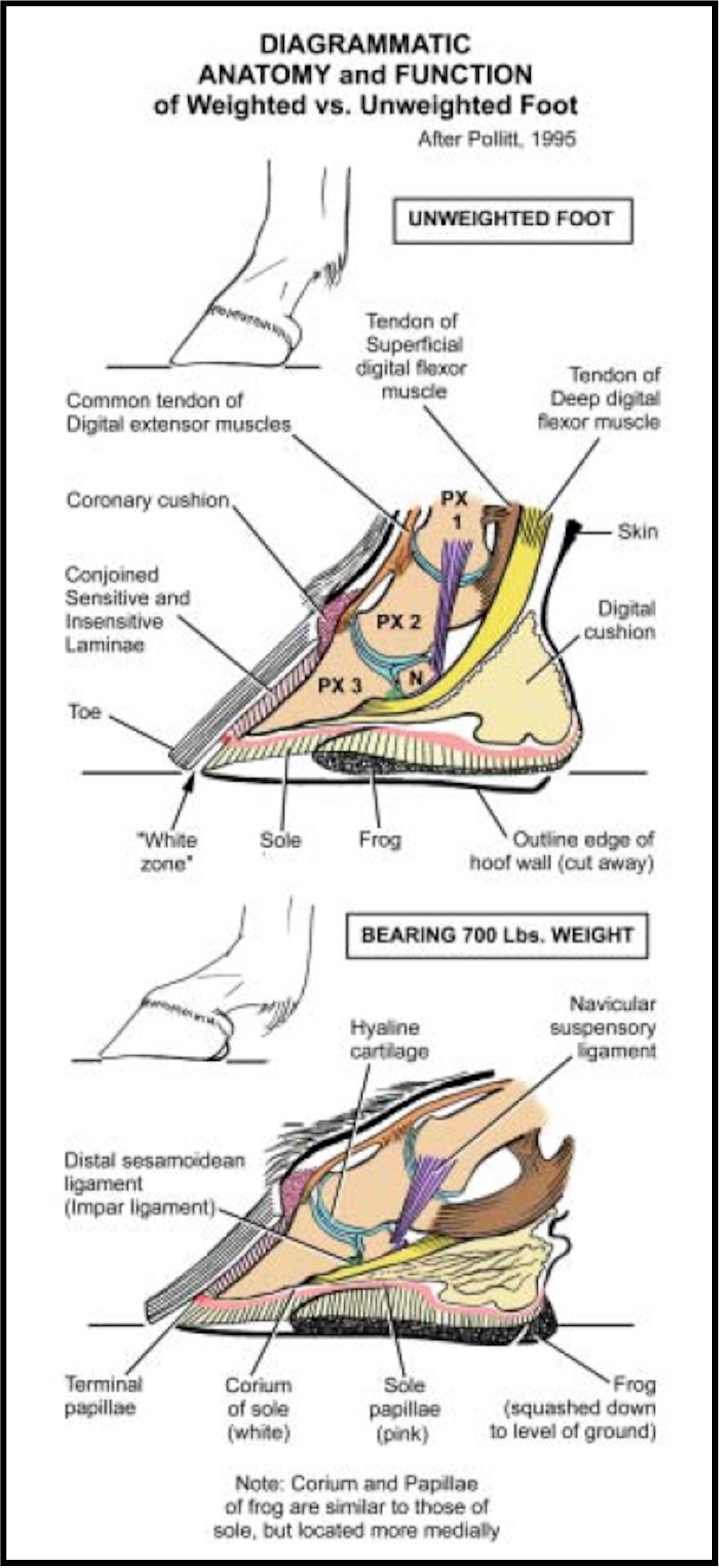
To be fair (to both the veterinarian and myself), we need to acknowledge several things about this radiograph and the conditions under which it was made. First and foremost, this hoof needs trimmed, and doing so will almost certainly drop the angle another degree or two. Second, note the very slight divergence in the toe angle; while the upper part of the wall is growing out nice and parallel to the dorsal surface of the coffin bone, the lower part still has some growing to do. Third, you can see where the tip of the coffin bone has deformed, taking on what’s usually called a “ski tip” appearance. More on that later. And fourth, I had to tip the image slightly because the horse wasn’t bearing weight on the foot when the radiograph was taken; the heels were off the ground. The implication of that is an almost certain decrease in the hoof angle, because the digital cushion (a shock-absorbing mass of fibro-fatty tissue – see below) at the back of the hoof compresses slightly as the hoof is loaded.

Weighted vs. Unweighted Foot - from Dr. Deb Bennett

All of this adds up to a hoof angle that’s darned near perfect, regardless of how different it is from its mate!

So why is it steeper than the other hoof? Well, that’ll have to wait ’til next time. But let me just say that the veterinarian’s recommendation for this horse was to lower the heels on this foot – into living tissue, I might add – to make them match and “fix” the problem. No way was that going to happen!

More soon…