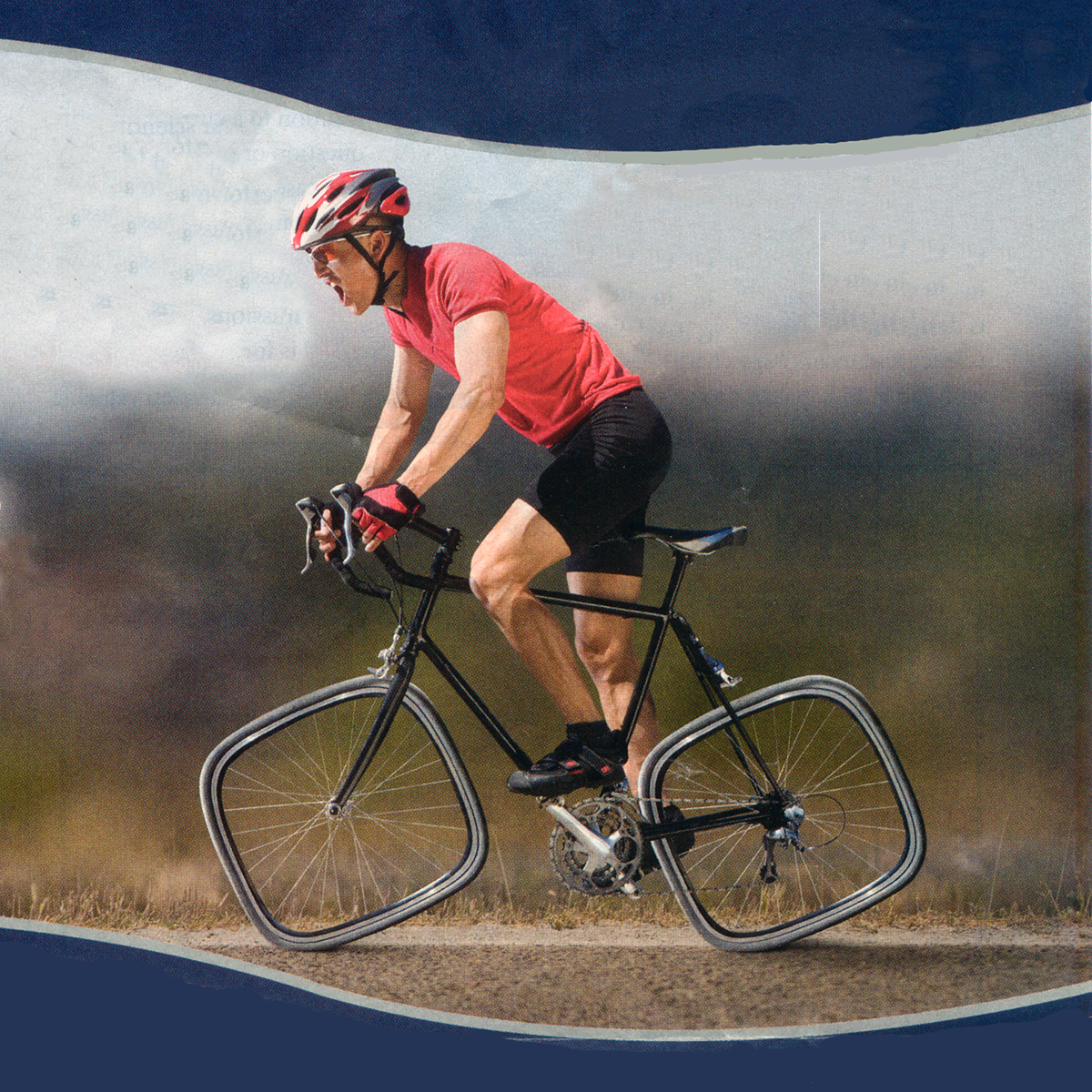
Photo of a Square-Wheeled Bike
– advertisement from Central Semiconductor

Yes, I know it’s been far too long since I’ve posted an article, but life seems to have a way of interfering with my writing! The good news is that I now have  several articles well under way, and so will try hard to keep the gaps shorter.

I had to laugh when I saw the above image as part of an advertisement in one of my technical magazines a couple of months ago, because it seemed as if they knew I was going to be writing this article on heel-first landings and wanted to help illustrate the problem with an easily-understood picture! But that statement will probably make more sense later on…

I want to be absolutely clear right from the start: this notion that horses are “supposed” to land heel-first is, without a doubt, one of the most widely-propagated and dangerous misunderstandings currently in vogue in the horse world. I had intended to start posting my series of articles on navicular disease, but since navicular disease and landings are so closely connected, and because I decided I simply couldn’t bear to listen to one more horse owner or hoof care provider tell me that horses should land heel-first, I decided my priority had to be to weigh in on this very important subject now. In fact, this article could just as correctly be called “Navicular Disease – Part 0.” So although I’ve briefly mentioned in the past that a properly-trimmed horse will land flat at the walk (see, for example, Hoof Angles – Part 4), I haven’t yet discussed the logic behind that assertion at length. By doing so here, I hope to save a lot of horses from a lot of problems on down the road.
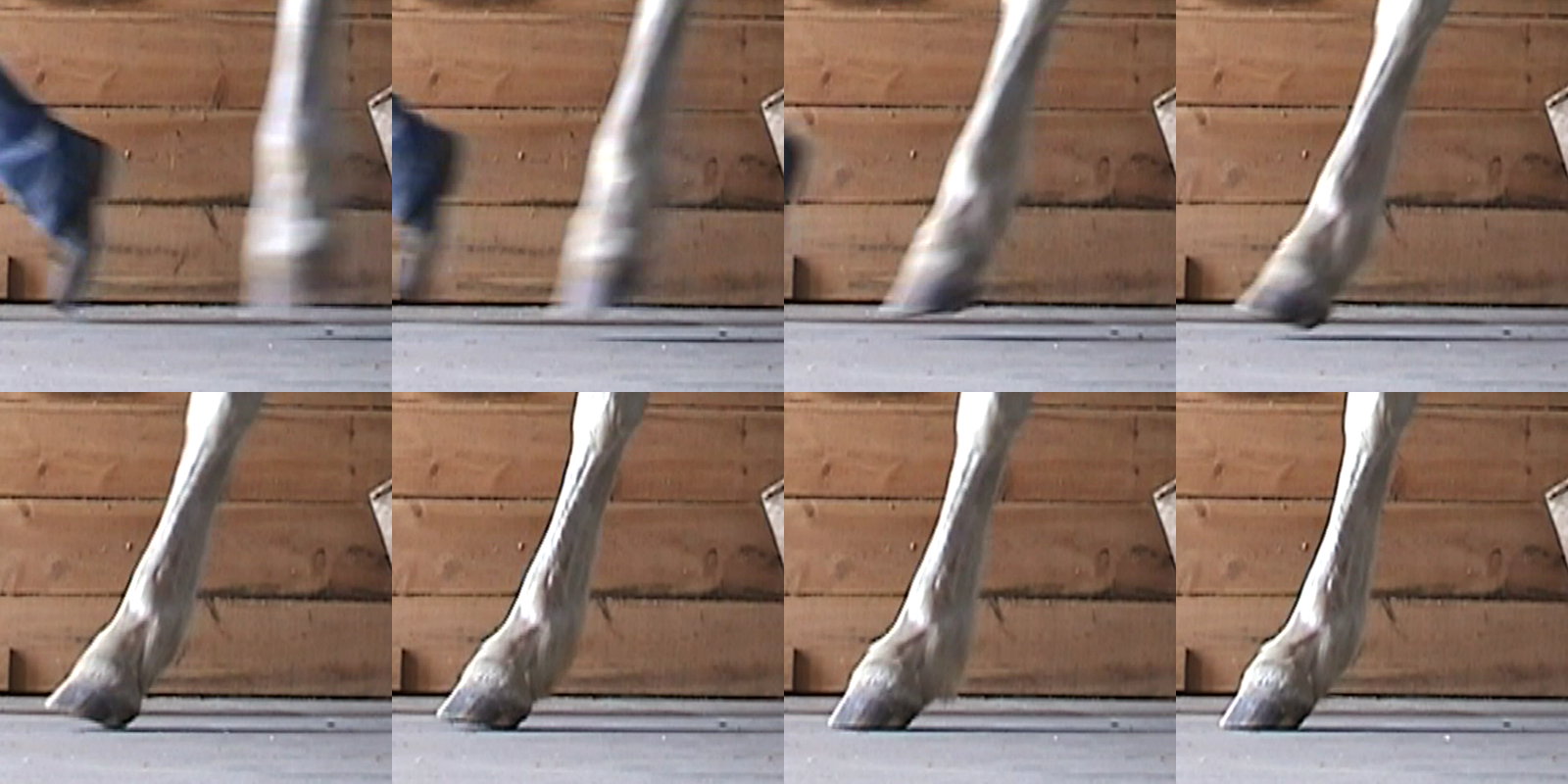
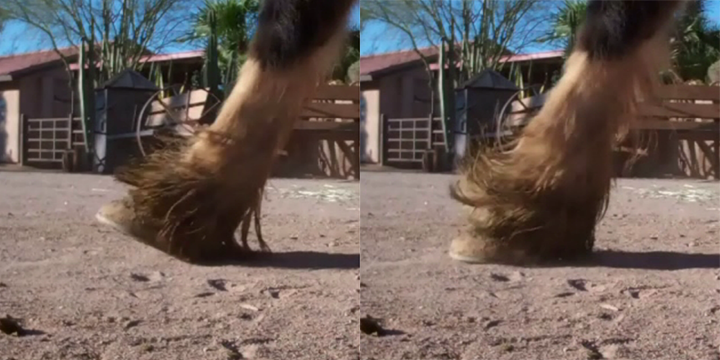
photo sequence of a heel-first landing on a bare hoof
A heel-first landing on an improperly-trimmed bare hoof

To be fair, I also need to tell you that I, too, used to believe horses should land heel-first because years earlier I’d read a passing statement in renowned equine pathologist Dr. James Rooney’s book Biomechanics of Lameness in Horses in which he said that horses land flat to slightly heel-first (emphasis added). He did not, however, mention the conditions, such as gait or speed, under which he believed this to be the case, nor did he state whether or not this was a theory based on physiology, or merely an observation of horses he’d encountered. Interestingly, later parts of the same book strongly contradict the heel-first part of his statement, which he then supports with both theory and observation, and his most recent writings on the subject clearly state that the horse should land flat at the walk. In his webpage discussion of feral hoof form entitled “The Shape of the Equine Hoof,” for example, he says:

At the slow walk, the hoof usually contacts the surface over the whole bearing edge of the hoof wall; that is, the foot impacts flat-footed.

Unfortunately, this fallacy about heel-first landings still persists, largely (I believe) because one particular barefoot clinician has stated it many times in his clinics, and because humans tend to land heel-first. But long before I’d read Dr. Rooney’s most recent work, or even his earlier work more carefully, I’d already come to the conclusion that common sense tells us a properly-trimmed horse – whether by nature or by human – must land flat at the walk. In talking to many people over a number of years about this subject, I’ve found that non-horse people, especially technical types, tend to immediately understand why, while many horse people seem to struggle with it. But I’ll do my best to make it clear!
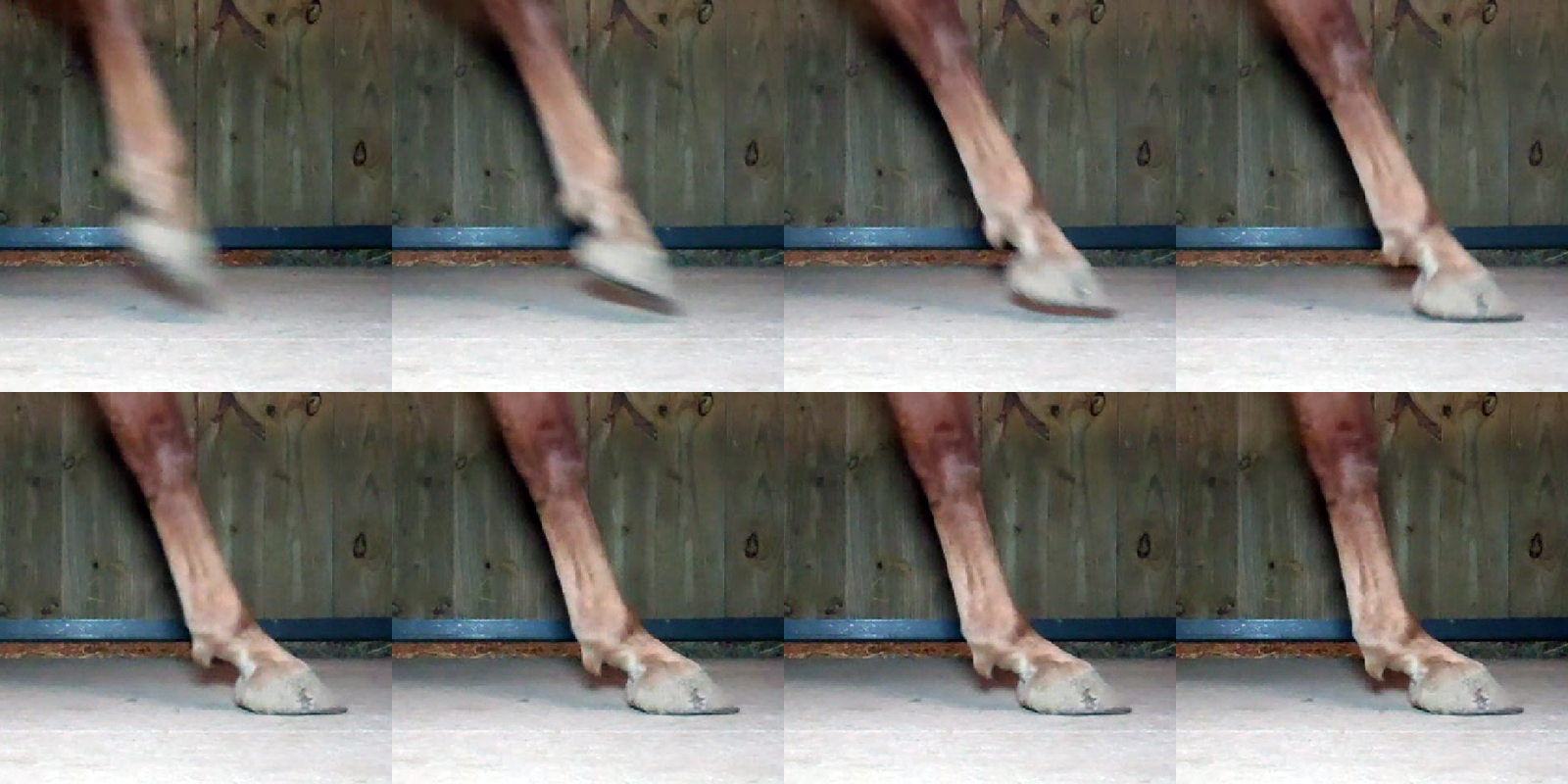
photos of a proper landing on a properly-trimmed bare hoof
A proper landing on a properly-trimmed bare hoof

In this installment, we’ll take a look at two things we need to understand before really discussing the landing problem at length: first, the differences between biped and quadruped limb construction and movement, and second, the issues surrounding how humans perceive landings.

As you’ll see in this image from Dr. Deb Bennett’s Principles of Equine Orthopedics Part 1 comparing the equine and human forelimb, they’re very different in both structure and function –
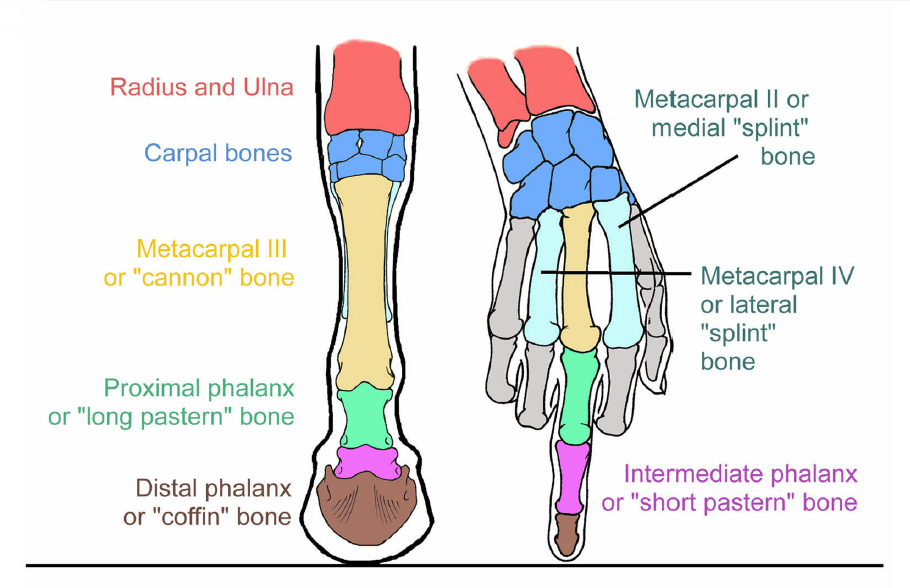
Comparison of the horse and human forelimbs

So in the forelimb, what we generally refer to as the horse’s “knee” is in fact his wrist, or carpus. The horse actually walks on a hoof attached to what would be the last joint of our middle finger. In the rear limb, the horse’s ankle is the hock joint, and not the fetlock as may seem intuitive. The image below shows their comparative anatomy; the hock image is from Principles of Equine Orthopedics Part 1, and the ankle image is from www.kidport.com –
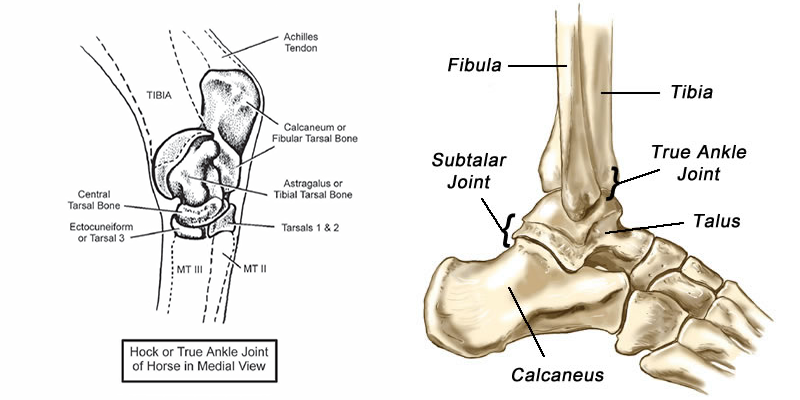
Horse & Human Ankle Joints

As we consider differences in the way we move, it’s important to note the consequences of these anatomical distinctions. The human ankle consists of an inverted cup of bone perched on top of a ball, stabilized by ligaments. It’s quite compliant by design, and although it flexes fairly readily in both the front-to-back (A-P) and side-to-side (M-L) directions, it’s less stiff and has a far greater range of motion in the A-P direction. In contrast, the forelimb diagram above shows the lowest joint in the equine limb to consist of much broader surfaces designed to articulate only in the A-P direction. With good reason, I might add; if you’ve ever rolled your foot to the inside in a misstep, you can imagine the “train wreck” that would occur if a horse were able to do that at 40 MPH! That complete lack of lateral flexibility, incidentally, is also the reason so-called “corrective” trimming & shoeing is such a long-term disaster, as I pointed out in What Makes it “Natural Hoof Care?”.

The following image from R. C. Schafer’s book entitled Clinical Biomechanics: Musculoskeletal Actions and Reactions (2nd ed.) is very helpful in understanding biped locomotion. Pay particular attention to where the torso is with respect to the leading and supporting limbs –
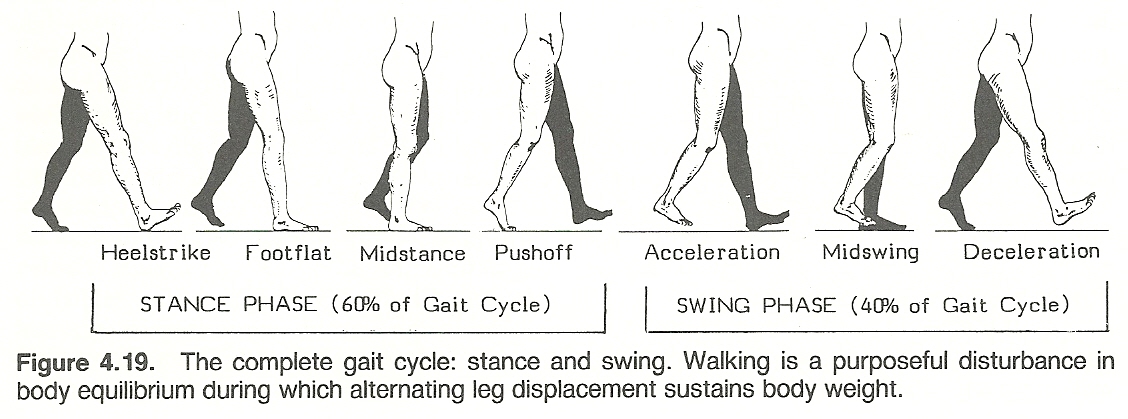
Diagram of the human gait cycle

And here’s what the author has to say about the mechanics of walking:

Biomechanically, walking can be considered as a series of continuous losses and recoveries of balance in which the rhythmic play of muscles narrowly averts toppling. Steindler refers to the basic sequence of movements in walking as a “series of catastrophes narrowly averted.”

In other words, walking in a particular direction involves shifting your center of mass in the direction you wish to go, and then “catching yourself” with the leading leg as your mass comes over that leg. In essence, you fall forward to move forward. And if your foot is in a neutral position – basically perpendicular to the axis of your leg – it strikes the ground more and more heel-first as your stride length increases.

The quadruped, on the other hand, doesn’t walk like that because their center of mass is never ahead of the leading limb while it’s loaded. The cat in the following (bad!) photos walked through my video setup while I was recording a horse. As you can clearly see, he’s stable on 3 legs and his center of mass is behind the leading leg. Like your horse, he doesn’t have to “fall” onto the leading leg like you and I must do to move forward. You’ll also note he’s definitely not landing heel-first, and I didn’t even have to trim him! –
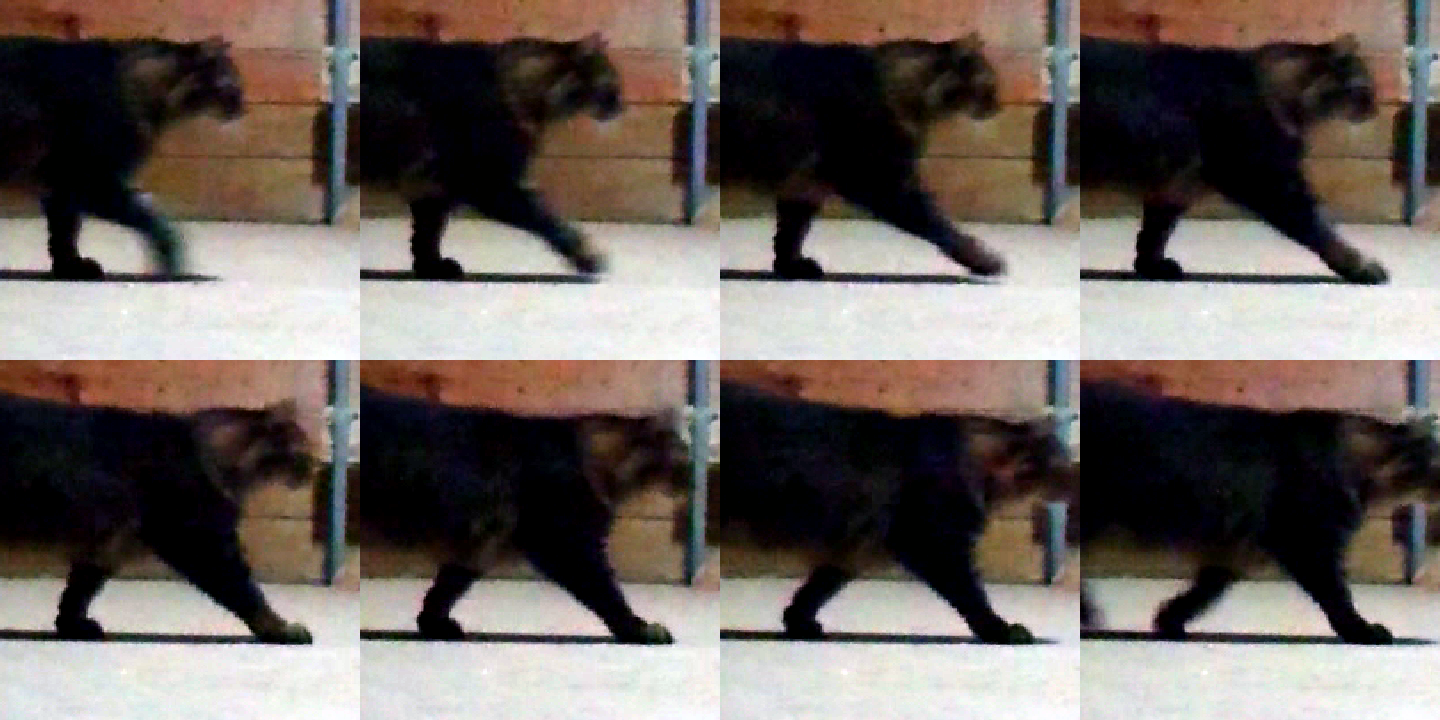
photo sequence of a cat landing properly
Someone forgot to tell this cat he’s supposed to be landing heel-first…

The other part of this background information has to do with how humans perceive things. Back in 2008 when I began to seriously question this notion of a heel-first landing being “correct,” I became convinced that humans probably aren’t able to see differences in timing between heel contact and toe contact. So I wrote to a number of researchers in the field of visual perception, and posed the following question (since I couldn’t assume they knew anything about horses!):

An observer watches (but does not hear) someone slap both hands down on a tabletop in a brightly-lit kitchen. At what interval between slaps will the hands striking the tabletop appear to be a simultaneity?

The responses I received were all nearly identical, but Dr. Ken Norwich, Professor Emeritus at the University of Toronto’s Institute of Biomedical Engineering provided the following answer with some qualifiers:

How bright is the light used to make the observation? The interval you seek will depend on the illumination. What is the background to the images of the hands? Let us assume that it is a black background, but contrast will also affect the measured interval. Probably the interval is very close to the reciprocal of the flicker fusion frequency i.e. the frequency of flicker where an observer sees a steady image rather than a flickering light. This frequency is about 55 seconds (-1), so the interval you are looking for is at least as great as 0.02 seconds, or 1/50th of a second, and that is for a very bright image.

So in brightly-lit conditions against a high-contrast background, the limit of a human’s perception is in the neighborhood of 20 milliseconds. Any timing difference between heel and toe contact shorter than that will be seen as a flat landing. And just how many barns have you been in where you find “brightly-lit conditions against a high-contrast background?” Darned few, if any, in my experience!

To help put things into more meaningful terms, observe the first set of hoof images in this post. This heel-first landing, from heel contact to toe contact, was quite obvious to me at normal speed, and measures approximately 80 milliseconds.

And now take a look at the following two landings –
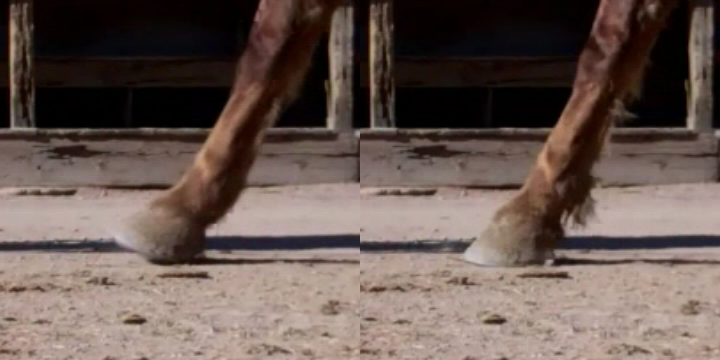
Horse Bad Landing

Draft Bad Landing

In both of these cases, the heel-first landing wasn’t particularly apparent at normal speed, and only became obvious when I slowed down the video. Although the background isn’t very high-contrast, the lighting was reasonably bright. They both also measure approximately 20 milliseconds from heel down to toe down. In fact, of the 6 heel-first landings I happen to have slow-motion video of as I write this, the average heel-to-toe contact time was only 32 milliseconds – alarmingly close to the limits of human perception under ideal laboratory conditions.

Therein lies the rub: if you can see an obvious heel-first landing, the landing must be very heel-first in order for you to perceive it as such! And soon I’ll explain why that’s a serious problem for your horse.

So those are the first two hurdles to overcome in this discussion of landings in horses: regardless of what you may observe about human movement, you cannot apply it to equine movement because horses and humans are fundamentally different; and, the timing of a heel-first landing strains the limits of human perception, so you can’t be absolutely certain of anything without using additional tools such as slow-motion video.

More soon…

Photo of a horse in autumn

There’s a company called Farriers’ Greeting Cards that sells all manner of practical paper products – business cards, billing forms, greeting cards, etc. – for hoof care professionals. They also have a number of less practical ones featuring “things not to say to a hot, tired farrier” sayings that no doubt everyone in the hoof care world can relate to, like “Now that you’re done, could you hold that check till next week?” and “I’ve been planning to work with this yearling – just haven’t found the time to get him halter trained yet.” This product line came to mind the other night when a long-time client asked me if she was a “good client.”

The answer to such a question is obviously a matter of opinion, because everyone has his or her own idea of what is and isn’t acceptable behavior for both horse and human. But given the “things not to say” phrases, I’m guessing all hoof care providers have similar issues, and only our tolerance to the severity of the infractions varies with the individual. For me, I think it all boils down to the following six statements. And please note that although abundant, I’m avoiding any specific anecdotes in this article! So, here are my expectations –

Have your horse ready. When I arrive, I expect you to already be present and prepared for me, which means the horse is immediately available – not out in a pasture somewhere – and reasonably clean and dry. Please don’t wash the horse right before I arrive, because working on a soaking-wet animal, especially in cold weather, is not my idea of a good time! If the horse is muddy, it’s far better to brush and/or wipe off the mud, and the rest will quickly dry. If it’s fly season, please let me use my herbal-based fly spray on your horse rather than have to be in direct contact with pyrethrin-based products. Pyrethrin – derived from chrysanthemums – is a neurotoxin, and I’d rather not be rubbing it into my skin all day!

Provide a reasonable work environment. To do the best possible work for you and your horse, I need to be able to both see what I’m doing and not have potentially dangerous items in the work area. The light in most barns usually isn’t the best because it’s directly overhead, which means that my own shadow and/or the horse’s shadow prevents a good view of the hoof. Ideally, the light should come from above and behind the horse. And make certain there’s adequate clear space around the horse, which includes not being in a major traffic spot. Constantly stopping to move myself, my tools, and the horse makes for a very long appointment.

Keep me safe. My preference is nearly always for you to hold your horse while I work, because it allows the horse some latitude in movement. Prompt handler correction for inappropriate behavior (the horse’s!) is important but needs to be coordinated with me, since I’m usually the one at risk when the horse jumps or dances away. And much as I might like your dog or chicken (yes, chickens like hoof trimmings!), your horse may not have the same warm feelings. And my constantly worrying about falling over one of your animals only increases the odds of one of us getting hurt.

Pay me promptly. If you’re not able to hand me cash, a good check, or a credit card as payment for my services at the conclusion of the appointment, please reschedule before I get there. We did, after all, agree on this date and time probably well in advance of the actual appointment, so it’s not a surprise – you knew you needed to pay me! I do realize things happen, of course, but if you get caught short, please be courteous enough to tell me before I begin so I have the option of not doing the work at that time. I, too, have bills!

Respect my time. I love horses, or I wouldn’t be doing this work, and I truly enjoy talking with my clients. Nevertheless, I’m not there to play with your horse, watch you train your horse, or always spend a lot of extra time in conversation, because I owe my next client the same prompt and efficient service I just gave you. If your horse requires time for training or energy release before trimming, please have it done before I get there. Otherwise, tell me in advance and expect to pay for the extended appointment.

Acknowledge your role. Even if I spend an entire hour with you and your horse every 6 weeks, it still amounts to less than one-tenth of one percent (<0.1%) of any given year that I’m actively caring for his feet and providing advice. You are responsible for the other 99.9% of the time. His diet, the amount of time he spends moving (not standing), and the terrain over which he travels all directly contribute to the quality of material his foot produces, and therefore factor greatly into the potential for owning a healthy and pain-free barefoot horse, which is always my objective. But I don’t have control over those things – you do!

And now for the other side of the coin…

You, the client, naturally have certain expectations of me as well, which I always strive to meet or exceed. But at a bare minimum, you can always expect me to –

Return your phone calls, emails, and/or messages as promptly as possible, including requests for appointments and answering whatever questions you may have. I’m always amazed when people tell me horror stories about hoof care providers’ bad attitudes and poor business practices, and I don’t ever want to be perceived in that way!

Show up on time and prepared to work. I generally have a good idea of how long it takes to trim a particular horse, and don’t schedule appointments so close together that I’m late for the next appointment. Sure, things can and do happen. But if I’m more than 5 minutes late for an appointment, which is extremely unusual, something has happened and I’ll do my best to let you know I’m running behind.

Give you and your horse the full benefit of my hoof knowledge, trimming skills, and horse-handling abilities. That includes answering questions and being patient with both of you, and not taking out whatever frustrations I may have on your horse no matter what happens. Horses have good and bad days, as do owners. And trimmers. Nevertheless, you’ll still get my best work.

Act as your advocate to other horse owners, barn owners, veterinarians, and other equine professionals. The decision to have your horse’s feet properly trimmed in accordance with what nature and logic tell us to be true can be difficult enough; other people, usually with good intentions but bad information, can make your decision seem like the most challenging thing you’ve ever taken on. I’m always happy to discuss the merits of proper hoof care with them, as well as provide other opportunities for educating them. You’re never alone!

Those are my specific promises to you, and I believe every hoof care professional should have the same, or certainly a very similar, set of criteria for their behavior and the care they provide to their clients. So…is your hoof care provider a good hoof care provider?

And are you a “good client?”

Photo of Gerald Bremseth
Gerald B. Bremseth 2/11/1936 – 9/8/2013

For me, this has definitely been a record year for losses of loved ones, which, of course, all of us go through at various times in our lives. Most recently, I received word that less than a week after I last saw him, my very dear long-time friend Gerald Bremseth unexpectedly passed away. And so I decided the best thing I could do was to pay tribute to this truly remarkable man by sharing a bit about him with my readers.

I first met Gerald in 1982 when I moved to Oklahoma City to work as an engineer for Altec Lansing, a manufacturer of high-end industrial/professional audio equipment. This was not, I hasten to say, the Altec now known to most of the public as a supplier of inexpensive computer loudspeakers; this was the Altec who was a pioneer in the fields of sound reproduction and acoustics, and manufactured massive loudspeaker systems found in every major recording studio, and in movie theaters, churches, and large sound-system installations, all over the world. But it’s also the company, through its University Sound division, that made many less-publicly-visible products: ceiling loudspeakers for schools, hospitals, and airports; outdoor loudspeakers for ball fields, race tracks, and amusement parks; and specialty loudspeakers for things like swimming pools, mines, and oil rigs.

As Chief Engineer, Gerald was responsible for the design and/or redesign of many of the company’s hundreds of products, and since I was hired to develop new production test methods for those products, we ended up spending a great deal of time together and becoming fast friends. For many months, evenings and weekends often consisted of intense work sessions as we designed and implemented computer-controlled test systems for several of our production lines. And as I shared meals and off-time with him and his family, I began to understand what an exceptional man he was. To give you some sense of the scope of his expertise: after leaving Altec, he worked on the design of what was later considered the most advanced production line in the world for AT&T’s brand-new line of personal computers – an accomplishment acknowledged by a visit from President Reagan; he then moved to Colorado, where he initially helped develop an automated switching system for power companies to monitor and respond to changing power requirements, and later wrote the software for a National Weather Service raincloud-study project to acquire and measure ice crystals in clouds at jet airplane speeds. Not bad for a guy with a degree in chemical engineering, right? But he was also an award-winning photographer, and was extremely well-versed in physics, mechanics, and optics.

In spite of all of this, Gerald, like most engineers, remained largely unknown to the general public even though his efforts touched (and still touch) the lives of many hundreds of thousands of people. Nevertheless, there was one area of his life where his expertise was acknowledged at the very highest levels: Gerald was a competitive rifle shooter, and won many, many awards for his exceptional skill in shooting. In fact, he won the Individual Rifle Match at the Camp Perry National Matches in 1958, for which he received the Medal of Honor – the highest award issued by the U.S. Congress, and the only non-combat circumstance for which it’s given. Winning this, by the way, requires an amazing bit of shooting – at its extreme, hitting a plate-sized target at 600 yards! And yet, as fate would have it, his college newspaper reported the event but misspelled his name, giving credit to “George Brumworth” instead. Regardless, he was very proud of his shooting accomplishments, and could talk at great length about the design and use of all types of firearms.

We remained close friends until the very end, and continued to work together on a number of projects for various companies around the country – some extremely serious, and some pretty far-out. There was the automatic fish counter. The golf swing analyzer. The underwater whale teaching system. The cardiac monitor. And many, many more. Each of us relied on the other as both a sounding board for ideas, and as a source of information the other didn’t possess. In that respect I had the advantage, as I’m sure I learned far more from him than he from me.

And, finally, Gerald had a great sense of humor, and we spent a lot of time laughing together. He was always very proud of his Norwegian heritage, and often talked of wanting to visit the little town in Norway where his father’s family had come from. In fact, he had a favorite silly little poem he used to frequently recite, and so I’ll close this tribute with it –

Ten thousand Swedes,
Ran through the weeds,
Chased by one Norwegian.

You truly chased a lot of dreams for success in your life, Gerald, and certainly caught far more of them than most do. Thank you for allowing me to be a part of that, and chase many of them beside you – a debt which I cannot repay.

So chase on, my dear friend.

Chase on…

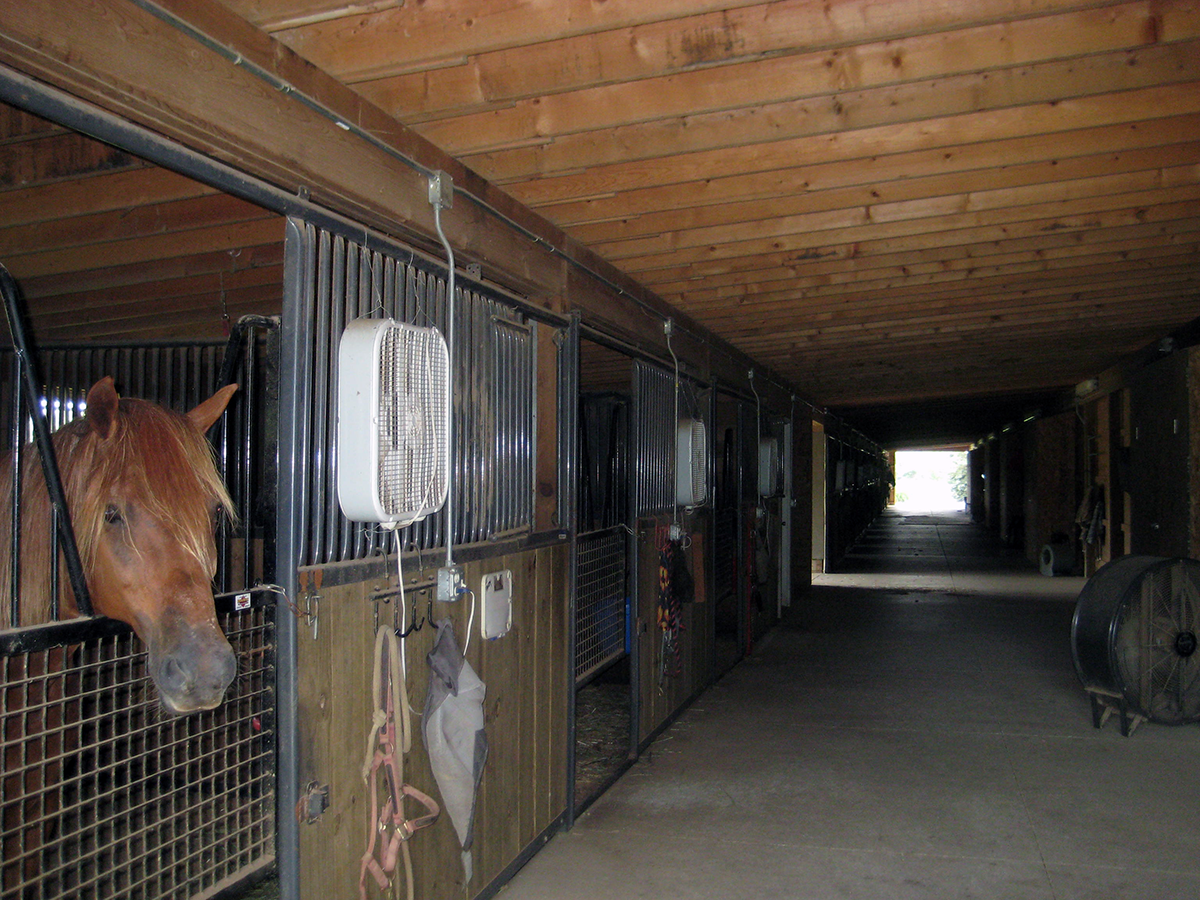
I realize this may seem to some like a radical departure from my usual articles about hoof care, but since the subtitle of the site is, after all, “Better Horse Management through Science,” I thought it appropriate to weigh in on a common situation I see in barns every summer. And that’s the one where people are trying to use fans – usually a lot of them – in what I see as a largely futile attempt to cool the barn. Here’s a photo of a typical fan arrangement in a horse barn. Note not only the box fans on each stall, facing inward, but the large fan on the floor and the blower on farther down the aisle. And yes, that’s my horse Andy wondering what I’m doing!

Barn aisle with box fans

 So what’s wrong with this setup? Well, several things. Cooling takes place when a body loses heat by transferring it to cooler molecules, either directly to cooler air, or indirectly to perspiration and then to cooler air. Think of it like this: heat always moves from higher temperatures to lower temperatures, which means you don’t (can’t) “add cold” to an environment, but can only “remove heat.” So for cooling to occur, the surrounding air temperature has to be cooler – and ideally, drier – than the horse. The greater the difference in temperatures, the more rapidly heat will move. And it’s also important to note that cooling a horse isn’t like cooling a pie, because a horse’s body is constantly converting food to (heat) energy and we’ve got to stay ahead of that conversion in order to effectively cool him.

When moving air passes by an object, a couple of things happen. First, if the object is warmer than the moving air, the warmer object will give up heat to the cooler air, making that “chunk” of air warmer. That’s why the air needs to move – a new chunk of cooler air must take its place for the heat transfer to continue, or the air and the object will be at the same temperature and no cooling will take place. And second, if the object is wetter than the moving air, some of the moisture will evaporate and heat will once again be transferred to the air. And as in the first situation, a new chunk of drier air must replace the now-wetter air for the process to continue. When a living, perspiring being is the object in this second situation, this cooling effect is perceived as being greater than it actually is because the being’s body is constantly attempting to maintain its surface temperature. This perceived effect is referred to as wind chill.

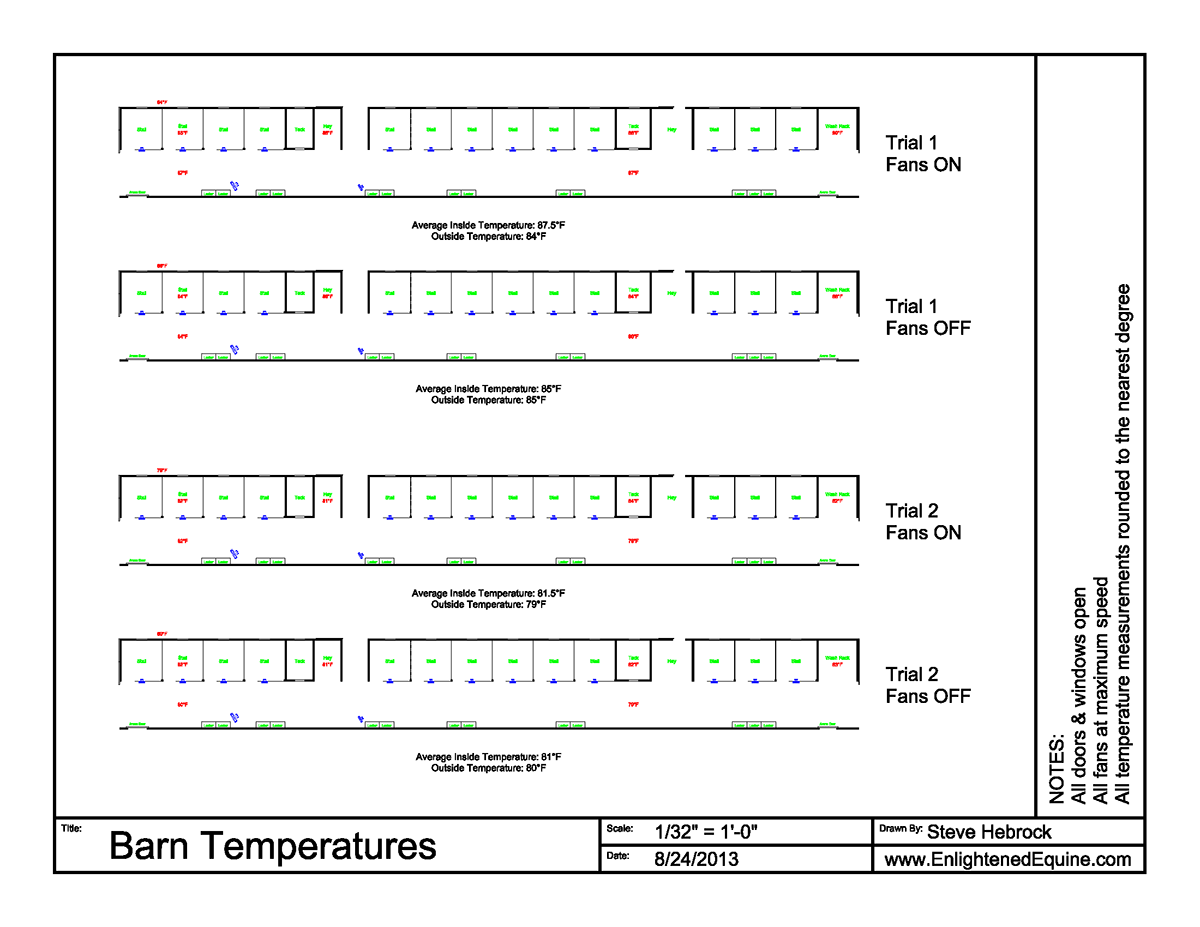
Blowing air in the general vicinity of a horse, consequently, does very little actual cooling because the air doesn’t really “go” anywhere; it simply wraps around the fan and transfers its heat and moisture to the other air in the vicinity. So, very quickly, you reach a state of equilibrium in which all you’re doing is recirculating high-temperature, moisture-laden air. The vast majority of cooling that seems to be occurring is really only because of wind chill, and not because of any actual significant temperature reduction. That also means the fans not aimed directly at a horse or a person aren’t doing anything at all other than recirculating the same small amount of air over and over again. Check out the following diagram of the barn aisle in the photo above, with the temperatures measured in the seven locations indicated both with and without the fans running –

Diagram of barn temperature measurements

Notice anything? It would probably shock most barn owners to see that the inside temperatures, at least in these two sets of measurements, were closer to the outside temperatures with the fans off! That means in spite of moving literally tens of thousands of cubic feet of air per minute, not to mention spending money to do it, you’re actually making the situation worse with the fans rather than better.

So is trying to cool a barn really a no-win situation? Not at all. Horse people just seem to go about it the wrong way, and ought to take a cue from many livestock barns. To effectively cool the barn, which, unless you’re willing to invest in some sort of refrigeration system means lowering the barn temperature & humidity to match the outside air temperature & humidity when it’s cooler outside, you have to replace the air in the barn. And it’s a lot easier and less expensive to do than you might think. It’ll also lower your electricity costs, labor costs, and risk of fire.

You begin the process by understanding that in order to really move air, you have to use a fan properly. A fan is, in effect, an air pump, and works by decreasing the pressure on one side of it while increasing the pressure on the other side. When it’s just sitting in space, there isn’t anything separating the lower-pressure side from the higher-pressure one, so the actual air movement any distance from the fan is very small. It’s like trying to fill a balloon with water by aiming a hose at it from several feet away. You might manage to get a little water into it, but it certainly isn’t going to make a big splash! So just as we can make filling the balloon much more efficient by keeping the water pressure confined to only the inside of the balloon, we can greatly increase the efficiency of a fan by separating its inlet from its outlet.

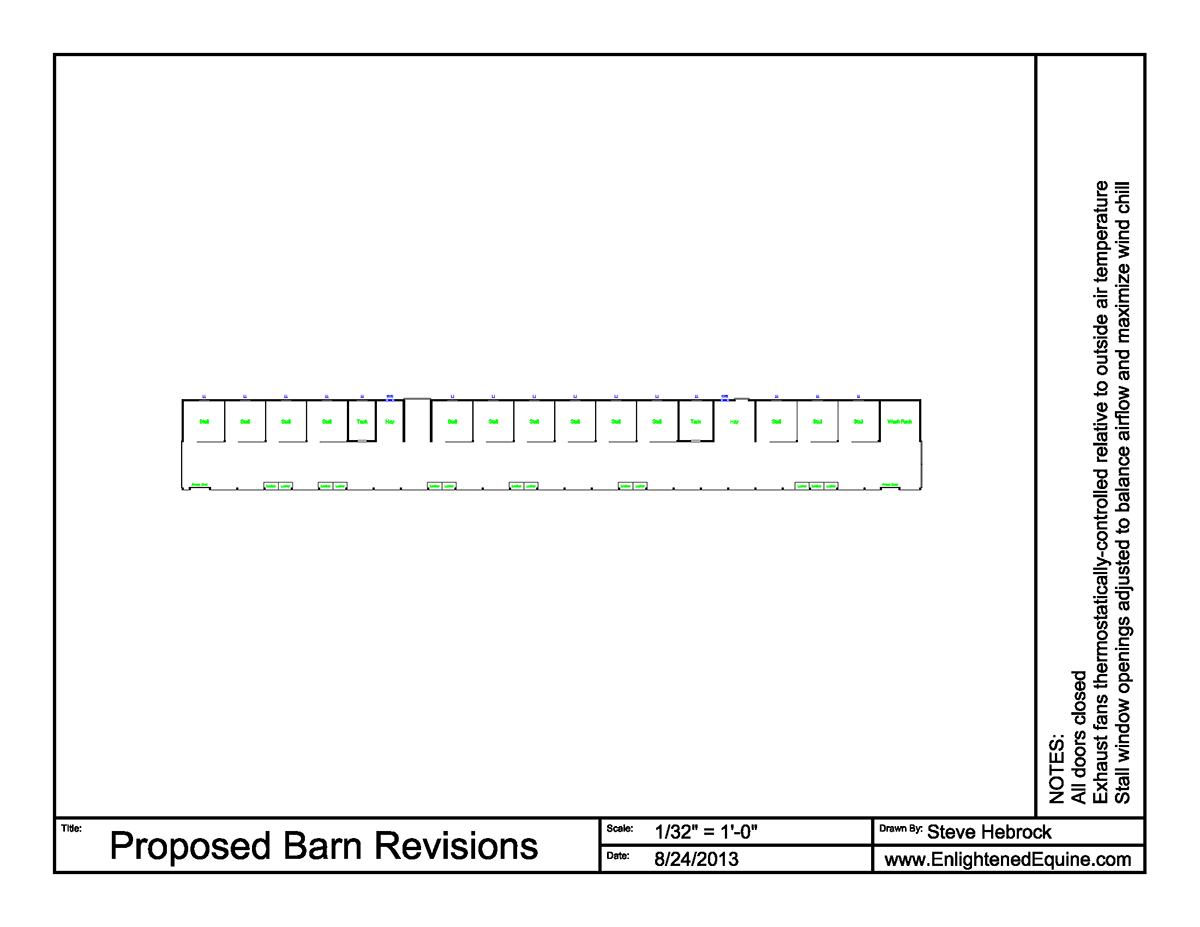
That means we need to think about making the barn more of a closed box, with a fan or fans mounted through the wall of the box to pull the warmer inside air out of the barn and, thereby, draw in cooler outside air through openings in our box. We can take advantage of the faster air movement that occurs at the openings by using the stall windows as our air inlets, and adjusting how open or closed they are to both balance the airflow and create a fan-like effect (same thing – a pressure difference) to blow air on our horses and utilize wind chill for additional perceived cooling. It’s also important to turn the fans on only when the inside temperature is higher than the outside; otherwise, you’ll be heating the barn! So you need a thermostat arrangement that will compare inside and outside temperatures in carefully-chosen locations (maybe more than one location inside the barn), and turn on the fans accordingly. Here’s my proposed fan placement for the barn I’ve been describing –

Drawing of propsed barn revisions

Choosing fan quantity, size, and location is relatively simple. First, look for possible mounting places in the barn that are as equidistant from as many stalls as possible, so with the stall windows open the same amount, the quantity of air moving into and out of each stall is about the same. If what I’m describing isn’t quite clear, it may help to imagine a round barn with stalls placed around the perimeter, with a window in each stall. Placing the fan in the center of the roof would give fairly even airflow throughout the stalls, assuming the windows were all open the same amount. If you were to place the fan directly over one of the stalls, though, most of the air movement would be from that stall unless you started closing windows closer to the fan to pull air from the more distant stalls. You’d like to avoid that scenario as much as possible, because you want all of the horses to experience the same benefit from wind chill. Since warm air rises, try to find locations closer to the ceiling; don’t rule out using roof-mounted fans, either. Many barns, like the one in the example, are long and narrow, so you may end up with two or three sites. You shouldn’t, however, need any more than that in any horse barn I’ve seen, as you’ll soon see from the math.

Next, you’ll have to calculate fan size. For that, you’ll need three pieces of information: the number of fans, the volume of the barn in cubic feet, and the air turnover rate, which is the amount of time in minutes it takes to completely replace the air in the barn. Typical values for air turnover rate range from 10 to 20 minutes. Rather than lead you through the formulas, though, I decided to create a very simple MS Excel spreadsheet to make it easier, since I suspect many of you (like my students) both despise math and/or have forgotten most of what you learned in high school! If you have anything other than a flat, sloped, or peaked roof (like a gambrel roof, for example), you’ll have to do more measuring to calculate an accurate volume. But “guesstimating” the numbers in this application is generally sufficient. Here’s the spreadsheet –

Barn Ventilation Fan Calculator

Once you have the CFM per fan calculated, it’s just a matter of choosing a fan or fans with sufficiently-high airflow to meet or exceed the required value. To completely replace the air in the barn in 10 minutes, my example barn needs two fans, each with a CFM rating of at least 2,500. Looking online at a fan supplier such as this one, I see a number of 16″ shutter-type exhaust fans with ratings over 2,500 CFM. On the other hand, if I’m content to replace the air every 15 minutes, the required CFM drops to 1,667 per fan, and I can use 12″ models instead. I do recommend both shuttered and heavy-duty fans, by the way, to minimize potential problems.

Now, the really interesting thing about all of this is the most common box fans used in barns are 20″ fans with CFM ratings of between 1,700 and 2,200 per fan. That means in my example barn, there’s already a total capacity of over 25,000 CFM – five times what’s necessary, with the ability to replace all of the air in the barn every 2 minutes – but it’s not working because the fans are not being properly used! So instead of fifteen 20″ fans running in my example barn, I can replace all of them with only two 16″ fans, and do a far better job of cooling the horses! Quite a revelation, right?

There’s much more to say, but this should at least get you thinking about more efficient, less expensive, and safer ways to cool your barn. I’ve already put a PDF version of this article in the Printable Article Archive that can be easily printed and shared with your barn-owning friends. More coming…

Mustang Hooves
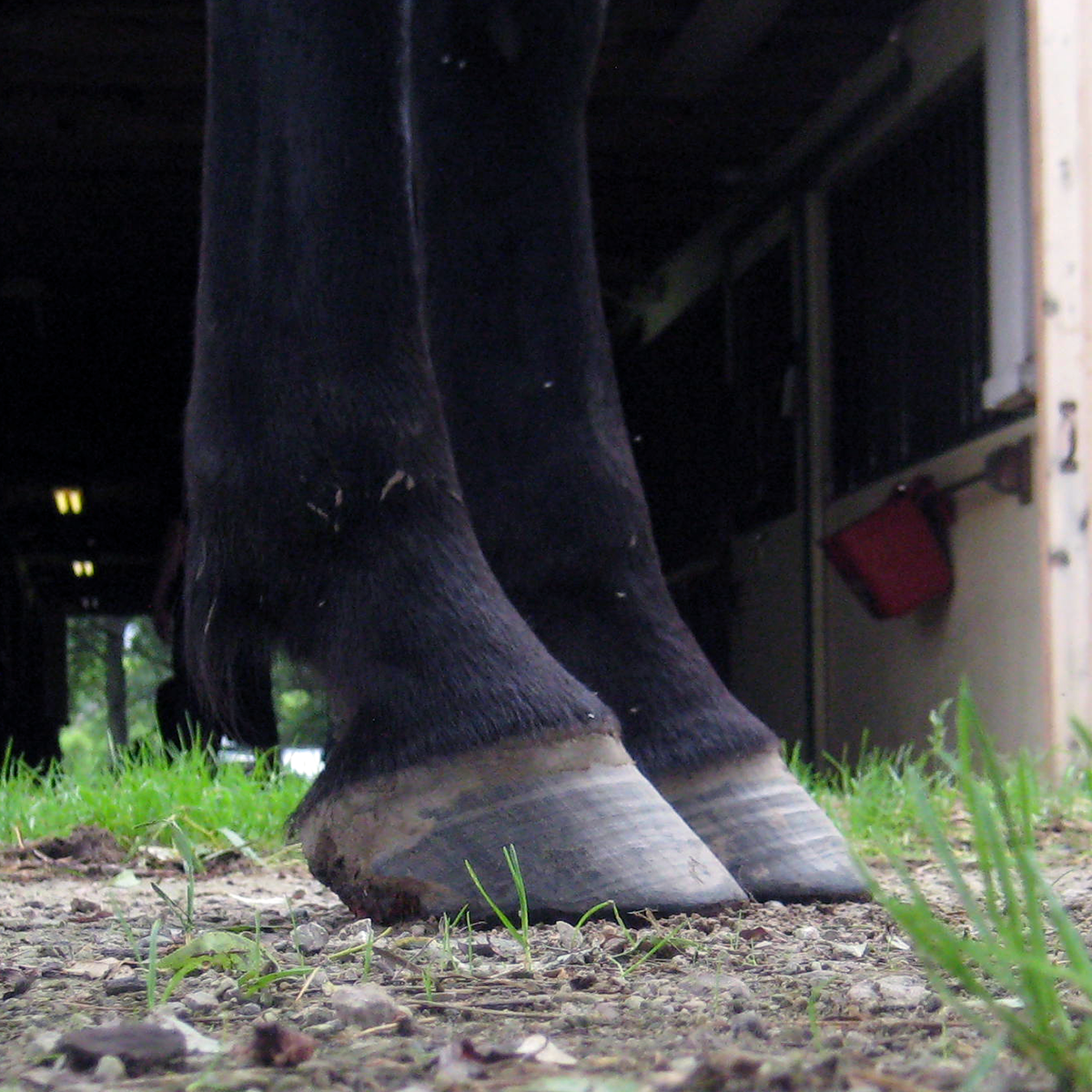
See anything wrong with this mustang’s front hooves or lower legs?

It’s a constant struggle. The other night I gave a 2-year-old mustang born in a BLM holding facility his first real trim. I say “real” because he surely must’ve been trimmed at least once or twice in the holding facility, but almost certainly either in a squeeze chute, tranquilized, or both. As you can see, he has practically textbook-perfect feet, with smooth, healthy frogs and soles, and thick, uniform hoof walls. The problem was, the owner who’d adopted him had been told by her veterinarian just a couple of days earlier that he had an entire litany of front hoof and leg problems: both feet were clubbed, an extensor tendon was about to bow, he’d had a couple of bouts of laminitis and was currently experiencing another, and he had a bad case of thrush. She was therefore understandably in a state of near-panic when I showed up to trim the horse.

Mustang Hoof
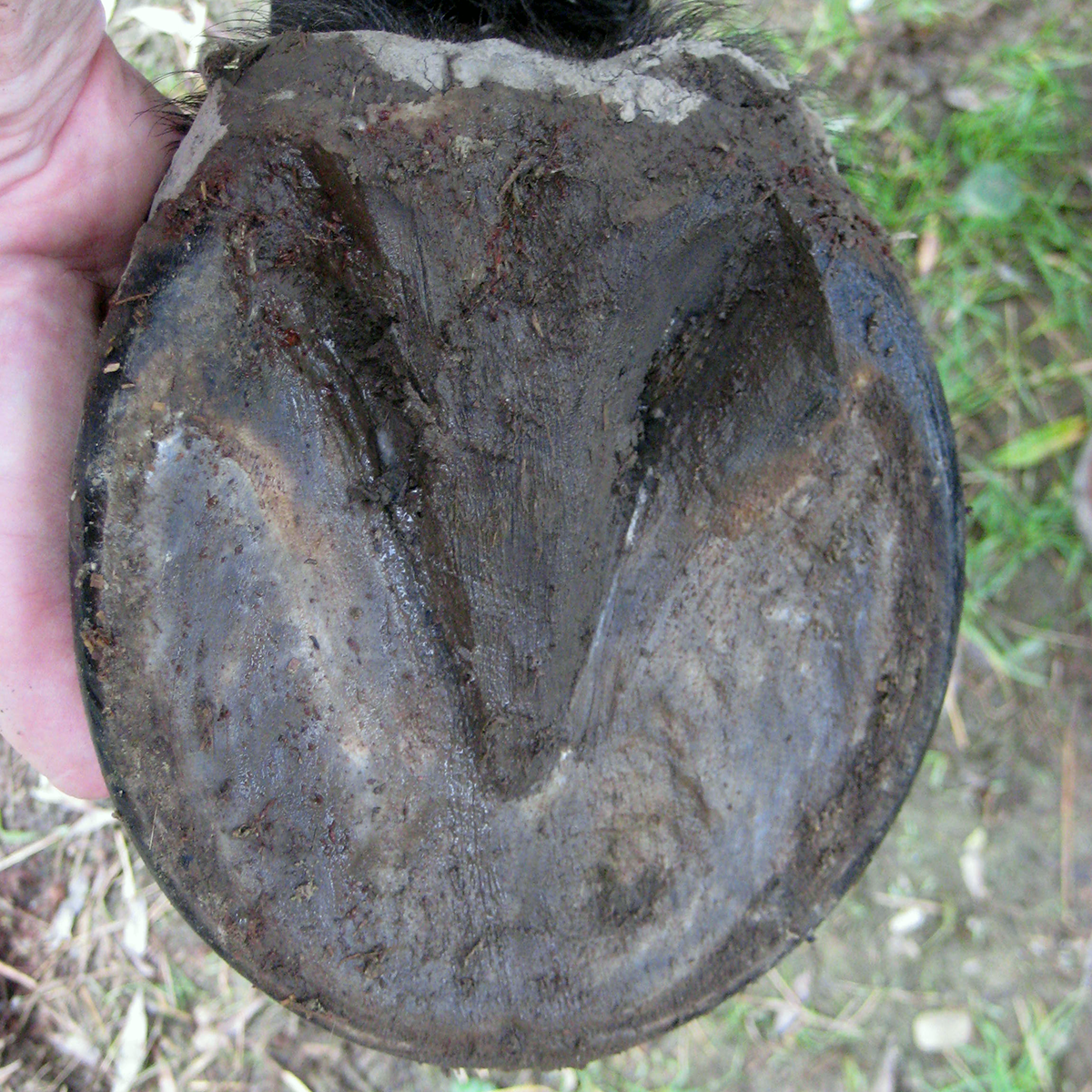
How about in the bottom view?

And so I was once again in the too-familiar position of trying to explain to the owner that her horse was not only going to be fine, but that he in reality had none of the problems described by the vet! The closest thing I could find was evidence that he probably previously had a fairly mild bacterial infection (but not thrush) in one frog.

Four nights earlier, I had been asked to look at a draft mare whose owner had been told by a farrier (not hers) that her horse’s lameness was being caused by laminitis. Her vet subsequently performed an exam, including radiographs, and confirmed the laminitis diagnosis, and her regular farrier was then called in to replace the shoes and put on pads. As was the case with the mustang, this mare didn’t have the problem identified by not just one, but by three, professionals! Instead, she had a very obvious and very severe infection of the frog in one of her front feet (see Mistaken Identity for more information on these infections) that was causing her lameness.

And I’ll save a complete description of the instance last month where the horse owner was told, after radiographs and nerve blocks, that his horse had “mild navicular” and desperately needed wedge shoes, when in reality he had sore hips, for my upcoming series on navicular disease.

I’m also not going to mention the amount of money that changed hands between owners and other professionals in these three situations, because it just makes me angry, and should make the horse owners angry as well!

So why do these misdiagnoses happen, you may ask? Simple: because, as I’ve mentioned in previous articles, most veterinarians just aren’t adequately trained in matters of the hoof (see An Interview with The Vet). I remember one young woman a month away from vet school graduation telling me she wished I could come lecture at the school because she’d learned nothing of substance about the equine hoof in the entire time she’d been there. And now, as she said, she was about to graduate, was out riding with a horse vet, and was constantly encountering hoof problems she knew very little about. I have to give her a lot of credit, though, for at least recognizing (and acknowledging) what she didn’t know, given that a lack of recognition is at the root of this problem (see The “Expert Syndrome”) in my opinion.

And the situation with the majority of hoof care providers isn’t much better. Most horse owners probably don’t realize that not only is there no legal or licensing requirement – no measure of competence needed – for calling yourself a hoof care professional in the vast majority of this country, but that what’s studied in the various horseshoeing schools, assuming your farrier even attended one, is metalworking. That means the person you’re entrusting with the primary care of your horse’s hooves may well have never studied the underlying mechanical or medical causes for the numerous pathologies that can occur in the equine foot, or even taken a basic anatomy class. Or understand why it’s important to do so.

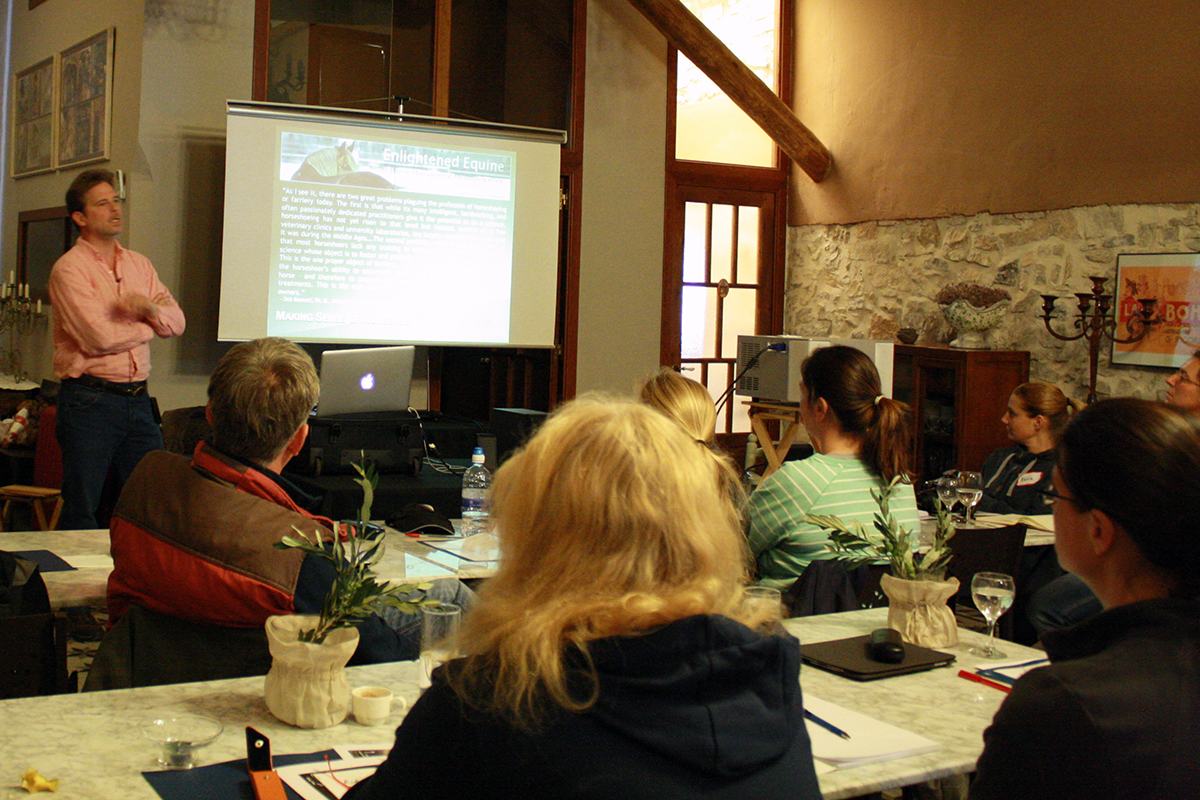
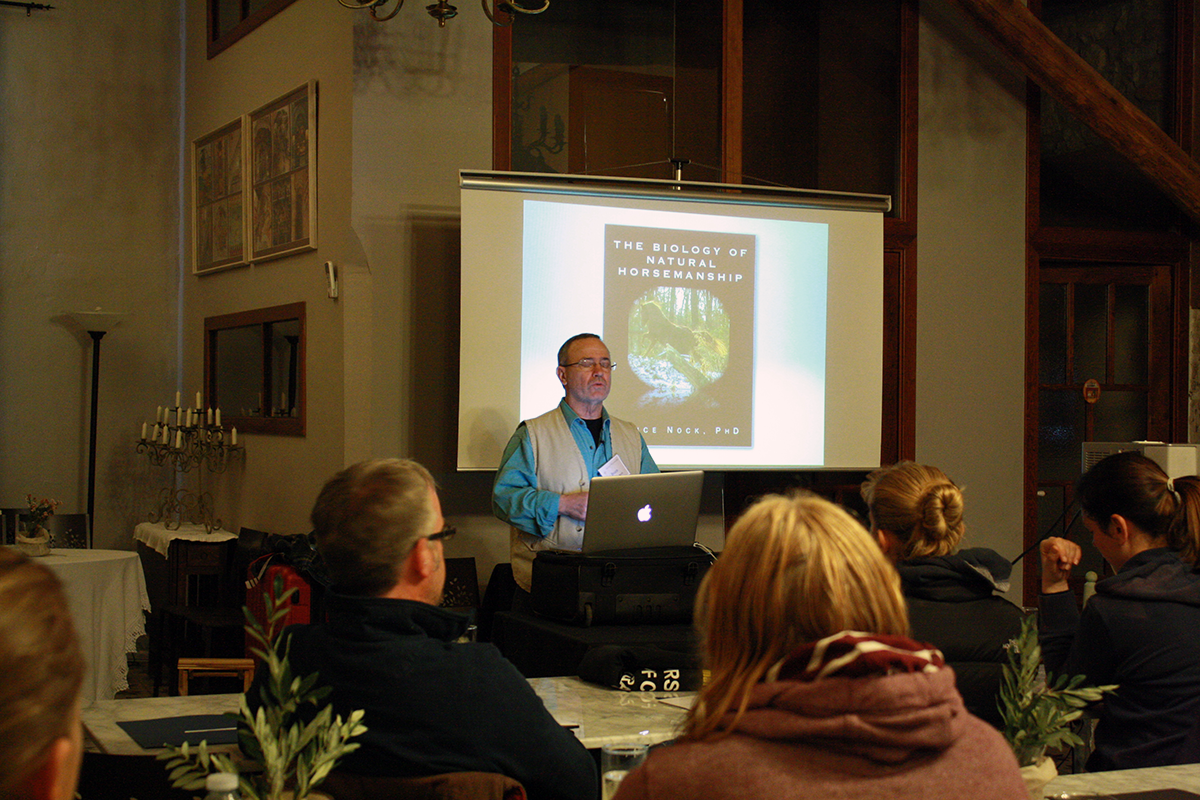
Lecture on hoof pathologies - La Llacuna, Spain
Lecture on hoof pathologies – La Llacuna, Spain

At this point, I want to be very clear about two things. First, my goal in writing this is not to be unduly critical of veterinarians and other hoof care providers; on the contrary, I have a lot of respect for many of their considerable talents and knowledge that I don’t happen to possess. I just continue to hold out hope that they’ll recognize and acknowledge the gaps in their training and do something about them, for the sake of horses and their owners! And second, I’m not suggesting that licensing or other government-imposed requirements are the solution to the problem, because I think it’s been repeatedly demonstrated both here and in other countries that such things simply don’t work.

Instead, I’m offering a solution that relies on the horse owners’ help: I’m asking owners to place consumer-imposed “regulations” on their hoof care professionals to ensure they’ve been adequately educated and are up to the task. As I’ve said before, and as the anecdotes at the beginning of this article reinforce: in spite of what owners very much want to believe, most horses aren’t excelling because of receiving good hoof care, but are rather getting by in spite of receiving mediocre hoof care. I’ve already written quite a bit on this subject so I won’t say any more about it in this article, but a good introduction to sorting things out can be found here.

Bruce Nock's lecture on equine metabolism - La Llacuna, Spain
Bruce Nock’s lecture on equine metabolism – La Llacuna, Spain

In keeping with that solution, I’m especially pleased to announce that the second offering of Liberated Horsemanship’s Kick Start Clinic will take place at The Ohio State University ATI in Wooster, Ohio (where I teach) this coming October 11th – 13th. This intensive 3-day program is aimed squarely at the hoof care professional interested in filling in some of those knowledge gaps with respect to hoof care theory & practice, in an effort to help the already-experienced professional onto the fast track to becoming a Certified Hoof Care Professional through Liberated Horsemanship. And that means something. Being certified through our program indicates that the hoof care provider has not only spent many hours trimming hooves of all types, but has also successfully completed a whole-horse-centric education and examination on hoof care theory & practice, anatomy, and booting, as well as other management issues such as nutrition and stress management. And those are the minimum requirements for certification; advanced clinic topics currently include the veterinarian/trimmer relationship, physical therapy, custom boot fitting, advanced anatomy, biomechanics & movement, dentistry, and managing hoof pathologies.

Ann Corso demonstrating proper hoof balance - La Llacuna, Spain
Ann Corso demonstrating proper hoof balance – La Llacuna, Spain

Equally as exciting is that Dr. Nock has agreed to open up the lecture portions (but not the trimming portions) of this clinic to auditors, which means any interested party can receive over 10 hours of education in hoof care – the same education taught to hoof care professionals from all over the world – for only $400! This is a great opportunity to learn from four highly-educated and eminently-qualified acknowledged experts in the field of hoof care.

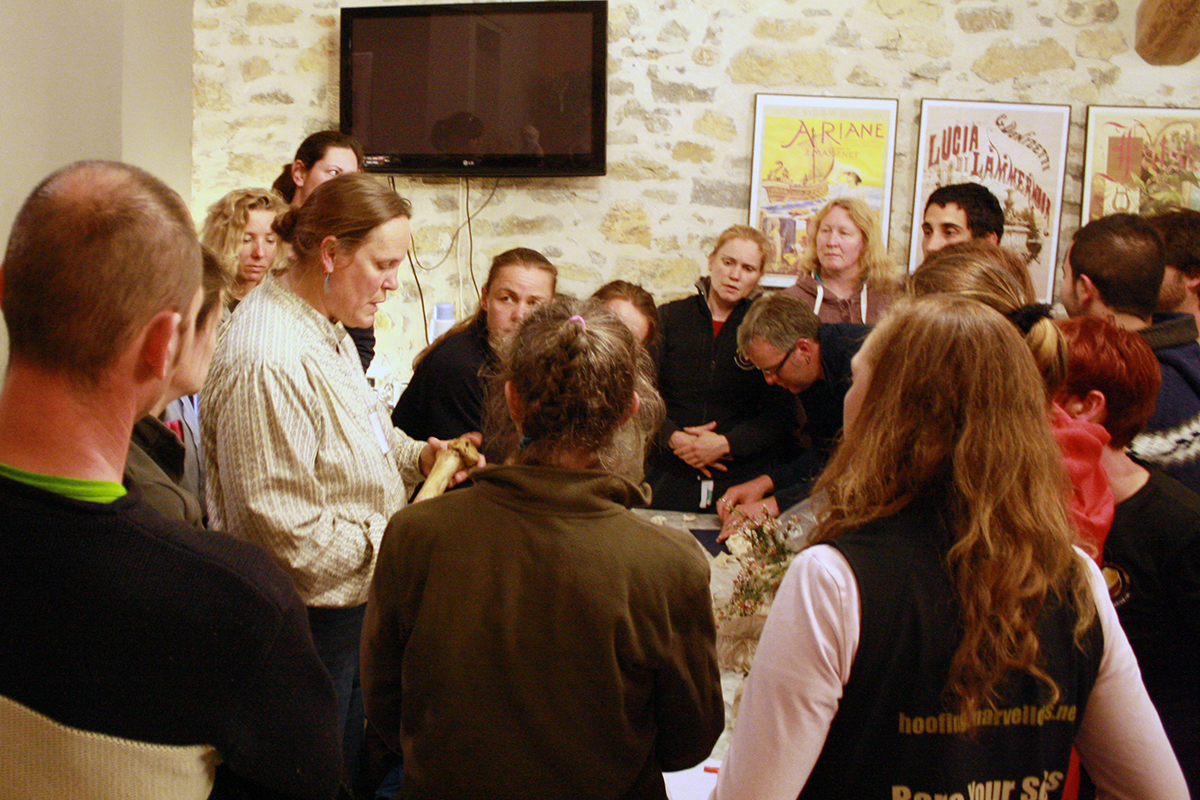
Cynthia Niemela's anatomy clinic - La Llacuna, Spain
Cynthia Niemela’s anatomy clinic – La Llacuna, Spain

So please consider joining us for three highly-informative and entertaining days in October. I promise you an educational experience that will put you in a position to better assess – and appreciate – the abilities and knowledge of your veterinarian and hoof care provider. Invite your veterinarian, hoof care provider, and fellow horse owners to attend as well. Even consider joining forces with other horse owners in your barn and offering to help defray the expense for your farrier to attend. He or she won’t regret it, and you and your horses will be much better off for it!

Hope to see you in October…

(And a special note of thanks to my assistant “Faith” for cleaning the mustang’s hooves for their photo session!)

Faith