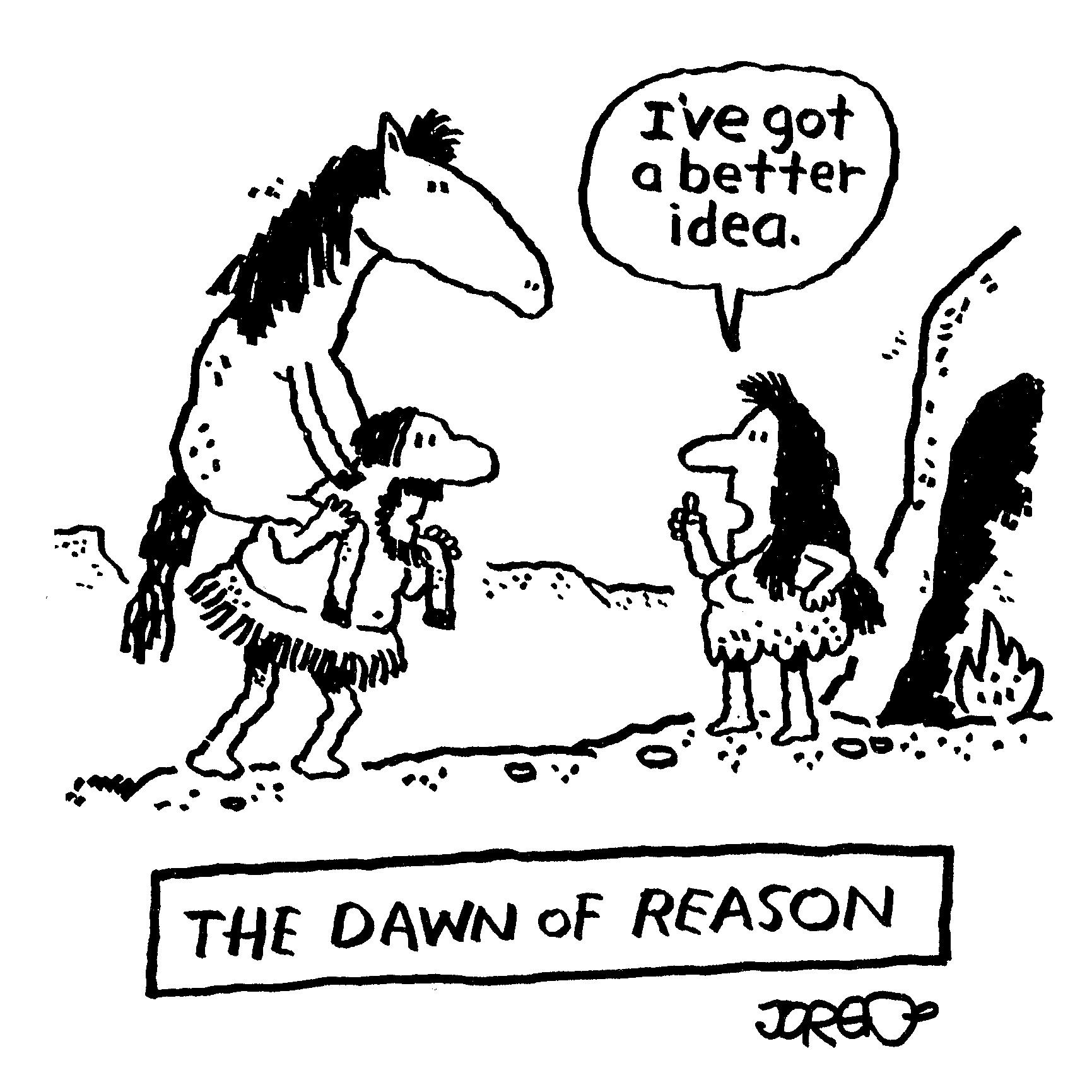
"The Dawn of Reason" cartoon b y Jared Lee

Jared Lee’s cartoon makes light of what is pretty obvious to most of us: the horse is far better equipped to carry people than the other way ’round! And yet, as the size of our population continues to increase, the shrinking weight difference between horse and rider is definitely having an impact on the horse world. For example, one of the owners of the guest ranch I frequent in Arizona (the White Stallion Ranch) told me that although they don’t have an upper weight limit for riders (unlike most guest ranches, by the way), they’ve had to buy increasingly-larger horses to keep up with the changes in guest size. Likewise, my travels to various horse farms have led me to the same undeniable conclusion: there is a growing number of larger riders.

At this point, I realize some of you may be thinking “Oh no! I don’t think I like where this is headed!” But as I’ve mentioned before, my commitment is to the long-term comfort and soundness of the horse. And that includes not only proper hoof care, but nearly every aspect of equine management. So please understand that I’m just delivering information; what you choose to do (or not do) with it is up to you! On we go…

A few years ago, this subject caught the attention of a couple of our equine professors who were interested in finding research in support of some particular method of determining the maximum weight-carrying capability of a horse, particularly the common assertion that a horse should carry no more than 20% of its body weight. But as with many of the horse world’s popularly-held ideas, they found very little actual data to support any specific method or assertion. And so they decided to design a study of their own to investigate the effects of a horse carrying 15%, 20%, 25%, and 30% of its body weight. The resulting paper, entitled “Evaluation of Indicators of Weight-Carrying Ability of Light Riding Horses” (DM Powell et al) was published in the Journal of Equine Veterinary Science (Vol 28, No 1  (2008)). Their publication forms the basis for the information presented in the first part of this article.

I won’t go into great depth on their methodology here, but a brief summary is as follows:

  • Eight fit, mature horses – geldings and mares – of light horse type were used, with feed intake adjusted weekly to maintain initial body weight
  • During the course of the study, the horses were housed individually in stalls, with daily turnout
  • Each horse carried 15%, 20%, 25%, and 30% of their body weight in a series of randomly-assigned trials, with 14-day rest periods between trials
  • After a standardized warmup, each horse performed a standardized exercise test with one of three experienced riders, with the load adjusted by means of lead weights added symmetrically to the saddle
  • Twenty-four hours before and after each exercise test, muscle soreness and tightness changes were evaluated by the same professional animal massage therapist in 40 consistent locations on each horse
  • Blood samples were collected immediately before and after exercise, with additional samples taken 10 minutes, 24 hours, and 48 hours after exercise
  • Heart rate, respiration rate, and rectal temperature were measured immediately before and after exercise

Both the subjective and objective results showed statistically-significant differences indicating greater work rates when the horses carried 25% and 30% of their body weight compared to 15% and 20%. More importantly, when horses carried 30% of their body weight, their serum creatine kinase activity – an indicator of skeletal muscle damage – was elevated immediately after exercise, and remained higher when measured 24 and 48 hours after exercise. So the recommendation that a horse carry no more than 20% of its body weight does, indeed, seem to have some defensible logic behind it!

For heavier riders, then, it might seem logical to use larger horses, right? Well, unfortunately, only to a point, because there’s also arguably an upper limit beyond which a horse’s congenital soundness is in question. Read what Dr. Deb Bennett, noted equine anatomist and author, has to say about equine size and soundness in Principles of Equine Orthopedics –

 Before horses were brought into domestication more than 5,000 years ago, the species averaged 13 hands, 2 inches in height and around 800 lbs. Until as late as 1820, horses over 15 hands, 2 inches and about 1100 lbs. were an absolute rarity – and this, by the way, is the maximum size that any wild equine ever attains. Only after the advent of railroad transport did teamsters see an advantage to utilizing cart and carriage horses that were in the 16- to 17-hand range and drafters going as high as 2200 lbs. (And no – despite what you may think you have learned from Hollywood, there were no knightly chargers as big as the modern Shire; the Medieval “Great Horse” stood 14 hands, 2 inches and weighed around 1000 lbs.). The modern Shire is twice as massive as the largest wild equine that ever lived, and the average riding horse which stands 16 hands and weighs 1400 lbs. is itself “pushing the design envelope”….It is sheer foolishness not to recognize massiveness as a significant contributor to abnormalities of the bones, joints, ligaments, tendons, and dentition of modern horses. A good rule of thumb: any horse standing over 16 hands, 2 inches, or weighing in excess of 1450 lbs., is automatically and congenitally unsound for any use involving prolonged trotting, cantering, or jumping. In terms of horseshoeing, even when large horses are used for walk-activities such as pulling wagons or other heavy loads, their massiveness implies a need not merely for correct work but for constant orthopedic prophylaxis or “preventive and supportive medicine.”
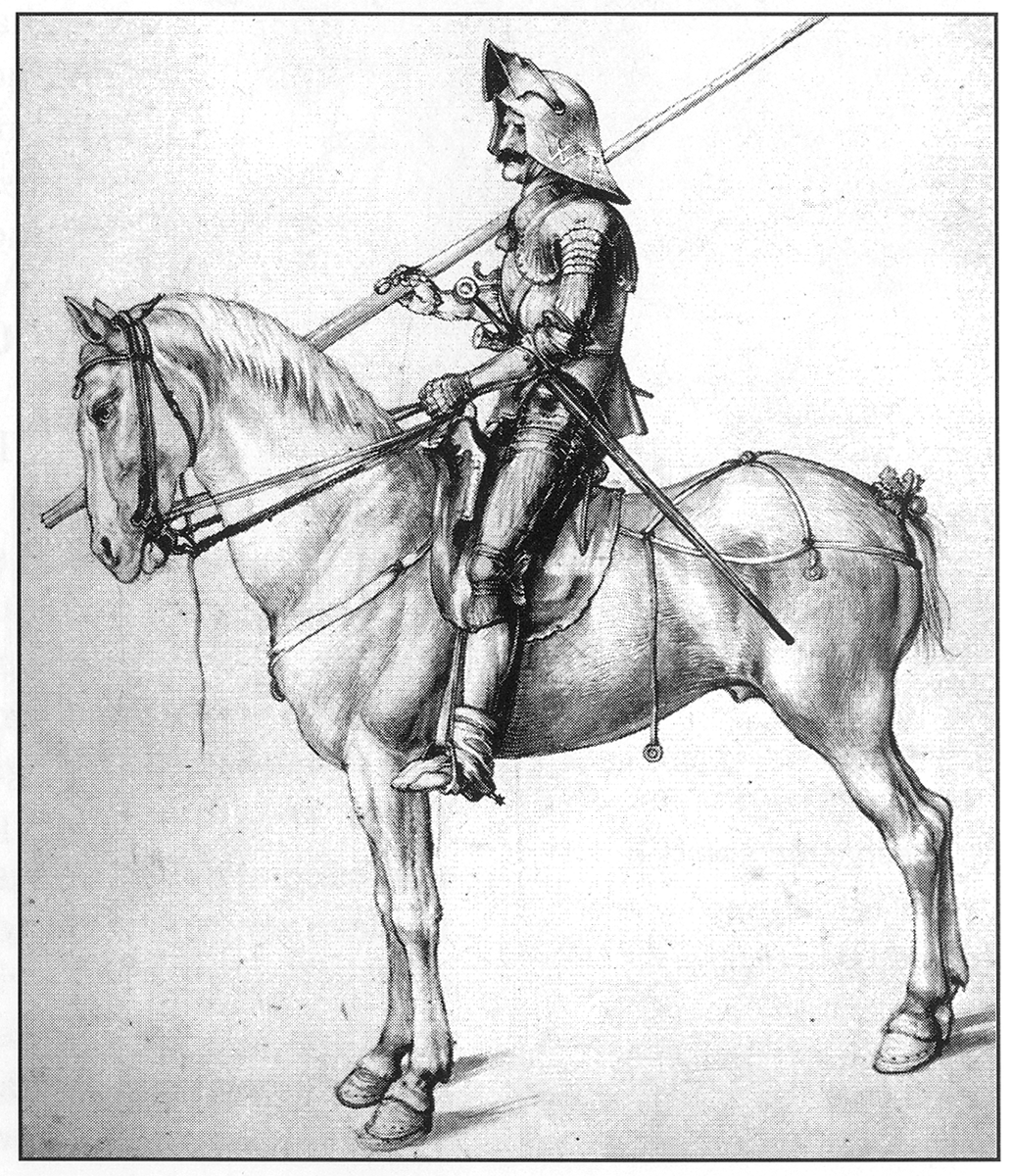
Drawing of a mounted knight prepared for battle ca. A.D. 1500 by Albrecht Durer
Drawing of a mounted knight prepared for battle ca. A.D. 1500 by Albrecht Durer. Note the relatively small size of the horse vs. rider, and the evidence of strain on the horse’s back. From Conquerers: The Roots of New World Horsemanship by Dr. Deb Bennett.

Now, I realize some of you may be inclined to argue that certain breeds have denser bones than others, and are therefore better equipped to carry heavier riders. But Dr. Bennett also did some measurements and calculations of bone density using skeletons at the Smithsonian Institution, with the following results:

  • Horses that weighed (in life) 1000 lbs. or less had normal bone density. There was no consistent trend as to breed; they all fell within a single, fairly tight, cluster.
  • Horses that weighed 1500 lbs. or more had below-normal bone density, and although there were a few individual exceptions, the density tended to drop with increasing weight.
  • Horses between these two weights showed a weaker tendency for below-normal bone density. The majority of animals had normal bone density, but there were some which were as low as the lowest in the heavyweight group.

So although some breeds and individuals obviously have larger-diameter bones than others, and are therefore probably better suited to carrying more weight than other breeds, there’s no scientific basis to support the notion that, for a given bone diameter, the bones of a particular breed are stronger than those of another breed. In fact, based on Dr. Bennett’s evidence, one might argue that the less-dense bones of very large horses are probably weaker on a per-inch-diameter basis, in spite of their being bigger.

I also feel compelled to mention two other factors affecting weight-carrying ability:

  •   The horses used in the study were fit horses. So if your horse is out of shape and heavy, it seems logical that some percentage of that excess weight must be deducted from his weight-carrying ability. Because the extra body weight is fairly evenly distributed, it’s probably not the full amount, but I’m willing to bet that it’s at least 50% of the excess amount. For example, if his ideal weight (Body Condition Score of 5) is 1,000 pounds, but he weighs 1,100 pounds instead (Body Condition Score of approximately 6), his weight-carrying ability for rider and tack (assuming a 20% maximum load) would be reduced from 200 pounds to 150 pounds.
  • There’s no weight-carrying “bonus” for riders with good equitation skills, but the poorer the rider, the more of a reduction in weight-carrying ability would seem to be necessary to account for the added weight moving out-of-sync with the horse, which increases peak forces (and therefore strain).

I might also add that although proper foot care is always important for long-term comfort and soundness, Dr. Bennett’s research points out the absolute necessity of it for larger horses. So be certain to use a hoof care provider who not only truly understands the concepts of correct hoof form and function, but who also appreciates the necessity of minimizing unnecessary stresses on these horses’ joints by keeping them barefoot and properly trimmed. That will give your horse the absolute best chance at long-term comfort and soundness.

To help you more quickly determine a given horse’s weight-carrying ability, I’ve created the following charts – in pounds and kilograms – that cover a range of horses from small ponies to those at the upper limit of Dr. Bennett’s recommendation –
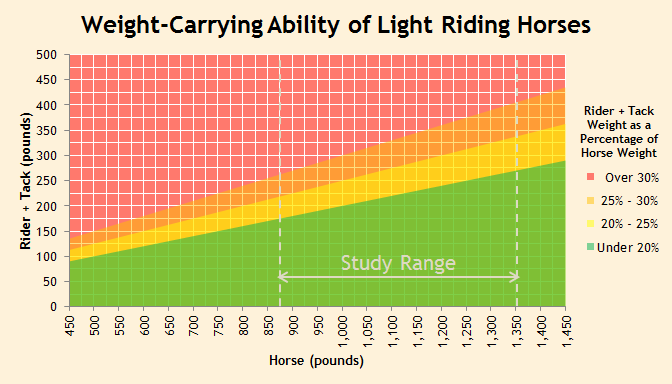
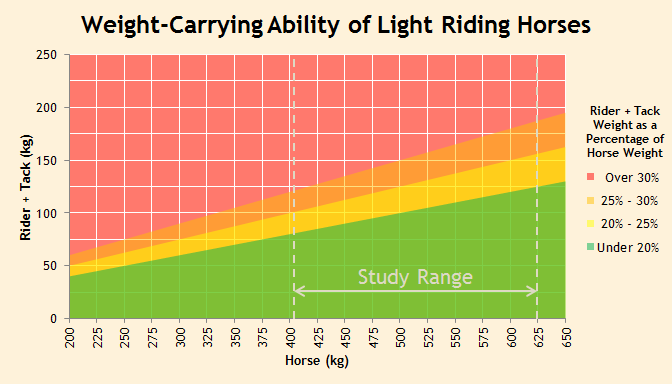
Graph of weight-carrying ability of light riding horses in pounds
Chart in pounds
Graph of weight-carrying ability of light riding horses (kg)
Chart in kilograms

I’ve also put printable versions of the charts here (pounds) and here (kilograms), so print one out and hang it in your barn. But don’t be too surprised if it makes some people uncomfortable! For our horses’ sake, it would be far better if we were all “in the green,” but I realize a great many of us are not. So please carefully consider what’s best for all concerned parties. And keep in mind that one fairly simple solution for many riders may be to get rid of that 40-pound Western saddle!

Meanwhile, guess I’d better think about doing away with the Fanta…
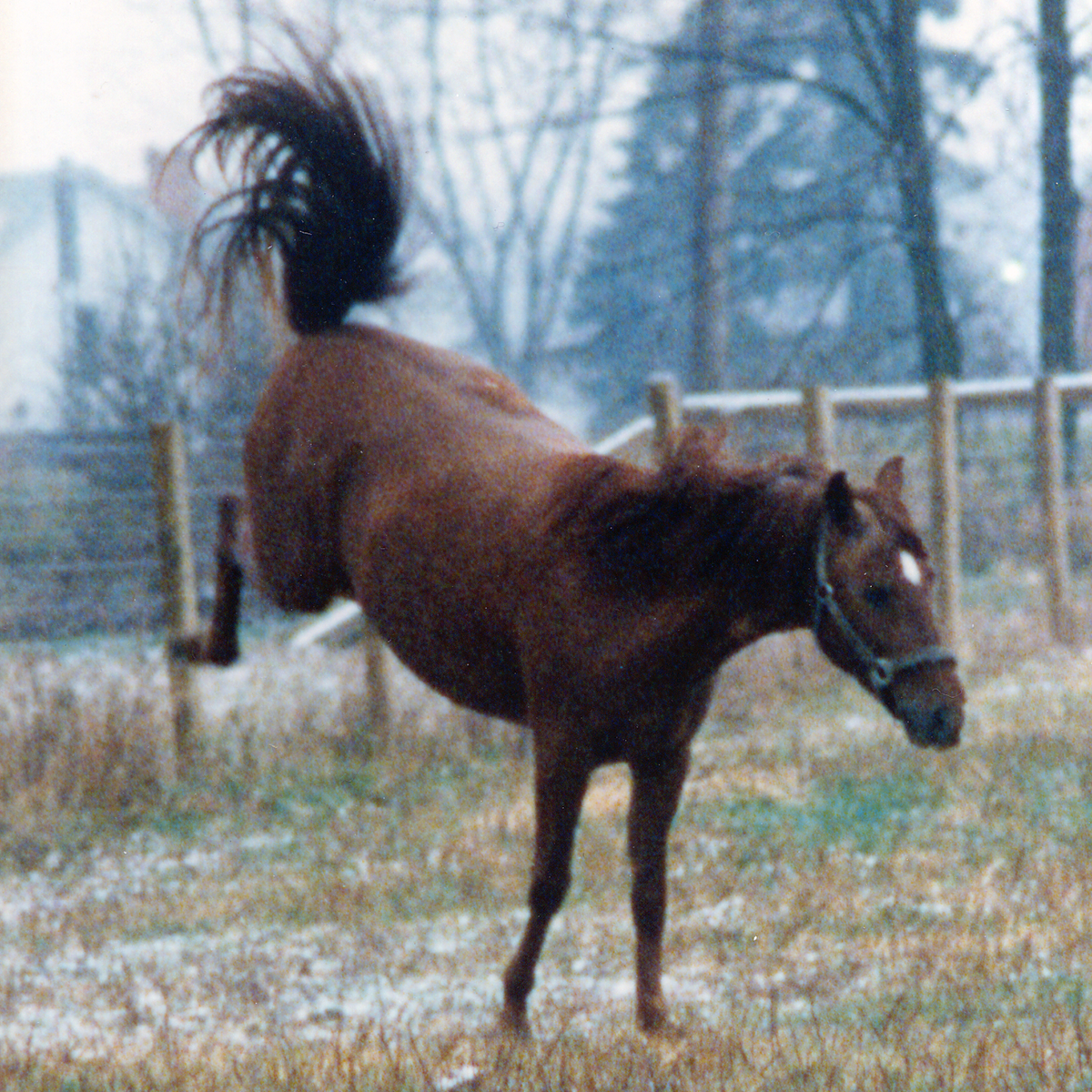
 

Happy Horse!

I know just how my horse felt when I took this photo many years ago. Following some surgery, he’d been stuck inside for a couple of weeks, so I carried a camera with me (pre-digital days, I might add!) as I turned him loose again for the first time. He was ecstatic!

The weather here in northeastern Ohio has been absolutely miserable this year, so I’ve been feeling rather trapped as well. But I’m fairly confident that soon the snow will disappear for good, the flowers will bloom, and another season of horse-related activities will begin! And to that end, I want to share some information about upcoming clinics and other appearances I’ll be making over the next couple of months.

First up is the Ohio Equine Affaire, held annually at the Ohio State Fairgrounds in Columbus, OH. Although I’m not a speaker at this year’s event, I’ll be both attending the show and spending some time in the university’s booth – #702. If you’ve never been to the Equine Affaire (either here or in Springfield, MA), it’s well worth a visit! There are always plenty of horses to see, seminars and events to attend, and a whole lot of shopping. So check out the show schedule on their website, and if you come, please stop by our booth to say ‘hello!”

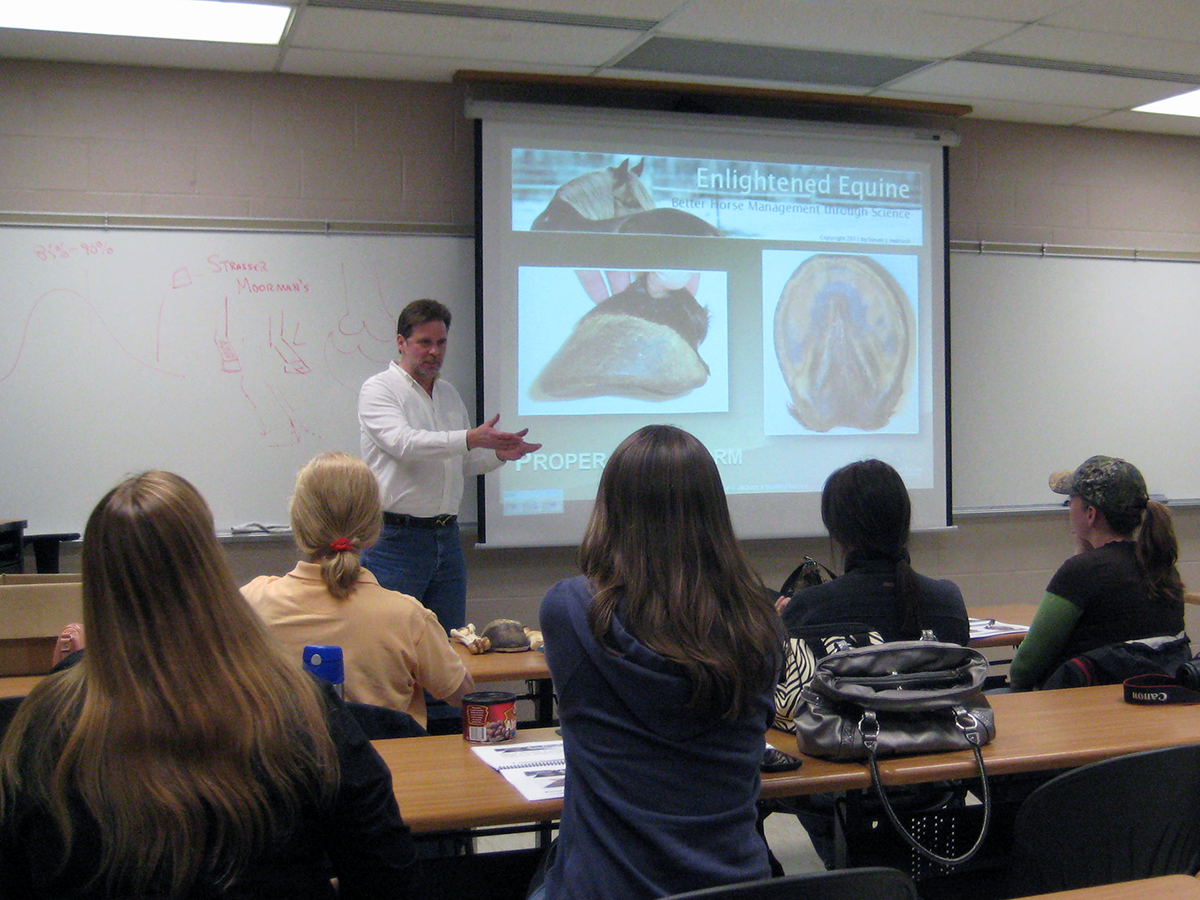
Introduction to Natural Hoof Care clinic

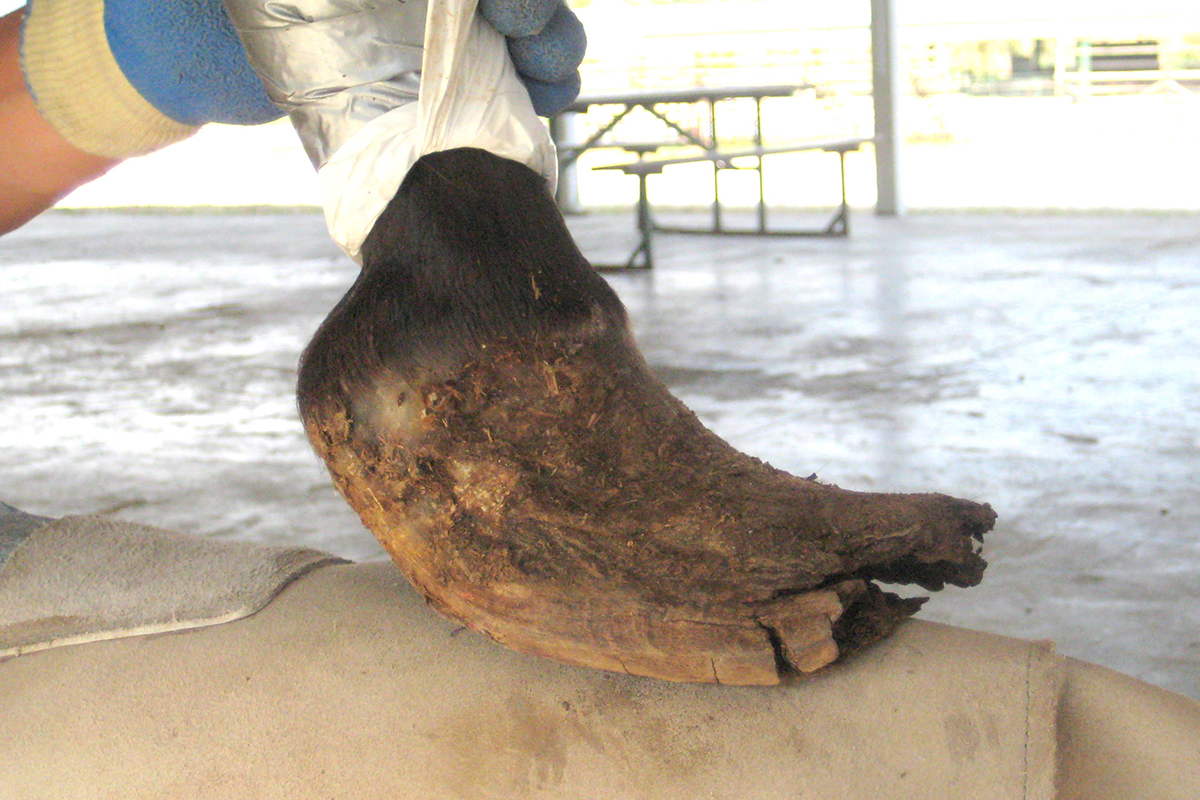
I’m once again offering my Understanding Natural Hoof Care workshop in May. This 5-hour lecture/demonstration is a wonderful introduction to the science behind proper hoof care, challenging the participants to set aside their preconceptions and watch as we reveal a logical, science-based approach to healthier hooves and happier, better-performing horses! And for those who’ve been curious about the actual trim experience, you can sign up for the full-day workshop version where we discuss the tools and techniques of proper trimming and conclude with cadaver hoof trimming. This is a great opportunity to share the advantages of “true” natural hoof care with others, so be sure to bring your friends!

Equine Hoof Pathologies clinic

I’m very excited about my new Equine Hoof Pathologies: Causes, Symptoms and Treatment Options clinic, which is an offshoot of the teaching I do for Liberated Horsemanship in Warrenton, MO! I talk to many horse owners whose animals are collectively suffering from a relatively small number of pathologies that are directly tied to management issues such as feeding and footing. This 6-hour lecture/demonstration takes an in-depth look at the origins, diagnosis, and treatment of laminitis/founder, navicular disease/syndrome, white line disease, hoof cracks, abscesses, and infections, with an emphasis on simple preventative steps for the horse owner.

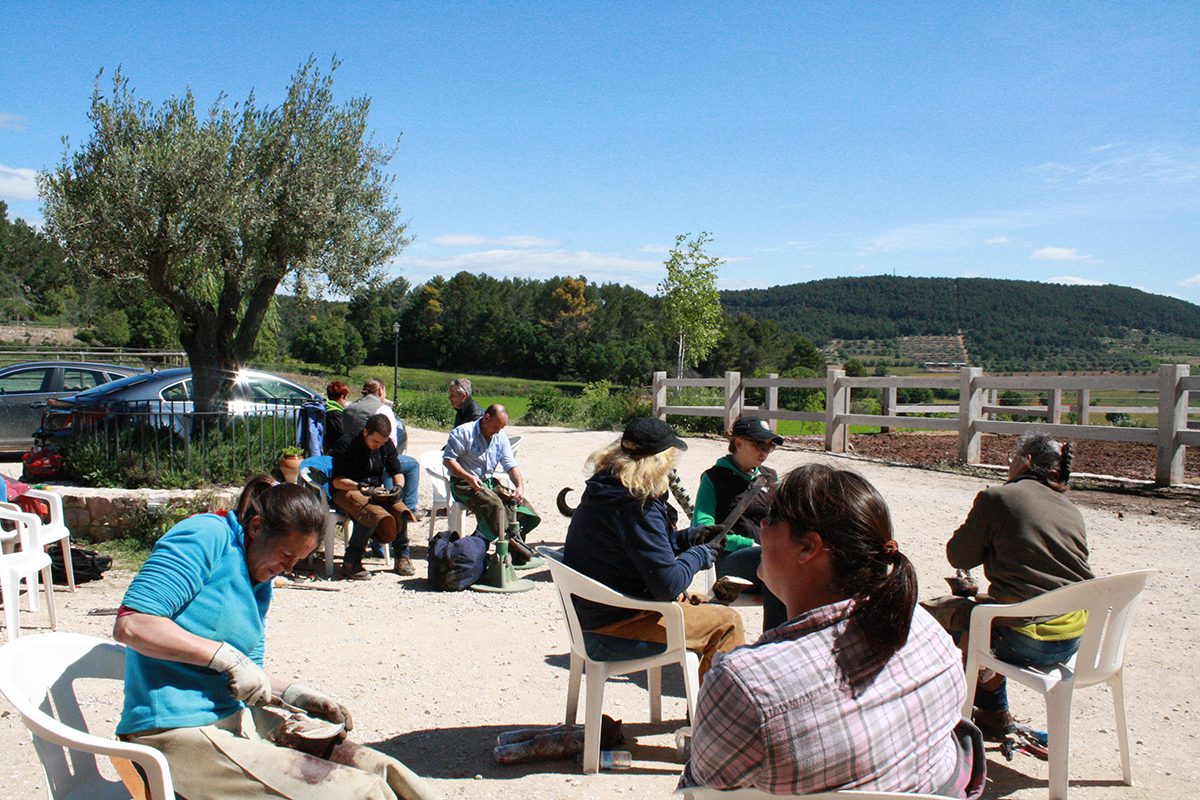
Cadaver trim class in La Llacuna, Spain

And I’ll once again be traveling to Spain for a presentation at Liberated Horsemanship’s Spain Gateway to Hoof Care for the 21st Century Clinic, where I’ll be doing a talk called Navicular Disease and the Forces of Impact: The Connection between Improper Landings and Long-Term Lameness. This 5-day clinic is a wonderful opportunity to learn from some of the most well-respected and highly-educated working hoof-care professionals in the world in a beautiful setting in rural Spain, and I hope to see many of my international readers there!

So, there are a few more possibilities for your “horse calendar!” We cover a lot of material in my clinics, but remember: once you’ve paid to attend a clinic, you can always retake that same clinic – any time or place it’s offered – as many times as you want for no additional charge.

Happy Spring!

In the first article in this series, I started us down the path to understanding why the proper landing for a horse at the walk has to be flat-footed by describing the anatomical differences between humans and horses, and pointing out the limitations of our ability to perceive fairly significant differences in how the horse lands without using slow-motion video techniques. In this installment, we’ll continue on by examining the orientation of the foot as it travels through the flight arc and prepares to make ground contact.

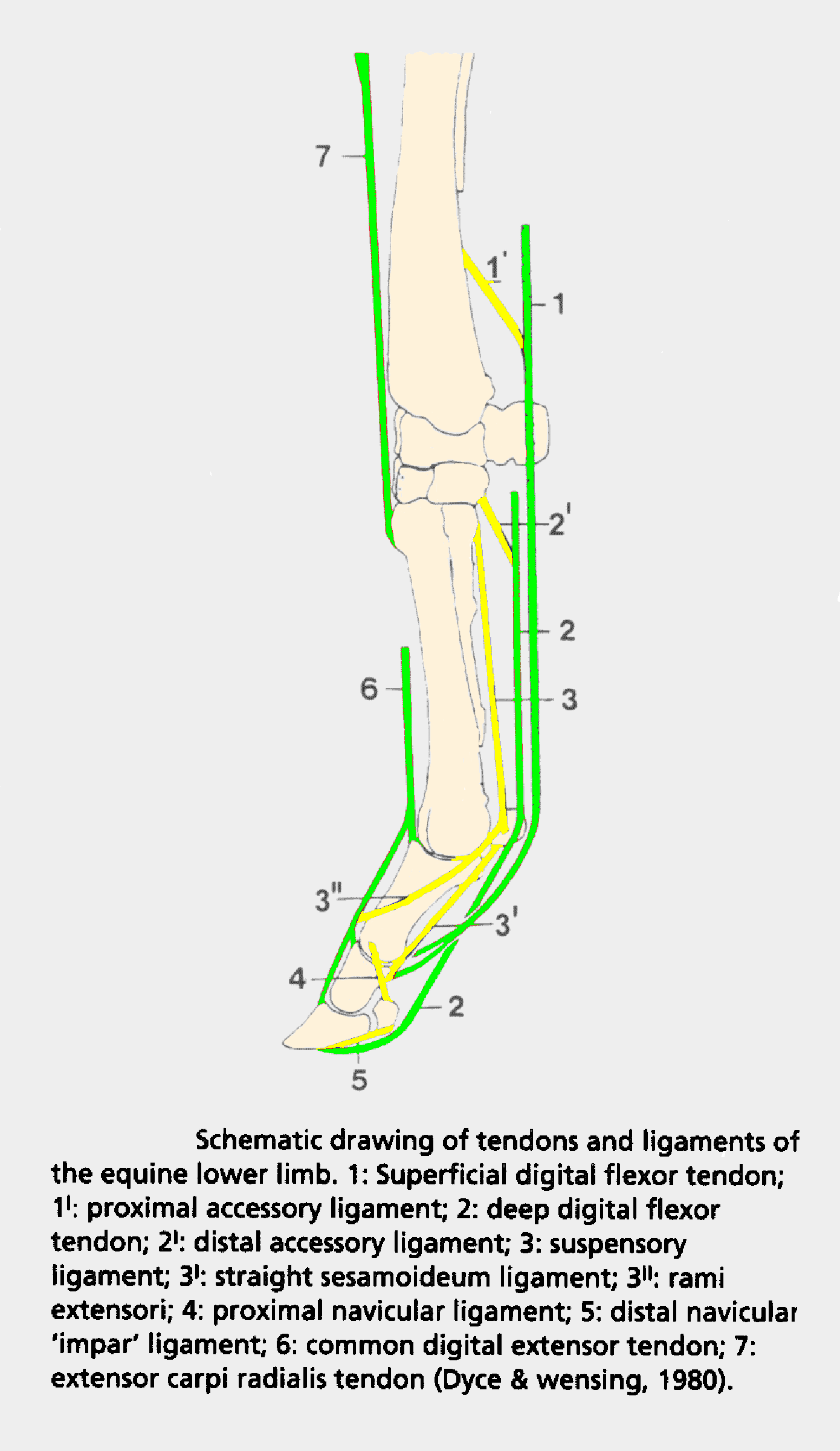
Diagram of major tendons & ligaments of the lower limb
– from Equine Locomotion, by Willem Back & Hilary Clayton. I added the color.

As you’ll note in the diagram above, the common digital extensor tendon (6) and the deep digital flexor tendon (2) both have insertions (attachments) on the coffin bone – the most distant (distal) bone in the horse’s limb that resides inside the hoof capsule. Like humans, the horse’s foot is stabilized by these tendons as well as ligaments, and, shortly after leaving the ground, its orientation to the rest of the limb immediately above it (long & short pasterns) remains essentially constant throughout most of the flight arc. And like us, horses don’t typically think about where to place the next foot when they walk. So although the tendons stabilize the position of the foot, the attached muscles do not actively pull or relax to reorient it as it prepares to land. In fact, James Rooney’s Biomechanics of Lameness in Horses, which I’ve referenced a number of times before, describes Dr. Rooney’s somewhat counter-intuitive discovery that transecting the extensor and deep flexor tendons in the vicinity of the short pastern really had no significant effect on the orientation of the hoof as it landed. He concluded, therefore, that (like humans) foot placement in “normal” walking is not an active effort. Keep in mind, by the way, that we’re talking only about A/P orientation in the horse; the M/L orientation, as we saw in Part 1, is dictated by the construction of the joint surfaces themselves.

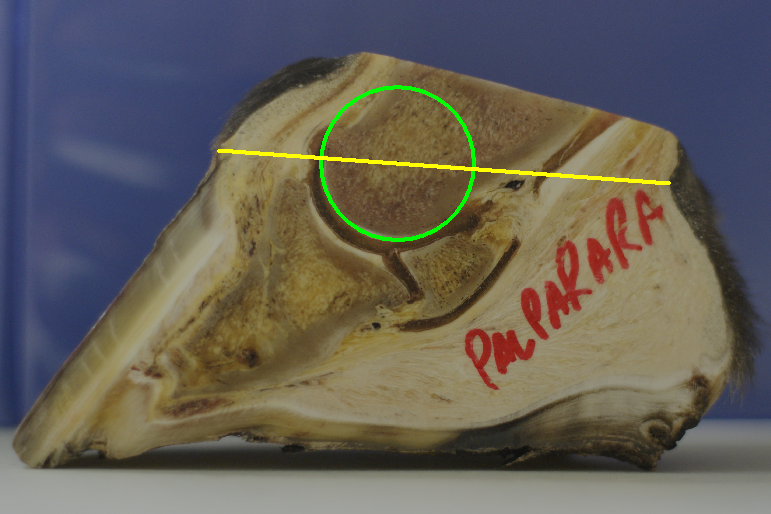
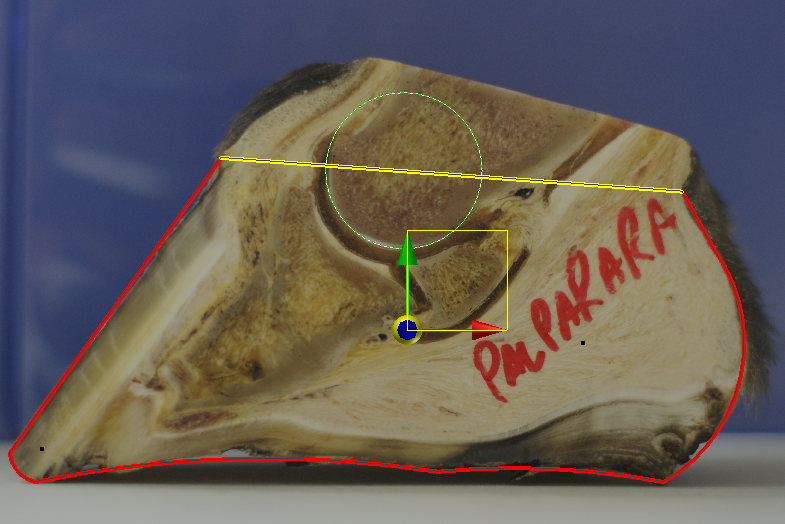
Dr. Rooney’s comments inspired to me look at the center of coffin joint rotation and the center of gravity of a properly-trimmed bare foot, which is fairly easy to do with my CAD system by importing an image of a sagittally-cut foot, visually noting the center of joint rotation, and tracing the foot’s outline so the software can then compute the center of gravity. Check out the images below of one of Brian Hampson’s feral horse feet from Australia/New Zealand. And as an interesting  aside,  also note the bone remodeling evident at the tip of the coffin bone –

Center of coffin joint rotation on a feral foot
The center of coffin joint rotation (the circle’s center) lies on a line indicating the top of the foot
Center of gravity of the foot
After outlining the foot, the software calculates the foot’s center of gravity, which lies directly below the center of joint rotation

The interesting thing about this observation is that it was consistent for all of the feet I looked at in cross-section, regardless of their toe angle. What this means is that the hoof balanced for a proper (flat) landing is quite literally “hung in balance” on the end of the limb! Thus, Dr. Rooney’s experience with the severed tendons makes sense; because the mass of a properly-trimmed bare foot is, by design, evenly distributed in the A/P direction, the tendons are only providing a stabilizing (damping) force rather than actively controlling pastern/foot alignment. This is similar in function to the shock absorbers on an automobile; they don’t determine the position of the car body, but they help the body more quickly return to a neutral position after being displaced.

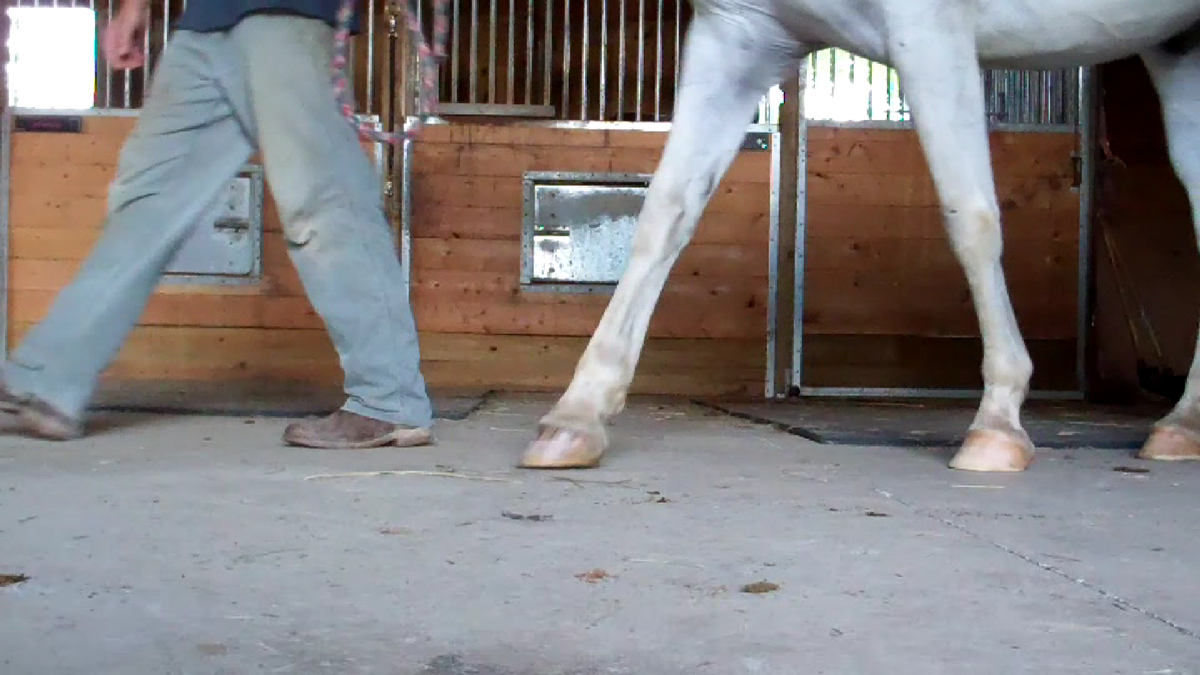
The point I’m trying to make is that the horse isn’t consciously “aiming” his foot so it hits the ground a particular way based on what’s happening with the bottom of his hoof. Instead, the orientation of the bones of his foot and leg are the consequence of masses, muscle tensions, and joint construction – all under the influence of gravity and other external forces (we’ll get there in a moment!). As designed, the hoof itself is bare, quite short, and (as we saw above) the mass distribution of the foot overall is quite even; therefore, it’s able to quickly accelerate and decelerate to a position of proper alignment with respect to the limb above it, aided by the “neutral” tensions in the tendons/muscles, as it travels through the flight arc. So given a properly-trimmed bare hoof, the net result is that the internal and external structures of the foot will be in proper alignment as the hoof prepares to contact the ground. Check out the following photo, taken from a video of a client, in which the hoof position has been captured as close to the ground as possible just before making contact –

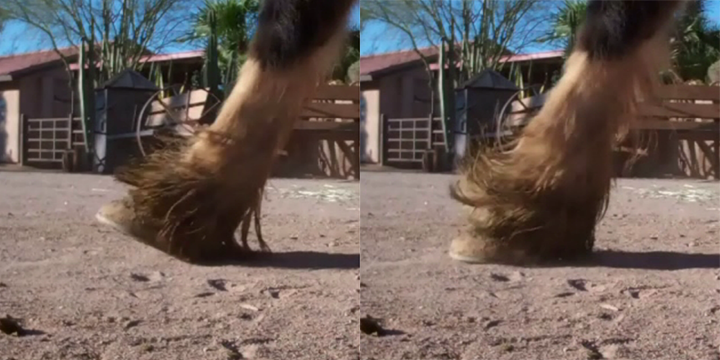
Properly-trimmed hoof about to make contact

Note, however, that I’ve been using the phrase “properly-trimmed bare hoof.” Within some particular range of variation from “proper,” the internal structures of the foot will still be in the correct orientation with respect to the leg and the ground, but the external structures will not be. You have only to look at the preceding photo to understand that if some part of the hoof is left long with respect to the other parts, the longer part will end up striking the ground first. So a long toe will yield a toe-first landing, and long heels will produce a heel-first landing. As you’ll learn in later articles when I discuss the origins of navicular disease, this is an extremely problematic situation because, by design, the coffin joint is not intended to be rotating at the instant of contact! But if a horse is contacting the ground any way other than flat, the coffin joint will, necessarily, be rotating when the hoof “slaps” the ground as the leg comes under load.

But the situation gets worse. Once the hoof exceeds this range of variation from “proper” (and I don’t pretend to know precisely what those limits are), the internal foot/limb orientation, and therefore the internal and external foot/ground orientation, will be further mitigated by three factors, particularly at the beginning and end of the flight arc. These are: 1) hoof length, 2) hoof weight (mass), and 3) hoof weight (mass) distribution.

Remember Newton’s First Law of Motion?

Every object in a state of uniform motion tends to remain in that state of motion unless an external force is applied to it.

Because the coffin joint is fairly flexible, departures from this “intended design” of a short, properly-balanced bare hoof can have a significant effect on the motion of that joint during the flight arc, with profound consequences on the form of the landing. Probably nearly every horse owner has handled a horseshoe before, but relatively few have held a cadaver horse foot; I can assure you that most steel shoes are a significant percentage of the weight of a foot! And as we add weight to the end of the limb in the form of excess untrimmed growth and/or (more significantly) a shoe, we start changing the dynamics of the flight arc. In essence, the lower limb of the horse begins to act more and more like a double pendulum – the long & short pasterns forming one pendulum suspended from the fetlock joint, and the foot with whatever extra weight has been left or added suspended from the coffin joint. The resulting motion, and the mathematics describing it, can be quite complicated, but we can make some general statements about the effects of length, mass, and mass distribution:

  • As the length of the hoof increases, the time it takes to accelerate from the ground or decelerate for a landing increases. This is because the timing (period) of a pendulum is a function of its length; the longer the pendulum, the longer the period.
  • As the mass of the hoof increases, the time it takes to accelerate from the ground or decelerate for a landing increases. This is a consequence of both the center of mass shifting away from the coffin joint, effectively lengthening the pendulum and therefore the period; and the increase in the rotational force (moment of inertia) on the coffin joint, to which the period is also proportional.
  • As the mass distribution of the hoof moves away from being symmetrical, there will be increased unilateral A/P torsion forces on the joints, affecting both the effective length of the pendulum and the center of mass.

What does all that mean in practical terms? It means a foot designed to contact the ground in a particular orientation with respect to the limb above it may not be able to do so because whatever has been done (or not done) in the trimming/shoeing process has altered its dynamics. This is why a shod horse with obviously-long heels can have a reasonably-flat, or even toe-first, landing. The shoe, whose weight distribution has shifted the foot’s center of gravity toward the toe, is modifying the flight arc such that it’s keeping the toe from rotating properly right before contact. But when you remove the shoe, the horse immediately starts contacting the ground heel-first! Similarly, horses with any type of bar shoe, where the weight of the shoe is much more A/P symmetrical or even back-heavy (depending on the specific design – think about wedges!) tend to really come down heel-first, because the weight of the shoe is keeping the heel down plus the horse’s heels are already too long. And the added weight also increases stresses on joints and soft tissues, because that extra weight must be accelerated and decelerated with every step.

So we’ve now added yet another variable to the “landing picture.” Not only do horses not walk like humans, and not only can we not reliably observe landings at normal speed, but the landings we do observe can be a far cry from “proper” because of how the aforementioned factors can modify pastern/hoof alignment. But the problem is this: as Dr. Deb Bennett says, “What people come to see every day, they naturally come to consider ‘normal’…But what a culture or a nation comes to expect is usually common instead of normal.”

Please don’t fall into the trap of thinking that just because you observe a lot of heel-first landings, they’re supposed to land that way. Those landings are merely common, they’re not biologically normal! That’s simply not the way the equine limb is designed, and we’ll continue to provide further evidence to support this claim in the near future.

More to come…

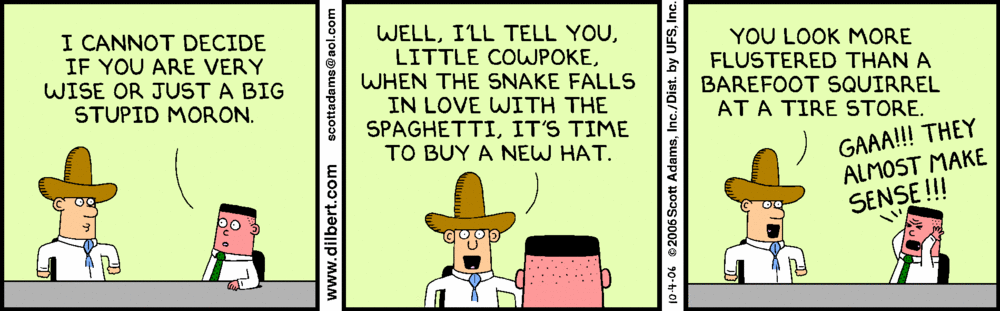
Dilbert cartoon about an "expert"

I hope Mr. Adams doesn’t mind me sharing “Dilbert” with you, but recent events prompted a return to the topic of experts in the horse world, and these particular cartoons seemed especially appropriate! I’ve commented about this problem before in my article entitled The “Expert Syndrome”, and decided to revisit it after a couple of experiences last week.

First, I was visiting the facilities of a trainer whom I’d never met before, and was listening to her talk with one of her clients. They were discussing how and why horses react in various situations when the trainer said, “Now, unlike human beings, the horse’s adrenal gland doesn’t work unless their head is up. Otherwise, it doesn’t secrete anything.”

Wow – that one really threw me! I’d never heard of “position-dependent gland secretion” before, and it seemed highly unlikely. But I am well aware that I am neither a biologist nor an endocrinologist, so I didn’t want to rule out the (seemingly-very-remote) possibility that the trainer was correct. So I called my friend Dr. Bruce Nock, who’s a professor of neurobiology in the psychiatry department of Washington University’s School of Medicine, where he conducts research on stress – the effects of which are intimately connected with the operation of the adrenal gland (Bruce also happens to run our Liberated Horsemanship training programs). And (after he finished laughing,) Bruce confirmed that the whole notion of the horse’s adrenal gland only working when his head is up is, indeed, complete nonsense!

On the surface, though, you can see how someone could relatively easily buy into that story because it sounds somewhat plausible based on our experiences with horses: they appear calm when their head is down, and excitable only when their head is up. But the perpetrator of this myth would seem to be confusing causation and correlation. Just because we typically experience events as occurring together does not mean that one causes the other to occur. And this episode ended up jogging my memory about a similar story from nearly 20 years ago…

Back when I was a relatively new horse owner, I was riding my rather-excitable horse in the indoor arena when another rider remarked that horses spook because they perceive objects as being “larger than they actually are,” which tends to frighten them. “For example,” she stated, “when a horse sees a dog, it looks to him to be the size of a pony!”

Frankly, I didn’t even know how to respond to that because it defied not only the most basic principles of optics, but of logic as well! And yet the woman said she’d recently read it in one of the more popular horse magazines. Back in those days, I was inclined to believe she’d simply misunderstood something the author had written, because I couldn’t imagine anyone with even a modicum of common sense writing anything so preposterous. But the next day, the woman brought me the feature article, written by a veterinarian, which “explained” how horses’ vision works and how they perceive the world. It certainly affected my vision – it was an eye-opening example of what I’ve come to recognize as a very real problem in the horse world.

Given the circumstances, I could hardly fault that horseperson for her confusion. Granted, she should have questioned such a patently absurd claim. But how can I blame her for repeating what she’d read in a leading publication that should have had procedures and policies in place to prevent this sort of thing? She had every right to expect accuracy in what she read. Yet, here was an article with not just a relatively minor and understandable mistake: a misplaced decimal point or an incorrectly-labeled drawing. This was an entire feature article whose fundamental premise was dreadfully flawed, written by some presumably well-intentioned person who should’ve stuck to writing about what she knew, instead of presenting illogical speculation as fact at the readers’ expense.

Dilbert cartoon about an "expert"

My point is this: real experts aren’t born; they’re created. They’ve had extensive education(formal and informal) and experience, and can always back up their claims with facts about their education, experience, and the subject matter under discussion. They never rely on the following three “credentials” or their variations as evidence of their expertise, as is all too common in the horse world:

  1. I love horses
  2. I’ve been doing this for many years
  3. I’m an expert in this subject, so I must be an expert in that subject

We all have an obligation to not just accept everything at face value, and, especially, to not pass it along without questioning its origins and accuracy. A few days ago, I noticed a Facebook post by my wonderful friend Jessica imploring people to stop sharing information about a particular group of horses because the situation had been resolved and the information was no longer correct. I admire and respect her for that, and wish more horsepeople took that initiative! And while that situation as well as the ones I’ve been sharing are probably relatively harmless in the grand scheme of things, other types of misinformation can lead to much more serious consequences, and not challenging it can very possibly put the safety and welfare of not only yourself and your horse, but of others and their horses, at risk. I’ll close with a much more serious and extreme example to really demonstrate this point…

I once spent a day helping a farrier fine-tune his trimming skills. This gentleman had been a shoer for quite some time, and had an impressive collection of leg and foot bones he carried around with him. As he was showing me his collection, he pulled out a pair of coffin bones with well-defined, nearly horizontal, grooves on their front faces. I’d never seen anything like that before, and asked him where the grooves had come from. He explained that a client had had a horse that foundered – extreme laminitis where the coffin bone has moved out of position – and a friend of the client told him that his horse’s pain was caused by “pressure building up inside the hoof.” So the client promptly pulled out his electric reciprocating saw, and sawed through the front of the horse’s hooves.

I absolutely cringe when I think about the pain that horse had to have experienced; already in the midst of the most painful condition a horse can endure, and someone decided it made sense to saw into his feet all the way into the bones! I can only hope they ended his life quickly and humanely.

What we choose to believe, and what we choose to share, matters, because actions nearly always have consequences, and lives may quite literally rest in your hands.

Please choose wisely…

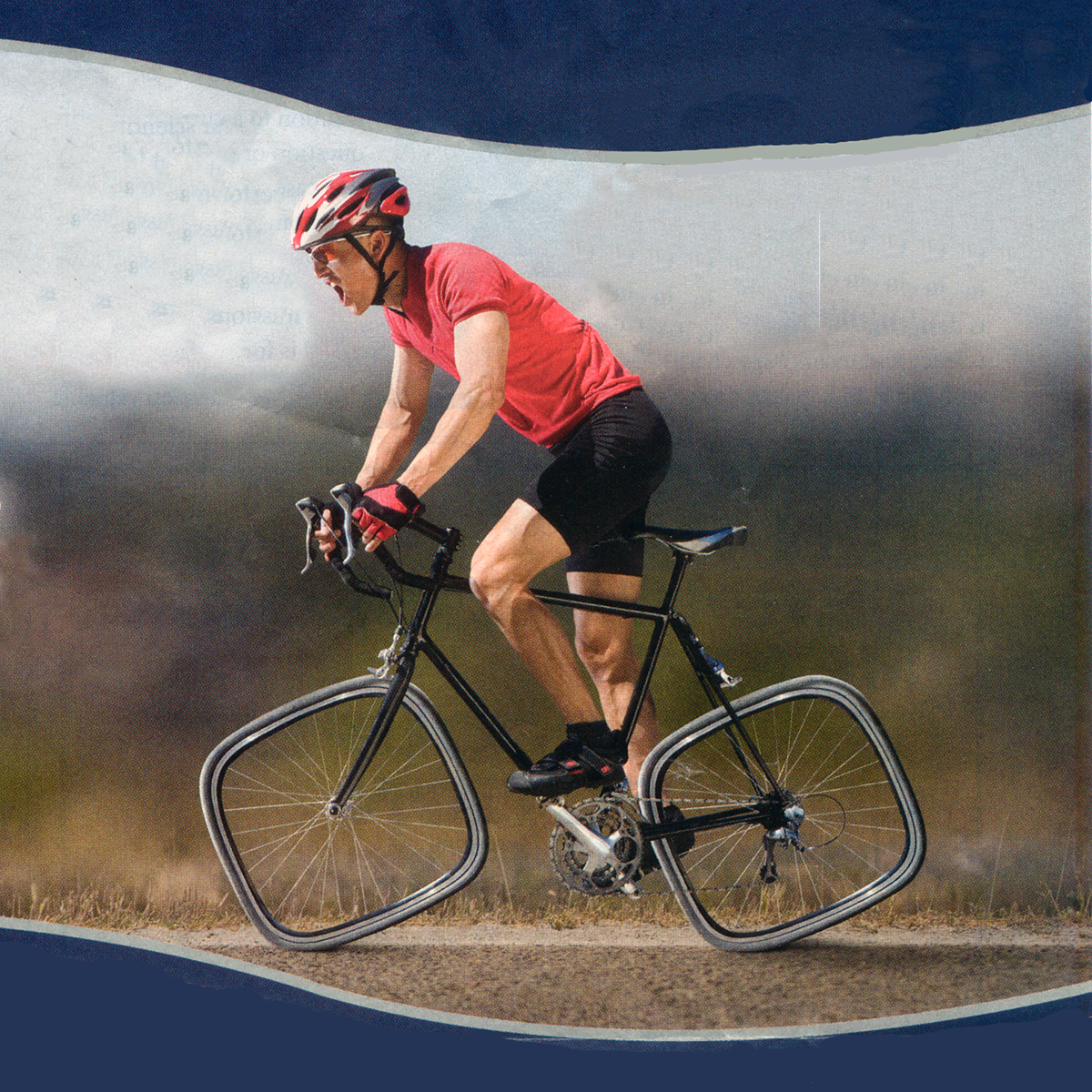
Photo of a Square-Wheeled Bike
– advertisement from Central Semiconductor

Yes, I know it’s been far too long since I’ve posted an article, but life seems to have a way of interfering with my writing! The good news is that I now have  several articles well under way, and so will try hard to keep the gaps shorter.

I had to laugh when I saw the above image as part of an advertisement in one of my technical magazines a couple of months ago, because it seemed as if they knew I was going to be writing this article on heel-first landings and wanted to help illustrate the problem with an easily-understood picture! But that statement will probably make more sense later on…

I want to be absolutely clear right from the start: this notion that horses are “supposed” to land heel-first is, without a doubt, one of the most widely-propagated and dangerous misunderstandings currently in vogue in the horse world. I had intended to start posting my series of articles on navicular disease, but since navicular disease and landings are so closely connected, and because I decided I simply couldn’t bear to listen to one more horse owner or hoof care provider tell me that horses should land heel-first, I decided my priority had to be to weigh in on this very important subject now. In fact, this article could just as correctly be called “Navicular Disease – Part 0.” So although I’ve briefly mentioned in the past that a properly-trimmed horse will land flat at the walk (see, for example, Hoof Angles – Part 4), I haven’t yet discussed the logic behind that assertion at length. By doing so here, I hope to save a lot of horses from a lot of problems on down the road.

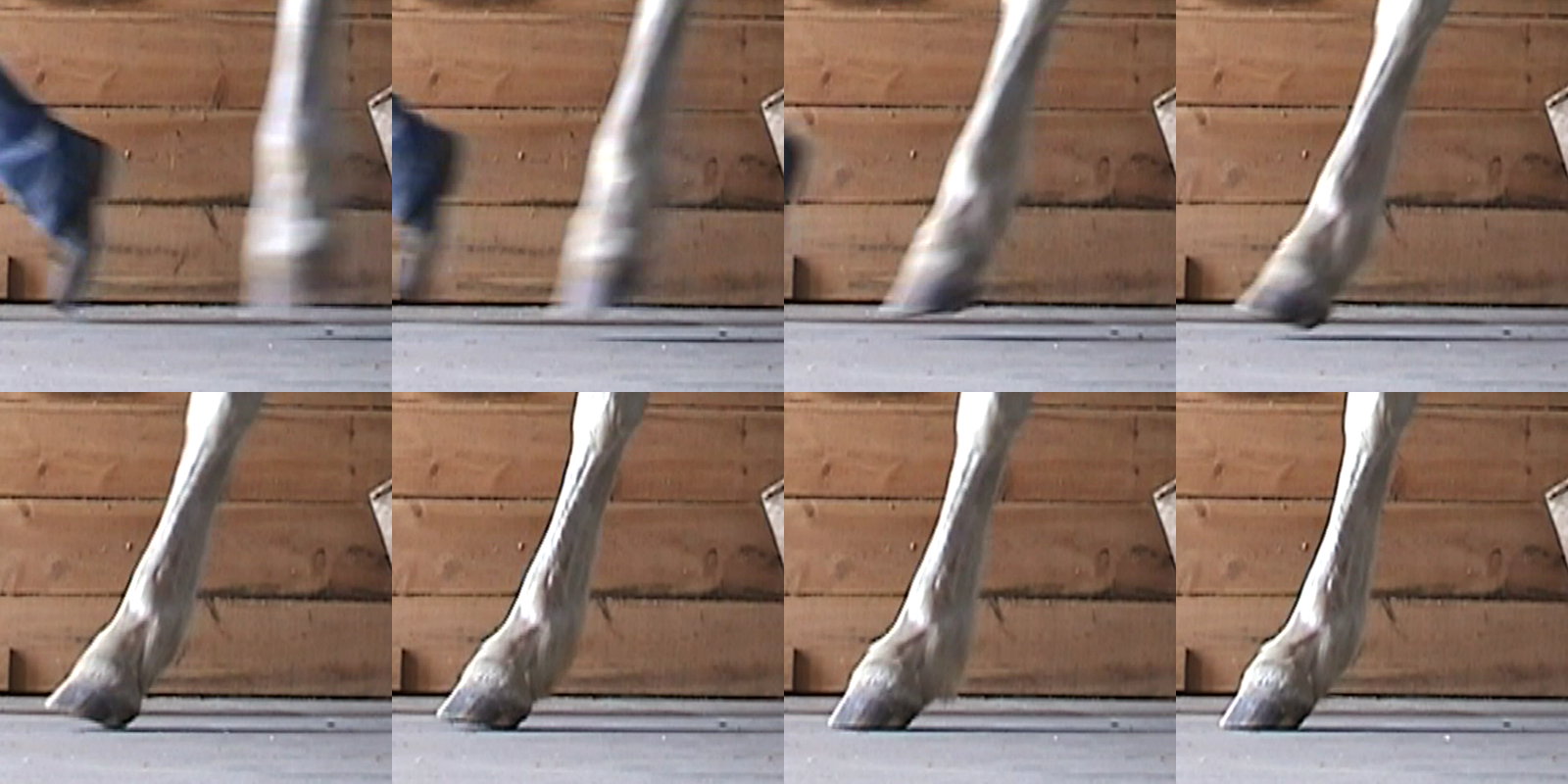
photo sequence of a heel-first landing on a bare hoof
A heel-first landing on an improperly-trimmed bare hoof

To be fair, I also need to tell you that I, too, used to believe horses should land heel-first because years earlier I’d read a passing statement in renowned equine pathologist Dr. James Rooney’s book Biomechanics of Lameness in Horses in which he said that horses land flat to slightly heel-first (emphasis added). He did not, however, mention the conditions, such as gait or speed, under which he believed this to be the case, nor did he state whether or not this was a theory based on physiology, or merely an observation of horses he’d encountered. Interestingly, later parts of the same book strongly contradict the heel-first part of his statement, which he then supports with both theory and observation, and his most recent writings on the subject clearly state that the horse should land flat at the walk. In his webpage discussion of feral hoof form entitled “The Shape of the Equine Hoof,” for example, he says:

At the slow walk, the hoof usually contacts the surface over the whole bearing edge of the hoof wall; that is, the foot impacts flat-footed.

Unfortunately, this fallacy about heel-first landings still persists, largely (I believe) because one particular barefoot clinician has stated it many times in his clinics, and because humans tend to land heel-first. But long before I’d read Dr. Rooney’s most recent work, or even his earlier work more carefully, I’d already come to the conclusion that common sense tells us a properly-trimmed horse – whether by nature or by human – must land flat at the walk. In talking to many people over a number of years about this subject, I’ve found that non-horse people, especially technical types, tend to immediately understand why, while many horse people seem to struggle with it. But I’ll do my best to make it clear!

photos of a proper landing on a properly-trimmed bare hoof
A proper landing on a properly-trimmed bare hoof

In this installment, we’ll take a look at two things we need to understand before really discussing the landing problem at length: first, the differences between biped and quadruped limb construction and movement, and second, the issues surrounding how humans perceive landings.

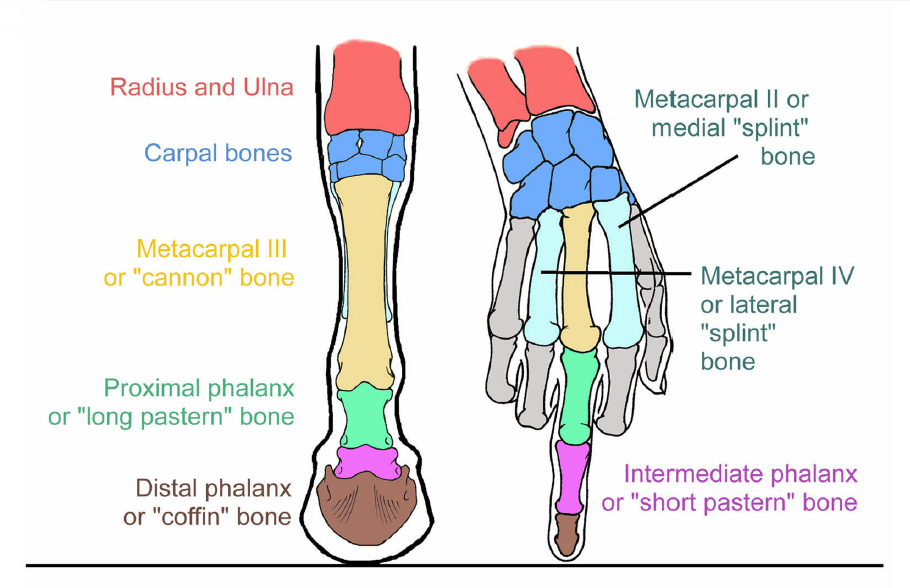
As you’ll see in this image from Dr. Deb Bennett’s Principles of Equine Orthopedics Part 1 comparing the equine and human forelimb, they’re very different in both structure and function –

Comparison of the horse and human forelimbs

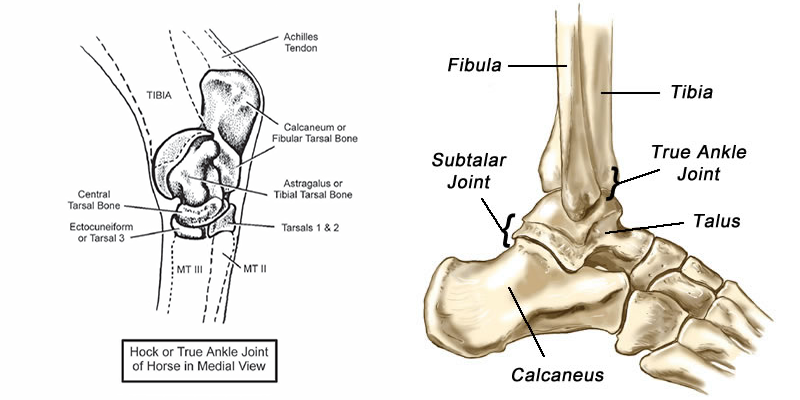
So in the forelimb, what we generally refer to as the horse’s “knee” is in fact his wrist, or carpus. The horse actually walks on a hoof attached to what would be the last joint of our middle finger. In the rear limb, the horse’s ankle is the hock joint, and not the fetlock as may seem intuitive. The image below shows their comparative anatomy; the hock image is from Principles of Equine Orthopedics Part 1, and the ankle image is from www.kidport.com –

Horse & Human Ankle Joints

As we consider differences in the way we move, it’s important to note the consequences of these anatomical distinctions. The human ankle consists of an inverted cup of bone perched on top of a ball, stabilized by ligaments. It’s quite compliant by design, and although it flexes fairly readily in both the front-to-back (A-P) and side-to-side (M-L) directions, it’s less stiff and has a far greater range of motion in the A-P direction. In contrast, the forelimb diagram above shows the lowest joint in the equine limb to consist of much broader surfaces designed to articulate only in the A-P direction. With good reason, I might add; if you’ve ever rolled your foot to the inside in a misstep, you can imagine the “train wreck” that would occur if a horse were able to do that at 40 MPH! That complete lack of lateral flexibility, incidentally, is also the reason so-called “corrective” trimming & shoeing is such a long-term disaster, as I pointed out in What Makes it “Natural Hoof Care?”.

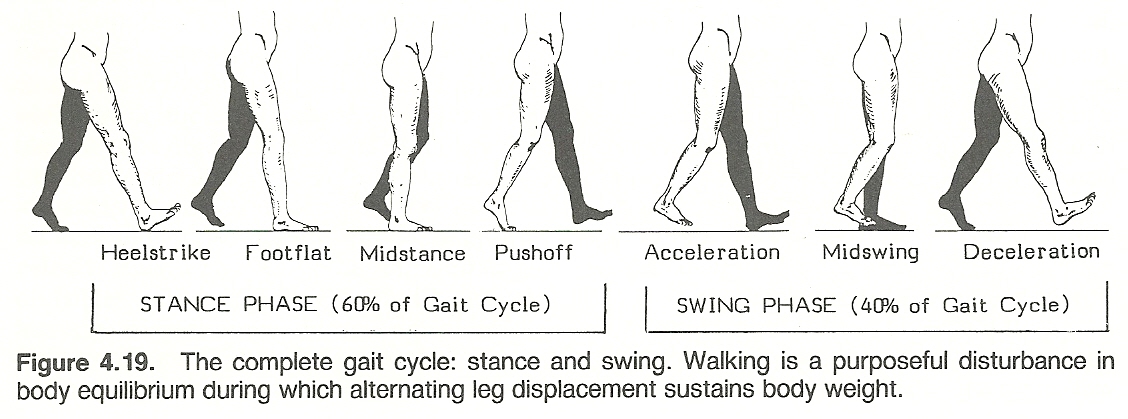
The following image from R. C. Schafer’s book entitled Clinical Biomechanics: Musculoskeletal Actions and Reactions (2nd ed.) is very helpful in understanding biped locomotion. Pay particular attention to where the torso is with respect to the leading and supporting limbs –

Diagram of the human gait cycle

And here’s what the author has to say about the mechanics of walking:

Biomechanically, walking can be considered as a series of continuous losses and recoveries of balance in which the rhythmic play of muscles narrowly averts toppling. Steindler refers to the basic sequence of movements in walking as a “series of catastrophes narrowly averted.”

In other words, walking in a particular direction involves shifting your center of mass in the direction you wish to go, and then “catching yourself” with the leading leg as your mass comes over that leg. In essence, you fall forward to move forward. And if your foot is in a neutral position – basically perpendicular to the axis of your leg – it strikes the ground more and more heel-first as your stride length increases.

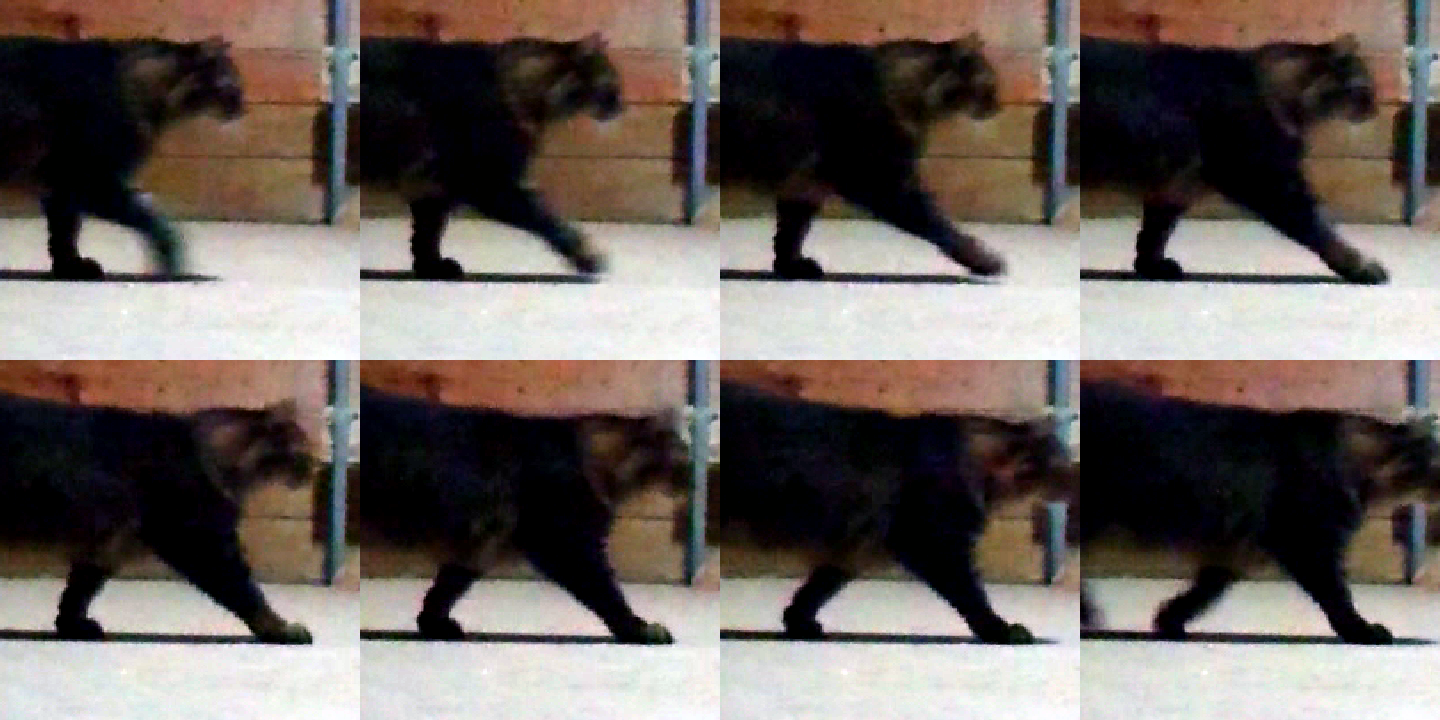
The quadruped, on the other hand, doesn’t walk like that because their center of mass is never ahead of the leading limb while it’s loaded. The cat in the following (bad!) photos walked through my video setup while I was recording a horse. As you can clearly see, he’s stable on 3 legs and his center of mass is behind the leading leg. Like your horse, he doesn’t have to “fall” onto the leading leg like you and I must do to move forward. You’ll also note he’s definitely not landing heel-first, and I didn’t even have to trim him! –

photo sequence of a cat landing properly
Someone forgot to tell this cat he’s supposed to be landing heel-first…

The other part of this background information has to do with how humans perceive things. Back in 2008 when I began to seriously question this notion of a heel-first landing being “correct,” I became convinced that humans probably aren’t able to see differences in timing between heel contact and toe contact. So I wrote to a number of researchers in the field of visual perception, and posed the following question (since I couldn’t assume they knew anything about horses!):

An observer watches (but does not hear) someone slap both hands down on a tabletop in a brightly-lit kitchen. At what interval between slaps will the hands striking the tabletop appear to be a simultaneity?

The responses I received were all nearly identical, but Dr. Ken Norwich, Professor Emeritus at the University of Toronto’s Institute of Biomedical Engineering provided the following answer with some qualifiers:

How bright is the light used to make the observation? The interval you seek will depend on the illumination. What is the background to the images of the hands? Let us assume that it is a black background, but contrast will also affect the measured interval. Probably the interval is very close to the reciprocal of the flicker fusion frequency i.e. the frequency of flicker where an observer sees a steady image rather than a flickering light. This frequency is about 55 seconds (-1), so the interval you are looking for is at least as great as 0.02 seconds, or 1/50th of a second, and that is for a very bright image.

So in brightly-lit conditions against a high-contrast background, the limit of a human’s perception is in the neighborhood of 20 milliseconds. Any timing difference between heel and toe contact shorter than that will be seen as a flat landing. And just how many barns have you been in where you find “brightly-lit conditions against a high-contrast background?” Darned few, if any, in my experience!

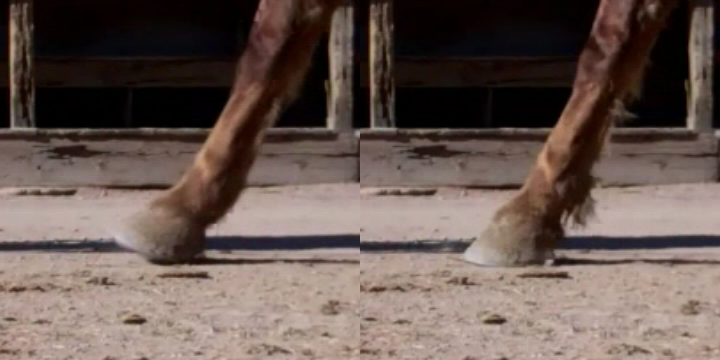
To help put things into more meaningful terms, observe the first set of hoof images in this post. This heel-first landing, from heel contact to toe contact, was quite obvious to me at normal speed, and measures approximately 80 milliseconds.

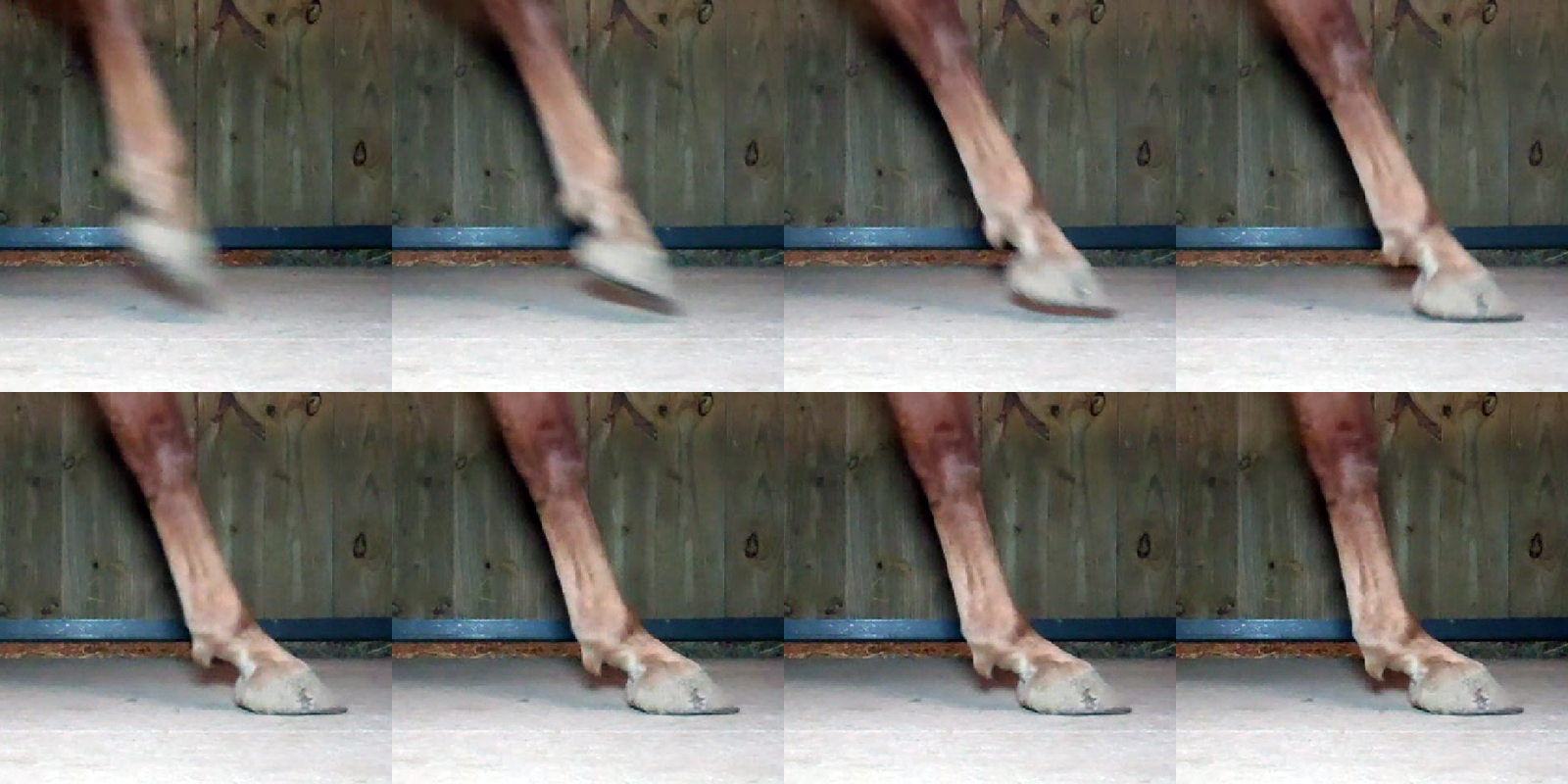
And now take a look at the following two landings –

Horse Bad Landing

Draft Bad Landing

In both of these cases, the heel-first landing wasn’t particularly apparent at normal speed, and only became obvious when I slowed down the video. Although the background isn’t very high-contrast, the lighting was reasonably bright. They both also measure approximately 20 milliseconds from heel down to toe down. In fact, of the 6 heel-first landings I happen to have slow-motion video of as I write this, the average heel-to-toe contact time was only 32 milliseconds – alarmingly close to the limits of human perception under ideal laboratory conditions.

Therein lies the rub: if you can see an obvious heel-first landing, the landing must be very heel-first in order for you to perceive it as such! And soon I’ll explain why that’s a serious problem for your horse.

So those are the first two hurdles to overcome in this discussion of landings in horses: regardless of what you may observe about human movement, you cannot apply it to equine movement because horses and humans are fundamentally different; and, the timing of a heel-first landing strains the limits of human perception, so you can’t be absolutely certain of anything without using additional tools such as slow-motion video.

More soon…