Tower of Babel
– with apologies to Athanasius Kircher for modifying his drawing

This isn’t even remotely what I expected to be writing about right now. In authoring my recent series on heel-first landings, I assumed that everyone likely to read them was familiar with the definitions of the various types of landings – probably because what the different landing types are called are, in themselves, accurate descriptions of what happens when the hoof contacts the ground. That seemed like a completely logical assumption, since in my 20+ years of discussing this subject with all types of hoof care providers, horse owners, veterinarians, and students, I’d never encountered a single person who didn’t understand these distinctions.

Until now. For the past several days, I’ve been carrying on an interesting and lively exchange with some hoof care providers on Facebook over what constitutes a “good” landing for a horse, with them insisting that a heel-first contact is healthy and normal. If you’re reading this, you probably already know that I steadfastly believe this to be not only incorrect, but damaging as well. Consequently, we’ve been going round and round, making absolutely no progress at all, until trimmer Dora Libby pointed out that the landings they’ve been observing in a number of videos on YouTube are improperly labeled as showing heel-first landings when they’re very clearly flat landings. So it’s now evident we’ve really been disagreeing over semantics rather than biomechanics!

Yes, this is a big deal. Proper landings are not only a major topic of controversy in the hoof care and horse worlds, but are also very important for the long-term comfort and soundness of your horse, as you’ll see in the upcoming series on navicular disease. So if much of the apparent disagreement “out there” is really a matter of definitions, the first order of business must be to get that straightened out.

The definitions I’ve always used and taught are the same ones Dr. Rooney used in Biomechanics of Lameness in Horses. They’re easy to understand because, as I’ve previously stated, the landing type also describes what happens as the foot contacts the ground. In the front-to-back (A/P) direction, there are three possible ways a hoof can make contact: toe-first, heel-first, and flat.

In a toe-first landing, initial ground contact is with the bottom leading edge (“toe”) of the hoof, followed by a rapid front-to-back rotation of the coffin joint as the foot comes under load, until the heel buttresses (“heels”) contact the ground. Note, by the way, that Jaime Jackson points out in The Natural Horse that toe contact can occur in several different areas of the toe, including a single region directly at the toe, or two regions located symmetrically or asymmetrically about the toe. In my experience, toe-first landings are the least common type, which is fortunate because they’re also the most potentially destructive.

In a heel-first landing, initial ground contact occurs in the opposite order: the rear-most bottom part of the hoof – the heel buttresses – contact the ground first, followed by a rapid back-to-front rotation of the coffin joint as the foot comes under load, until the toe contacts the ground. This is far and away the most common type of landing I see, and trimming or shoeing to accomplish it is the stated objective of many hoof care professionals, veterinarians, and horse owners. But this is also a destructive type of landing, as my upcoming articles on navicular disease will explain.

In a flat landing, the toe region and the heel buttresses contact the ground simultaneously, with no rotation of the coffin joint following ground contact. Note that as pointed out in The Myth of the Heel-First Landing – Part 3, the heels of horses who live on softer terrain will actually penetrate the terrain on ground contact and therefore have no coffin joint rotation as the foot comes under load. This is effectively a flat landing under those conditions, but be aware that the same horse will exhibit a distinct heel-first landing on harder terrain.
Play Image

To help make the differences more obvious, I’ve produced the YouTube video above showing clear examples, in slow motion, of each type of landing, along with a bit of commentary. Please share it with other hoof care providers and horse owners so we’re at least on the same page when it comes to discussing this very important topic!
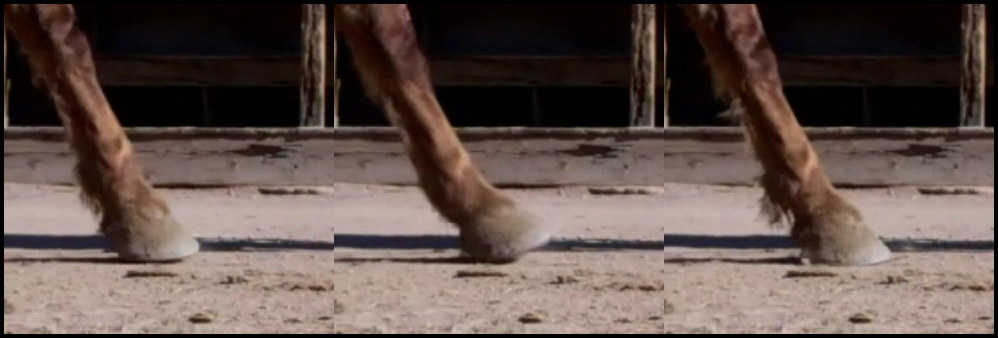
A pronounced heel-first landing in slow motion

Hopefully, Part 1 and Part 2 of this series have laid sufficient groundwork (no pun intended!) for you to now be ready to hear why the feral horse lands flat-footed at the walk. Let’s briefly summarize what we’ve covered so far:

  • As a quadruped, the horse’s anatomy and way of going differs from the bipedal human, and therefore his movement cannot be compared to the movement of the human
  • The human is incapable of seeing small but significant differences in how a horse lands without the aid of slow-motion video
  • Barring injury or other mitigating circumstances, the horse does not actively position his foot for landing
  • The mass of the healthy, properly-trimmed equine foot is fairly evenly distributed front-to-back about the center of coffin joint rotation
  • Any longer part of the hoof wall relative to the rest of the hoof wall will strike the ground first
  • The addition of length or mass can significantly affect the flight arc of the hoof, and, therefore, the way the hoof impacts the ground

And now we need to talk about the effects of movement and terrain on the hoof.

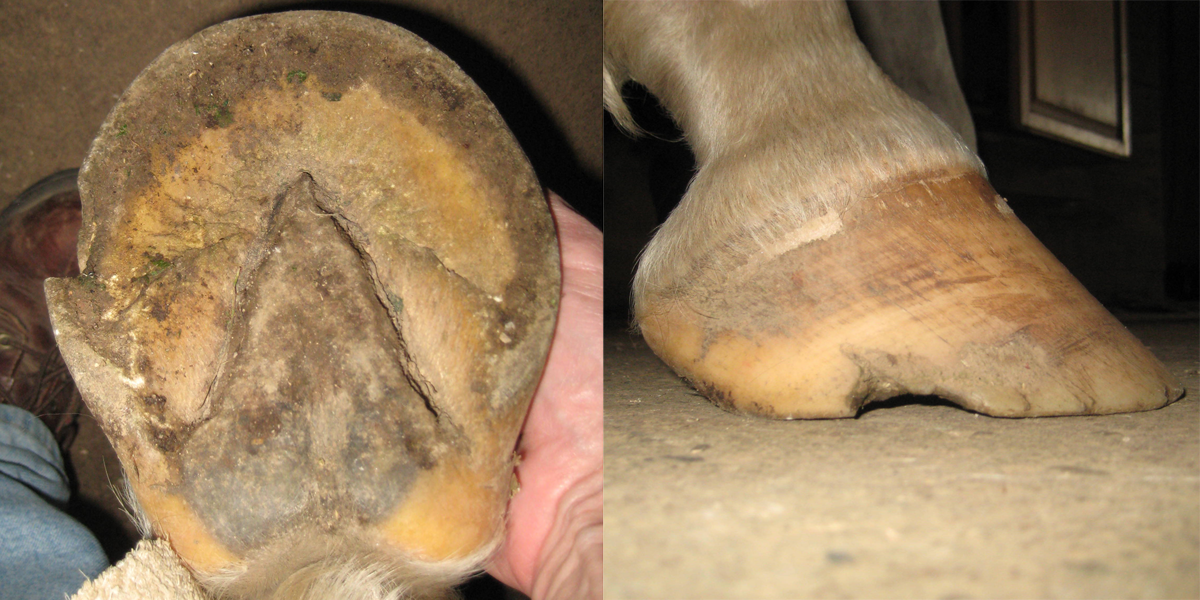
One of the things you may have noticed about your horse, whether he’s shod or barefoot, is that the harder and rougher the terrain he’s used on, the more rapidly his shoes or hooves wear. That’s only logical, since even the steel of a horseshoe is not as hard as many of the minerals present in soil. And given that the typical feral horse travels an average of just under 12 miles per day, it’s no wonder that the constant abrasion results in obvious signs of wear. So if we look at the foot of a feral mustang from a very arid and abrasive environment like the U.S. Great Basin, we see evidence of considerable wear –

A U.S. Great Basin feral Mustang hoof

Note the pronounced rounding of the wall (“mustang roll”) where it contacts the ground, the arch of the foot in the quarters, the blending of the bars and sole into a smooth, polished-looking surface, and the leather-like appearance of the frog. The entire hoof is very short, with the heels worn back to the widest part of the frog.

In contrast, look at the same features on this domestic Ohio horse, whose typical day consists of about half his time in a fairly wet, grass-filled pasture and the other half in a stall, about 6 weeks after his last trim –

A domestic American Quarter Horse hoof

As you’ll note, the wall shows little evidence of wear, with a fairly sharp edge. The arch in the quarters is only evident to the extent that the horse has started to break off excess length in that area in the form of a large chip. The bars are quite a bit higher than the contour of the sole, and the presence of tiny cracks along with the lack of a smooth, shiny appearance suggest that old sole growth has not yet been worn away. The frog has a somewhat “swollen” appearance, and the heels are disproportionately long and therefore well forward of the back of the foot.

These two hooves are rather typical examples at the near-extremes of a continuum of wear, with the consequences of lots of movement over arid, abrasive terrain at one end, and relatively little movement over soft, wet terrain at the other. Keep in mind that the difference in movement between typical feral and domestic horses is tremendous; the domestic horse would have to do 24 laps per day around the perimeter of a 10-acre pasture to equal the distance traveled by a feral horse in the same amount of time!

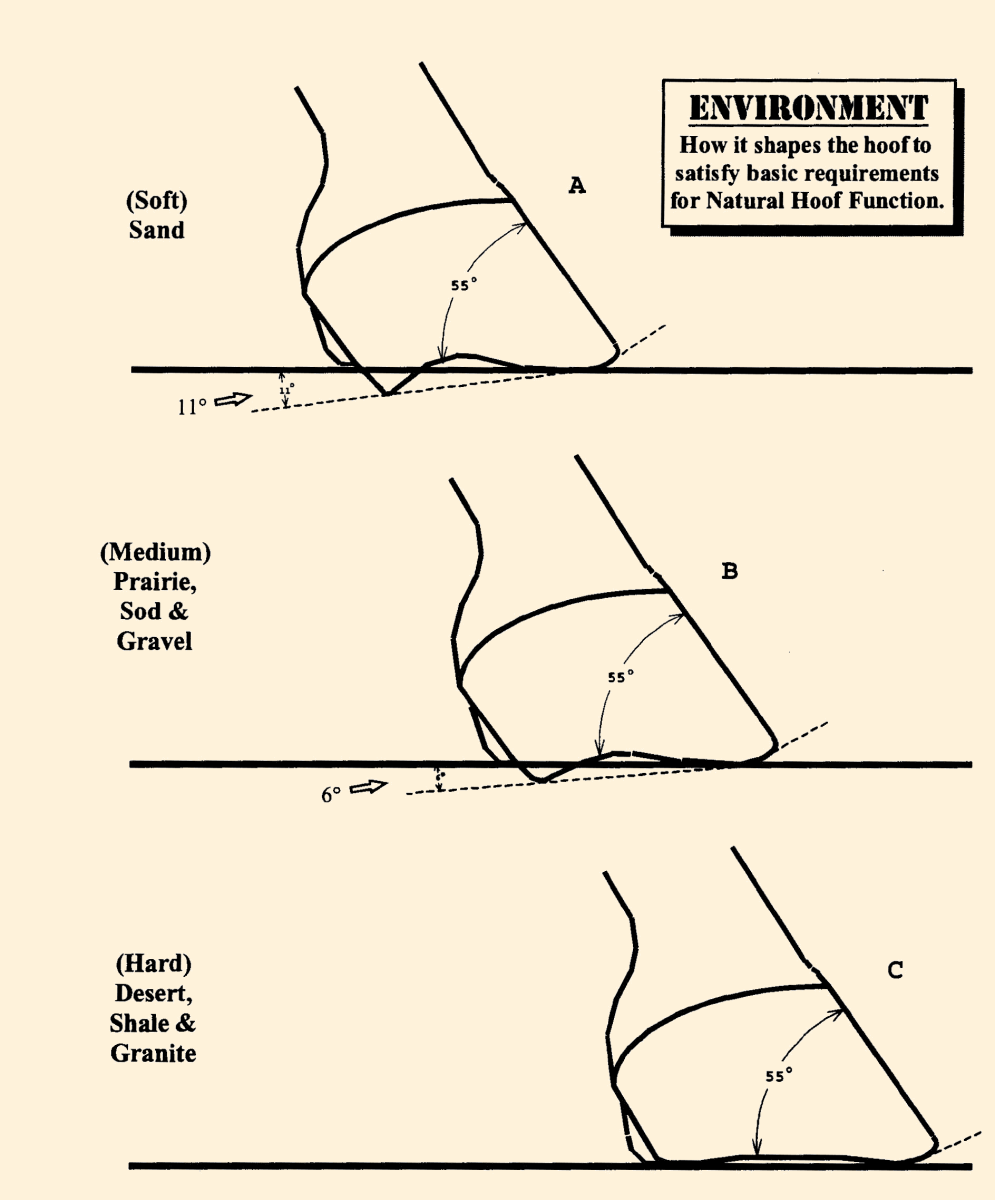
The relationship between types of terrain and degree of wear was documented by farrier and horseshoe designer Gene Ovnicek. Take a look at this illustration from his book New Hope for Soundness, Second Edition –

How environment affects heel length

As you can see, as the terrain becomes softer, the heels experience less wear. But because the heels actually penetrate the softer terrain, the effective toe angle remains essentially constant. Obviously, if you were to stand these three horses on a flat, unyielding surface such as concrete, or move Horses A and B into Horse C’s environment, only Horse C would measure with the same toe angle as he did in his “natural” environment; Horses A and B would have more upright toe angles because of their longer heels. From what we learned in Part 2, therefore, we know that on a flat, unyielding surface, Horse A is unquestionably going to have a more pronounced heel-first landing than Horse B, who will have a more pronounced heel-first landing than Horse C.

This is why so many people erroneously conclude that horses must be designed to land heel-first; very few of our domestic horses both live in desert environments and move as much as feral horses, which makes them much more like Horse A than Horse C. So it’s logical to assume that every horse we’re likely to observe moving over a flat, unyielding surface, including all feral horses except those from environments like Horse C, will land heel-first to one degree or another. But just because that’s what we happen to observe on flat, unyielding surfaces doesn’t mean they’re supposed to land that way on every surface!

The very important point to be made in this discussion lies in the realization that all three horses in the above illustration share a critically-common albeit not obvious characteristic, in spite of the differences in their environment: at the instant of impact, the coffin joint (the joint between the short pastern and the coffin bone) is undergoing no 3rd-order acceleration. Although the foot as a whole is decelerating as it makes contact, the coffin joint is not also rotating at the moment of impact. Any rotation (3rd-order acceleration) of the joint, as we’ll examine in the next installment of this series to be entitled “Navicular Disease – Part 1: Background,” turns out to be an absolutely crucial factor affecting the long-term comfort and soundness of the horse.

Meanwhile, when we consider all this wear happening to the bottom of Horse C’s hoof from miles and miles of travel over highly abrasive ground, isn’t it a logical conclusion that any part of the hoof that was long relative to the rest of the hoof would very quickly be worn off? For example, each front leg of a 1,000-pound horse will have approximately 600 pounds of weight grinding that hoof into the ground with every stride over his entire life. How could it not be worn flat? So Horse C’s coffin joint ends up not rotating because he’s hitting the ground flat; Horse A and Horse B are undergoing no coffin joint rotation because their heels are penetrating the terrain and they’re effectively landing flat.

A beautiful, zero-coffin-joint-rotation landing

In closing, I’m going to leave you with a couple of statements to consider in preparation for the next article in this series. I truly hope I’ve paved the way for them to be read and understood. But before you read them, I sincerely hope you’ll put aside whatever else you may have heard or read to the contrary on this subject, regardless of where you heard it or whomever said it, and let only common sense and your own experiences – horse and non-horse – guide your thinking. These statements are my inevitable conclusions about landings drawn after a careful analysis of facts over a 20-year period, and I unreservedly stand behind them. They are:

In the feral horse, a heel-first landing is not possible

In the domestic horse, a heel-first landing is not desirable

As I mentioned in Part 1 of this series, the eminent author and equine pathologist Dr. James Rooney – arguably one of the most experienced researchers of the equine limb in the world – also eventually came to these same conclusions. So why is it taking so many others so very long to catch on?

More soon…


ADDENDUM

Following the publication of this article, I’ve had discussions with several people who seem to have not read the entire series of articles, and have therefore misunderstood my two conclusions about landings stated directly above. Therefore, I thought I’d clarify/qualify them a bit more, even though this same information is contained within this and the previous two articles.

Statement 1:

In the feral horse, a heel-first landing is not possible

This statement is predicated on a couple of conditions. First, it is relevant only to a healthy feral horse moving on its flat native terrain at its most common gait (the walk). Although I suspect the same landing happens at faster gaits, I’ve done only a bit of video work at higher speeds, and am therefore not yet comfortable making that statement. Second, as I’ve tried very hard to explain in this article, on softer terrains the heels will appear to strike the ground first, but are actually penetrating the terrain. The net result is that there is no rotation of the coffin joint at the instant of impact; thus, in mechanical terms, they are effectively landing flat. So a heel-first landing, by my definition, is actually a non-zero-coffin-joint-rotation landing. This is the important distinguishing characteristic in a landing.

Statement 2:

In the domestic horse, a heel-first landing is not desirable

Similarly, this statement is really meant to say that a non-zero-coffin-joint-rotation landing is not desirable in the domestic horse. This is applicable when the horse is observed walking on a flat, unyielding surface, and often cannot be seen without the aid of slow-motion video. It can, however, be readily heard on these surfaces because of differences in our auditory, as opposed to our visual, acuity.

In the first article in this series, I started us down the path to understanding why the proper landing for a horse at the walk has to be flat-footed by describing the anatomical differences between humans and horses, and pointing out the limitations of our ability to perceive fairly significant differences in how the horse lands without using slow-motion video techniques. In this installment, we’ll continue on by examining the orientation of the foot as it travels through the flight arc and prepares to make ground contact.

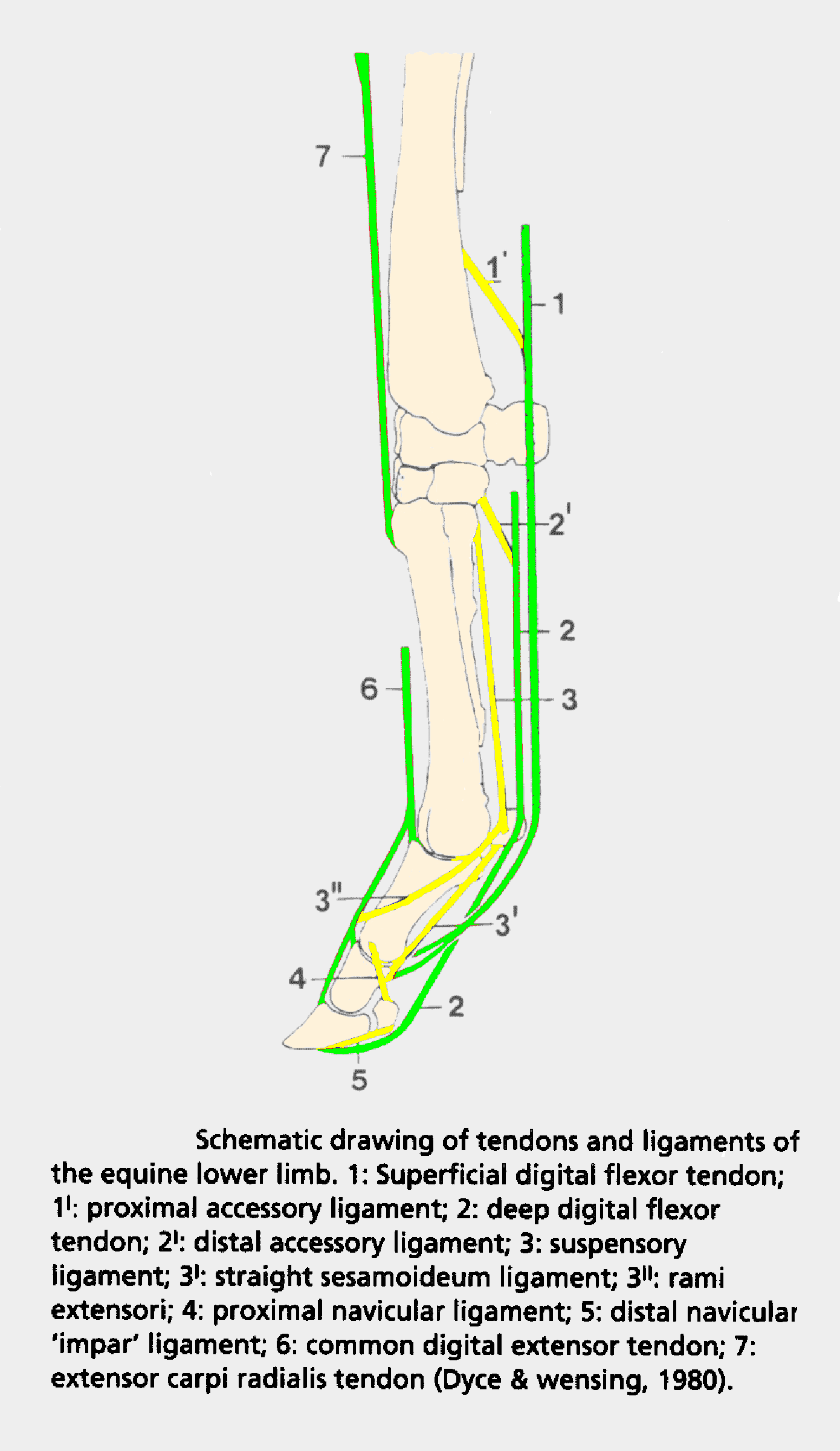
Diagram of major tendons & ligaments of the lower limb
– from Equine Locomotion, by Willem Back & Hilary Clayton. I added the color.

As you’ll note in the diagram above, the common digital extensor tendon (6) and the deep digital flexor tendon (2) both have insertions (attachments) on the coffin bone – the most distant (distal) bone in the horse’s limb that resides inside the hoof capsule. Like humans, the horse’s foot is stabilized by these tendons as well as ligaments, and, shortly after leaving the ground, its orientation to the rest of the limb immediately above it (long & short pasterns) remains essentially constant throughout most of the flight arc. And like us, horses don’t typically think about where to place the next foot when they walk. So although the tendons stabilize the position of the foot, the attached muscles do not actively pull or relax to reorient it as it prepares to land. In fact, James Rooney’s Biomechanics of Lameness in Horses, which I’ve referenced a number of times before, describes Dr. Rooney’s somewhat counter-intuitive discovery that transecting the extensor and deep flexor tendons in the vicinity of the short pastern really had no significant effect on the orientation of the hoof as it landed. He concluded, therefore, that (like humans) foot placement in “normal” walking is not an active effort. Keep in mind, by the way, that we’re talking only about A/P orientation in the horse; the M/L orientation, as we saw in Part 1, is dictated by the construction of the joint surfaces themselves.

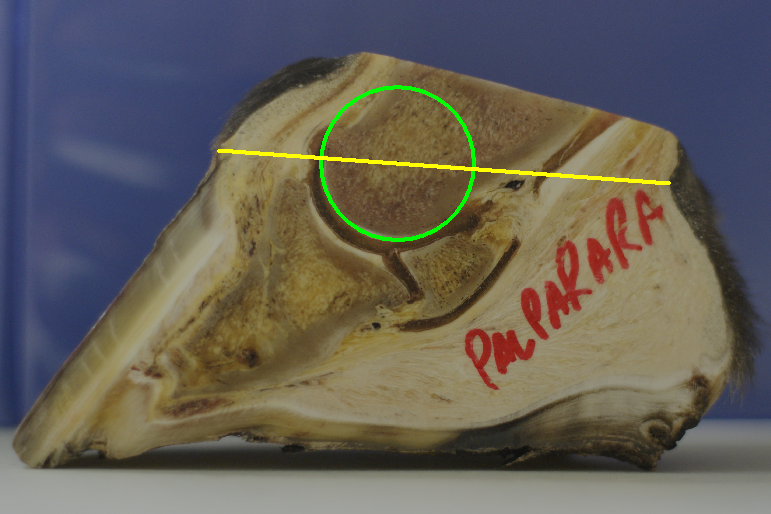
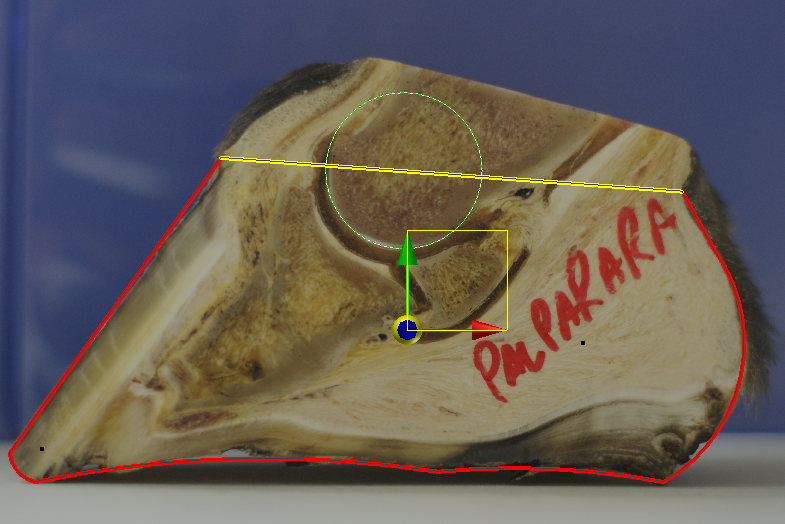
Dr. Rooney’s comments inspired to me look at the center of coffin joint rotation and the center of gravity of a properly-trimmed bare foot, which is fairly easy to do with my CAD system by importing an image of a sagittally-cut foot, visually noting the center of joint rotation, and tracing the foot’s outline so the software can then compute the center of gravity. Check out the images below of one of Brian Hampson’s feral horse feet from Australia/New Zealand. And as an interesting  aside,  also note the bone remodeling evident at the tip of the coffin bone –

Center of coffin joint rotation on a feral foot
The center of coffin joint rotation (the circle’s center) lies on a line indicating the top of the foot
Center of gravity of the foot
After outlining the foot, the software calculates the foot’s center of gravity, which lies directly below the center of joint rotation

The interesting thing about this observation is that it was consistent for all of the feet I looked at in cross-section, regardless of their toe angle. What this means is that the hoof balanced for a proper (flat) landing is quite literally “hung in balance” on the end of the limb! Thus, Dr. Rooney’s experience with the severed tendons makes sense; because the mass of a properly-trimmed bare foot is, by design, evenly distributed in the A/P direction, the tendons are only providing a stabilizing (damping) force rather than actively controlling pastern/foot alignment. This is similar in function to the shock absorbers on an automobile; they don’t determine the position of the car body, but they help the body more quickly return to a neutral position after being displaced.

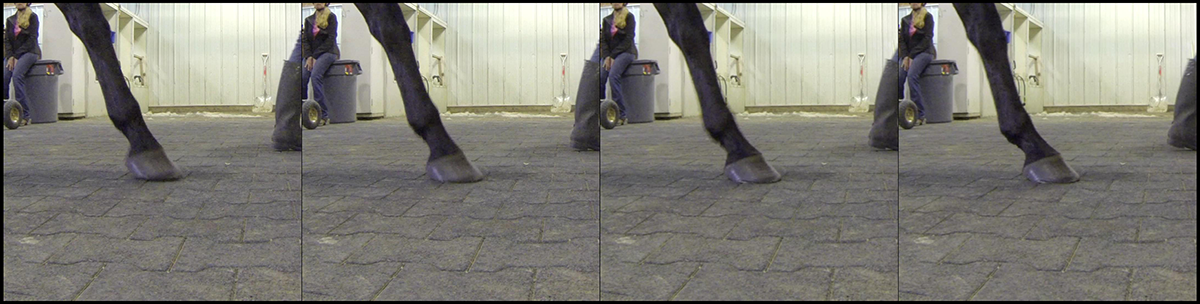
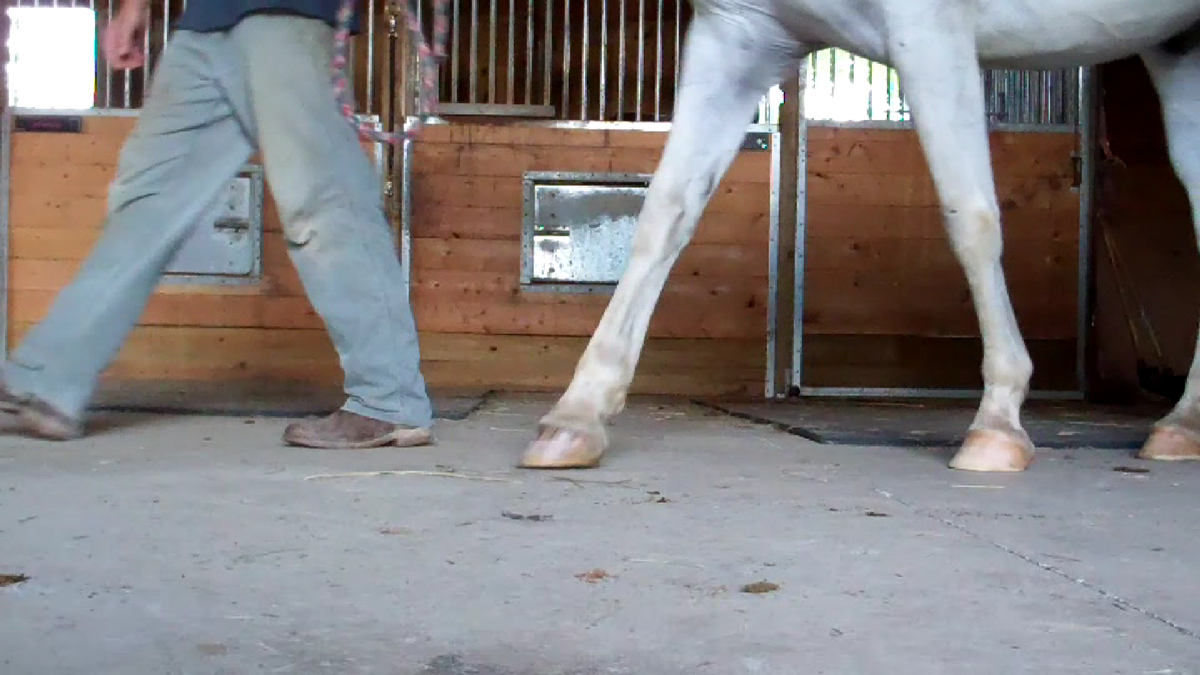
The point I’m trying to make is that the horse isn’t consciously “aiming” his foot so it hits the ground a particular way based on what’s happening with the bottom of his hoof. Instead, the orientation of the bones of his foot and leg are the consequence of masses, muscle tensions, and joint construction – all under the influence of gravity and other external forces (we’ll get there in a moment!). As designed, the hoof itself is bare, quite short, and (as we saw above) the mass distribution of the foot overall is quite even; therefore, it’s able to quickly accelerate and decelerate to a position of proper alignment with respect to the limb above it, aided by the “neutral” tensions in the tendons/muscles, as it travels through the flight arc. So given a properly-trimmed bare hoof, the net result is that the internal and external structures of the foot will be in proper alignment as the hoof prepares to contact the ground. Check out the following photo, taken from a video of a client, in which the hoof position has been captured as close to the ground as possible just before making contact –

Properly-trimmed hoof about to make contact

Note, however, that I’ve been using the phrase “properly-trimmed bare hoof.” Within some particular range of variation from “proper,” the internal structures of the foot will still be in the correct orientation with respect to the leg and the ground, but the external structures will not be. You have only to look at the preceding photo to understand that if some part of the hoof is left long with respect to the other parts, the longer part will end up striking the ground first. So a long toe will yield a toe-first landing, and long heels will produce a heel-first landing. As you’ll learn in later articles when I discuss the origins of navicular disease, this is an extremely problematic situation because, by design, the coffin joint is not intended to be rotating at the instant of contact! But if a horse is contacting the ground any way other than flat, the coffin joint will, necessarily, be rotating when the hoof “slaps” the ground as the leg comes under load.

But the situation gets worse. Once the hoof exceeds this range of variation from “proper” (and I don’t pretend to know precisely what those limits are), the internal foot/limb orientation, and therefore the internal and external foot/ground orientation, will be further mitigated by three factors, particularly at the beginning and end of the flight arc. These are: 1) hoof length, 2) hoof weight (mass), and 3) hoof weight (mass) distribution.

Remember Newton’s First Law of Motion?

Every object in a state of uniform motion tends to remain in that state of motion unless an external force is applied to it.

Because the coffin joint is fairly flexible, departures from this “intended design” of a short, properly-balanced bare hoof can have a significant effect on the motion of that joint during the flight arc, with profound consequences on the form of the landing. Probably nearly every horse owner has handled a horseshoe before, but relatively few have held a cadaver horse foot; I can assure you that most steel shoes are a significant percentage of the weight of a foot! And as we add weight to the end of the limb in the form of excess untrimmed growth and/or (more significantly) a shoe, we start changing the dynamics of the flight arc. In essence, the lower limb of the horse begins to act more and more like a double pendulum – the long & short pasterns forming one pendulum suspended from the fetlock joint, and the foot with whatever extra weight has been left or added suspended from the coffin joint. The resulting motion, and the mathematics describing it, can be quite complicated, but we can make some general statements about the effects of length, mass, and mass distribution:

  • As the length of the hoof increases, the time it takes to accelerate from the ground or decelerate for a landing increases. This is because the timing (period) of a pendulum is a function of its length; the longer the pendulum, the longer the period.
  • As the mass of the hoof increases, the time it takes to accelerate from the ground or decelerate for a landing increases. This is a consequence of both the center of mass shifting away from the coffin joint, effectively lengthening the pendulum and therefore the period; and the increase in the rotational force (moment of inertia) on the coffin joint, to which the period is also proportional.
  • As the mass distribution of the hoof moves away from being symmetrical, there will be increased unilateral A/P torsion forces on the joints, affecting both the effective length of the pendulum and the center of mass.

What does all that mean in practical terms? It means a foot designed to contact the ground in a particular orientation with respect to the limb above it may not be able to do so because whatever has been done (or not done) in the trimming/shoeing process has altered its dynamics. This is why a shod horse with obviously-long heels can have a reasonably-flat, or even toe-first, landing. The shoe, whose weight distribution has shifted the foot’s center of gravity toward the toe, is modifying the flight arc such that it’s keeping the toe from rotating properly right before contact. But when you remove the shoe, the horse immediately starts contacting the ground heel-first! Similarly, horses with any type of bar shoe, where the weight of the shoe is much more A/P symmetrical or even back-heavy (depending on the specific design – think about wedges!) tend to really come down heel-first, because the weight of the shoe is keeping the heel down plus the horse’s heels are already too long. And the added weight also increases stresses on joints and soft tissues, because that extra weight must be accelerated and decelerated with every step.

So we’ve now added yet another variable to the “landing picture.” Not only do horses not walk like humans, and not only can we not reliably observe landings at normal speed, but the landings we do observe can be a far cry from “proper” because of how the aforementioned factors can modify pastern/hoof alignment. But the problem is this: as Dr. Deb Bennett says, “What people come to see every day, they naturally come to consider ‘normal’…But what a culture or a nation comes to expect is usually common instead of normal.”

Please don’t fall into the trap of thinking that just because you observe a lot of heel-first landings, they’re supposed to land that way. Those landings are merely common, they’re not biologically normal! That’s simply not the way the equine limb is designed, and we’ll continue to provide further evidence to support this claim in the near future.

More to come…

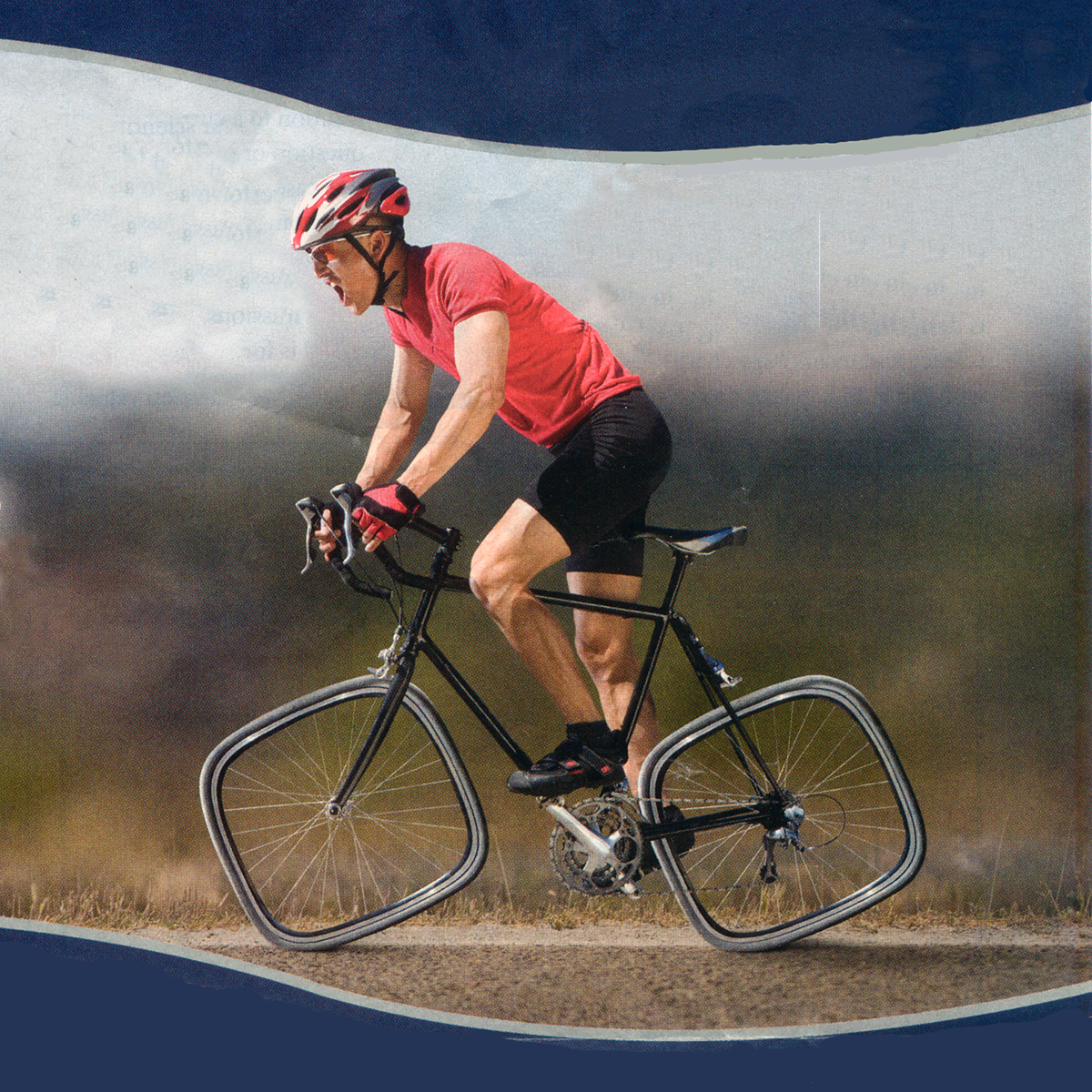
Photo of a Square-Wheeled Bike
– advertisement from Central Semiconductor

Yes, I know it’s been far too long since I’ve posted an article, but life seems to have a way of interfering with my writing! The good news is that I now have  several articles well under way, and so will try hard to keep the gaps shorter.

I had to laugh when I saw the above image as part of an advertisement in one of my technical magazines a couple of months ago, because it seemed as if they knew I was going to be writing this article on heel-first landings and wanted to help illustrate the problem with an easily-understood picture! But that statement will probably make more sense later on…

I want to be absolutely clear right from the start: this notion that horses are “supposed” to land heel-first is, without a doubt, one of the most widely-propagated and dangerous misunderstandings currently in vogue in the horse world. I had intended to start posting my series of articles on navicular disease, but since navicular disease and landings are so closely connected, and because I decided I simply couldn’t bear to listen to one more horse owner or hoof care provider tell me that horses should land heel-first, I decided my priority had to be to weigh in on this very important subject now. In fact, this article could just as correctly be called “Navicular Disease – Part 0.” So although I’ve briefly mentioned in the past that a properly-trimmed horse will land flat at the walk (see, for example, Hoof Angles – Part 4), I haven’t yet discussed the logic behind that assertion at length. By doing so here, I hope to save a lot of horses from a lot of problems on down the road.

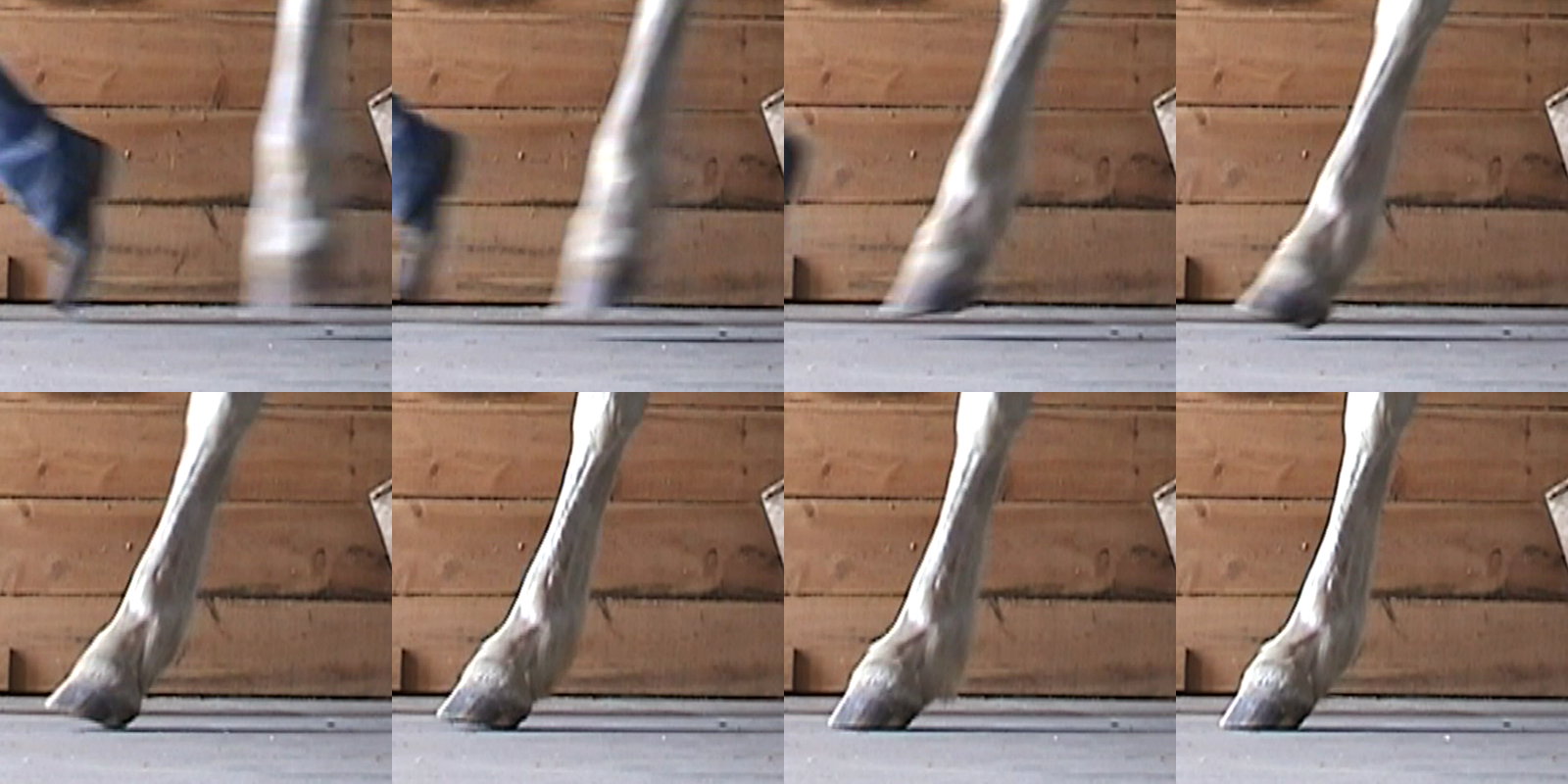
photo sequence of a heel-first landing on a bare hoof
A heel-first landing on an improperly-trimmed bare hoof

To be fair, I also need to tell you that I, too, used to believe horses should land heel-first because years earlier I’d read a passing statement in renowned equine pathologist Dr. James Rooney’s book Biomechanics of Lameness in Horses in which he said that horses land flat to slightly heel-first (emphasis added). He did not, however, mention the conditions, such as gait or speed, under which he believed this to be the case, nor did he state whether or not this was a theory based on physiology, or merely an observation of horses he’d encountered. Interestingly, later parts of the same book strongly contradict the heel-first part of his statement, which he then supports with both theory and observation, and his most recent writings on the subject clearly state that the horse should land flat at the walk. In his webpage discussion of feral hoof form entitled “The Shape of the Equine Hoof,” for example, he says:

At the slow walk, the hoof usually contacts the surface over the whole bearing edge of the hoof wall; that is, the foot impacts flat-footed.

Unfortunately, this fallacy about heel-first landings still persists, largely (I believe) because one particular barefoot clinician has stated it many times in his clinics, and because humans tend to land heel-first. But long before I’d read Dr. Rooney’s most recent work, or even his earlier work more carefully, I’d already come to the conclusion that common sense tells us a properly-trimmed horse – whether by nature or by human – must land flat at the walk. In talking to many people over a number of years about this subject, I’ve found that non-horse people, especially technical types, tend to immediately understand why, while many horse people seem to struggle with it. But I’ll do my best to make it clear!

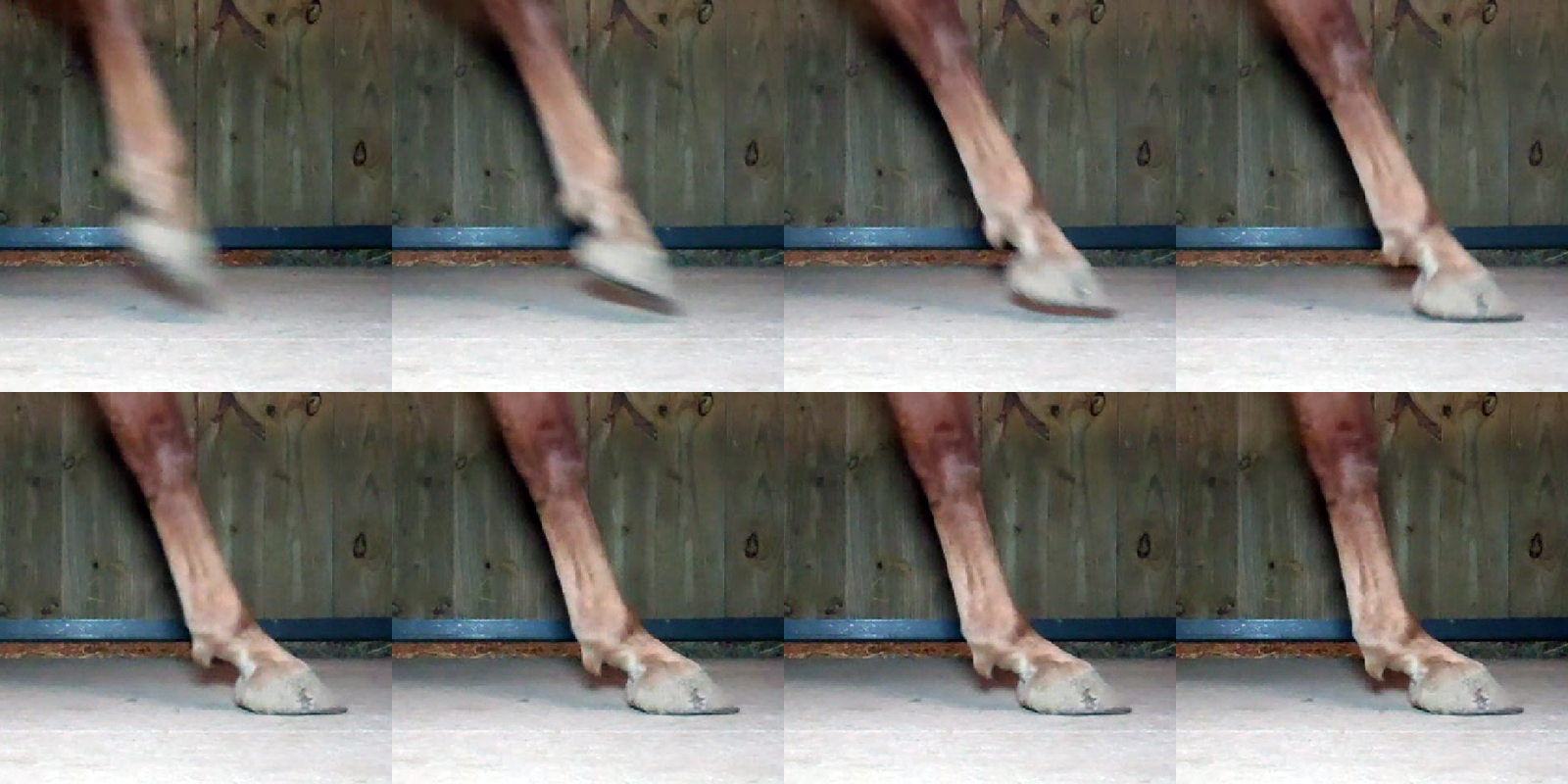
photos of a proper landing on a properly-trimmed bare hoof
A proper landing on a properly-trimmed bare hoof

In this installment, we’ll take a look at two things we need to understand before really discussing the landing problem at length: first, the differences between biped and quadruped limb construction and movement, and second, the issues surrounding how humans perceive landings.

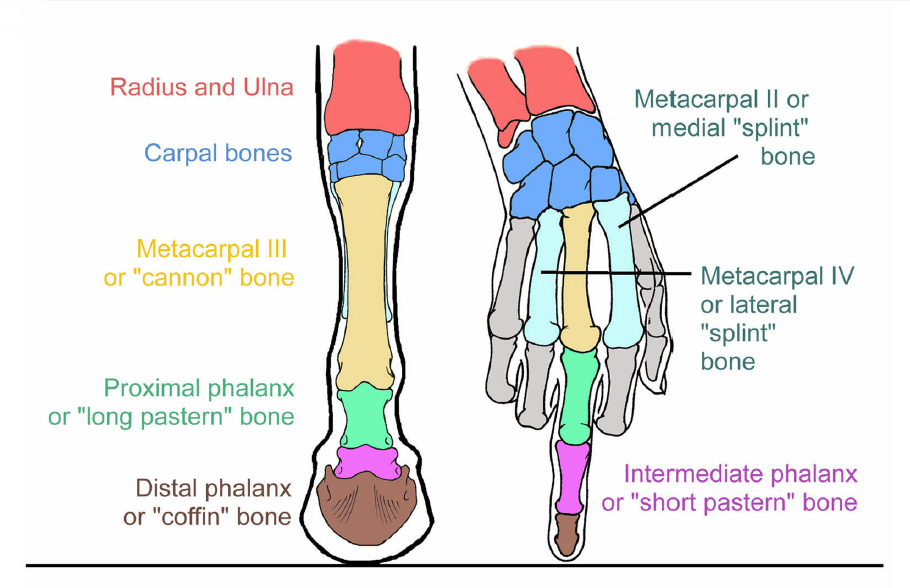
As you’ll see in this image from Dr. Deb Bennett’s Principles of Equine Orthopedics Part 1 comparing the equine and human forelimb, they’re very different in both structure and function –

Comparison of the horse and human forelimbs

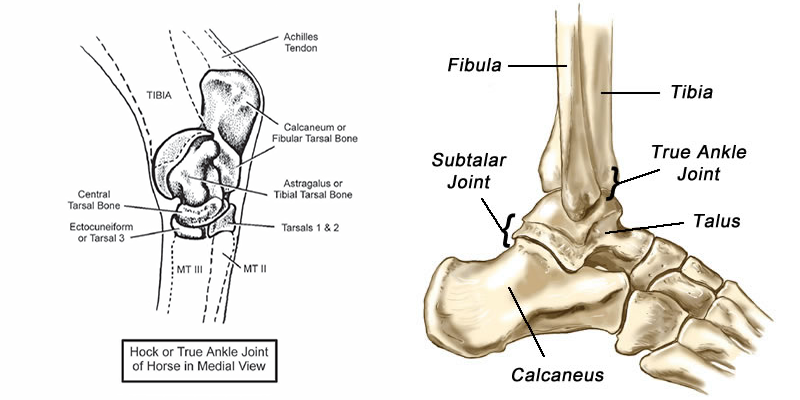
So in the forelimb, what we generally refer to as the horse’s “knee” is in fact his wrist, or carpus. The horse actually walks on a hoof attached to what would be the last joint of our middle finger. In the rear limb, the horse’s ankle is the hock joint, and not the fetlock as may seem intuitive. The image below shows their comparative anatomy; the hock image is from Principles of Equine Orthopedics Part 1, and the ankle image is from www.kidport.com –

Horse & Human Ankle Joints

As we consider differences in the way we move, it’s important to note the consequences of these anatomical distinctions. The human ankle consists of an inverted cup of bone perched on top of a ball, stabilized by ligaments. It’s quite compliant by design, and although it flexes fairly readily in both the front-to-back (A-P) and side-to-side (M-L) directions, it’s less stiff and has a far greater range of motion in the A-P direction. In contrast, the forelimb diagram above shows the lowest joint in the equine limb to consist of much broader surfaces designed to articulate only in the A-P direction. With good reason, I might add; if you’ve ever rolled your foot to the inside in a misstep, you can imagine the “train wreck” that would occur if a horse were able to do that at 40 MPH! That complete lack of lateral flexibility, incidentally, is also the reason so-called “corrective” trimming & shoeing is such a long-term disaster, as I pointed out in What Makes it “Natural Hoof Care?”.

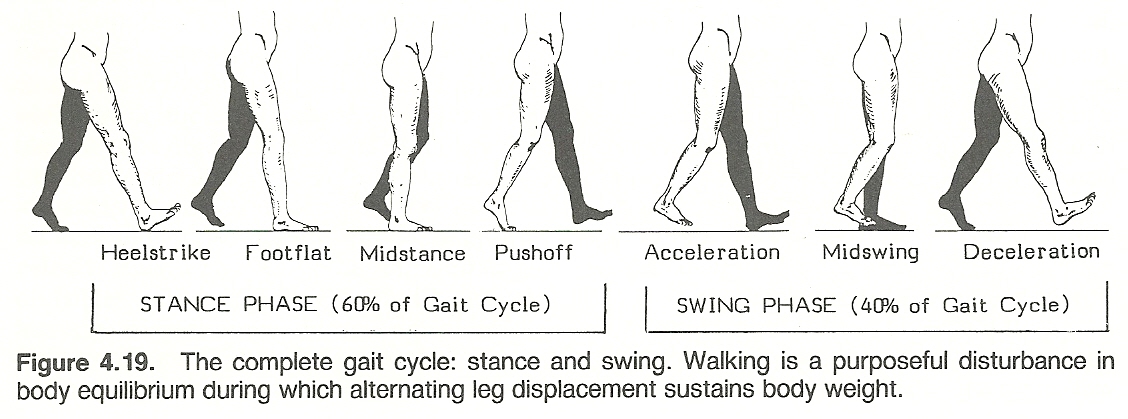
The following image from R. C. Schafer’s book entitled Clinical Biomechanics: Musculoskeletal Actions and Reactions (2nd ed.) is very helpful in understanding biped locomotion. Pay particular attention to where the torso is with respect to the leading and supporting limbs –

Diagram of the human gait cycle

And here’s what the author has to say about the mechanics of walking:

Biomechanically, walking can be considered as a series of continuous losses and recoveries of balance in which the rhythmic play of muscles narrowly averts toppling. Steindler refers to the basic sequence of movements in walking as a “series of catastrophes narrowly averted.”

In other words, walking in a particular direction involves shifting your center of mass in the direction you wish to go, and then “catching yourself” with the leading leg as your mass comes over that leg. In essence, you fall forward to move forward. And if your foot is in a neutral position – basically perpendicular to the axis of your leg – it strikes the ground more and more heel-first as your stride length increases.

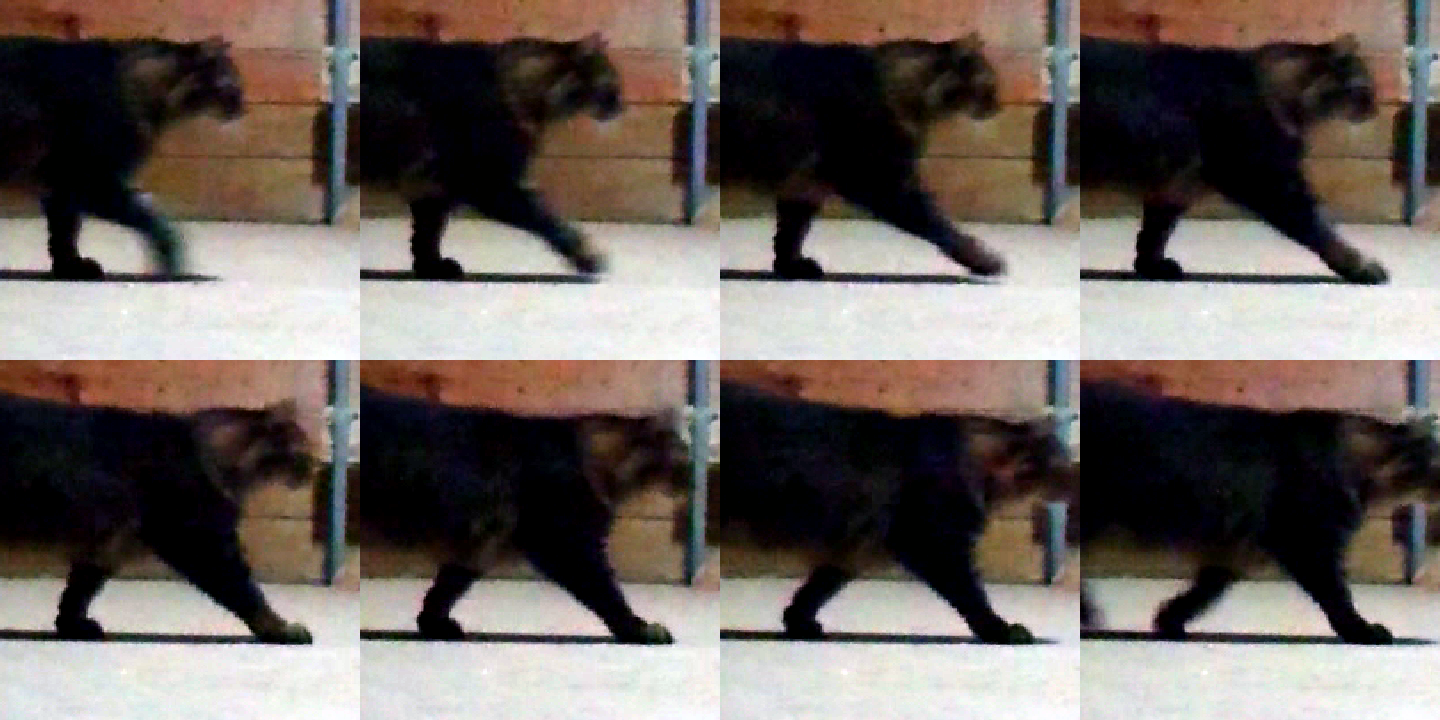
The quadruped, on the other hand, doesn’t walk like that because their center of mass is never ahead of the leading limb while it’s loaded. The cat in the following (bad!) photos walked through my video setup while I was recording a horse. As you can clearly see, he’s stable on 3 legs and his center of mass is behind the leading leg. Like your horse, he doesn’t have to “fall” onto the leading leg like you and I must do to move forward. You’ll also note he’s definitely not landing heel-first, and I didn’t even have to trim him! –

photo sequence of a cat landing properly
Someone forgot to tell this cat he’s supposed to be landing heel-first…

The other part of this background information has to do with how humans perceive things. Back in 2008 when I began to seriously question this notion of a heel-first landing being “correct,” I became convinced that humans probably aren’t able to see differences in timing between heel contact and toe contact. So I wrote to a number of researchers in the field of visual perception, and posed the following question (since I couldn’t assume they knew anything about horses!):

An observer watches (but does not hear) someone slap both hands down on a tabletop in a brightly-lit kitchen. At what interval between slaps will the hands striking the tabletop appear to be a simultaneity?

The responses I received were all nearly identical, but Dr. Ken Norwich, Professor Emeritus at the University of Toronto’s Institute of Biomedical Engineering provided the following answer with some qualifiers:

How bright is the light used to make the observation? The interval you seek will depend on the illumination. What is the background to the images of the hands? Let us assume that it is a black background, but contrast will also affect the measured interval. Probably the interval is very close to the reciprocal of the flicker fusion frequency i.e. the frequency of flicker where an observer sees a steady image rather than a flickering light. This frequency is about 55 seconds (-1), so the interval you are looking for is at least as great as 0.02 seconds, or 1/50th of a second, and that is for a very bright image.

So in brightly-lit conditions against a high-contrast background, the limit of a human’s perception is in the neighborhood of 20 milliseconds. Any timing difference between heel and toe contact shorter than that will be seen as a flat landing. And just how many barns have you been in where you find “brightly-lit conditions against a high-contrast background?” Darned few, if any, in my experience!

To help put things into more meaningful terms, observe the first set of hoof images in this post. This heel-first landing, from heel contact to toe contact, was quite obvious to me at normal speed, and measures approximately 80 milliseconds.

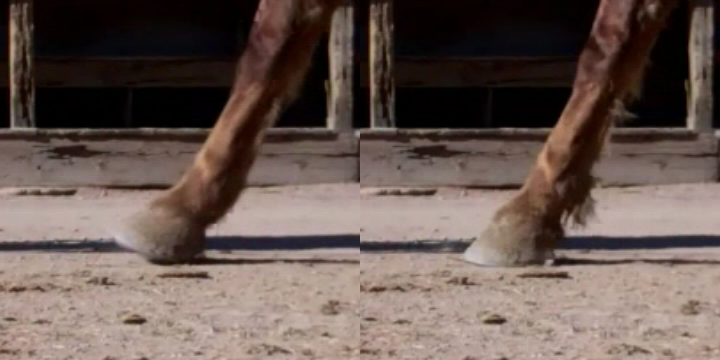
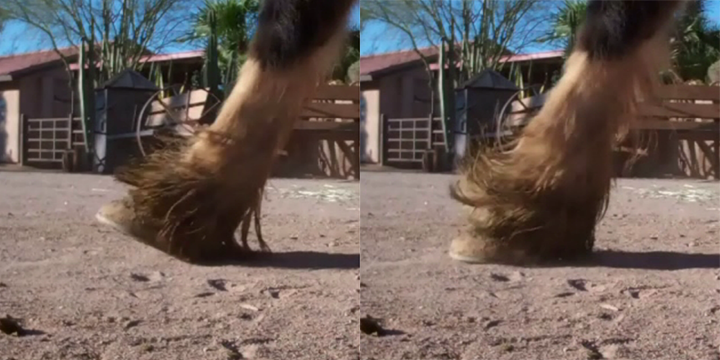
And now take a look at the following two landings –

Horse Bad Landing

Draft Bad Landing

In both of these cases, the heel-first landing wasn’t particularly apparent at normal speed, and only became obvious when I slowed down the video. Although the background isn’t very high-contrast, the lighting was reasonably bright. They both also measure approximately 20 milliseconds from heel down to toe down. In fact, of the 6 heel-first landings I happen to have slow-motion video of as I write this, the average heel-to-toe contact time was only 32 milliseconds – alarmingly close to the limits of human perception under ideal laboratory conditions.

Therein lies the rub: if you can see an obvious heel-first landing, the landing must be very heel-first in order for you to perceive it as such! And soon I’ll explain why that’s a serious problem for your horse.

So those are the first two hurdles to overcome in this discussion of landings in horses: regardless of what you may observe about human movement, you cannot apply it to equine movement because horses and humans are fundamentally different; and, the timing of a heel-first landing strains the limits of human perception, so you can’t be absolutely certain of anything without using additional tools such as slow-motion video.

More soon…