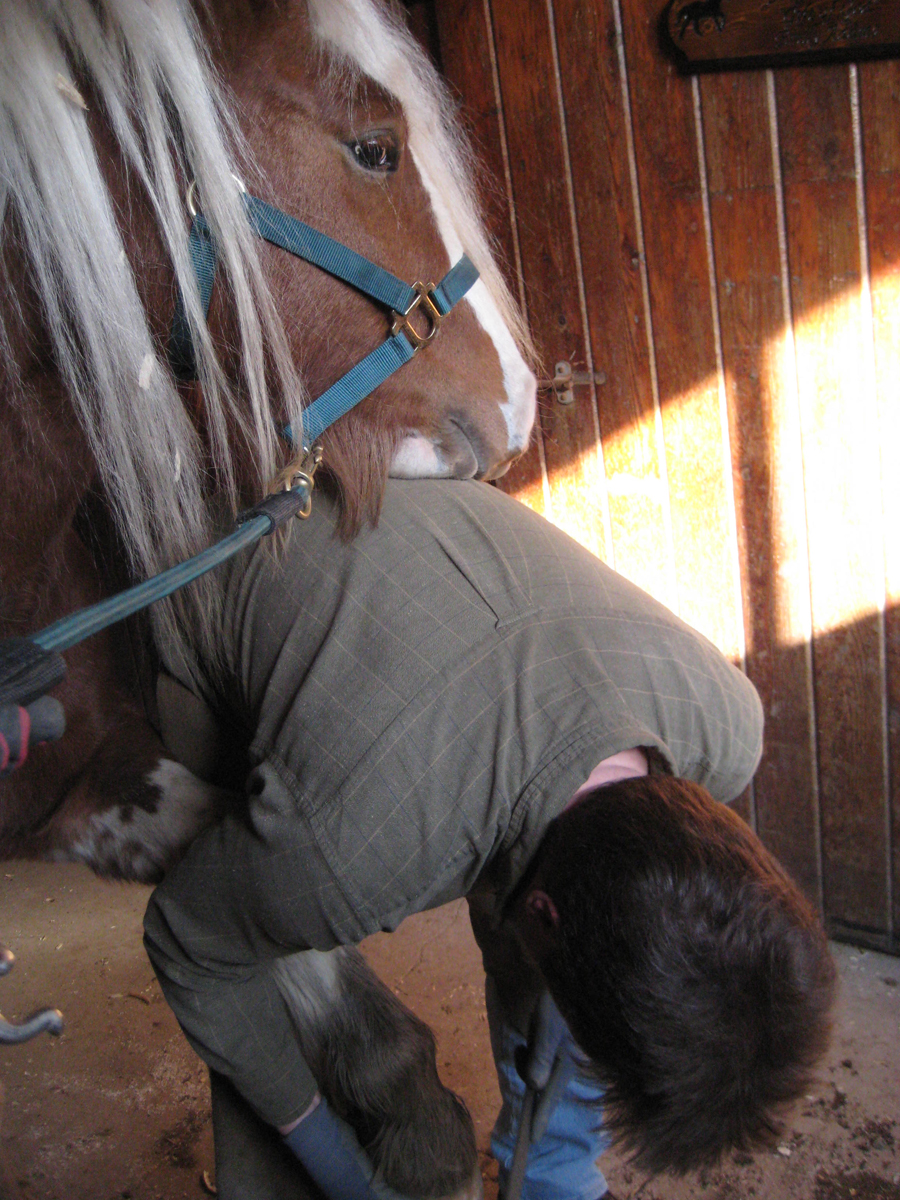
Relaxed Client

This youngster looks really upset, doesn’t he? But his contentment with me is only part of the hoof-care story, which brings me to the subject of this post: the following email I received from a brand-new client the other day –

 Steve, I just wanted to take a minute and thank you for the work you did on _______ on Sunday. By Monday I saw a difference. This evening (Wednesday) I had my horse back. She has not moved this fluidly in 5 years.

This horse owner had been unhappy with her farrier for quite a while because it seemed to her that her horse’s hooves weren’t properly balanced. And she was right: besides the usual too-long heels, her horse’s rear hooves had been out of medial/lateral (side-to-side) balance for a long time, as evidenced by the asymmetrical flares in the heel quarters. But, as she explained to me, although she’d been observing my work at her barn for a year and was impressed with how well the horses were doing, she just couldn’t figure out how to tell her farrier “goodbye.”

This is certainly not the first time I’ve heard this story. I remember one owner in particular who called me in to look at a horse with an undiagnosed and absolutely crippling frog infection neither her farrier nor her vet had managed to recognize. That horse’s hooves, along with her other 3 horses’ hooves, were also quite out of balance. And yet, in spite of the realization that her horse was suffering at the hands of her current farrier because of his apparent lack of knowledge, as well as the other problems with his work, she was extremely reluctant to dismiss him. “He’s such a nice guy!” she kept exclaiming.

“Niceness” is a wonderful quality, of course, but my horse doesn’t really care a fig about that. He cares about the hoof care provider’s competence, horse-handling abilities, and overall demeanor. Those are the characteristics of any equine professional that ultimately matter to the horse. If my horse’s care providers possess those characteristics, I may (or may not) elect to overlook some of the other things I hear about them, like chronic lateness, unreturned phone calls, unwillingness to answer questions, arrogance, and just plain rudeness. Frankly, I don’t see why I shouldn’t expect to “have it all” from anyone calling himself or herself a professional, but everyone has a different tolerance for what they consider to be “too much.” On the other hand, if I thought for one moment that my horse’s care providers weren’t adequately trained and doing the absolute best possible for him, they’d be gone in half a heartbeat, nice or not!

Sadly, that’s the case in the hoof care world – at least, in the U.S., where there aren’t any licensing or certification requirements for hoof care providers (which, I might add, absolutely shocked a horse owner from the U.K. when I told her that the other day). So the burden is on the owner to try to determine whether or not a person under consideration is adequately prepared to take on the job. And how do you determine that? Well, I’d begin by reading these 5 articles –

The information presented in them will help you figure out if your hoof care provider, or one under consideration, is actually up to the task from a knowledge perspective. And while I realize they’re written with the barefoot horse in mind, I want to emphasize that everything in them is equally relevant to a horse who wears shoes. That’s because physics is physics, and the laws of nature don’t change just because I might wish they could! So what’s important in trimming a horse to be barefoot is equally important when trimming a horse about to be shod.

Once the hoof care provider has cleared the knowledge hurdle, move on to the others. Watch him or her trim a horse or two, and observe how he/she interacts with the animals. Do the horses seem reasonably happy, or can’t wait to get away? Does the handling seem unnecessarily rough? Would you want him or her performing a professional service on you? At that point, the rest is pretty easy; you can decide readily enough whether the people and business skills are adequate, and probably gain some useful insight by talking to some existing customers (which he/she should be happy to have you do).

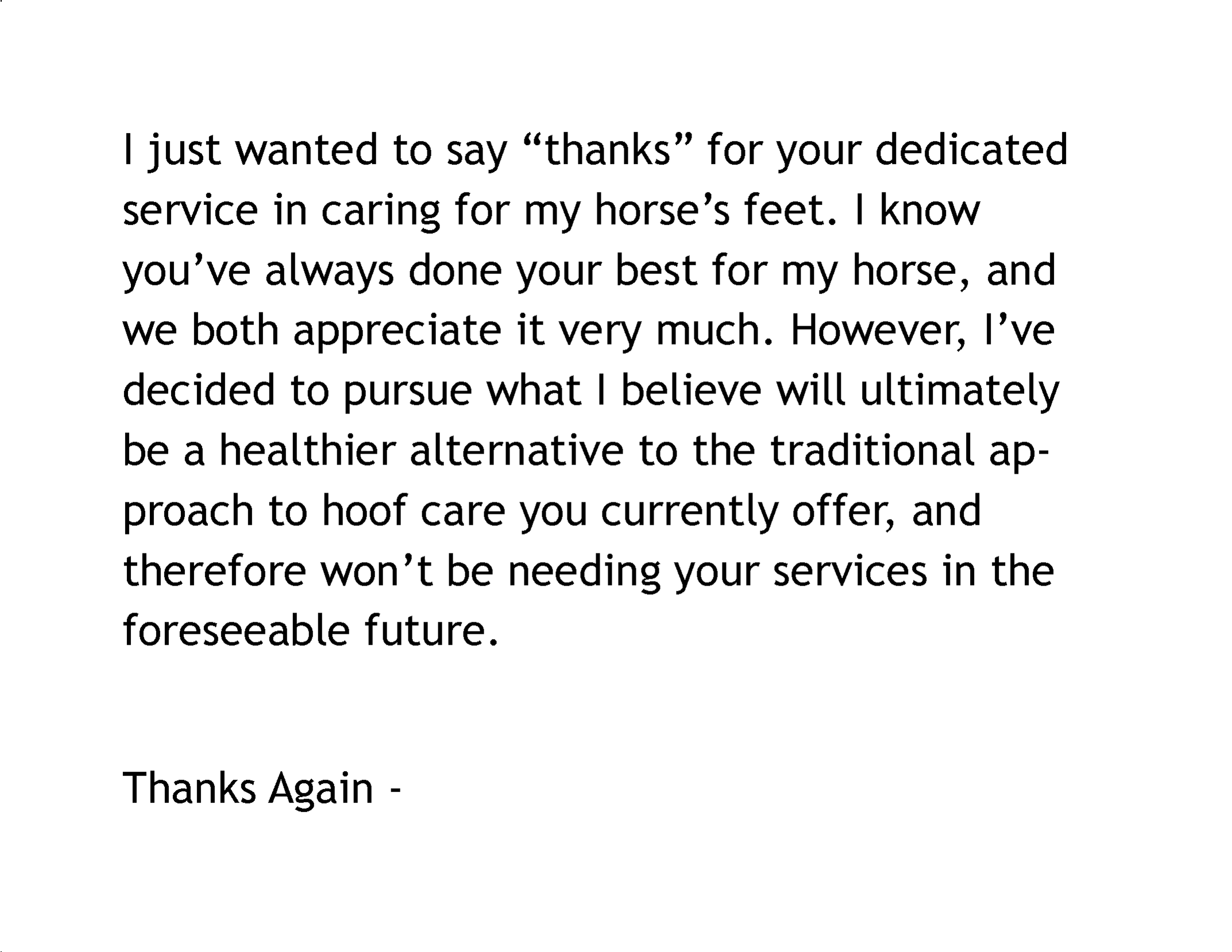
So if your hoof care professional isn’t measuring up, whether because of a lack of knowledge, a lack of horse or people skills, or both, think hard about making a change. And if it’s the right thing for your horse, politely tell your current hoof care provider “thanks” and move on. Use the card below if you like; clicking on it will take you to a printable version –
Front

Inside

As hard as I know this can be, it’s very important. And, ultimately, your horse will thank you for it. He’ll reward your difficult decision with a happier attitude, better movement, and more years of sound service, which also means more riding time with fewer vet bills. And you’ll reward your decision with less worry, less drama, and a happier attitude about every trip to the barn, which means less overall stress in your life.

Life is, indeed, short. You’re worth it. And so is your horse.

Sticker Front
Front of sticker

A few weeks ago, I was lamenting to a friend about the decided lack of representations of the shoeless horse in the horse world. I mean, every piece of jewelry, sign, and T-shirt uses the horseshoe as a symbol of the horse. But for those of us who don’t believe horseshoes are in the best interest of our animals, we’d rather not use that particular image to symbolize the significance of the horse in our lives. “Why don’t you design a sticker?” she said. “Everyone likes stickers!” And since I had to start somewhere, I decided that was a great idea.

The result is a 3-1/2″ square sticker featuring an image I took of a feral horse’s beautiful hoof whose trim is provided courtesy of extreme movement over abrasive terrain – a true “natural trim.” The removable backing directs the sticker holder to this website, in case you want to hand them out as a means of promoting natural hoof care and/or hoof care education in general.

Sticker Back
Back of sticker

The silk-screened vinyl sticker is coated for UV protection and is rated for 5 years of outdoor use, so you can put them on tack boxes, trailers, bumpers…anywhere you want to display your support for our barefoot friends.

Order your stickers here, and help spread the word!


P.S. I’ve also added a Products section to the sidebar on the right. Stay tuned for more items…

Smoking Advertisement

Hello Steve,

Hope you can help me out. I own a thoroughbred racehorse, and want to know that he is being properly shod. I read parts 1,2 and 3 of Hoof Angles, but I’m still not sure how I should proceed to make sure my horse is properly shod. Do I need to measure before I give instructions to my farrier? If so, what should I measure? Then what instructions do I need to convey to the farrier? I guess I’m a little confused, because other reading I’ve done gave straightforward instructions, but after reading your Hoof Angles I’m not so sure about what they said. I hope you can unconfuse me.

Thanks for any advice you can give.

Joe

Hi Joe –

I’ll try, but there are no guarantees because it’s a subject fraught with misinformation and confusion!

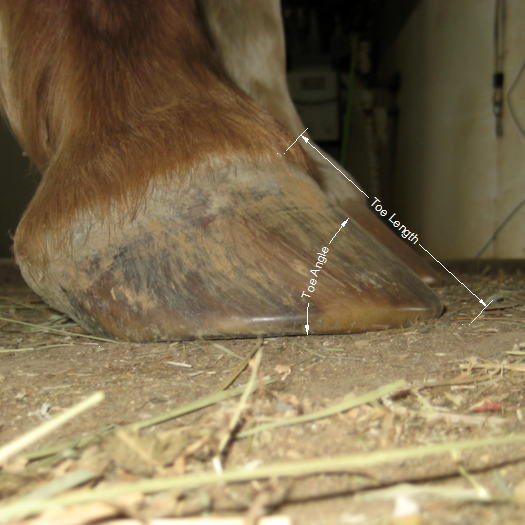
There are a lot of folks out there who attempt to quantify the “correctness” of hoof trimming or shoeing using particular measurements – most often toe angle, and occasionally, toe length.  That’s understandable, because many texts and training programs teach hoof care professionals to trim “to the numbers” instead of imparting a clear understanding of proper hoof form (which, I believe, most people lack).

Unfortunately, trimming a horse to a specific toe angle and/or length is not in the horse’s best interest, because: 1) horses vary widely in terms of what constitutes an optimal hoof length and angle, and 2) horses vary widely in their sensitivity to deviations from that optimal length and angle. For example, one horse may have an optimal hoof angle of 53 degrees and length of 3-3/8 inches, while another may have an optimal hoof angle of 48 degrees and length of 3-7/8 inches. But although either or both of those horses may appear to do fine (at least in the short term) with, say, a hoof angle of 50 degrees and length of 3-1/2 inches, it’s just as likely that one or both will be lame with that much deviation from optimal. And that’s the problem: we can’t predict which ones will and which ones won’t. We can only see the extent of the effects of less-than-optimal trimming after the damage has already occurred – often quite far into the future.

Number 2 above is also the reason many horses give every appearance of doing fine in spite of their hooves being grossly out of balance; for whatever reason, they’re not particularly sensitive to angle and length variations. That makes it difficult for people to see and understand the short- and long-term advantages of proper hoof care. I’ll often look at a horse with significant chronic imbalances, evidenced by deviations from straight hoof capsule growth such as flare, thickening, and bent horn tubules, and hear “My horse has been trimmed/shod by the same guy for the last 10 years, and he goes just fine!” Of course, those same people will often be the ones whose horses eventually start experiencing a shortened stride, heel pain, or “mysterious” lamenesses.

Photo of Toe Angle & Length Measurements
Toe Angle & Length Measurements

In the short term, it’s often a matter of being in a position to appreciate the distinction between “just fine” and “optimal.” And if you’ve only experienced “just fine,” how would you even know there was something better? The woman who always runs races wearing her high heels, for example, would never deny that it’s possible to run in them. But if she were to exchange them for flat shoes, she’d quickly discover that the flat shoes allow her to run much more efficiently. Perhaps more importantly, if she were able to look into the future, she’d also see that the high heels were actually causing long-term damage to the tendons in her feet in the form of premature arthritis.

As with this woman in her high heels, this distinction is lost on most horse people because the horse isn’t immediately lame in the vast majority of cases. And this situation is very similar to several others we’re familiar with. For example, look at the old cigarette advertisement at the beginning of this post. People used to think smoking was ok because the effects aren’t apparent in the here and now, but only at some future date and time. There’s no visible health issue after the first or tenth or one hundredth cigarette. In nearly every case, it happens very gradually, just as heavy-metal poisoning and hearing loss do. But science undeniably tells us that damage does, indeed, occur, whether we’re aware of it at the time or not.

So how do you know if a horse is trimmed correctly? As I’ve tried to explain above, there’s no set of measurements you can take or numbers you can use that will make that determination. But there is a set of characteristics that properly-trimmed hooves have, as we’ve learned from the feral horses of the U.S. Great Basin as well as other abrasive, arid environments where horses must travel long distances to find adequate food and water. I’ve attempted to compile these characteristics onto the following single page. Note that these are not trimming instructions, but may be useful in helping you assess whether or not your hoof care provider is properly trimming your horse –

Characterisctics of Optimal Hoof Form

I’ve also created a PDF file of this document for easy printing and reference –

Characteristics of Optimal Hoof Form

Again, I want to caution you that while many trim styles have some of these characteristics, only proper hoof care will result in all of these characteristics. So if you’re not seeing hooves that have 100% of these attributes, you’re either not seeing hooves that have been trimmed in accordance with natural hoof care practices for any length of time, and/or you’re seeing the consequences of other management problems such as environment or stress.

I hope that helps!

Steve

Last December I told you I had some big news to share with you, and the time has finally arrived. But first, a little background information…

Andero Start Screen

As you may have read elsewhere on this site, I have a particular interest in helping horse owners understand, and hopefully prevent, equine laminitis. The most common form of this potentially devastating disease is called “endocrinopathic laminitis,” and is shockingly common this time of year with the sudden appearance of the spring grass. Compounding the problem is that most veterinarians and farriers don’t seem to have a good grasp of how to successfully mange the laminitic horse, and end up unintentionally prolonging the horse’s suffering and recovery.

The better approach, of course, is to try to prevent the problem in the first place by properly managing your horse’s diet. To that end, I created a couple of tools for the horse owner, including an MS Excel spreadsheet and a couple of charts – all based on a paper authored by Dr. Don Walsh of the Animal Health Foundation called “Field Treatment and Management of Endocrinopathic Laminitis in Horses and Ponies.”

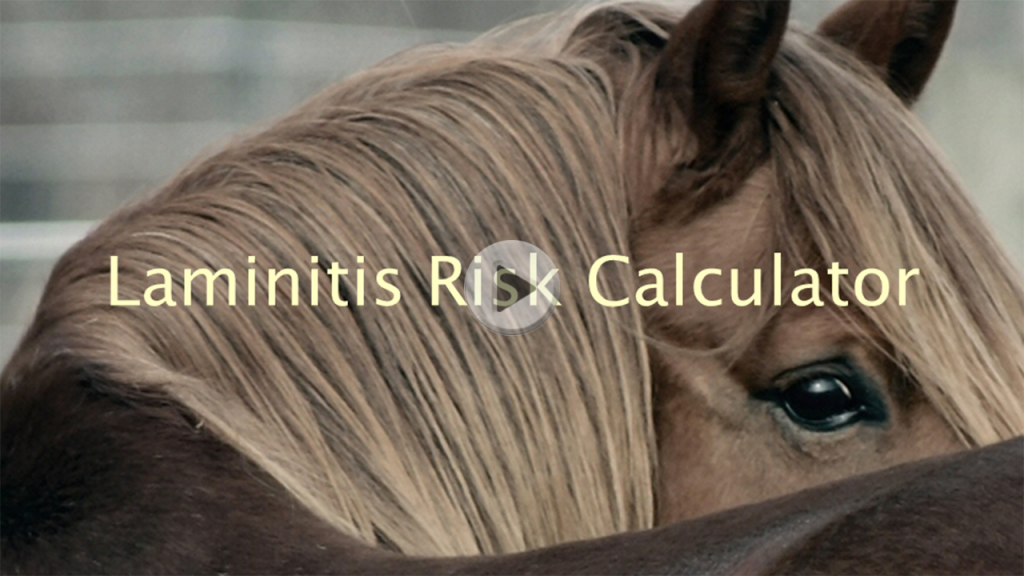
But to make these calculations even easier and put the power to make a difference directly in the hands of those working “in the field,” I’ve created an app for the iPhone that’s now available in Apple’s App Store! The following video will walk you through the features and use of the app –

Laminitis Risk Calculator Video

What I don’t really emphasize in the video is that the app is great for figuring out any horse’s dietary requirements and current caloric intake. In fact, I used it for my own horse last week so I could figure out how many days per week he needs to be wearing a grazing muzzle. So your horse doesn’t need to have laminitis for this to be a useful addition to your “horsey” repertoire; it’s intended, as I’ve already mentioned, to help prevent laminitis.

To find it in the App Store, just search on “laminitis.” I have several more apps in the works, and I’ll be adding a Support Page on the website for this app in the near future. I also hope to have an Android version available soon as well.

Meanwhile, please share this video with your fellow horse owners. If it helps save even one horse from the most painful condition a horse can endure, it’s well worth the effort.

Best wishes for a happy and healthy riding season with your horse!

First and foremost, I want to remind everyone, particularly my European readers, that the registration deadline for the Insights from World Leaders in Hoof and Horse Care conference and natural hoof care training workshop is upon us. I would encourage every horse owner to consider joining us next month in Barcelona, Spain for this important and highly-informative event. It’s not often we make an appearance in Europe, so this opportunity may not be available again for quite some time. But you’ve got to sign up now!

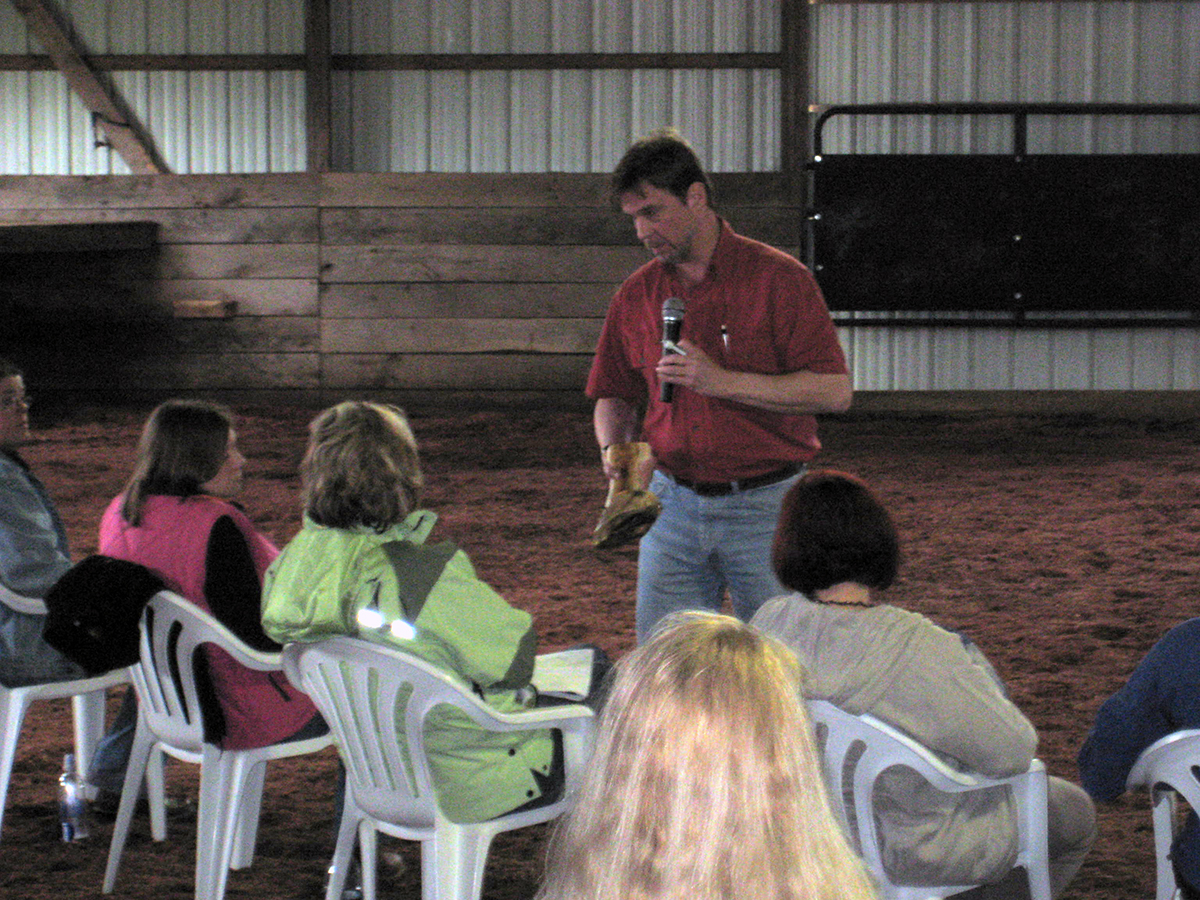
Workshop - Sunset Farm Saddlebreds

I’m also pleased to announce that I’ll once again be offering my one-day Understanding Natural Hoof Care lecture/workshop Saturday, May 25th on the Ohio State University ATI campus in Wooster, OH. I probably should consider changing the name of this clinic, because it sounds as if it’s only about so-called “natural” hoof care when, in reality, it’s about every type of hoof care. So while I haven’t really stressed this in the past, I firmly believe the lecture-only option for this workshop is immensely useful to every single horse owner who has anything more than just a passing interest in the long-term comfort and soundness of his/her horse, regardless of personal hoof care philosophy, because it explores the why of hoof care and emphasizes what can and cannot be accomplished through trimming and shoeing. As such, it gives the horse owner a much more in-depth look at the key aspects of hoof care philosophy and practice than can possibly be conveyed during trim appointments or through casual reading. I like to think it provides an unparalleled wealth of hoof information in an easily-understood format over the course of 5 hours, and is a real bargain at only $75 including all materials plus lunch! So grab your riding friends and come join us for an entertaining and educational look at arguably the most important part of your horse’s anatomy.

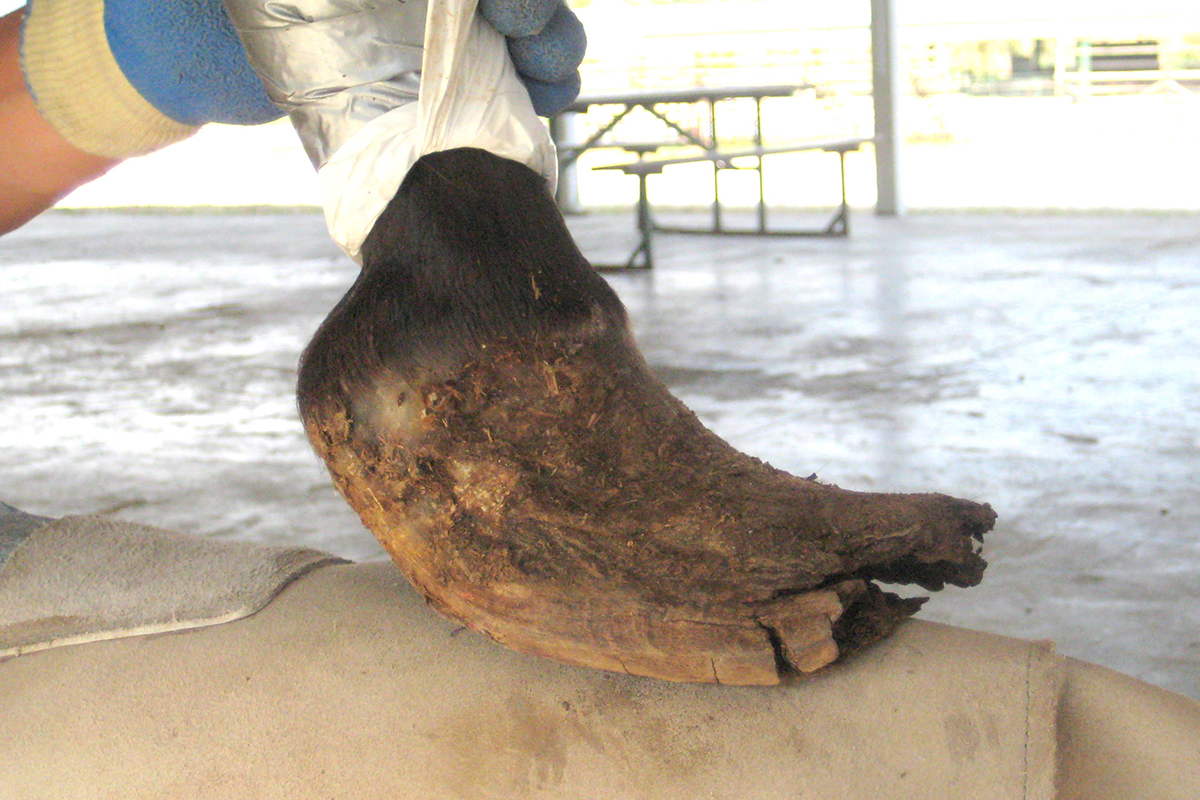
For those interested in an even more intimate hoof experience, the full-day workshop continues for another 3 or so hours with step-by-step trimming instruction using cadaver hooves to provide a safe learning environment for horse owners who want to learn more about what it’s like to actually trim a hoof.

Cadaver Hoof - Liberated Horsemanship Clinic

An important consideration is that once you’ve attended one of my lecture/clinics, you’re welcome to attend any future offerings of the same workshop (regardless of the location) for no additional charge except materials – a real bonus in terms of keeping up with current information. I have several participants who’ve attended multiple times, and I expect I’ll continue to see them because I’m always adding new content!

I hope to see you all there. But sign up soon, because space is limited. Here’s a description…

Understanding Natural Hoof Care

Given the overwhelming amount of information available to today’s horse owner, making well-informed decisions about hoof care can be a daunting undertaking for those interested in both short-term performance and long-term sound­ness. When facing abnormal conditions such as laminitis or navicular disease, the challenges are even greater, and the horse owner can suddenly find himself/herself at the mercy of conflicting advice from well-meaning veterinarians, farriers, and other horse owners.

Through the use of large-screen video and other visual aids, this lecture/clinic presents anat­omy, biomechanics, and hoof care theory in a comprehensible and logical format that will equip the horse owner with the information necessary to make informed decisions based on fact, not sup­position. For those desiring a more intimate look at the actual trim experience in anticipation of further education, or just wanting to “get their hands dirty,” the clinic continues with a descrip­tion of tools & tool use, the step-by-step process of natural hoof trimming, and hands-on guided in­struction through the natural trim process using cadaver hooves.

Date:           Saturday, May 25th, 2013

Time:          9AM – 5PM (lecture portion ’til 2PM)

Location:    OSU Agricultural Technical Institute, Wooster, OH

FAQ Sheet:  Click Here

Cost:           $300 (materials & lunch incl., cadaver hooves extra)                               $75 lecture only (materials & lunch incl.)

Register:     Click Here

[DKB url="http://enlightenedequine.com/wp-content/uploads/2012/03/Understanding-Natural-Hoof-Care.pdf" text="Print a Flyer" title="Hang it in the barn or hand it out!" type="extrasmall" style="gradient" height="30" width="" opennewwindow="" nofollow="" color="#d5a251" textcolor="black"]