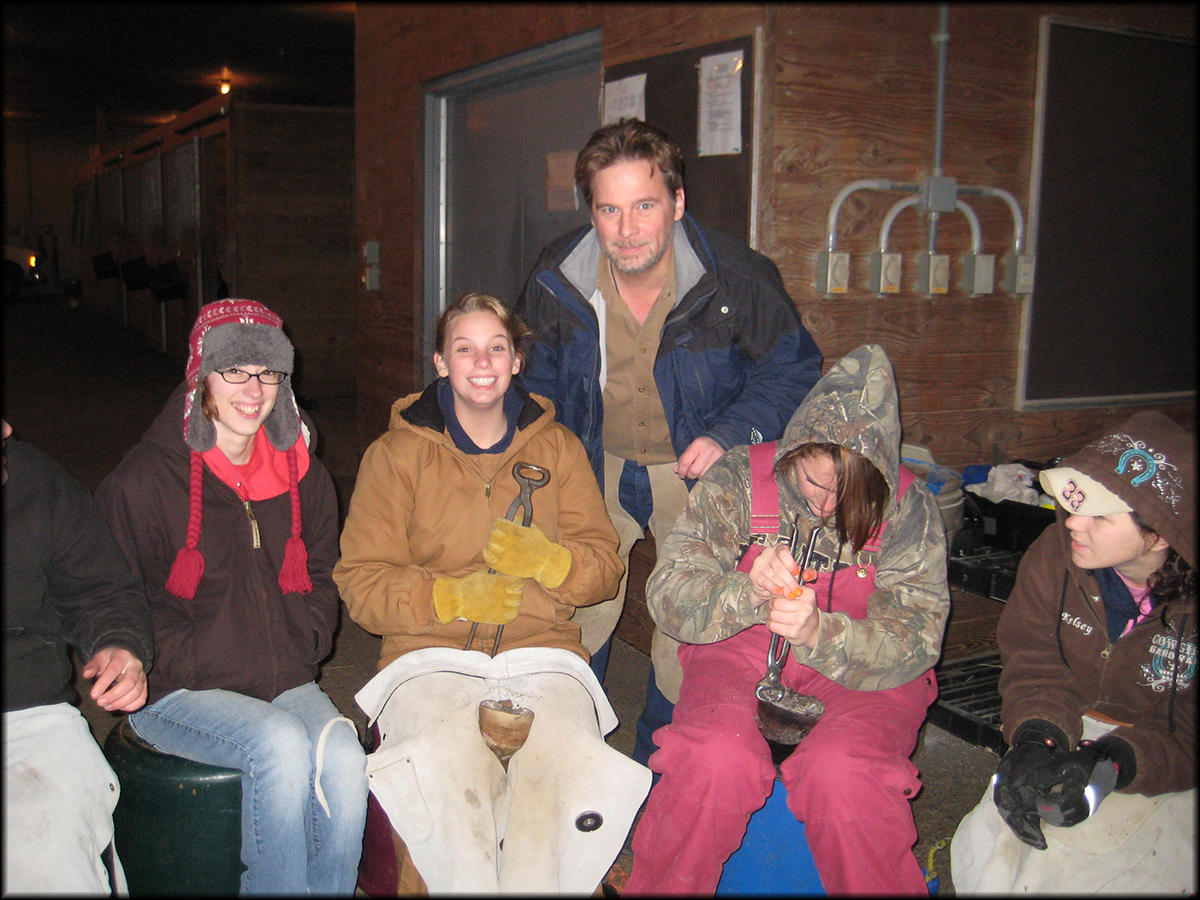
Steve & ATI students

A very quick estimate reveals that I’ve now spent well over 10,000 hours in university classrooms over the past 34 years, teaching a wide variety of technical subjects to students of all ages and backgrounds. Those teaching experiences, along with my other parallel careers/passions – electronics engineer, hoof care professional, recording engineer, and jazz musician – have indeed given me a very rich and full life. And while I’d be hard-pressed to pick a “favorite career” among them, I have to say that I truly enjoy sharing my knowledge with others.

The last couple of weeks have been particularly rewarding, because in addition to my usual classes, I’ve had the pleasure of teaching some basic hoof theory and trimming to the Horse Health & Disease class in our Horse Production and Management degree program. I’m a big fan of such two-year programs, because, depending on your career objectives, I believe programs like this offer students the best return on their investment in terms of practical, real-world experience coupled with relevant theory and some broader liberal-arts education. Most of these programs have a particular focus; in our case, we have an emphasis on reproduction and genetics, and students gain considerable experience in both live cover and artificial insemination in our 46-stall barn, breeding shed, and laboratory. And Dr. Karen Wimbush, the program’s Technical Coordinator, is to be commended for her dedication to continually improving our course offerings.

This three-week series of lectures and laboratory experiences has been designed to equip the students with the knowledge necessary to make informed decisions about hoof care based on science, and not on the hearsay, speculation, and out-and-out incorrect information so often offered up by well-intending but misinformed horse owners, farriers, and veterinarians. And so our first class concentrated on examining the characteristics of both a correct and incorrect landing, the factors that determine the form of the hoof and how it lands, and the short- and long-term movement and health consequences of proper and improper landings – a great start for any horse owner!
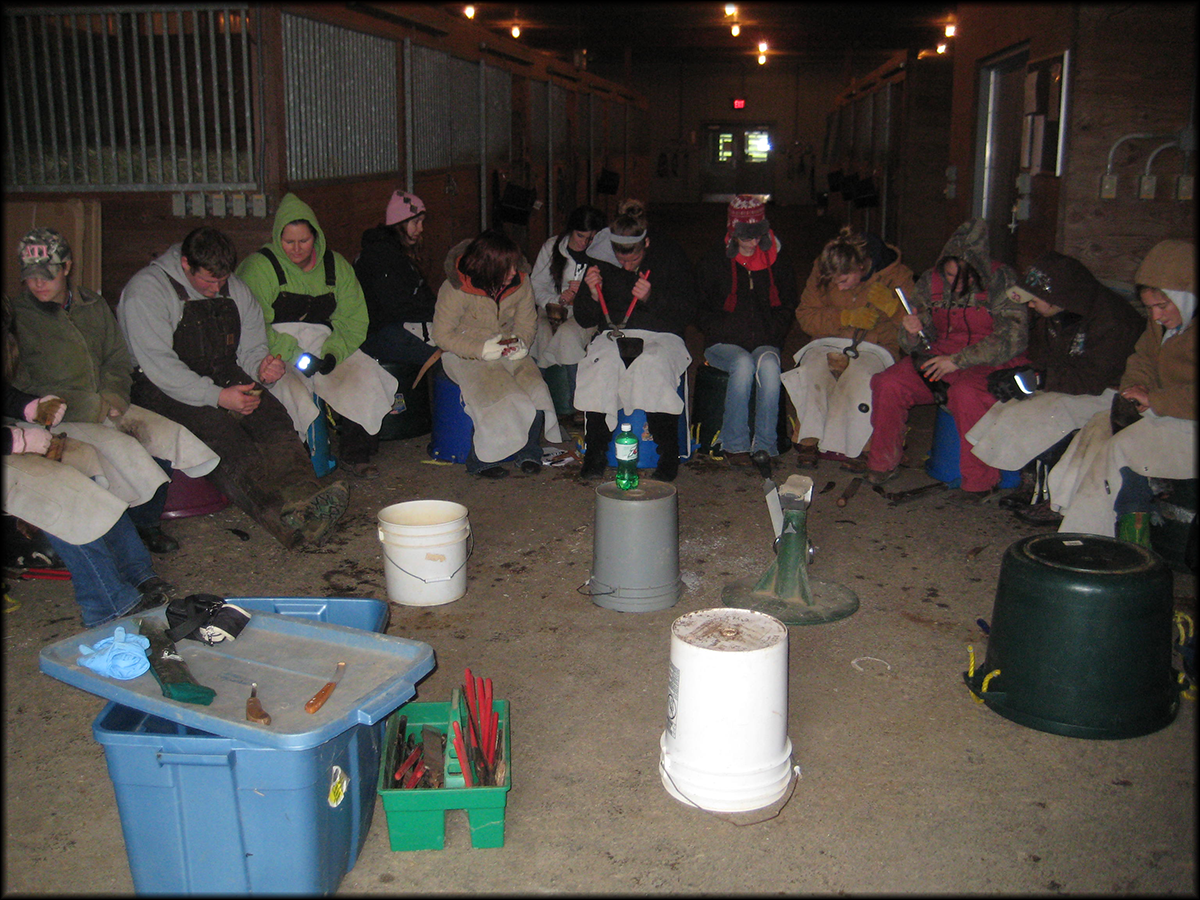
ATI students trimming cadaver hooves

Then, this past Thursday, we gathered at the barn to brave the cold and do some hands-on trimming of cadaver hooves. “Sounds gruesome!” you might say, but there are some important advantages (as well as a couple of disadvantages) to using cadaver hooves to teach trimming. First and foremost, it minimizes the risk to the student. It’s enough of a struggle for a beginner to learn to use the tools correctly, so complicating the situation with trying to properly hold and safely manage a horse at the same time is, in my opinion, not in everyone’s best interest. I once heard someone liken hoof trimming to trying to carve a duck out of a flying piece of wood, and, believe me, that’s very close to the truth! And second, it also minimizes the risk to the horse. After all, it’s pretty hard to lame a dead horse. So I generally prefer to begin any hands-on instruction using cadavers.

The lead-up to the cadaver trimming class got off to a bit of a rocky start, though. The short version of the story is that the frozen hooves were delivered on Friday while I was in Massachusetts visiting Annie. Trouble was, they couldn’t find them to get them into our big walk-in freezer. And so the hooves ended up sitting in my office all weekend, thawing and smelling! And then Hurricane Sandy caused my return flight to be cancelled, so instead of teaching half the class Tuesday and half Thursday, per the original plan, we had to group the entire class together for our big trim adventure with the smelly hooves. But all’s well that ends well, as they say, and everyone did a fine job with their hooves.
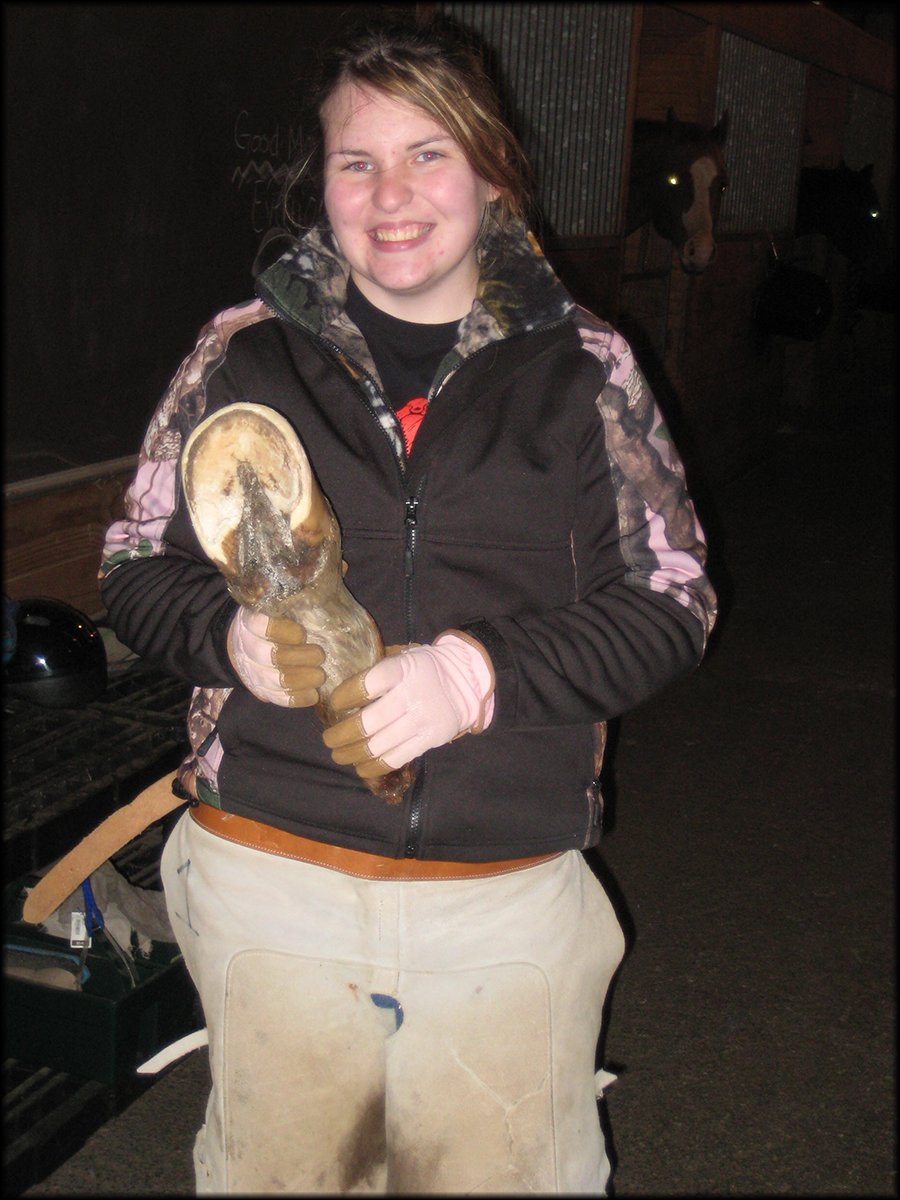
A happy student with her hoof!

Next week, we’ll finish up this brief look at hooves by trimming live horses. And even though we’ve barely scratched the surface in terms of both theory and practice, if this group is like every other person I’ve taught how to trim, they’ll emerge with a new respect for their hoof care provider, whomever he/she is!
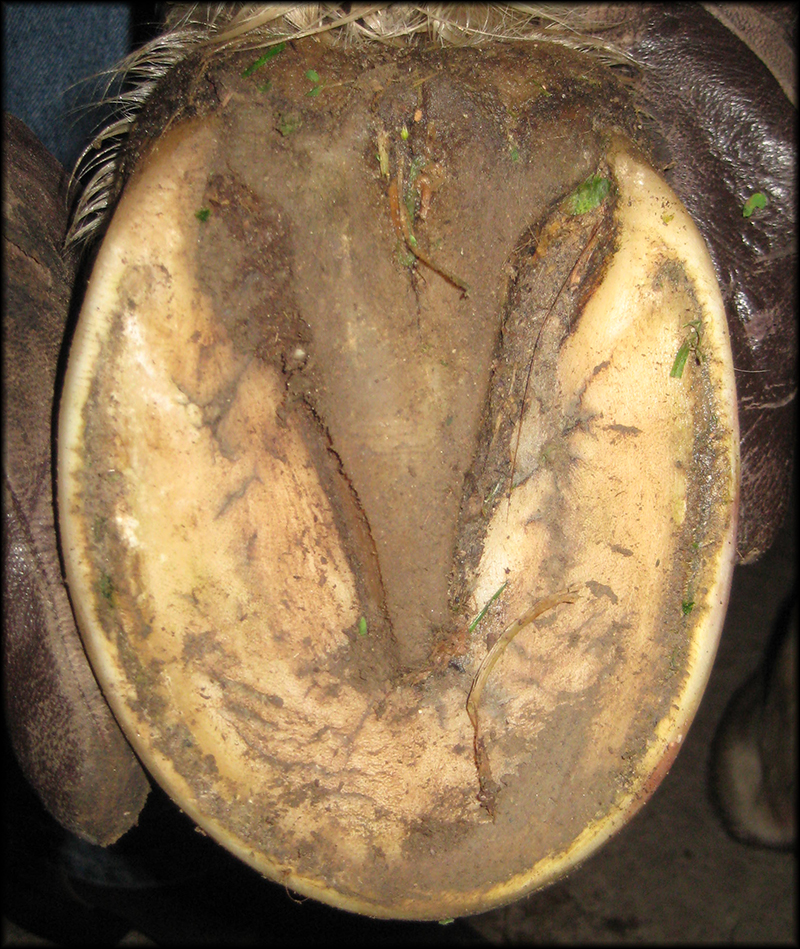
Properly-trimmed bare hoof
A client horse’s beautiful white hoof!

New clients, particularly those with horses going barefoot for the first time since their youth, often ask, “When can I ride my horse again?” as I’m finishing up the first trim. That question used to puzzle me quite a bit, because nothing we do ought to affect a horse’s comfort in any way but positive. But an experience with a farrier finally made that question make perfect sense.

I was trimming a couple of horses for a new client some distance from home when her farrier walked into the barn. I later realized this had been the plan all along; she wanted him to observe me so he could “duplicate” the natural trim and continue using him, which I didn’t particularly appreciate. Nor, by the way, do I think anyone can grasp true natural hoof care simply by observing a single trim. But that’s not the issue at hand right now, so I’ll defer comments on that subject to another time. At any rate, he was a nice guy and I enjoyed talking with him. But after he’d watched me for a while, he suddenly said, “I see you don’t cut into any live tissue.” “No!” I replied with some shock. “Do you???” He then explained that at the very well-known and well-respected farrier school he’d attended, they were taught to cut into the live tissue of the sole (“pare out the sole”) as part of the trim process before applying a shoe.

And then it all made sense! I realized I’d watched other farriers who had trained at this same institution cut away sole tissue until they could flex the sole with their thumbs. I don’t think you have to be a genius to figure out that if I can flex the sole with my thumbs, a 1,000-pound horse stepping on a rock is going to hurt! But this, at least in my experience, is a very common practice. I remember helping a young farrier with his trimming some time later, and watching him cut the toe way down into live tissue. “Too short?” he’d ask. “Yes!” I’d reply, “When you see red (blood), it’s definitely too short!”

This is why new clients often ask that question; they’re used to having their horses be a bit tender after shoeing because living tissue has been violated. Obviously, the shoe, acting as a spacer between the sole and the ground, helps mitigate the discomfort. But this is why so many people who “try” taking their horses barefoot aren’t successful – because the same person who shoes their horse, cutting into living tissue as part of the process, is the person who trims their horse to be barefoot. And the horse, predictably, ends up sore – sometimes very sore. The owner then concludes the horse can’t be barefoot, and the shoes go back on. And “barefoot” takes the blame, even though the horse really never stood a chance because he wasn’t given a chance.

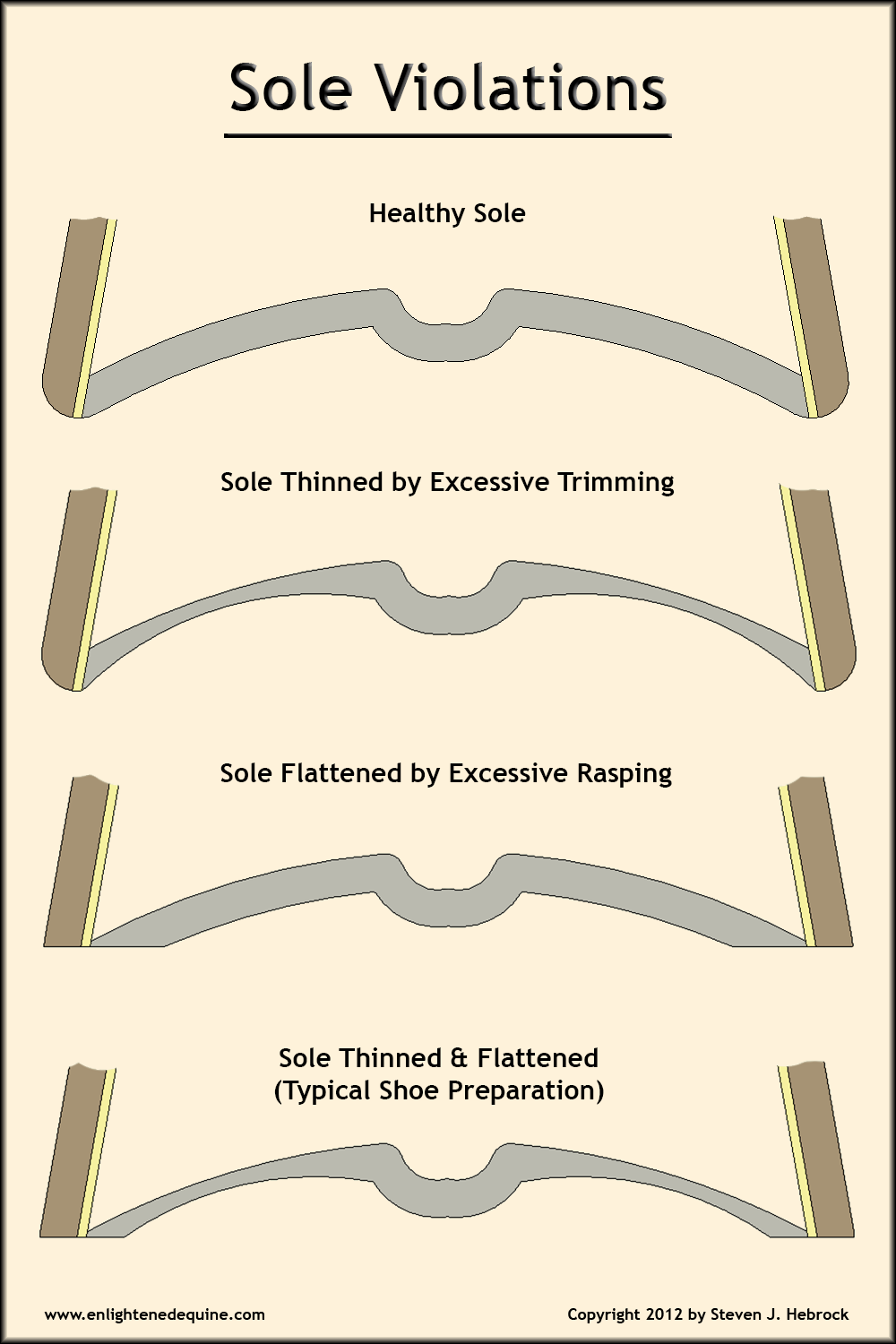
I typically see several different variations on sole tissue violation, depending on the farrier/trimmer. To be fair, many so-called “natural” hoof trimmers are also guilty of these same errors. But true natural hoof care never removes living tissue, but always removes only the ready-to-slough-off tissue that adequate movement over suitably-abrasive terrain would remove, given the opportunity. The illustration below shows a cross-section of the wall/sole/frog at the widest part of the hoof –

Chart of sole violations

The top illustration shows the concavity and consistent thickness of a healthy hoof with all of the “junk” exfoliated. As you’ll note, the sole blends smoothly into the wall (at the white line), with no “lip” or “rim.”

The second drawing depicts the very common situation where the trimmer has “pared out” living sole tissue. This weakens the supporting and shock-absorbing capabilities of the hoof, allowing the weight of the horse to flex the sole more than it should, and therefore more readily come into contact with the ground. That, combined with the sensitive tissue that’s been exposed through over-trimming, often makes the unshod horse very sore on anything but a flat, unyielding surface. Even if shod, this horse will be sensitive on rocks or large gravel until the sole has had the chance to grow back. Often, these horses end up with very flat soles until proper hoof care is implemented.

Another very common scenario is shown in the next image, where the trimmer has over-rasped the hoof and violated the hoof’s concavity. It appears as a “rim” of sole inside the hoof wall, and is often covered up by a shoe. This destruction of the sole’s natural concavity also weakens the supporting and shock-absorbing capabilities of the hoof as above, although these horses, if shod, are often not as obviously sore because the over-thinned portion of the sole is covered. On the other hand, the loss of concavity places the sole that much closer to the ground. These horses can often take quite a while to regain the lost concavity, depending on the severity of the situation. These soles will sometimes appear to be flat, but only because the surrounding wall has been cut too short. An improperly-exfoliated hoof can mimic this problem, incidentally, because normal wall rasping flattens the sole material that should’ve been removed; the only way to distinguish between the two is by proper exfoliation.

The last illustration combines the previous two problems, and is what I witness in nearly every shod horse to one degree or another. This is why a shod horse often has trouble transitioning to barefoot: his hooves have endured many years of highly-invasive trimming with its attendant sole thinning and loss of support, and the horse is understandably uncomfortable on anything but the most forgiving terrain. In these situations, hoof boots are often necessary to allow the horse to be pain-free when ridden until the hoof recovers.

Proper hoof care should never cause pain. Sadly, many horses never get to experience that life. But once you understand what the farrier is doing, it’s pretty simple to understand why so many owners believe his or her horse cannot be without shoes, or have limited success with being barefoot. But the only way to truly “give barefoot a chance” is to hire a well-trained natural hoof care provider who understands what genuine natural hoof care is all about. So if your hoof care provider is guilty of either (or both) of these errors, don’t you owe it to your horse to look elsewhere? I think he’d think so…

One of the constant frustrations I encounter is nicely illustrated by the preceding clip from the 2004 – 2008 television show Wildfire. No, I’m not talking about chipped hooves and the common perception that they’re a problem; I hope I’ve adequately addressed that issue in earlier posts. What I’m talking about instead could perhaps be called the “expert syndrome,” which is when someone with a small amount of knowledge in a particular subject area feels qualified (and compelled) to offer his or her opinion on the subject to an extent that’s far in excess of what he or she actually knows.

I want to be absolutely clear here that I am not saying these people are stupid or incapable of learning. I’m talking about the gaps every person alive has in his or her knowledge. For example, I’m probably the most ignorant person on the planet when it comes to sports. I have no interest in the subject, and I know nothing about it. But most importantly, I know I know nothing about it and therefore refrain from commenting on it. That distinction is the subject of this article.

The “expert syndrome” is extremely common and certainly not confined to the horse world. For example, when I worked full-time designing professional audio products, a colleague once complained that a reviewer for the leading industry publication had written a rather bad review of one of her company’s new products, describing in technical detail a very specific problem with its performance. So she had the engineering department measure and re-measure samples of the product in an attempt to identify and fix the problem. Trouble was, they couldn’t find the problem; in spite of their $100,000-plus testing facilities, they simply couldn’t get the problem to show up. After about a week of this, she called the reviewer to ask him about the test conditions he’d used  to test the product for the review. His answer? “I didn’t actually measure anything, but I heard the problem while listening in my living room.”

I won’t even bother describing the differences between objective measurements done under very controlled laboratory conditions and one person’s subjective opinion in his living room, but I’m sure you get the idea. The more amazing part of this situation is not that he gave very specific numbers in his review as if he’d measured the product, but that he apparently thought nothing of writing a bad review of the product (which could’ve had dire consequences for the company) based on absolutely no objective information!

In the equine world, this often translates to some trainer or owner freely offering advice or making some proclamation as if it were based on actual data rather than anecdotes or speculation. Yes, I know it’s just a television show, but how many Wildfire fans nevertheless ended up believing that horses must be shod to avoid “risking a chip”? Even within the story line of the show, there’s nothing about this young woman’s history that would put her in a position to make such an authoritative comment on hoof care.

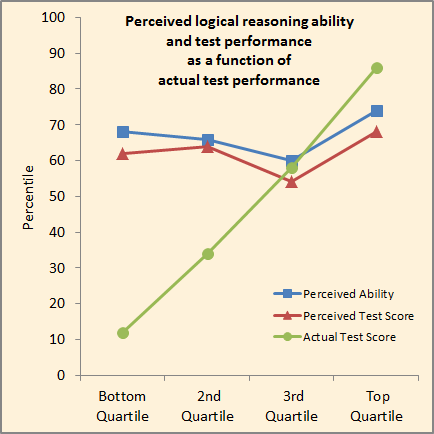
Some folks at Cornell University have actually measured this misperception of self- knowledge, and reported their findings in a paper authored by Justin Kruger and David Dunning and published in the Journal of Personality and Social Psychology entitled “Unskilled and Unaware of It: How Difficulties in Recognizing One’s Own Incompetence Lead to Inflated Self-Assessments“. In this study, the authors asked people to assess their knowledge of a particular subject area, and then tested them on that subject. Following the test, they also asked each participant to assess how they thought they’d performed on the exam. The results for logical reasoning ability are reproduced below –

Graph of perceived versus actual ability

As is obvious, the people with the least amount of subject knowledge grossly overestimated both their knowledge and their test performance. And not just by a small amount; their actual knowledge ranged from approximately one-half to only one-sixth of what they thought they knew! That truly frightens me, because the data suggests that half of the population overestimates its knowledge of a particular subject to a very significant degree.

The big problem, as the title of the paper points out, is that people don’t know what they don’t know. Based on their study, the authors make four “predictions” about the connections between competence, metacognitive ability (the ability to “know what one knows”), and inflated self-assessment, which I’ve summarized below –

  • Incompetent individuals will dramatically overestimate their ability and performance relative to objective criteria when compared to their more competent peers
  • Incompetent individuals will be less able than their more competent peers to recognize competence when they see it, whether their own or someone else’s
  • Incompetent individuals will be less able than their more competent peers to use information about the choices and performances of others to form more accurate impressions of their own ability
  • Incompetent individuals can gain insight about their shortcomings, but this comes by making them more competent, thus providing them the metacognitive skills necessary to be able to realize they have performed poorly

So the bad news is really the inability of these “experts” to know they’re not experts, which means it falls to the rest of us to try to sort things out. And that’s not always easy to do, because if we were experts in the subject area in question, we wouldn’t be seeking the advice of others! So it’s almost the classic “Catch-22.”

What can the horse owner do? Well, the study shows us that as a person’s actual subject knowledge decreases, his or her perception of their knowledge increases. So the most questionable sources would seem to be the individuals who freely offer advice about aspects of equine management that, logically, one wouldn’t expect them to have knowledge of, have nothing in their backgrounds that suggests knowledge of the subject area in question, and/or otherwise offer vague credentials such as “because I love horses” or “because I’ve been around horses my entire life.”

Unfortunately, and contrary to popular opinion, this also includes many veterinarians when it comes to hoof care. Logically, a veterinary student cannot spend much time on any particular aspect of the horse, since, in four years’ time, they have so much to learn – mostly about small companion animals. It’s not possible for them to spend more than a very small fraction of their time (maybe a class or two) on the equine digit. Yes, we horse owners tend to expect them to have the knowledge, but it’s simply not logical to assume they have it. After I posted Toy Story, I received a number of comments from horse owners and other hoof care professionals lamenting about similar experiences. Here’s one comment from a very well-trained and highly-experienced trimmer –

When I began to trim I asked my farrier, who had moved away, about barefoot trimming. He told me to keep records of at least the first year of my trimming and figure out what the success rate was for lame horses that I trimmed. He had spent years as the orthopedic shoer for the Florida vet school. He told me that the vet/farrier combination had less than a 30% success rate for bringing lame horses back to soundness; that most of what they did was simply extending the horses’ usability for a couple more years. My first year of trimming had an 85% rate in returning horses to work under saddle, many of those with a veterinary recommendation for euthanasia, After that, I was off and running with barefoot trimming.

Board-certified veterinary surgeon Neal Valk, who teaches in our training program, has told me similar things; that, even as a “super vet” from an education perspective, he was taught very little about hoof care, and what he was taught was aimed at getting a bit more use out of a horse, with the full knowledge that once the owner went down the “corrective shoeing” route, it was only a matter of time before it no longer “worked.” But this post has gotten much longer than intended, and I’ve got to wrap it up!

I see this lack of actual knowledge and the subsequent propagation of misinformation as a very real problem in the horse world, and I like to discuss this topic in my workshops because I want horse owners to not only be able to recognize suspect information when they encounter it, but also to halt its spread when possible. So question everyone and everything, and do your level best to share only well-researched sources of information supported by objectively-credible credentials. We all have an obligation to our horses to stop inaccurate information.

Please do your part.

Toy and Aubrey
Toy & Aubrey

I want to share the story of a horse named Toy who recently reappeared in my life. I consider my experiences with Toy to be pivotal in my development as a hoof care provider because they were particularly eye-opening with respect to the knowledge of veterinarians and farriers. And I also hope his story may save other horses and owners from needless pain because his situation is not unique; I’ve since seen a number of horses suffer for very similar reasons. So here goes…

It was early 2000. Although I’d been trimming horses for a number of years, I’d just discovered Jaime Jackson’s first book entitled The Natural Horse, and was eagerly digesting its contents because I recognized that finally there was someone in the horse hoof care world who made sense! I met Toy’s owner Susan at a horse show, where she shared his very dire circumstances with me. But I’ll let her tell you in her own words –

Toy was a barefoot horse from birth until age 6 or 7. I always thought in the back of my mind there is just something not right about nailing metal to a horse’s feet, but I had no idea about proper barefoot trimming. I had a track farrier trimming him – the guy that did the whole barn.

Toy started coming up unsound. He was diagnosed with navicular disease around 6 or 7 by a vet in Johnstown, Ohio, and we started to shoe him then. We started out with just plates, and then over the years continued to get more and more aggressive with his shoeing in accordance with what the vet would tell us.

Then around 11 or 12, he started getting progressively worse. He was then put on Isoxsuprine by another vet in Delaware, Ohio, and we were told he now needed pads and high-heeled shoes. He would go sound for a while – or what we thought was sound – but then as that started to not work, the vet in Delaware did x-rays and said his navicular bone was full of holes and in terrible shape. He then told us to jack him up even more, and put wedge pads on him too. It was to the point where the farrier I was using said he didn’t want to shoe him anymore because he said if one of the shoes and pads came off, it could be a disaster because of the angles Toy was at, and he was very concerned. The vet at this point told us that Toy had reached the end of the line and that we needed to start thinking about putting him down and that he had had a great life.

This is the point where I entered the story. From her description, I thought navicular disease was a pretty far-fetched diagnosis, and urged her to consider de-shoeing the horse and getting him properly trimmed before taking the final, irreversible step of euthanasia. I loaned her my copy of The Natural Horse, and she contacted Jaime to see what he recommended. Jaime set her up with an appointment with Mike Lagrone – one of his very first students – who was doing a clinic in Kentucky the following weekend. So on the appointed day, we loaded up Toy and headed to Kentucky. Back to Susan –

Before the first visit with Mike, though, our vet caught wind of us taking Toy to a barefoot natural trimmer from someone up in Delaware, and he called me at work and told me that I was making a huge mistake. He said that if those shoes and pads were removed from Toy’s feet, he was in grave danger of the navicular bone completely crushing, and he would have to be put down on the spot. I chose to take my chances, as his only option was to put him down. I felt I had to try everything before that decision was made. This horse had carried my little girl as an infant, and taught her to ride and never made a wrong move with her. He was one of the most important things in her life at that time.

Everyone reading this probably knows what a “three-legged lame” horse looks like. Toy came off the trailer barely able to bear weight on his left front foot. He was wearing what I call “the usual hardware” in these situations: wedge bar shoes with full wedge pads, with silicone poured in between the pad and the sole. I’ve since taken this same combination off many, many horses – particularly those with laminitis or navicular syndrome/disease.

Mike looked over the radiographs and remarked that he didn’t see anything particularly problematic. He then removed the shoes and cleaned out the soles; so far, pretty routine stuff. His next move, however, was truly astounding.

After examining Toy’s left front hoof, Mike picked up his nippers and proceeded to cut away hoof wall from the lateral heel quarter to the toe, about a third to half of the way up the hoof! When he was done, we were looking through the side of Toy’s hoof at his coffin bone. Although Susan was practically beside herself, Toy never reacted and there wasn’t a single drop of blood. You see, in spite of the veterinarians and farriers telling her otherwise, and in spite of their willingness to put this horse down, Toy didn’t have anything wrong with his navicular bone. Instead, he had a raging case of white line disease, and the disease had absolutely decimated the lamellar connections holding the hoof wall to the coffin bone in the area that Mike resected. And because the bottom of the hoof had been sealed up with the full pads and silicone, the anaerobic organisms present in white line disease had “gone to town,” wreaking havoc on the lamellar connections.

Mike told Susan to take Toy home, buy a wire brush and her favorite hoof cleaner, and scrub the affected area with the wire brush every day. He stressed how important it was to keep the area absolutely clean, and assured her that Toy would be fine! Here’s Susan again –

After being off for a year and doing the barefoot natural trim, Toy and Aubrey went on to win the State Championship in English Equitation out of 70-some horses. That day he was not on Isoxsuprine or bute, and was barefoot.

Today he is almost 27 years old. He has arthritis – probably from the ignorance of shoeing him and keeping his weight on his toes for all those years. I often wonder if we had gotten the correct information right off the bat how much better he would be today. But at least he is still with us, and my daughter had many more wins, trail rides, and her best friend, through junior high, high school, and college.

What a story! From death’s door to state champion, only because Susan was willing to go against the advice of her veterinarians and farriers and give Toy the chance she knew he deserved. I’ve not seen Susan, Aubrey, or Toy since that day. But I’m excited because Aubrey, now grown up, has relocated to my area and, by mere chance, found me through a referral. So I’ll get to take care of her new horse’s hooves!

As I mentioned at the beginning of this post, this was a key learning experience for me as well. Up until this point, I, like most horse owners, thought veterinarians had a generally good grasp of the equine foot. Toy’s situation really shook my confidence in that belief. How multiple veterinarians and farriers could miss such an obvious problem was, at that time, simply beyond my comprehension.

I’ve since found out that veterinarians typically don’t learn much about horse hooves in school, but instead rely on the knowledge of farriers and other veterinarians. That revelation, just so you know, was “straight from the horse’s mouth” from multiple sources, although I can’t go into details. This is an unfortunate circumstance; one that I sincerely hope will change in the near future. Until then, the horse owner has very few options when it comes to accurate, up-to-date knowledge of the equine digit and its unique problems.

All the best to Toy, Susan and Aubrey for their courage!


UPDATE: According to his owner, Toy passed away in 2020 at age 34 – 22 years and a good life after his near-death experience at the hands of incompetent equine health care providers!

I’ve mentioned Liberated Horsemanship in passing before, but I thought I’d take this opportunity to discuss our upcoming clinics at the end of next month (9/28 – 10/2).

Liberated Horsemanship logo

From my perspective, what’s offered a couple of times a year in Warrenton, MO (an hour west of St. Louis) is of immense potential benefit to every horse and owner, regardless of breed, discipline, or  hoof care philosophy. Every presenter has many years of education and experience in his or her particular area of expertise, and each offers a science-based look at an ever-increasing array of subjects related to the management of the whole horse. Although all of us share our love of horses and our commitment to natural hoof care, each of us also has one or more areas of specialization that combine to form an education program that I believe is unparalleled. Where else can you hear a board-certified veterinary surgeon give you the “straight story” on what veterinarians are (and aren’t!) taught about hoof care, or a PhD research scientist at one of the top medical universities in the country discuss the effects of physical and psychological stress on horses? Get advice about forage and feeding from an agronomist, not the guy down the street. Learn about laminitis and founder from the veterinarian who funds the top laminitis researchers in the world, not from a magazine article. Dissect a cadaver hoof and gain a real appreciation for the marvelous design of the equine digit. The list goes on and on, but I encourage you to visit the website and read the biographies for yourself.

I always have a great time there. It’s a warm, inviting atmosphere that fosters learning and encourages questions. And provides answers. Consider that in this one location, you’re in immediate contact with trained natural hoof care professionals with a (rough estimate) minimum of forty thousand natural hoof trims under their collective belts! Every location, every breed, every age, every discipline, every health problem. If you need answers, I can’t think of a better place to get them!

And…there’s a good barbeque place nearby! 🙂