Some further reflection on my last Post, coupled with conversations and comments from several readers and clients, has made me want to add a few other thoughts regarding what constitutes genuine natural hoof care.

In this case, I think it’s important (and, given the plethora of folks pretending to provide natural hoof care, becoming increasingly more so) to point out that natural hoof care is absolutely not a panacea. In spite of many claims and promises to the contrary, it will not cure every possible hoof ailment. How could it? Damage is damage, and while it does offer hope for comfort and a lessening of symptoms in every circumstance (more on that in a minute), it will not fix what’s truly broken. It won’t cure ringbone or sidebone or navicular disease – assuming the diagnosis is correct (admittedly a big “if” when it comes to anything “navicular”), those are very real pathologies with permanent consequences. And anyone who suggests otherwise is doing you and your horse a disservice.

I defined natural hoof care in my last Post, but, after having just talked about what it won’t do, let me now state that what natural hoof care does have going for it is this: natural hoof care offers the best possible chance at long-term comfort and soundness for your horse, regardless of what you do with him/her and regardless of when you begin the process. Now, I realize there are people out there who don’t care about that; their entire objective is to win at whatever they’re doing with their horse. And they try to accomplish it by putting their faith in trimming and shoeing techniques that are, at best, worthless, and, more commonly, extremely destructive to their horse.  And the fact that their horse is the real loser isn’t an issue for them. I’m not talking to those people here.

The people I am talking to are those who genuinely want the best for their horse. I met a rather “classic” example the other day – a woman trying to wade through the hoof care quagmire to get the best possible care for her horses. Three of them were barefoot (her preference), but the hoof care they’d been receiving was a far cry from natural hoof care. Instead, it looked like the usual prep to put on a shoe – flat bearing surface on the wall, too short in the toe, way too long in the heels, bad M/L (medial/lateral, or side-to-side) balance, and lots of bar and dead sole left on the bottom. Banging down on their heels with every step, causing not only heel pain, but upper-body pain as well. A hoof that can’t expand properly, limiting shock absorption, circulation, and sensation. And, of course, speeding up the arthritic process with the unilateral concussion. What a mess!

Her fourth horse needs (and will have) another Post devoted to fully describing his situation, but let me just say here that he’d been diagnosed with “navicular” and had been examined and “treated” by a number of vets and farriers, culminating in him being shod with things that had more in common with the Marquis de Sade than with hoof care. To make things really interesting, it was undoubtedly one of the worst trimming/shoeing jobs I’ve ever seen. This horse was sore!

These are the situations that make me angry. This is when I imagine seeing that vet and farrier subjected to the same torture they’ve put the horse through. Is ignorance a crime? No – of course not. But bad work, and, worse, recommending things that a 10-year-old with even a modicum of common sense could see are illogical, should be. Pretending to know things when you don’t should be as well. And the whole topic of knowing what you don’t know reminds me of an experience I had some years back…

When, after several years of contact with Jaime Jackson via email and telephone, I finally went to study with him in person, I’d asked him to bring along “challenging” cadaver hooves to trim since I was pretty confident about trimming “normal” feet. So after trimming a couple of pretty typical hooves, he pulled out the sorriest-looking mess of a hoof I’d ever seen – including in photos – and handed it to me. I studied it for a minute or two, and Jaime asked me how I was going to proceed. I started off my plan by saying, “I think,” only to have him interrupt me. “You think?” he said. “You THINK??? Listen, if you don’t know exactly how to proceed, you have no business touching this hoof!” After another minute of studying the awful thing, I simply handed it back to him. A big smile appeared on his face, along with the words, “That’s exactly what I wanted you to do!” I knew what I didn’t know, and he knew it, too! We then trimmed that hoof together – still the worst one I’ve ever seen – and dissected it when we finished. It didn’t even have a coffin bone left; it had been completely reabsorbed!

That was a very valuable lesson for me. No horse should ever pay the price for a care provider’s ignorance. The good news for these four is that it’s now over, and what a joy it was to see all of them walk off more comfortably after being properly balanced. Does the one horse truly have navicular disease? I don’t know yet – I’ve not seen any imaging, and it’s too soon to tell clinically. But he’s very obviously more comfortable, so, regardless of the ultimate diagnosis, he’s on the path to being as sound as he can be.

So, just a few more points about natural hoof care before I end this Post. The list, by the way, isn’t in any particular order and isn’t intended to be comprehensive. Also note that I’m still not describing the physical characteristics of a properly-trimmed hoof. That’ll have to wait for yet another Post.

  • Natural hoof care is right for every horse, but not for every owner. If your expectations are unreasonable, you’re not going to be happy even though your horse will be happier. The worst kinds of situations are those where the horse has been shod his entire life, stands 24/7 in a urine-laden stall eating the horsey equivalent of ice cream and bonbons (lots of processed feed and treats), and the owner wants you to “do that barefoot trim thing” so he/she can ride him 20 miles over rocks tomorrow. Not happening.
  • Natural hoof care makes sense, both viscerally and intellectually. If it didn’t, I wouldn’t be doing it. If it doesn’t to you, you shouldn’t be doing it either. Period.
  •  Natural hoof care takes time. The hoof grows fairly slowly, and achieving proper hoof form and function is very likely to be measured in months, not days or even weeks. The entire body often has to re-balance itself after years of uncomfortable and/or abnormal movement. Don’t expect to have a new horse tomorrow when you’ve both been living with the old one for years.
  • Natural hoof care is still atypical. Your horse’s hooves are likely to look very different from every other horse in the barn, so be prepared to hear about it from your friends, your trainer, the barn manager, and every other person anywhere nearby. Know that you’re absolutely doing the best for your horse, and remind yourself there’s plenty of data to support your position. Stand up for your horse’s right to be sound!
  •  Natural hoof care is a commitment. You can’t “sort of” do it – you’re either in or out. That means it matters whether or not you’re consistent in using the same (qualified) person, even if you have to wait a week or two longer than you might like. While it’s easy to tell yourself, “Oh my gosh, it’s been ___ weeks, and she’s got a couple of chips. I’ve got to get her trimmed today, so I’ll just get ol’ Charlie to give her a quick trim,” resist the urge. Your horse will be fine. Don’t risk undoing all the progress that’s been made by panic over what, to the horse, amounts to nothing.
  • Natural hoof care is a whole-body process. There are other factors besides trimming that contribute to hoof form, function, and quality, including what a horse eats, how much he/she moves, the type of terrain over which he/she moves, and (to a much lesser extent) genetics. Don’t imagine merely getting a proper trim is the end of it any more than buying a guitar makes me Jimi Hendrix.
  • Natural hoof care is about the balanced hoof, which leads to healthy hooves and balanced movement. Short and well-rounded for efficiency. All the dead sole material exfoliated for proper expansion and shock absorption. Absolutely minimal concussion at impact to stave off osteoarthritis and other joint and bone degradation. And no “corrective” anything – ever. The trim allows the horse to move properly; it does not make the horse move in a particular way. And it’s not about angles, lengths, or any other numbers, just so you know.

‘Til next time…

It’s not unusual these days to hear horse owners, farriers, and even veterinarians talk about so-called “natural” approaches to a wide variety of equine health and management topics, including vaccinations, deworming, feeding, and hoof care. Since (as I explained in my first post) my equine expertise lies primarily in the area of hoof care, that’s the only one of these I’m qualified to discuss. Hopefully, any advice you’re taking regarding any of the other issues is coming from someone equally well-educated in that particular discipline, and not just the ramblings found on so many websites! After all, a lot of folks (from altruistic to opportunistic) have eagerly jumped on the “natural” bandwagon without any credentials or data to support their claims. As usual, caveat emptor!

Sometimes it’s more effective to describe something by giving guidelines about what it isn’t, rather than describing only what it is. When educating horse people in any of the myriad circumstances in which I find myself, I always try to impress upon them that true natural hoof care is never a matter of simply removing the horseshoes and trimming the hooves as if they’re about to receive another shoe; there’s nothing even remotely “natural” about that type of trimming! Yet, that remains an extremely popular misconception. For example, I had an opportunity to speak with a horse owner the other day who described how her friend’s horse, who had been without shoes for quite a while, has developed sidebone. Sidebone, for those who may not be familiar with it, is ossification – the conversion of cartilage to bone – of one or both of the two so-called lateral cartilages. These fairly large, vertical plates of cartilage are found at the rear of the hoof on either “side” of the coffin bone, as can be seen in the following illustration –

Lateral Cartilages

These cartilages are normally fairly pliable, like a stiff pencil eraser; if you put your hand across the two “bumps” found at the top, rearmost part of the foot and gently squeeze, you’re flexing the lateral cartilages. But repeated unilateral concussion (meaning primarily on one side) hastens the ossification process. And so it was completely predictable when the horse owner went on to tell me that it appears her friend’s horse has been trimmed to leave one heel quite a bit longer than the other. This is something farriers do on a very regular basis, allegedly to “correct” conformation “problems.” Regardless of whether or not you believe it can possibly fix a twist in a limb that originates in the shoulder or hip (trust me – it can’t), it definitely creates a source of unilateral concussion which sets the horse on a path towards developing sidebone and ringbone (more about that one later). The fact that there’s no shoe on top of the unbalanced trim does not make this “natural hoof care.” It only means the situation is not quite as dire as it would be if a shoe were added to the mess, because a shoe would further increase the concussive forces as well as completely defeat any chance of the horse wearing off the uneven trimming. Again – merely being without shoes is but one step towards true natural hoof care. You can still have exactly the same disastrous consequences to your horse if the hoof care provider doesn’t fully understand what he/she is doing.

When it comes to hoof care, “natural” can be defined only one way: natural hoof care is hoof care done in complete accordance with what nature demonstrates to be true about the hoof and the forces that shape it. Indeed, nature’s name is…”physics.” Friction, mass, inertia, centripetal force, levers, equilibrium – all of these concepts, and many more, come into play when trying to grasp the realities of what makes a hoof successfully perform its primary function of facilitating movement while protecting its sensitive inner structures. There are, of course, other important roles the hoof plays in the life of the horse, but if the principal objective of efficient movement while protecting is honored, the rest will follow – naturally!

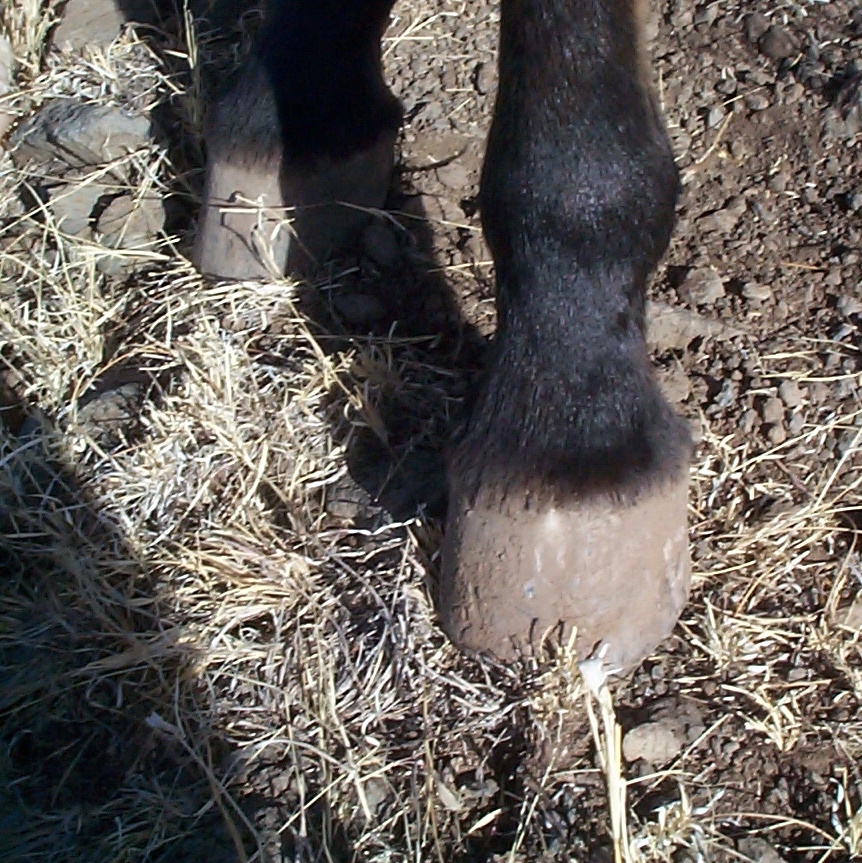
I’ll have to get into the specifics of the characteristics of a properly-trimmed hoof (whether by nature or by human) at a later time, but for now, consider what the effects of traveling miles every day over extremely abrasive terrain would be on a hoof, such as the ones shown in the following photo I took of a horse on Tomas Teskey’s ranch in Arizona –

Real Natural Hoof Care

Under these circumstances there can be no question of proper balance, since, with every step of the horse, his way of going on the rough ground will shape his hooves for optimal efficiency without compromising his comfort. There will be no excessive length, and no sharp edges to be found.

Since most of our horses aren’t fortunate enough to be kept in arid, 100-acre “paddocks” like those at Dr. Teskey’s, we must make up the difference by trimming for those same characteristics as if they were. That, coupled with proper diet and adequate movement, will ensure the healthiest, most problem-free feet possible.

And that is the essence of natural hoof care. If your hoof care professional is doing anything else – anything contrary to what your head and your gut tell you is true – he or she is not providing hoof care that’s in your horse’s best interest.

Caveat emptor!


I created the following image to compare horse and human ages some years ago, after reading the results of a study in Equus magazine. I updated it a bit, and thought I’d share it with you. It features one of my favorite photos of my first Peruvian Paso – Misionero – always known as ‘Spud.’ I didn’t give him the nickname, and have always assumed it was because he was red and round. Print him out, hang him up in the barn, and pass him along to your friends!

Horse Age

Last week was an interesting week in the “chips” department, beginning with the client, whose horse I’d trimmed only twice before, who called to cancel her appointment because her horse had chips in his hooves, and, therefore, needed to get him shod. “We tried,” she said, “but it’s just not working out.”

A day or so later, I was at a barn trimming a couple of horses while a young man intently scrutinized my work as the owners held their horses and commented on their happiness with the hoof care. “I don’t know,” he remarked. “It looks to me like that one hoof has a bit of a chip in it.”

Where does the notion that a chip in a hoof means anything more than excessive length come from? Is it because when a horse wears shoes, their hooves can’t chip because the bearing surface of the hoof wall is covered, so owners are used to seeing cosmetically “perfect” hooves (note that I’m blatantly ignoring the damage caused to the hoof by nails)? Or does it stem from an even deeper level still – some weird anthropomorphism where we equate a chipped fingernail with a chipped hoof? I honestly don’t know. I do know that people fuss about them – a lot. I even have new clients who want me to fill the chips caused by the nail damage (which I won’t do). What I DO know is the following –

  • I’ve never seen a hoof chip that involved live tissue – no bleeding, no fluid, no nothing
  • I’ve never seen a lameness, or even a mild sensitivity, caused by a hoof chip
  • I’ve never seen a hoof chip that was attributable to anything other than excessive length, with the exception of those that were the consequence of damage caused by nails

Until a horse receives proper hoof care – whether it’s an already-barefoot horse who up ’til now has only been getting the typical “pasture trim”, or a horse that’s wearing shoes, their hooves will nearly always be softer and less dense than those same hooves would be after a year of proper care (which includes correct nutrition and adequate exercise/turnout – trimming alone does not guarantee good hoof quality, just as merely being without shoes does not equate to proper hoof function). Once proper care has begun, there will still be a period during which their hooves will be more prone to chipping. After that time, most hooves hold up remarkably well; in fact, it’s pretty common for me to see a client horse with absolutely pristine-looking hooves, until you pick them up and see they need 3/8″ trimmed off!

Remember – with respect to his feet, a horse cares only about comfortable and efficient movement. That means the hoof needs to be as short as possible (without invading any live tissue, because that violates the “comfortable” part of the equation) with well-rounded edges. If there is any excessive length, which includes a sharp “edge” on the wall, the hoof will always attempt to self-trim, given sufficiently-abrasive terrain. So the only thing you should be thinking when you see chipped hooves is that it’s time for a trim!

There’s nothing wrong…really!

This is an especially exciting and important post for me. Last April, while in Warrenton, MO to do my Special Topics/Advanced Trimming workshop for Liberated Horsemanship, we all had the privilege of hearing Dr. Don Walsh of the Animal Health Foundation give a presentation on a very real and very serious threat to our horses – laminitis. In fact, I was surprised and dismayed to learn that complications due to laminitis make it the Number 2 killer of horses.

If you’ve never had the experience of seeing a laminitic or foundered horse, consider yourself fortunate. Seeing these beautiful creatures in constant pain, often recumbent and very discouraged, is the most heartbreaking type of situation I routinely encounter. The only “saving grace” for me is the very substantial difference in comfort and recovery proper hoof care (not, I hasten to say, the hoof care methods advocated by nearly every vet and farrier) can make in the lives of these horses, and watching them start to move with considerably less difficulty and pain is extremely rewarding. But, as Dr. Walsh pointed out, like so many other maladies affecting both humans and animals, the key to success lies in prevention. And prevention, in turn, requires education and awareness. To that end, Dr. Walsh has developed a risk assessment tool that uses five (5) lifestyle and management factors he and his researchers have identified as reliable indicators of the likelihood of a horse developing laminitis. And while the calorie calculations for the diet part of the assessment aren’t particularly difficult to perform, I felt the entire process could be greatly simplified by developing an MS Excel workbook that would enable every horse owner to get a better handle on these risk factors. The workbook is extremely easy to use, and incorporates calorie information from over 100 commercial feeds.  Answering just a few simple questions will allow the horse owner to not only assess the risk for laminitis, but also better understand the real dietary needs of his/her horse.

Follow the link below, and download the appropriate MS Excel file to your computer. There are two versions under the link – a 2007 version for the typical newer PC, and a 97-2003 version for the Mac and older versions of MS Excel. Rather than opening the file directly in MS Excel, I recommend you first Save the file to your computer or flash drive, and then Open it from the saved location. There are no macros in it, but I’ve protected it to ensure no corruption of the data or formulas, which is why it won’t open directly within the browser. Feel free to copy it and share it with every horse owner you know. Awareness starts with you. Spread the word. Save some horses. But, most importantly, use it yourself. Remember: it’s not about you – it’s about your horse.

I especially want to thank Dr. Walsh for providing the commercial feed data – it really helped make the workbook easier to use. And mostly I want to thank him for his seemingly tireless dedication to eradicating laminitis. Visit his site, and, if you agree, please consider making a donation…

Laminitis Risk Calculator

And I welcome any comments or suggestions you may have on how the workbook could be improved.