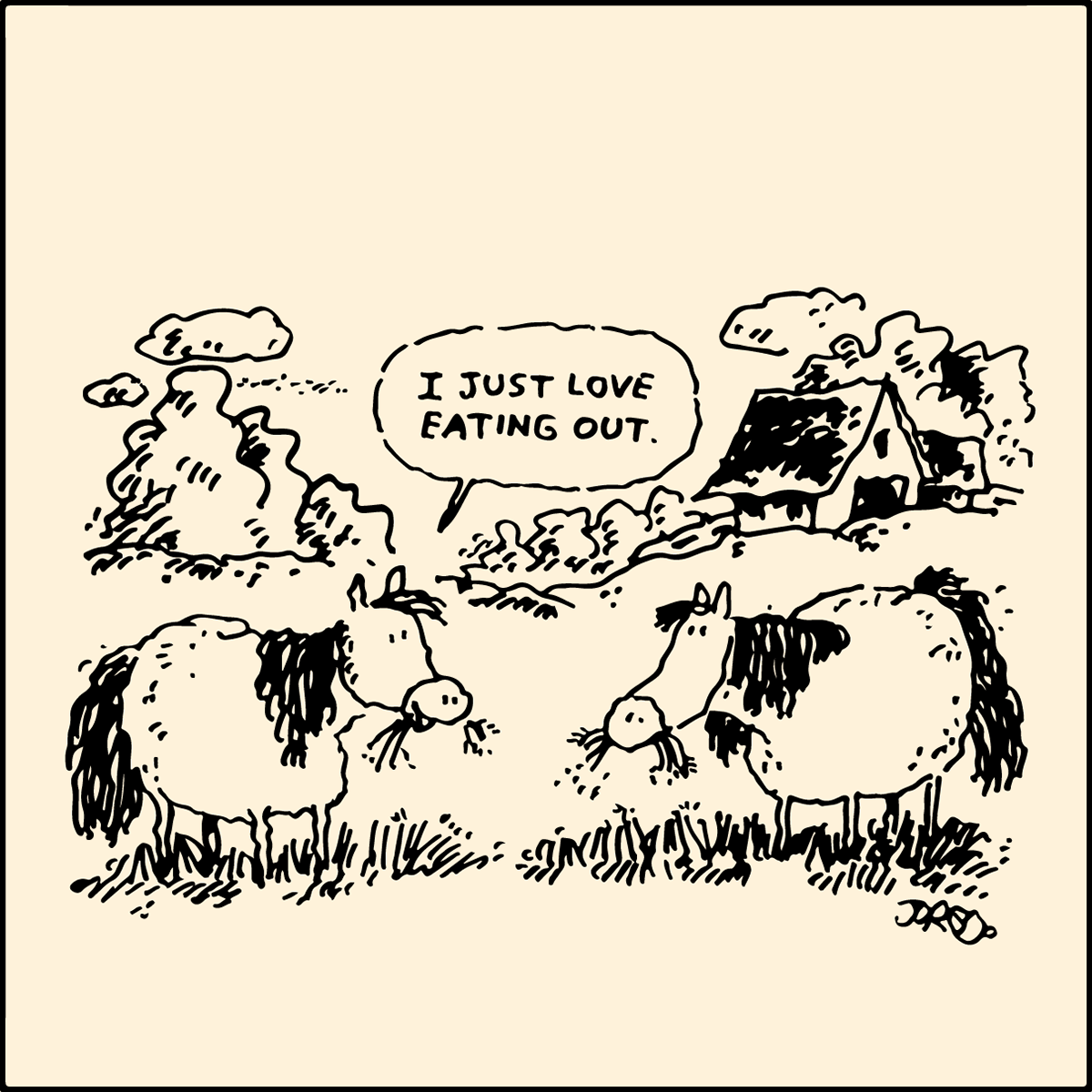
Thanks to COVID-19, most of us probably aren’t spending much time in restaurants these days. But many of our horses, on the other hand, may nevertheless be spending more time eating higher-calorie food than they should be! Yes, I realize I’m not an equine nutritionist, and I don’t pretend to be one. But I have spent a fair amount of time studying enough of the basics of equine nutrition with Dr. Jessica Bedore, my former equine nutritionist colleague at The Ohio State University, to feel competent talking about how to determine proper caloric intake.

My decision to discuss it now is being driven by three things: 1) the ever-increasing number of overweight horses we encounter on a daily basis, 2) the apparent lack of knowledge by horse owners and barn managers about how to determine how much a horse should be eating, and 3) the usual annual increase in the incidence of laminitis in the area because of the rapidly-growing (and sugar-laden) grass. And because truly comprehensive hoof care involves a great deal more than just proper hoof trimming (which, by the way, is why we spend a tremendous amount of time discussing other contributing factors to hoof quality and form in the Liberated Horsemanship Gateway Clinics), I feel compelled to share this knowledge in a sincere effort to help horses avoid the health issues that result from obesity.

Yes, I’m well aware many people find the idea of having to do any sort of calculations intimidating and even frightening. But the good news is the math we need for diet planning is extremely simple and straightforward, and can be done by anyone using even the lowliest of calculators, including the one on your phone. So let’s get started!

Part 1 of this series is aimed at teaching you to recognize whether your horse is too fat, too thin, or just right, and how to calculate how many calories per day he needs to maintain a proper weight. Probably the most standardized way of starting this process is to figure out your horse’s Body Condition Score, or BCS. This method of assessing the amount of fat on a horse’s body was developed in 1983 by Dr. Don Henneke at Texas A&M University, and the Henneke System has become the de facto standard for describing a horse’s condition.

For many, this will undoubtedly be the most difficult part of our task, simply because we horse owners can’t seem to look at our horses with an unbiased eye. But there’s no upside to convincing ourselves that our horse isn’t overweight if, in fact, he is – only a potentially horrible downside. Just make certain whoever does the evaluation is as objective as possible: someone with a discerning eye who’s willing to put aside all feelings and opinions and honestly assess your horse. And if you or your chosen evaluator isn’t reasonably familiar with the process of calculating BCS, I strongly suggest you both familiarize yourselves with this very useful process; you can find a good step-by-step article on Body Condition Scoring here, although there are a number of articles and video guides available. To help you with the actual process of Body Condition Scoring your horse, I’ve created the following worksheet and guide –
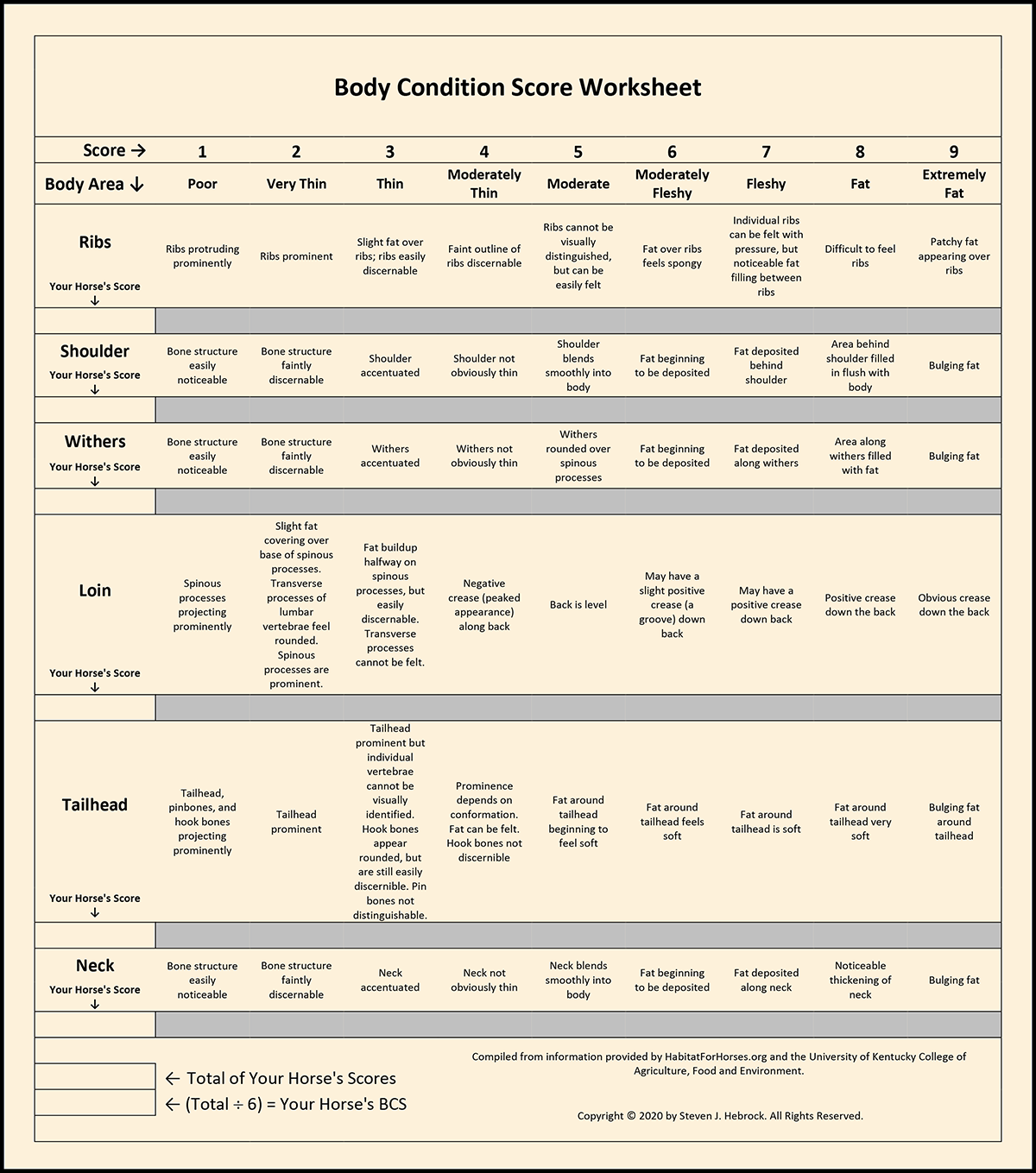
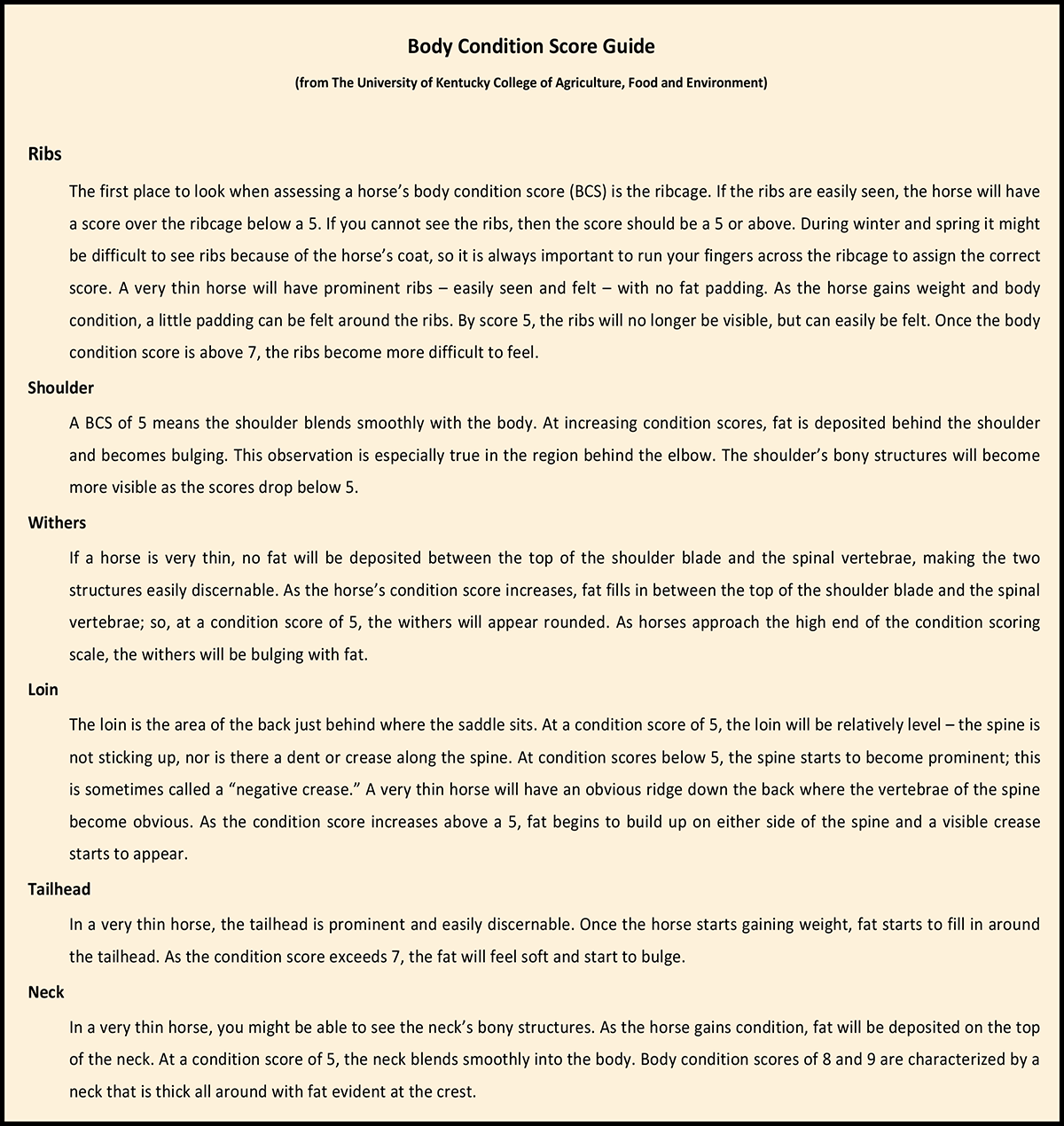
Incidentally, to make all this information a bit easier to read, use, and share with others, I’ve created a PDF file containing all of the tables, charts, and worksheets in this article for downloading and printing here!

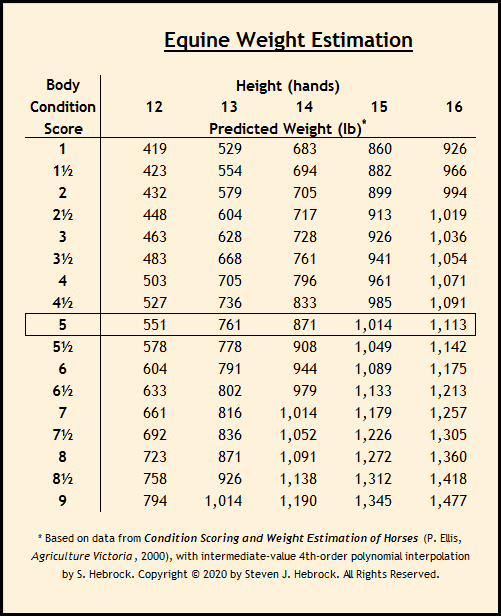
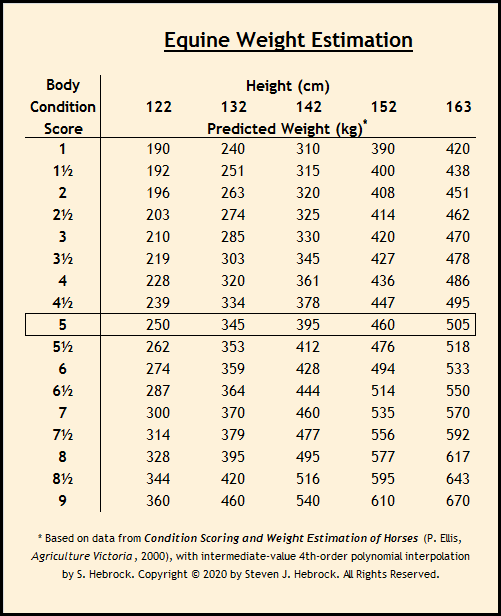
Once you’ve determined the BCS, the next step is to find out how much weight your horse needs to lose or gain. The following chart should help; just look up your horse’s BCS in the column under his height, and compare it to the weight given for the same height with a BCS 5. For example, a 15-hand horse with a BCS 6.5 (extremely common, in my experience) has an approximate weight of 1,133 pounds and a target weight of 1,014 pounds; therefore, he needs to lose about 119 pounds. Of course, these are approximations, and are presumably based on average-build i.e. riding horses. But the numbers should be accurate enough to give you a solid feel for how much weight change your horse requires. This table is in hands and pounds –
This is the metric version, with the hands heights converted to centimeters and the weights in kilograms –
At this point you may be wondering why we don’t simply use the ubiquitous weight tape instead of bothering with figuring out the horse’s BCS. A couple of reasons: 1) we know weight tapes aren’t particularly accurate, and 2) we want to actually look at the horse’s body fat to assess his condition, and not base our diet decisions solely on a string of numeric approximations. Still, the weight tape is a useful tool when it comes to tracking changes in our horse’s weight, so knowing what your horse weighs in addition to calculating his BCS is useful. However, Texas A&M University has developed a far more accurate method of estimating a horse’s weight than with a weight tape, using an ordinary cloth tape measure and some simple math as described below. I’ve discovered, by the way, that most of us will need some assistance to measure the Body Length on the average-sized riding horse; my arms just aren’t that long!
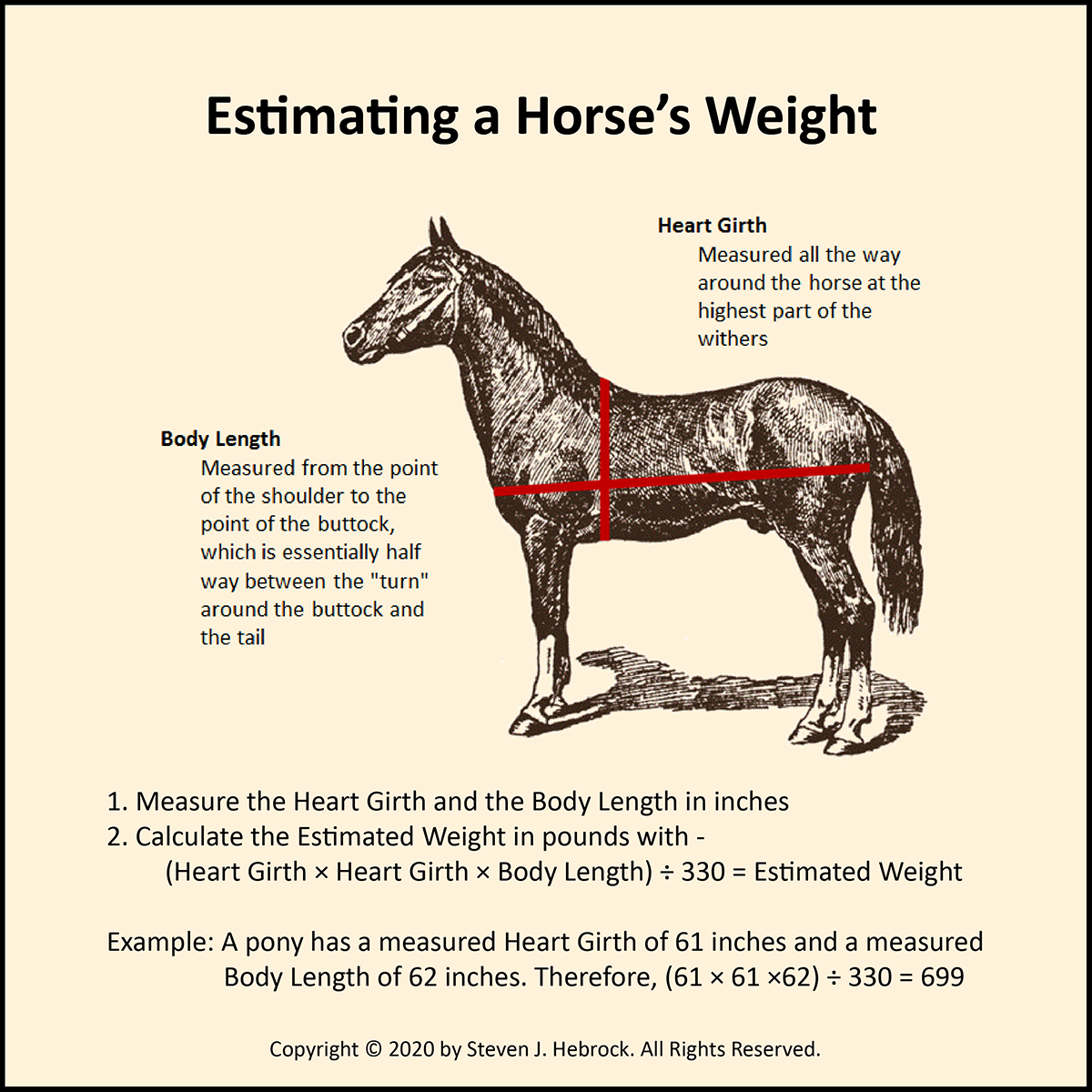
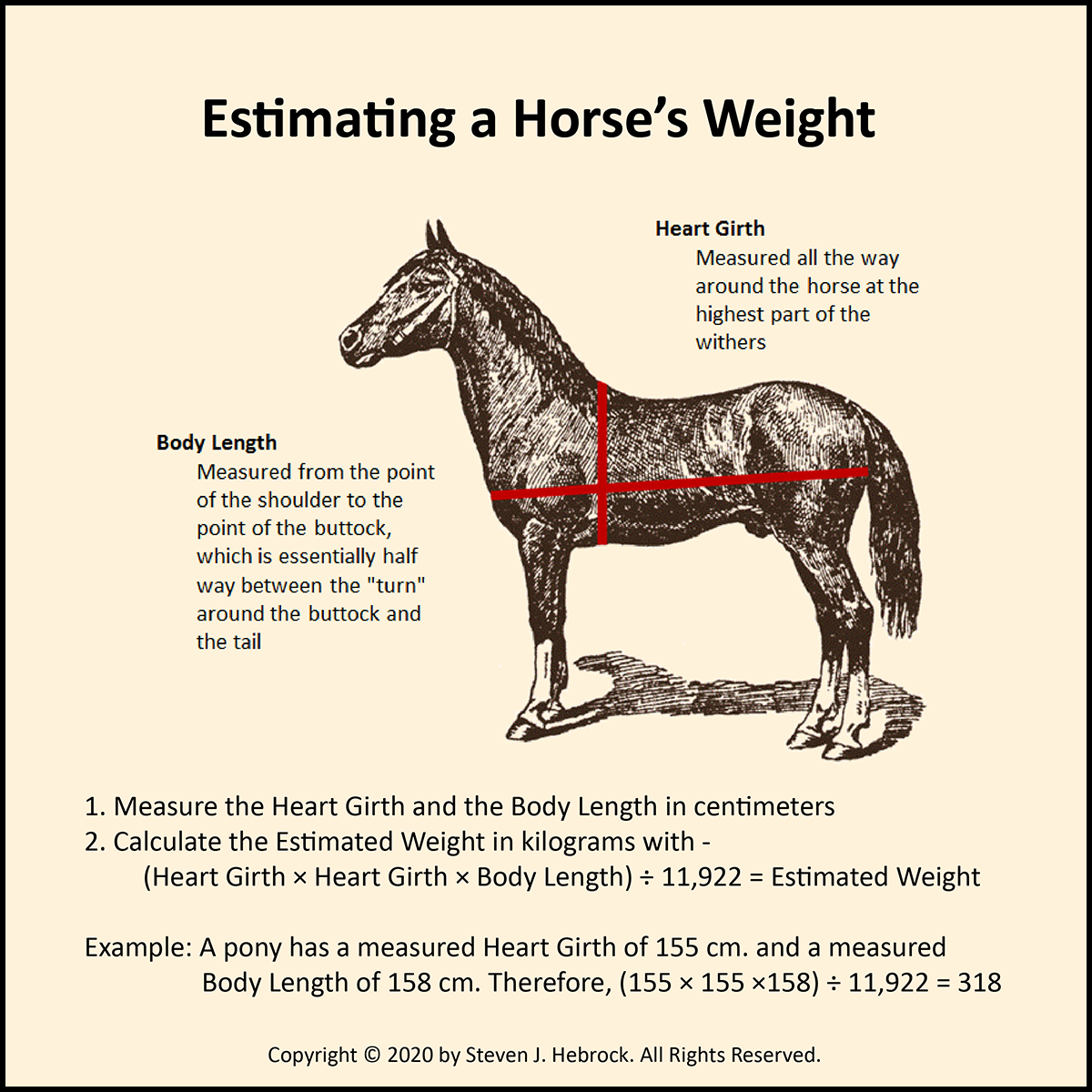
Again – here’s the metric version, with lengths in centimeters and weight in kilograms –
So you now know approximately how much your horse weighs, and how much he should weigh. Now it’s time to figure out how many calories per day are necessary for your horse to maintain his target weight, which is probably not his current weight. And just as with the BCS, determining caloric requirements requires you to be absolutely honest about how much you actually ride (or drive) your horse, because the amount of work he does is key to calculating caloric needs.

This is really the easiest and most straightforward part of the process;  all we need is some accurate information about your riding or driving habits. You’ll need to collect some information about how much you ride, and then do some simple calculations using the worksheet below to figure out how many calories per day your horse needs to maintain his target weight –

Here’s the metric version, with the target weight in kilograms –
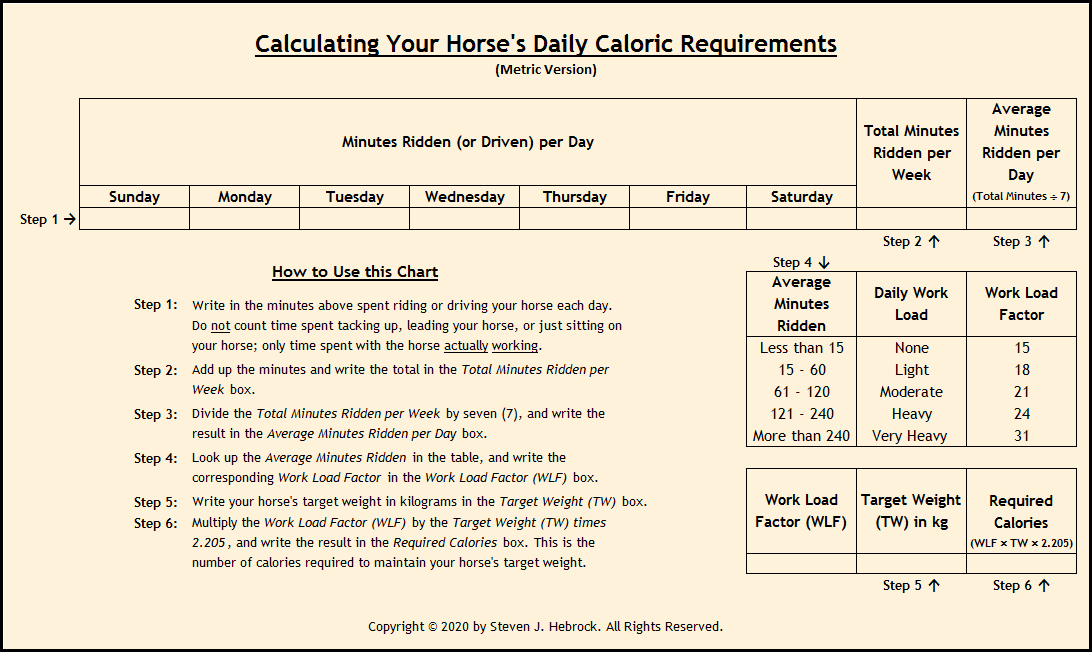
As an example, suppose I ride my 15-hand horse with a target weight of 1,014 pounds for 20 minutes every Tuesday, Thursday, Saturday, and Sunday. Just for the record, I’ve not counted the 10 minutes it takes to collect my horse from the pasture, the 10 minutes it takes to clean and tack him up, the 5 minutes each of a leisurely warm-up and cool-down walk, or the 10 minutes to get to and from the arena and untack and put him away when I’m done.  So, following through the worksheet:

Steps 1 & 2 –

20 + 20 + 20 + 20 = 80 Total Minutes Ridden per Week

Step 3 –

80 ÷ 7 = 11 Average Minutes Ridden per Day

Step 4 –

11 = Less Than 15 = 15 Work Load Factor

Steps 5 & 6 –

15 x 1,014 = 15,210 Required Calories per Day

And now we know how many calories our horse needs to maintain a healthy weight! So take an objective look at your horse’s body and your riding or driving patterns, and figure out how many calories your horse should be consuming in preparation for the second part of this series.

In the next installment, we’ll discuss the potential challenges of selecting appropriate types and amounts of forages and feeds to meet, but not exceed, this requirement. Why will it be challenging? Primarily for two reasons: 1) in the case of forage, the calorie content of all of them, including green grass, varies by a number of factors, including forage type, maturity when cut or consumed (in the case of green grass), time of day when cut or consumed, moisture content, and storage conditions, and 2) in the case of feeds, manufacturers don’t generally publish the calorie content of their products so you have to directly contact the company to get the information you need to plan the diet. But in spite of all these apparent obstacles, it’s fairly easy to ensure your horse is getting adequate, but not excessive, calories.

All for now…
LH clinics logo

Although I’ve discussed Liberated Horsemanship’s Gateway Clinics at various times in the past, I’ve never really taken the time to describe exactly what happens at the clinics, just how in-depth they really are, and therefore why I firmly believe they provide the most comprehensive and correct information on hoof care currently available. And since there are once again not one, but two, clinics scheduled for this year (June 3rd-7th at The Ohio State University ATI in Wooster, Ohio, US, and September 2nd-6th at Stonegarthside Hall in Nicholforest, UK), I’d originally intended to provide a more complete look at the clinics’ contents and this year’s presenters.

However, my plan to write a short biography of the clinic instructors, followed by a description of the topics each will be speaking about at the clinics, was quickly foiled as I started to put the biographies down on paper. Why? Because I was attempting to condense literally dozens of years of education and experience in hoof care into a few short statements, which would obviously be unsuccessful and of limited usefulness to anyone. So instead, I’ve decided to try to describe what I believe the strongest contributions of each of us are with respect to the clinics, and animal and hoof care in general, and leave the lengthier biographies to someone else. So here goes…

Bruce Nock badge photo

I met Dr. Bruce Nock in early 2006 when he was teaching an Advanced Horsemanship clinic as part of the certification program for natural hoof care pioneer Jaime Jackson’s organization called (at that point) the American Association of Natural Hoof Care Practitioners (AANHCP). Bruce is first and foremost a working scientist with an extremely impressive academic and practical background in animal behavior, learning theory, and stress physiology, and his current “day job” consists of ongoing research at Washington University’s School of Medicine which is funded by the U.S. National Institute of Health and focuses on the transgenerational and epigenetic effects of morphine. But Bruce is an avid horseman as well, and has used his extensive animal behavior education and experience to not only teach horse training and dressage for many years, but to author several books as well. In fact, his “Ten Golden Rules of Horse Training” is what led Jaime Jackson to require AANHCP students to study with Bruce, and later to make Bruce a member of the AANHCP’s Board of Directors. He’s also very actively involved in using his expertise in animal behavior and stress management to “give back” to the animals, through his efforts with The Kerulos Center and the American Wild Horse Preservation Campaign. In 2003, Bruce founded Liberated Horsemanship as what he describes as “a diversion from the impersonal world of science and to put my background in the science of animal behavior and physiology to practical use helping people with their horses.” That mission greatly expanded in 2009 when he and many others decided to leave the AANHCP, and the Liberated Horsemanship Barefoot Initiative was born.

Given Dr. Nock’s background, his clinic contributions will focus primarily on health and management issues: the physiology of equine insulin resistance, Cushing’s Disease, and laminitis; understanding and coping with management and use issues that impact horse and hoof health; and the unnatural stressors that are inherent to life in captivity. This means that clinic attendees have the exceedingly rare (dare I say…unique?) opportunity to learn about these absolutely-crucial-to-the-well-being-of-every-horse factors that the overwhelming majority of horse owners, veterinarians, and hoof care providers are rarely even aware of, let alone educated about, from an acknowledged expert. In my opinion, that alone makes these clinics well worth attending for every horse owner! I will further add that one of the many other things I  greatly appreciate and admire about Bruce is his unwillingness to offer advice on subjects about which he is not an expert; that’s a rare quality indeed, particularly in a horse world fraught with self-proclaimed “experts” constantly teaching and dispensing advice about things in which they have no education, limited (if any) actual experience, and therefore very little understanding of the subject.

Ann Corso Badge photo

Ann Corso and I first met in 2005 at a Carol Brett saddle-fitting clinic in Kentucky. A trained educator, Ann studied natural hoof care with Jaime Jackson from 2003 to 2005, was a Field Instructor and Natural Trim Workshop Leader for the AANHCP, and eventually became its Director of Training and Certification during its heyday as the premier hoof trimming training and certification organization. She left the AANHCP in 2009 to co-found the Liberated Horsemanship Barefoot Initiative with Dr. Nock, of which she is the Director. In addition to her large and diverse hoof care practice, Ann is the logistical mastermind behind all of Liberated Horsemanship’s clinics, and coordinates the field instruction and certification efforts of the students as well. One of the things I marvel at, and most value about, Ann is her seemingly endless knowledge of most of the hoof research efforts going on around the world, as well as the problems with what I call the various “fad trim styles” being taught and advocated by so many; if you want to know why a particular trim “style” can’t work – just ask Ann!

Besides making certain everyone has a ride from the airport, a place to sleep, and enough to eat, Ann will teach the fundamentals of proper hoof form and its importance, the underlying foot anatomy, and the theory of proper trimming. She’ll also discuss the various barefoot trim “models,”  and specifically why others may do certain things we don’t do – or not do things we do do – and the rationale behind those differences. Ann will also conduct the cadaver trim workshops every afternoon, where students not only receive extensive and specific trim instruction through hands-on learning, but also learn about the very necessary and practical matters of tool selection & use, hoof boot fitting, and horse handling.

Steve Hebrock badge photo

I don’t really enjoy writing about myself, so I’ll try to keep it brief. My rather diverse background includes music theory & composition, sound recording, and electronics/acoustics engineering, and I’ve designed products and one-off technical solutions for a number of companies over the years. Paralleling my engineering vocation was a career in education; I started teaching electronics classes in 1978 as an undergraduate student, and have continued teaching various technical subjects at several different universities since then. Most recently, I retired from nearly 20 years  of teaching at The Ohio State University ATI – the agricultural campus of the university – where I taught electronics, computer-aided design (CAD), and many different computer applications classes. More relevant to the subject at hand, I taught equine facilities management, sales preparation, and – yes – hoof care (which I still teach). You can read more about my hoof care journey in Why Me? and Horseshoes: A Means to What End?, but the bottom line is that the last 25 years of my life have been shaped by my realization in the early 1990s that the vast majority of horse owners, farriers, and veterinarians suffer from some very large misconceptions about how horses should bear weight and move, which drastically and adversely affects their care of, and advice about, horses. And I believe that my many years as a technical educator, natural hoof care provider, and hoof care educator have equipped me to share my knowledge and experience with others in a straightforward, logical, and extremely effective manner.

At the clinics, I’ll be discussing one of my favorite topics and ongoing areas of research: how and why the hoof should make ground contact as it does, and the importance of a proper landing to the long-term comfort and health of the horse. I’ll also be talking about the causes, symptoms, and management/treatment of the most common hoof pathologies, and be co-teaching the afternoon trim workshops with Ann.

So there you have it: three educated, acknowledged experts, each with lengthy and intimate experience with both natural hoof care and their individual areas of specialization, who also have extensive experience teaching their subject matter to people of every level of education and from every walk of life from all over the world! Whether you ultimately intend to regularly trim horses, or just want to take advantage of this unique opportunity to get your hoof, horse management, and behavior questions answered by experts, please consider joining us. I guarantee you won’t be disappointed. But…time and spaces are short, especially for the U.S. clinic, so contact me ASAP if you’d like to attend!